Adjustments that cool historic temperatures have almost doubled Australia’s rate of warming.

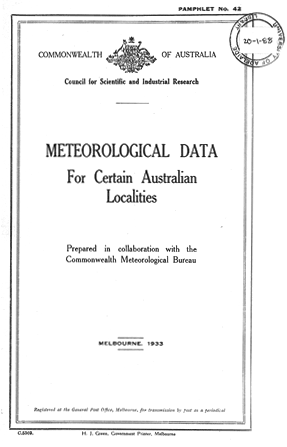
CSIR published “Meteorological Data” 1855 – 1931
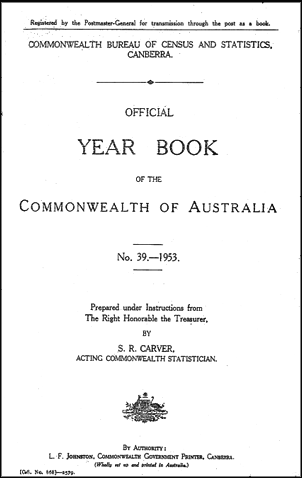
There was a time back in 1933 when the CSIRO was called CSIR and meteorologists figured that with 74 years of weather data on Australia, they really ought to publish a serious document collating all the monthly averages at hundreds of weather stations around Australia. Little did they know that years later, despite their best efforts, much of the same data would be forgotten and unused or would be adjusted, decades after the fact, and sometimes by as much as one or two degrees. Twenty years later The Commonwealth Bureau of Census and Statistics would publish an Official Year Book of Australia which included the mean temperature readings from 1911 to 1940 at 44 locations.
Chris Gillham has spent months poring over both these historic datasets, as well as the BoM’s Climate Data Online (CDO) which has the recent temperatures at these old stations. He also compares these old records to the new versions in the BOM’s all new, all marvelous, best quality ACORN dataset. He has published all the results and tables comparing CDO, CSIR and Year Book versions.
He analyzes them in many ways – sometimes by looking at small subsets or large groups of the 226 CSIR stations. But it doesn’t much matter which way the data is grouped, the results always show that the historic records had warmer average temperatures before they were adjusted and put into the modern ACORN dataset. The adjustments cool historic averages by around 0.4 degrees, which sounds small, but the entire extent of a century of warming is only 0.9 degrees C. So the adjustments themselves are the source of almost half of the warming trend.
The big question then is whether the adjustments are necessary. If the old measurements were accurate as is, Australia has only warmed by half a degree. In the 44 stations listed in the Year Book from 1911-1940, the maxima at the same sites is now about half a degree warmer in the new millenia. The minima are about the same.
Remember that these sites from 1911-1940 were all recorded with modern Stevenson Screen equipment. Furthermore, since that era the biggest change in those sites has been from the Urban Heat Island (UHI) effect as the towns and cities grew up around the sites. In some places this effect may already have been warming those thermometers in the first half of the last century, but in others UHI can make 5 to 7 degrees difference.
If Australian thermometers are recording half a degree higher than they were 70 – 100 years ago, we have to ask how much of that warming is the UHI effect? Common sense would suggest that if these older stations need any correction, it should be upward rather than downward to compensate for the modern increase in concrete, buildings and roads. Alternatively, to compare old readings in unpopulated areas with modern ones, we would think the modern temperatures should be adjusted down, rather than the older ones.

The Official Year Book 1953
Chris Gillham discusses the potential size of the UHI changes:
“In 2012 and 2013 it was anticipated that UHI warming in south-eastern Australia will continue to intensify by approximately 1C per decade over and above that caused by global warming (Voogt 2002), with tests in 1992 showing a UHI influence up to 7.2C between the Melbourne CBD and rural areas. [PDF]
Smaller but significant UHI influences were found in regional towns, with a 1994 test observing a UHI intensity up to 5.4C between the centre of a Victorian town and its rural outskirts.” [PDF]

 New Life Narrabri