A failure of democracy, of scientific institutions, of public servants and the media
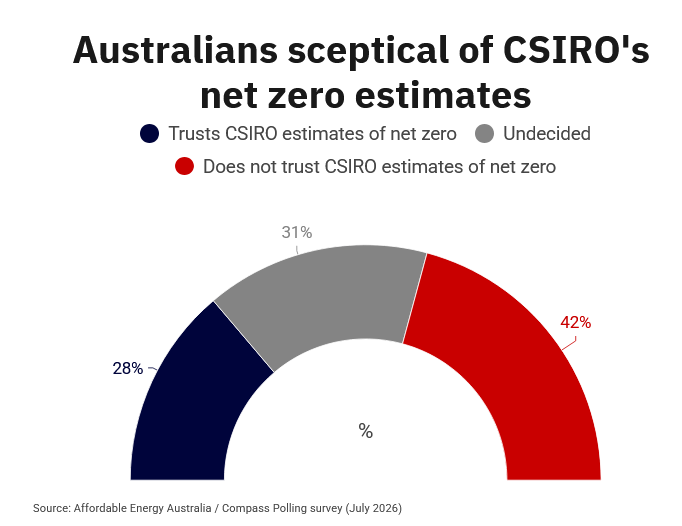
Barely 28% of Australians believe the experts at our premier scientific establishment. It’s a sad state.
The CSIRO have burned through 60 years of goodwill and scientific branding. They may have invented Aerogard, WLAN and broadcast the Apollo 11 moon landing, but most of the country don’t trust them on Net Zero. They make pronouncements about the complex science of climate change, but even with a media parroting the climate propaganda on their behalf, the unwashed masses can still see through the hypocrisy, the jargon, and the biodegradable shopping bags.
A generation of great scientific work, used up like cheap branding.
Trust in science took a savage beating during the pandemic. Then CSIRO staked their reputation on “cheap renewables” and they bombed. Now the truckdrivers, the plumbers, and burger-flippers know that renewables are *not* cheaper and their electricity bill is not $275 dollars less. The smug lectures by the experts are a bore, but the glory flights to holiday resorts for the UN just make that message burn.
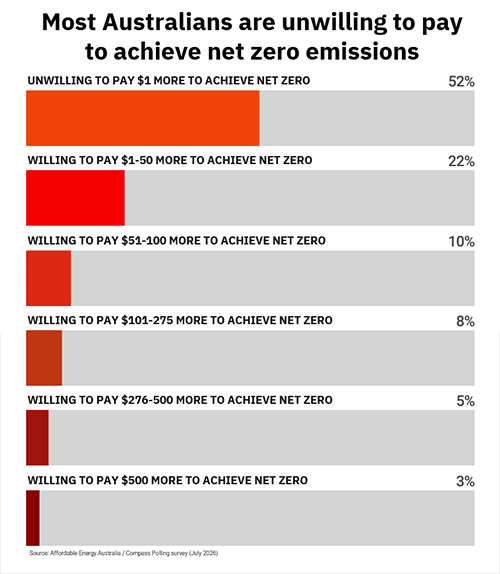
Half the country (still) doesn’t want to pay a single dollar more to achieve Net Zero
It was the most skeptical option anyone could pick in this survey and half the country picked it.
If there was a choice to have the cheapest electricity possible (emissions-be-damned) it might have changed the whole graph. But we are not even allowed to consider that option — the one where we stop trying to control the rain with our power plants. The one where we join the giant economies of China, the USA and India and go hell-for-leather to burn fossil fuels and make cheap electricity. The ABC would call that a “fringe” position.
So this giant voter pool has been ignored by both major parties for years. Way back in 2019, 4,000 star scientists all swore climate change was real, yet 54% of Australians thought they were wrong, and said climate change was not predominantly man-made. The vast skeptical vote has been there all along and conservatives ignored it until One Nation dragged them kicking and screaming to the table. Dear Angus, it’s not leadership when most of the country got there before you.
The Liberals have still not renounced the Paris Agreement. Dan Tehan, in the Shadow Cabinet, vowed the Coalition will absolutely, definitely spend “less” than the Labor Party on the Net Zero Quest. Is that all?
They still don’t get it.
Ponder that nearly half the country think the CSIRO is not trustworthy, and yet the organization still gets a billion dollars a year.
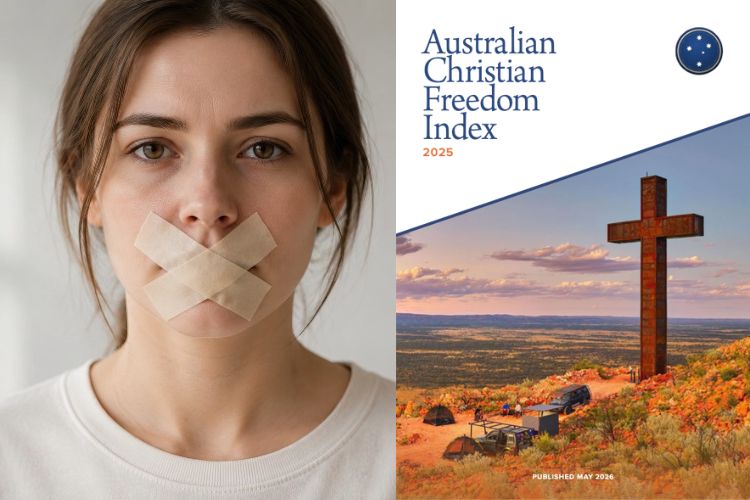
The Australian Christian Freedom Index documented 74 Acts of Parliament that have restricted Christian freedom over the past 25 years. Which parties and worldviews restrict Christian freedoms in Australia — and why?
I’ve spent a lot of time teaching people about worldviews. Because worldviews shape our actions — and Acts of Parliament.
Worldviews are our mental maps of reality — you want them to be accurate. They’re our underlying assumptions about what is true, what matters, and how the world works. Most people don’t consciously think about their worldviews, even though worldviews automate many of their actions.
For example, at footy training with many balls in the air, we often hear a warning, “Heads!” And everyone in the vicinity reels. Now the fact is, the ball can only hit one of us, yet all six of us react — because in that moment, our actions are shaped less by the fact itself than by what we believe the fact to be. Our beliefs about truth shape our worldviews, which shape our values, which shape our choices and actions.
Worldviews in Politics
Worldviews also shape actions in politics.
Some claim this only applies to religious conservatives. They complain that Christians vote according to their worldview, while progressives somehow operate from a neutral, objective place. They pressure conservatives to keep quiet about their foundational truths lest they shape their values and choices.
And yet progressives also possess foundational truth-claims, and assumptions about morality, identity, and human flourishing – and act accordingly. Yet they see no need for “separation of their beliefs and state,” because their beliefs are the state. So, their assumptions continue to shape their worldviews, their particular values, choices and actions… And sometimes those actions are Acts of Parliament.
2025 Australian Christian Freedom Index and 74 Acts of Parliament
One of its more startling findings is that since 2000, Australian federal and state governments have enacted 74 Acts of Parliament that have reduced Christian freedom, with more than half of those passed in the last five years.
As someone who studies worldviews, my immediate questions were: Who passed these laws? What were their worldviews? Who do we need to avoid?
I already suspected that the decline of Christian freedom was not just the result of fewer Australians holding a Christian worldview. It was also the result of governments increasingly operating from worldviews that replaced biblical foundations with their own secular truth claims.
History repeatedly shows that belief systems moving away from biblical truths eventually regard Christianity as an irritant to be contained, marginalised or removed. For decades, we’ve seen this happen in various forms, from within Islam, ancestral animism and secular socialism.
I went looking for the worldviews behind the 74 Acts.
Which Governments Passed Acts Restricting Christian Freedom?
On pages 77 to 80 of the Australian Christian Freedom Index 2025, all 74 Acts are listed with the year they were enacted. So, I cross-checked which governments were in office at the time of each.
Who passed each, and what were their worldviews?
61 of the 74 Acts were passed by Labor governments.
8 were passed by Coalition governments generally regarded as socially moderate or progressive: Turnbull, Berejiklian, Marshall and Gutwein.
5 were passed by Coalition governments that could be described as more conservative: the Hodgman government’s Mandatory Reporting 2018, and the Marriage and Gender amendments 2018; the Morrison government’s Online Safety 2021, and the Respect at Work legislation in 2021; and the Perrottet government’s Voluntary Assisted Dying legislation in 2022. Some of these were passed under new federal constraints, and/or under pressure from progressive elements within their parties.
Labor Party Worldview
Labor openly declares itself to be a democratic socialist party, as a core objective in its Constitution (page 4).
Progressives tend in the same direction, toward moral frameworks defined by secular assumptions rather than biblical ones. Doug Wilson pointed to 1 Samuel 8:11–17 and Deuteronomy 17:15–17 as biblical warnings about governments accumulating power and overreaching their proper boundaries. The state increasingly becomes the primary authority for defining rights and social morals. Socialist Karl Marx was explicit in his criticism of the Church, the nuclear family and private property as oppressive structures.
Worldviews automate actions.
That’s why voting citizens need to learn to discern which worldviews animate which political parties.
Yet many Labor voters have no idea that Labor is socialist, let alone what that means. Some voters read the Labor party platforms, but through Christian lenses when they should read them through socialist lenses to recognise what they really mean, even as they coopt the language of human rights.
And what also tells us what they really mean are their actions. The bills they introduce, the debts they accrue and why, the harms they allow, the restrictions they introduce… the Acts of Parliament.
If we fail to name those parties and worldviews that restrict our freedoms of conscience, aren’t we giving them tacit approval, free passage toward increasing their totalitarianism?
Surely, we have already allowed too much from parties and factions animated by socialist and progressive worldviews.
Read which governments passed which of the 74 Acts restricting Christian freedom and when here.
I don’t spend a lot of time out in the sun in the middle of the day, and when I do, I prefer to wear a hat. If this is confirmed, it is bad news. Also the point about Vitamin D is really important – we all need to spend about 10 minutes a day in the sun to get enough Vitamin D.
Study Finds Sunscreen Use Linked to Higher Risk of Multiple Skin Cancers
A 470,000+ person study found sunscreen users faced dramatically higher risk of melanoma, basal cell carcinoma, and squamous cell carcinoma — even after accounting for major skin cancer risk factors.
Jun 14, 2026
This article originally appeared on Focal Points and was republished with permission.
A UK Biobank study involving over 470,000 people found that individuals who reported using sunscreen more frequently had substantially higher risk of multiple skin cancers — even after researchers accounted for major confounding factors like age, sex, skin type, tanning ability, sunburn history, sunlamp use, and time spent outdoors.
Join 142K+ Substack readers and 1.9 million 𝕏 users following Vigilant Fox. Get critical news and exclusive stories the media won’t cover — all in one place. Subscribe today.Subscribe
The researchers categorized sun protection habits from “never/rarely” to “always” and found the strongest associations among the most frequent sunscreen users.
In other words: the more sunscreen use reported, the higher the observed skin cancer risk.
This was an observational study, meaning it cannot prove sunscreen directly caused cancer. However, the study was also not a simplistic comparison of random sunscreen users versus non-users. Researchers statistically accounted for many of the biggest known skin cancer risk factors — including skin color, hair color, tanning ability, childhood sunburns, tanning bed exposure, outdoor time, age, and sex.
Even after all of that, the association remained.
Many chemical sunscreens contain hormone disruptors that are rapidly absorbed into the bloodstream, including compounds like oxybenzone, octocrylene, and homosalate.
And then there is the vitamin D issue. Sunlight is how the human body produces vitamin D, a hormone precursor involved in immune regulation, cellular repair, inflammation control, and cancer defense. People who never receive sunlight exposure without sunscreen are likely to become vitamin D deficient.
That does not mean people should recklessly burn in the sun. Sunburns are clearly harmful. Aim for sensible sunlight exposure — spending enough time in the sun reap the benefits without reaching the point of burning. If you’ll be out in the sun for hours on end during mid summer, consider opting for zinc-based (mineral) sunscreens rather than heavily absorbed chemical formulations.
The takeaway is not to fear sunlight, but to respect it.
In this session, Dr Ben from Ghana shared by teleconferencing about his experience with John’s apostolic covering.
Derek Ott talked about the original slander against God and how the apostles witness to overcome satan’s accusations.
1 Kings 22:17-21 God has a heavenly household. He wants us to be involved in his counsel.
Deuteronomy 13:1-2 False prophets are allowed in order to test God’s people.
Deuteronomy 32:7-8 God gives nations inheritance We are God’s nation and we need to be cleansed and purified. The Lord’s portion is His people. All the other nations were ruled by lesser spirits but Israel ruled by God.
The first person to be slandered was the Lord by satan. Genesis 3.
Numbers 14 You have rebellion in church, God had rebellion in heaven. People are rebellious because they believe bad report. God threatens to destroy the people but Moses said if you do this the nation’s will think God is not able to save.
1 Corinthians 4:9 Apostles are witnesses. God’s answer to slander is apostles. They model the goodness of Christ and it multiplies through the church. This is the answer to the original slander against God.
Acts 8:4 Revival in Samaria but distracted by Simon the Sorcerer. He wants to buy the power to give the Holy Spirit. V. 21.He had not repented. They needed the apostles to come and bring discernment and confrontation.
Promise Isaiah 59: 21
“As for me, this is my covenant with them,” says the Lord. “My Spirit, who is on you, will not depart from you, and my words that I have put in your mouth will always be on your lips, on the lips of your children and on the lips of their descendants—from this time on and forever,” says the Lord.
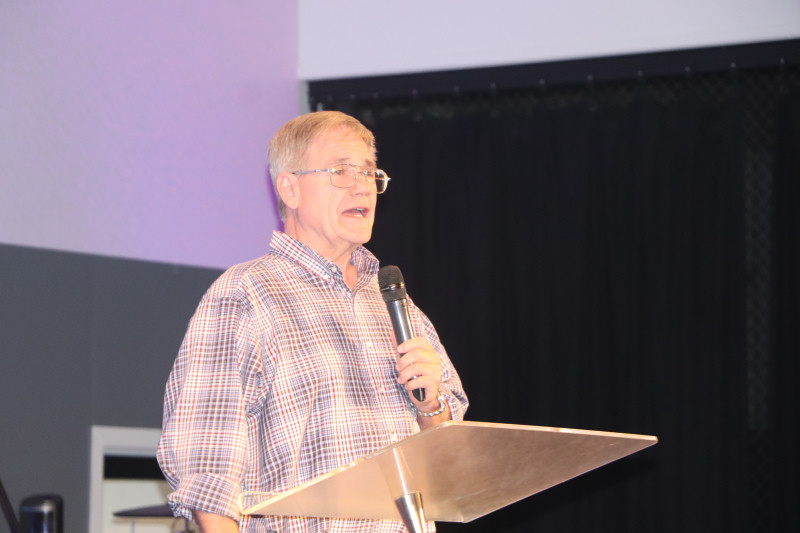
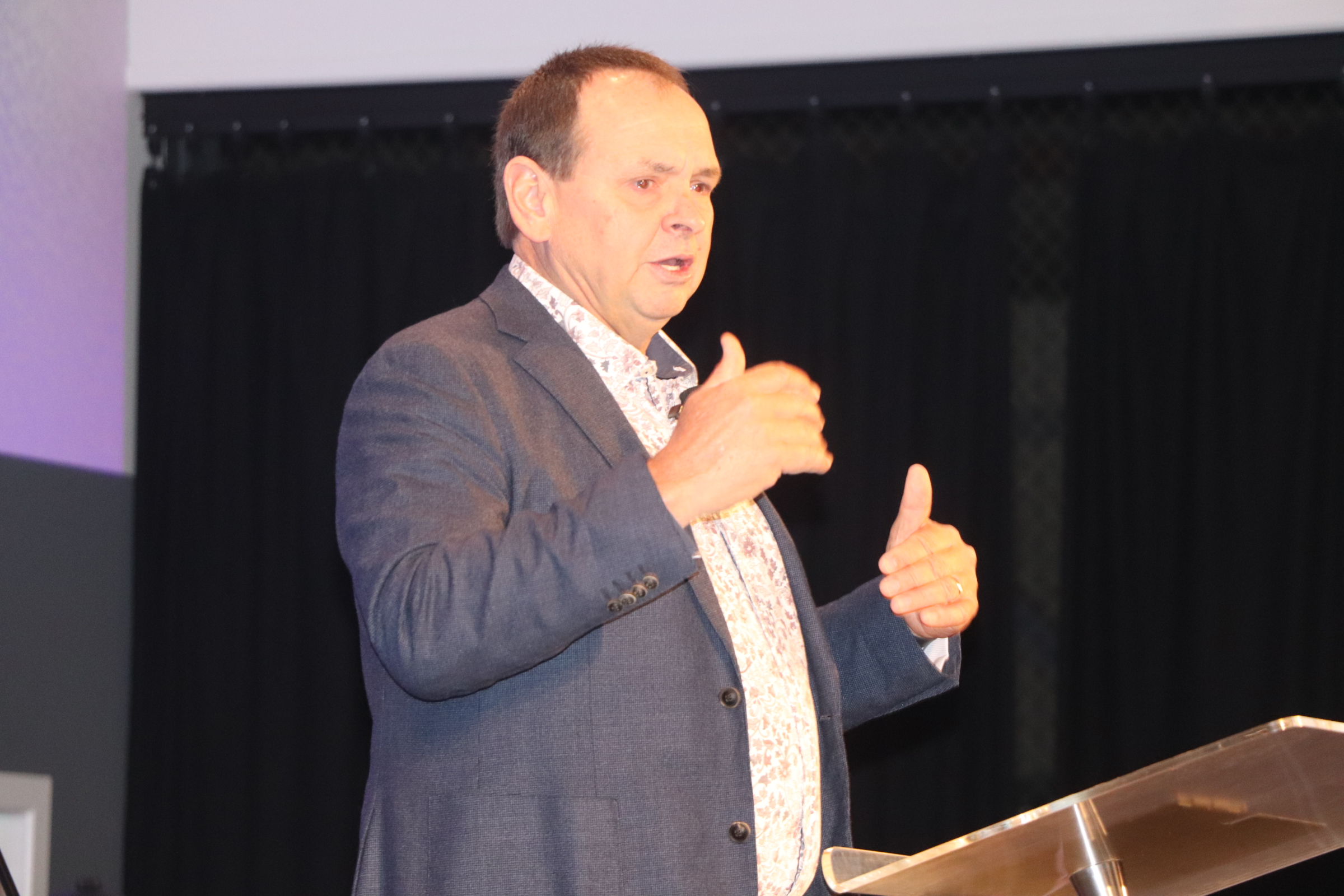
Charles Harrison comes form the United States Mid-West. He is a quietly spoken, depp thinking man.
When Charles came to meet John, he came not to learn doctrine but to meet the man and find out whether he is a true reflection of Jesus. He has come to love the people of Peace Church, who stood by him when his wife passed away. He loves the fact that the church building is just a shed. We must seek God’s glory not glamour.
The opponents of the apostolic movement think that anyone can govern a church – teachers, pastors, evangelists – except apostles.
One concern that is expressed is that apostles are said t make decrees. John feels that this is a wrong term. Decrees are made by God and by kings. However, any christian can make a declaration or a command with justification, because we are made in the image of God. Our words carry power.
God trusted men to write scripture, so He can trust people to speak His words.
The opponents think that prayer is limited to making requests of God. The Bible talks of wrestling with spirits and powers. The Lord requires active, hands on, engagement.
In Acts 9, Peter prays to get in the Spirit, and then commands Tabitha to get up. In Joshua 10, Joshua issues a command for the sun to stand still. All of this is evidence that Jesus honours commands and declarations.
It was unusually cool this morning, but warmed up as the day progressed.
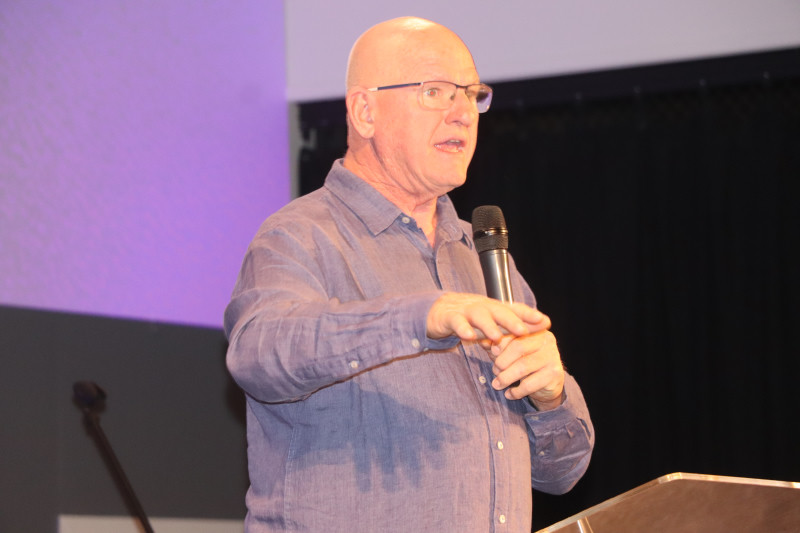
It was Lloyd Gill’s time to share. Lloyd has probably as close a relationship with John as anyone. His special area of ministry is Africa.
When people say they are honouring John & Hazel (or anyone else for that matter), we are in fact honouring Christ who moulded them, raised them, placed them in families, and gifted them.
While it is true that there are false apostles, sometimes it means that they are people who have a calling but are not yet mature enough to take up the calling. This is like Moses who was called at the burning bush, but did not step into leadership of the Hebrews for another 40 years.
In Exodus 3:4-10, God says “I am coming to rescue your people so go and do it.” The fact is that God always uses people to achieve His purposes.
Whatever your call is, it is holy ground, whether that is to be an apostle or a mother or a labourer.
The Friday evening session started with testimonies fro Peter Staines and Veronika Ott about how the Lord had led them into partnership with Apostle John Alley.
John then proceeded to talk about the error of cessationism, the doctrine that the gifts of the Holy Spirit and miracles ceased after the death of the first apostles or the completion of the New Testament.
Biblical errors of cessationism as evidenced in a polemic against NAR 1.Signs and wonders = miracles but see Hebrews 2:4
2. Signs are meant to confirm a message from the Lord. But miracles often come without a message
3. Signs and wonders confirm end times teaching by NAR
3. They assert that people always responded to Jesus’s miracles with faith. False.
4. If NAR miracles are to equal Jesus’s miracles, they should be easy to see.
5. Miracles will be so highly acclaimed leads to public news.
6. Surely the world would know if these miracles happened by NAR people. Countless people get miracles, but they are to meet needs not to be signs. The world is not interested in miracles and tends to ignore or dismiss them.
7. For the time being the NAR people have not changed the world in the way they claim.
“We are a civilised people,” intones John Alley in announcing that we will have 30 minutes for morning tea, even if we are running late. We were running to time, but John likes to ensure that there is time for fellowship between the sessions.
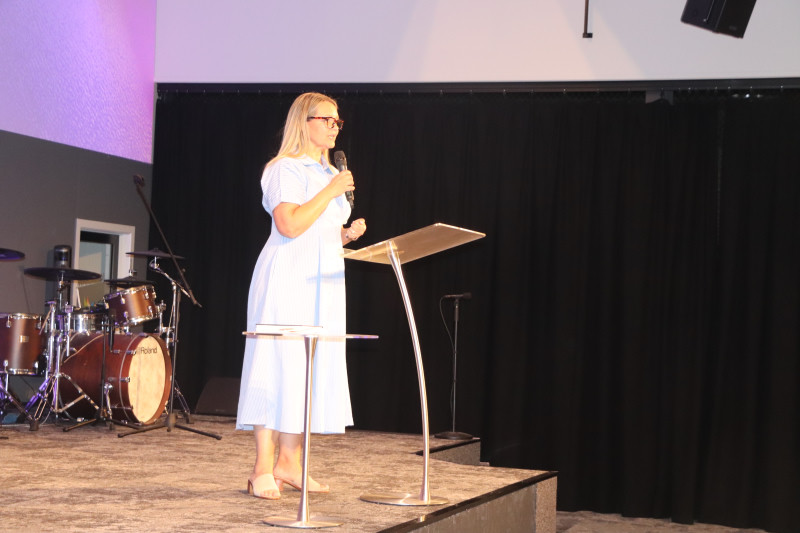
Debbie Gadd is the pastor of Snowy Valley Community Church in Tumbarumba, NSW. As you might guess, it is a cold place, even in summer. Debbie shared how she and her church came to be participants in the fellowship of John Alley’s apostolic network.
Derek Ott is a prophet and teacher from Arizona in the USA. It is the opposite of cold for most of the year. Derek was the main speaker for Session 3.
We were baptised into Christ’s death, and so our responsibility is to live from Christ not from ourselves. As spiritual sons of John Alley, we all need to step up in a bigger way in joining with John’s battle. If God calls a father to a mission. He is certainly calling the sons also. We need to be aware that battle weariness can catch up with us, but God prepares a feast for us on His holy mountain (Is. 25.) We are moving into a season where instead of fighting battles, we are sharing in this feast prepared by Jesus for His people,
For some reason I didn’t sleep well last night, so I was quite weary to start off with.
Mostly, everyone so-operated and we got to the church with a couple of minutes to spare.
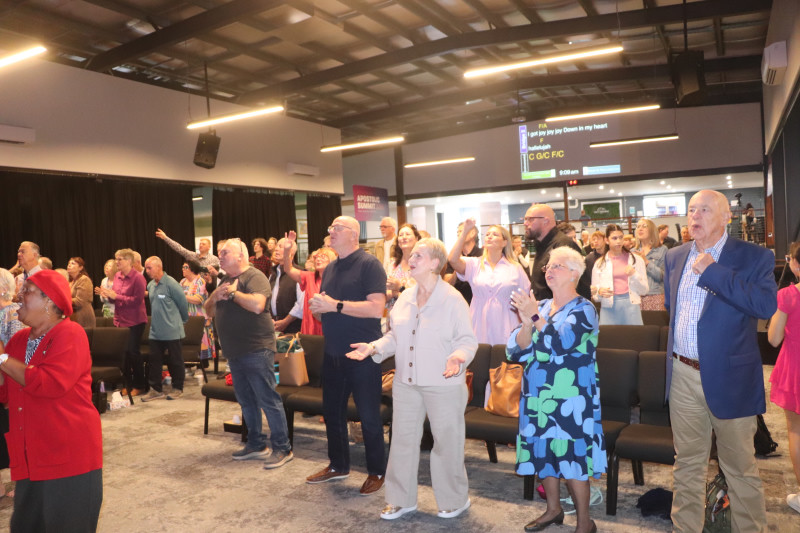
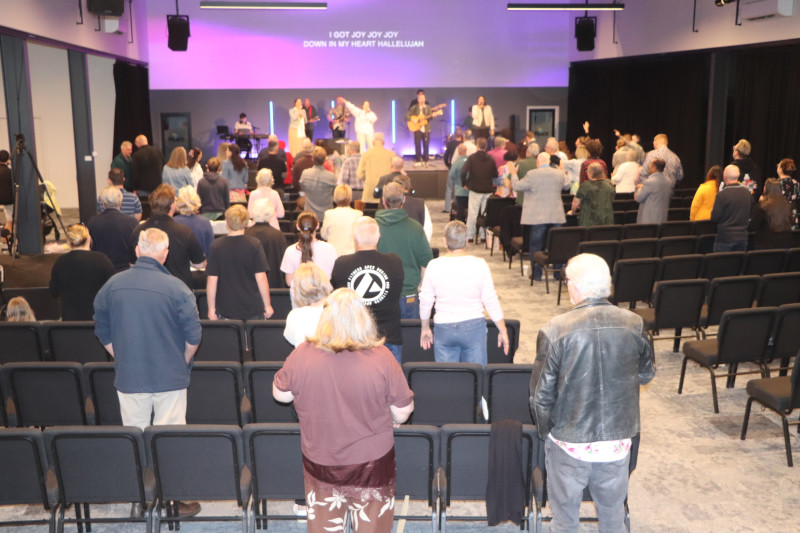
The session started with a powerful time of worship. Linden Scilley spoke about why he believes that John Alley is a genuine apostle. Linden is a Salvation Army officer based in south western Sydney.
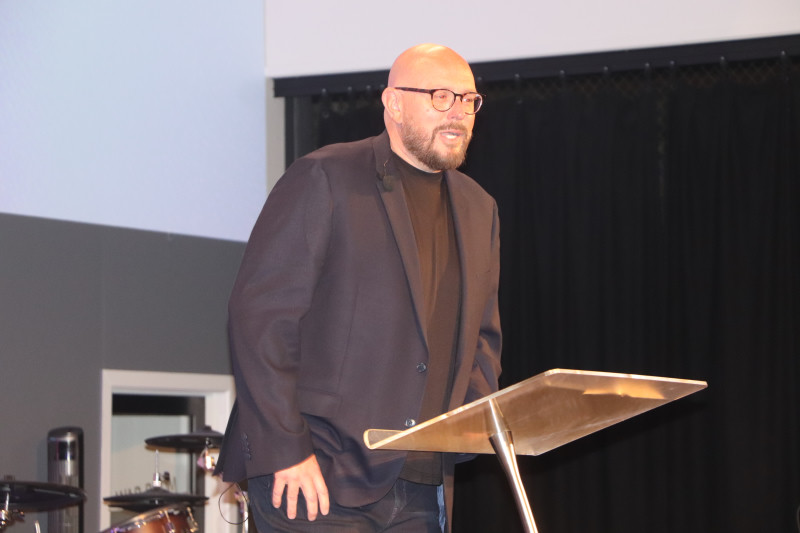
The main speaker was David Alley, John’s eldest son, who was born in Narrabri when John and Hazel were stationed there. David is now the pastor of Peace Church, and has worked tirelessly amongst the pastors and priests of Rockhampton, bringing a very real sense of unity amongst the churches.
The lighting of the stage has been confusing for the camera, and for some reason ir decided not to fire the flash.
David talked about how we can learn to feel love for other christians, especially those who are not of our “tribe.”
Make a deliberate choice to feel God’s love for me- we cannot love others until we have experienced God’s love as a reality.
Make a deliberate choice to ask God to give you love for others. Some people are easy to love; others not so much.
Make a deliberate choice to pray for God’s people. Prayer is like an investment. We pray for things that are important to us. Equally when we pray for other christians, we start to care about them