Reflection on Genesis 18:1-15

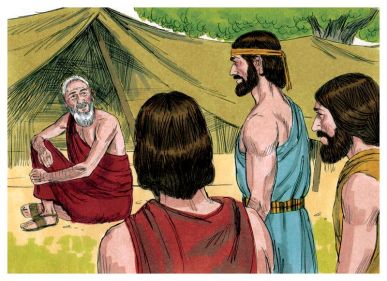
Book_of_Genesis_Chapter_18-1_(Bible_Illustrations_by_Sweet_Media)

Passage: https://www.biblegateway.com/passage/?search=Genesis+18.1-15

Scripture

Is anything too wonderful for the Lord?”

Observation

The Lord appears to Abraham in the form of three men. Abraham asks the men to stay for a while, and he prepares food for them. He has Sarah prepare some bread, and a servant kill a calf.

While the men are eating, one of them says that Sarah will soon have a son. Sarah is listening from inside a tent and she laughs at this statement because she is so old.

The Lord says to Abraham, “Why did Sarah laugh and say ‘Shall I bear a child in my old age?”” He then repeats the promise that Sarah will have a son.

Application

The Lord asks Abraham the rhetorical question, “Is anything too wonderful for the Lord?”

Human wisdom says that God is irrelevant to our lives. Faith says nothing is too hard for God.

Do I put my trust in God or in myself and my own resources?

Humanly speaking, it was impossible for Sarah to have a child. But now God brings a promise of something that seems impossible or too good to be true.

Surely I cannot have a child.

Surely I am too wicked to be forgiven.

Surely I cannot be healed

Surely I have missed my opportunity.

Faith says with God all things are possible.

Faith says God loves me and wants the best for my life.

Faith says that God is able to save, able to heal, able to give back what others have stolen.

Life can knock us around through hurt, disappointment, dashed dreams. But God can redeem these things, turning them around for our good.

Sarah didn’t have faith to receive the promise- not even a mustard seed of faith- but He acted anyway. How much more could she have received if she believed the promise?

Do not think “it could never happen for me.” Instead, remember nothing is too wonderful for the Lord.

Prayer

Today Lord I choose to believe your promise for me. Nothing is too wonderful for you. Hallelujah!

200 Years of Cycling

Two Hundred years ago, a German nutcase invented the first bicycle and transformed the world.


From the ABC:


Cyclists celebrate ‘nutcase’ inventor as bike turns 200 years old


Cyclists across the country have celebrated the 200th anniversary of the world’s first bicycle ride.

Monday marks 200 years since inventor Karl Drais rode a bicycle for the first time, in the German city of Mannheim.

“Everything we have today … came from this machine. It’s as simple as that,” said vintage cycling enthusiast Stewart Clissold at a celebration in the Melbourne suburb of Brunswick.

“Karl von Drais saw a lovely young girl ice skating, and he saw how fluently she moved across the ice. And his idea was, if he was to put wheels under himself, he could move as gracefully as her.”

Other celebrations have been held in Sydney, Darwin, Bendigo and Geelong.

“It started a total revolution,” Charlie Farren of the Vintage Cycle Club said.

“We’ve got to thank this nutcase inventor.”

Bicycle’s creation linked to Indonesian volcano

The bicycle was invented as Europe suffered in the aftermath of an Indonesian volcanic eruption that caused chaos across the world.

“Back in the early 1800s, there was this phenomenal eruption, clouds of smoke and dust permeated everywhere [in Europe],” Ms Farren said.

“It’s said that the crops failed, the horses starved.

“This invention of Baron von Drais became a hit overnight because it wasn’t a horse, it didn’t need feeding. All it needed was you, your legs, a bit of energy, and you were away.”

The invention quickly became popular, mainly with affluent young men.

However, poor road quality meant they would often ride on the footpaths, which led to the machine being banned soon after it was created.

‘You just glide along’: riding a replica

Vintage cycling club members were proudly showing replicas to keen onlookers today, and explaining the machine had its limitations.

“I think not only was it the first carriage that went underneath a human, it was also the first natural contraceptive,” Mr Clissold said.

“I can assure you, after riding one a short period of time on rather rough cobblestone roads, you were not going home for anything other than a hot bath.”

However, Ms Farren said the replica was a delight to ride on flat surfaces, likening it to ice-skating.

“It’s a little bit like roller-blading,” she said.

“You get a beautiful stride going, and you glide along.”

Porn Induced Erectile Dysfunction

Researchers are finding a link between the free availability of pornography and all kinds of sexual dysfunction including erectile dysfunction in increasingly younger men. It turns out that if you get your excitement from a screen, your brain eventually thinks that is preferable to the warmth of a real living person.

From Fight The New Drug

Contrary to what you might see in today’s mainstream media, instead of increasing sexual enjoyment, porn often leads to less satisfying sex in the long run and, for many users, no sex at all. Yikes.

Let’s break down how that actually happens, and how porn is playing a huge role in the skyrocketing number of cases of adolescent erectile dysfunction.

Porn and Erectile Dysfunction

Erectile dysfunction (ED) has been increasing in sexually active men under 40. [1] Internet porn is in some ways to blame for this rise, with a growing number of studies showing a correlation between porn and ED. Now, researchers have identified pornography-induced erectile dysfunction (PIED) and pornography-induced abnormally low libido.

It turns out that high exposure to pornography videos can result in lower responsivity in a male and an increased need for more extreme or kinky material for him to become aroused. Or in other words, as some users develop a tolerance for sexual-arousing material, the porn that used to excite them starts to seem boring. [2] Predictably, they often try to compensate by spending more time with porn and/or seeking out more hardcore material in an effort to regain the excitement they used to feel. [3] Many users find themes of aggression, violence, and increasingly “edgy” acts creeping into their porn habits and fantasies. [4]

And due to this porn overload, some guys are no longer aroused in the presence of a partner. They begin to experience sexual dysfunction, and even ED, and can only become sexually excited when watching porn, as explained by this extensive report from Medical News Today.

Read the full article here

Joseph Mattera: The Ministry of Apostles

THE MINISTRY OF APOSTLE IN CONTEMPORARY TIMES

THE MINISTRY OF APOSTLE IN CONTEMPORARY TIMES

The book of Ephesians 4:10-16 teaches us that the ministry gift of apostle will continue to function so that Christ can fill all things (every realm of society) until we come to full maturity in Christ as a church. Obviously these two things have not yet happened. So the question arises: What would the ministry of apostle look like in today’s world?

Without qualifying all my statements due to the brevity of this article, the following are some observations and opinions I have related to this ministry in context with today’s world. There have been many wonderful books written on the subject of the fivefold ministry (my favorite is Kevin Conner’s The Church in the New Testament). Thus, there is no need for me to repeat content found in these other fine books.

Those walking in the apostolic ministry have a strong leadership gift (Romans 12:7)

They are not primarily followers who conform to the mainstream but are willing to go against culture and carve out a countercultural movement that is based on the reign of God on earth as it is in heaven (read Acts 4:19-31). Thus, they are willing to lead a strong movement even in spite of religious and political opposition.

Contemporary apostles need to be able to preach the gospel and lead countercultural movements that can deal with postmodernism (that there are no absolute truths that can be known in this world) and a post-taboo world (a classical Greek-Libertarian approach in which we live and let live; people can engage in any behavior they want with legal protection, for example same-sex marriage, abortion, euthanasia) in a manner that does not make Christians come off as ignorant, uneducated biblicists but in a cogent, compelling manner that utilizes logic, godly wisdom, current events, statistics, and artful subtlety with the power of the Word and Spirit of God.

Apostolic leaders have the ability to manage whole networks of people, congregations and ministries that are relevant to and thrive in the midst of cultural complexities because they can adapt their methods and message based on the culture in which they labor.

For example, Paul established complex apostolic networks in over 30 diverse cities in the Roman world. He had to speak messages and build churches relevant to Jews (Acts 9, 21, 28), intellects (Acts 17:16-34) and people steeped in carnality and debauchery (First and Second Corinthians). He was not just an evangelist who blessed people and then left town; he was a master builder (1 Corinthians 3:10-14) who had a long-term plan to build communities of faith in the main cities of the Roman world (Ephesus, Philippi, Corinth, Colossae, Rome, Thessalonica) so they would eventually alter the culture and turn the world upside down (Acts 17:6; 19:21-41).

In today’s world, God is still using global leaders in India, Africa, Latin America, the USA, Asia and other places to start non-denominational complex apostolic networks that are driving missions across the earth.

Apostles develop new emerging leaders

When Paul met Timothy he immediately perceived that he was someone worth investing in to develop as a leader (Acts 16:1-3). Scripture teaches us that Paul’s intuition was correct; we read that Timothy turned out to be Paul’s best protégé (Phil. 2:19-25).

Perhaps the most important calling of apostles is to see and develop the leadership potential in others.

In today’s contemporary, fatherless world apostolic leaders are going to have to learn how to be fathers who can re-parent and bring healing to the fatherless, so potential leaders will have the internal affirmation necessary to become great leaders.

Apostles are humble and broken, not superstars in their own minds (2 Corinthians 12:1-7)

Scripture teaches us that Paul ministered out of his weakness, not his strength. In today’s world, I am skeptical of the superstar celebrity leaders who are always bragging about their ministries and accomplishments. Today we need authentic, transparent apostolic leaders who minister out of their weakness, as Paul did, so the glory and power are from Christ alone and to Him alone!

Apostles have seen Jesus

In Acts 1 we see the 11 apostles attempted to choose a person that had walked and talked with Jesus personally to take the place of Judas Iscariot who fell away from his calling and committed suicide. In 1 Corinthians 9:1 and Acts 22:14 an important part of Paul’s calling to the apostolic was that he had seen Jesus personally. Whether this was in the body or just a vision we don’t know (2 Corinthians 12). But the main idea is that Paul had a powerful life-changing encounter with Jesus that rooted and grounded him in the faith and gave him an intimacy with Christ that sustained him through all his trials and tribulations.

Contemporary apostles, like Moses and Paul, need to know the Lord face-to-face as a man knows his friend (Deut. 34:10) so they can clearly hear His voice and have faith to walk in great exploits, and so they are not walking in presumption and embarrass themselves and the gospel.

Apostles move in signs, wonders and miracles (Romans 15:18-20; 2 Corinthians 12:12)

Paul and the other New Testament apostles regularly moved in miraculous signs, wonders and miracles which included gifts of healing, working of miracles and casting out demons.

In contemporary times, this is not only related to the aforementioned supernatural signs, but the signs of God’s providential favor being at the right place at the right time, supernatural doors opening up, financial provisions miraculously coming for ministry projects, and great faith to see God do supernatural things in the hearts and minds of people so the great apostolic vision God has given them can be accomplished.

Apostles speak in principle what prophets prophesy by revelation

The apostolic leaders I know, like John Kelly (ICA), speak in principle words of wisdom that constantly flow out of them, even in ordinary spontaneous conversations. This is unlike many prophetic people who depend upon the Spirit to come upon them and prophesy to give a word of wisdom. Both are effective; that’s why prophets and apostles complement one another and give each other balance.

Apostles are great problem solvers and strategists

Apostolic leaders are able to look at a project and think of all contingency plans (and even have a plan A, B, C based on what happens) like no other leaders! They can take the complex and make it simple for all to understand. They are master builders who can come into a disorganized church or ministry and bring great order within a short period of time. While others see reality in bits and pieces, apostolic leaders can put all the pieces of the puzzle together; they plan ahead, see life at light speed, and see all of life like a chess player who plans ten moves ahead.

Apostles are great fundraisers and operate in the gift of faith for new territories

Apostolic leaders, like Paul, are great visionaries who can motivate people and churches to give to the things of the kingdom (read 2 Corinthians 8, 9).

I have never met a true apostle who didn’t have great vision as well as faith and strategy to believe and receive provision for the vision. This is one of the main ways to distinguish between true and false apostles. False apostles may have apostolic teaching and revelation, and call themselves apostles on their business cards, but they have never built anything of substance. True apostles not only talk but walk the walk with provision for the vision so they can build great works for the Kingdom of God. This is because they have learned to trust God to meet their needs as well as to touch the hearts of potential donors who can fund the vision.

Apostles usually don’t focus on minutia but see the big picture

Apostolic leaders usually miss the tree because they see the forest. They usually do not have much patience for one-on-one counseling unless it is with a high-level leader they are mentoring or covering. This is not because they do not have compassion but because God has wired them to focus on the big picture. Apostolic leaders are “high D” doers and are satisfied more in accomplishing tasks. If they had grace for minutia and hand-holding they would spend most of their time doing those things and would not have the emotional and spiritual energy left for the larger picture of the vision God has assigned to them. Thus, apostolic leaders have learned to nurture pastoral leaders who do the counseling, coaching and hand-holding that the congregation needs.

In closing, we need to greatly value the gift of apostle in our midst. God says this gift is so important that when He starts a work He first sets in an apostle to lay the foundation before any other office or function is established, thus ensuring that the whole building will have the proper foundation (read 1 Corinthians 12:28).
Reflection on Genesis 1:1-2:3

creation

Passage: https://www.biblegateway.com/passage/?search=Genesis+1:1-2:3

Scripture

In the beginning God created the heavens and the earth.

Observation

In the beginning God created. Over six days, God set about forming a bleak and dull universe into something beautiful and capable of sustaining life.

There is a method, a process, of firstly forming the heavens, the water and sky, and the earth, and then filling them.

At the end of the sixth day, God proclaims it is very good, and then sets aside the seventh day as the Sabbath rest.

Application

In the beginning God…

God is at the beginning of creation. Nothing is made without Him. Nothing lasts without Him.

Our lives should be the same- every plan, every thought , every deed should find its beginning in God. It is when we move away from the source of all things that we move towards sin and death.

In the beginning God created…

It is in God’s nature to create, to bring into being things that were not. We are created in God’s image, and therefore we are creators. Every human being has the capacity to create things- art, poetry, movies, buildings, inventions, more people.

When we believe that we are not creative, then we are in bondage to sin- satan has lied to us about our destiny and our purpose.

In my lifetime, I have seen an explosion in wealth around the globe due to creativity. Some of this is in harnessing God’s creation (agriculture and mining), some of it from turning God’s creation into human creation (industry), but much of it is in services where human ingenuity is harnessed, for example in the software that runs our apps and internet services. Financial services multiply wealth when money- intrinsically valueless in itself- generates more money as it is transformed into different states.

Creativity is a blessing from the Lord the creator. It is an exceptional sign of the image of God in human beings.

Of course, due to sin we can corrupt this to destructive and sinful ends. God calls us to build up not pull down and to create not destroy.

Prayer

Lord God, how amazing it is to think that before all things came into being, you were there. How awesome to contemplate that this world, for all its problems, is a product of your design and not a chance arrangement of atoms. Amen.

Hal G.P. Colebatch: The prophets of eco-doom: a perfect record of failure

CULTURAL HISTORY
The prophets of eco-doom: a perfect record of failure

by Hal G.P. Colebatch

News Weekly, June 3, 2017

Environmentalism, or at least its deep-green variety, has, by the clownishly failed predictions of its gurus and prophets, confirmed its place as a leader among those “sciences” in which a complete lack of factual accuracy bears not the slightest relationship to its proponents’ reputations or careers.

“Earth Day” was conceived 47 years ago, time enough for any catastrophic threats to the Earth forecast then to have materialised. At that time the late George Wald, a Nobel Laureate and professor of Biology at Harvard, predicted: “Civilisation will end within 15 or 30 years unless immediate action is taken against problems facing mankind.”

It didn’t.

The problems facing civilisation come chiefly from uncivilised men who denude landscapes by chopping down trees for fuel. Civilised men have available safe, clean nuclear energy, and if they live in a country like Australia, the means to quiet superstitious fears by building reactors in deserts.

At the same time as Professor Wald’s predictions of universal doom, Professor Paul Ehrlich of Stanford University boosted his bank account with the best seller, The Population Bomb. This declared that the world’s population would soon outstrip food supplies. He stated that the “battle to feed humanity” was lost. In 1969 he told Britain’s Institute of Biology: “If I were a gambler, I would take even money that England will not exist in the year 2000.”

The ludicrous nature of this doom mongering, looked back at from 2017, should speak for itself. Ehrlich was peddling a sort of doom pornography.

If anyone had taken it seriously, rather than as a subject for a cheap thrill, they would have been laying down stocks of food, guns and ammunition, and, like some American “survivalists” (whose fears came from a different direction), preparing refuges in the Outback against the coming Armageddon. On that first Earth Day, Ehrlich warned: “In 10 years, all important animal life in the sea will be extinct.”

Instead of being sacked from his chair, or being offered a job as a circus clown, since then, showing the limitless human appetite for flim-flam, Ehrlich has won no fewer than 16 awards, including the 1990 Crafoord Prize, the Royal Swedish Academy of Sciences’ highest award. As that well-known social philosopher Charles Manson put it: “You can convince anyone of anything if you push it to them all the time.”

In an article for The Progressive, Ehrlich predicted: “The death rate will increase until at least 100-200 million people per year will be starving to death during the next 10 years.”

Of course, the first influential proponent of ecological doom was Thomas Malthus, the first edition of whose Essay on the Principle of Population was published in 1798. Neither Malthus nor Karl Marx, with the Theory of Increasing Misery, foresaw that improved agricultural and industrial production and technology would lead to the Earth being able to support populations many times larger and at a much higher level than they imagined.

Thus, with the “green revolution” allowing at least countries with good governments to feed themselves, a new hobgoblin was called for. How many of us remember that in the 1970s the existential threat hanging over mankind was not global warming but global cooling?

In International Wildlife of July 1975, one Nigel Calder warned: “The threat of a new ice age must now stand alongside nuclear war as a likely source of wholesale death and misery for mankind.” In Science News the same year, C.C. Wallen of the World Meteorological Organisation is reported as saying: “The cooling since 1940 has been large enough and consistent enough that it will not soon be reversed.”

In 2000, climate researcher David Viner told The Independent that within “a few years”, snowfalls would become “a very rare and exciting event” in Britain. “Children just aren’t going to know what snow is,” he said. “Snowfalls are now just a thing of the past.” In the following years, Britain saw some of its largest snowfalls and lowest temperatures since records started being kept in 1914.

In 1970, ecologist Kenneth Watt told a Swarthmore College audience: “The world has been chilling sharply for about 20 years. If present trends continue, the world will be about four degrees colder for the global mean temperature in 1990 but 11 degrees colder in the year 2000. This is about twice what it would take to put us into an ice age.”

2000 has come and gone, and there is no ice age in sight.

Also in 1970, Senator Gaylord Nelson wrote in Look magazine: “Dr S. Dillon Ripley, secretary of the Smithsonian, believes that in 25 years [ie, by 1995], somewhere between 75 and 80 per cent of all the species of living animals will be extinct.”

A chart in Scientific American that year estimated that mankind would run out of copper shortly after 2000. Lead, zinc, tin, gold and silver would disappear before 1990. In 1974 the U.S. Geological Survey said that the U.S. had only a 10-year supply of natural gas.

J. Lee Grady: 6 Signs of a Toxic ‘Apostle’

From Charismamag.com, J. Lee Grady warns of toxix “apostles.” I’m glad my apostle is the real deal and is the opposite of this.

6 Signs of a Toxic ‘Apostle’

Untrained, untested leaders often result in spiritual abuse, false doctrines and financial corruption. (Getty Images)

I’ve just spent two weeks in South America, where the Holy Spirit is moving in unprecedented ways. Churches are growing and average Christians are sharing their faith passionately. One recent Pew Research study showed that 1 in 5 Latin Americans now identifies as an evangelical Christian—and a majority of these are Pentecostals.

But this growth is not without problems. While there are certainly many healthy Christian movements in the region, other churches are suffering from a lack of trained leadership. And untrained, untested leaders often result in spiritual abuse, false doctrines and financial corruption.

I’ve become more concerned lately with leaders who declare themselves “apostles” when they have no business wearing that label. I believe true apostolic leadership is needed today, but a small army of imposters is threatening to damage the work of God. It is time to heed the apostle Paul, who warned of “false apostles” and “deceitful workers” who were “disguising themselves as apostles of Christ” (2 Cor. 11:13).

Discerning the difference between a true and false apostle is not complicated. Since Scripture clearly tells us that Paul is our apostolic model (see 1 Cor. 4:16), we can use his surrendered life as our standard. Here are six signs that a man or woman who claims apostolic leadership is actually a dangerous influence in the church.

Read the full article here