Ephesians 2:9

Here is my commentary on Ephesians 2:9. I am publishing these once or twice a week, but you can read all of the available articles at our web-site, www.new-life.org.au

Ephesians 2:9

… not because of works lest any person boast.

We are saved by faith and not by works lest we should become boastful.

The idea that we could save ourselves in any way is, on the face of it, ludicrous. There is a huge chasm separating us from God. The chasm is called sin. We might be able to cross that chasm if we were not crippled by sin. but everyone is born in sin. It is only someone without sin who can cross the chasm, that is Christ. We cross the chasm by trusting in the one who can cross it for us.

it is folly to think that our works and get us to heaven. This does not stop people trying.

Religion is one such method. It is almost universal that people fearing God, or the gods, are angry with them present sacrifices or perform religious rituals in order to earn God’s/ the gods’ favour. This does not work, and cannot work, because it starts to with the false premise that God is impressed by our puny gifts. He made the whole of creation! Will He be swayed by our returning to him what he already owns?

Sometimes even christians think that God may be impressed by religious activities such as a forty day fast or some kind of prayer marathon. God already knows who we are. It is He that gives us the ability and determination to do these things.

Charitable deeds are another way people try to assuage gilt. Selling your possessions and giving it all to the poor is a worthy deed, but it will never, of itself, gain the favour of God.

In ancient times there was a collection of belief systems called Gnosticism. These varied in lots of ways and tended to collate beliefs from all the religions including paganism, Judaism, and Christianity. The common link in all of these belief systems was that attaining certain types of knowledge (Greek: gnosis ) would allow a person to rise to higher levels of spiritual power, and ultimately to Heaven itself.

The modern-day equivalent would be the conference junkie, or the person who looks for hidden “Bible codes” thinking that such knowledge will set them free or draw them closer to God.

Other works might be living a lifestyle of poverty, volunteering to serve the poor, missionary work, or whatever. Pastors are often bemused to receive discounts from business people hoping to earn brownie points with God.

All of these things that have been mentioned are not wrong of themselves. When they become ways in which we try to earn salvation or God’s favour then they become toxic to our souls.

People try to earn God’s favour, seemingly unaware that his love is there for the taking. We try to please God in all kinds of ways, but it is futile because he already loves us.

if only the person driven by guilt to do the good works would stop, hear the promises of God, and then put their trust in Jesus.

My works will never tempt God to love me. but a heart surrendered to him, trusting in Christ, will draw his affection.

John 3:18 says,” He who believe believes in Christ will not be condemned.”

We are saved by faith and not by works so that nobody has anything to post about.

If I were to do some outrageously courageous religious deed, such as fasting or charitable work, I could, with some justification, boast about that. I could draw attention to myself as a “good person.”

When I simply turn away from my sins, and accept the gift of salvation in Jesus Christ, then there is nothing to boast about. I can’t even think that I was smart enough to work it out, because even the faith that allows me to reach out to Jesus is a gift from God.

There is nothing to boast about. Any fool can get saved. Any sinner can repent. To boast about it is as foolish as a person claiming to be superior because they put on a life preserver as their boat was sinking.

One sin that christians should never be capable of his self-righteousness. It is Christ who makes us righteous and not our own works. Therefore we should never assume that we are better than paedophiles, prostitutes, or drug addicts. We just sin differently to them.

What an awesome message this is, to be saved by faith not works. Of course, some people find this offensive. They think that people should have to atone for their sins in some way. Pride makes it hard for them to believe it is all free of charge. Grace sometimes can be offensive to people who want to pay their own way.

Key points in this verse:

  • We are not saved by works
  • Religious deeds, charitable giving, and extensive knowledge of the Bible will not impress God
  • Christians have nothing to boast about and have no reason to be self-righteous

Reflection on Acts 18:18-28

Scripture

He had been taught the way of the Lord, and he taught others about Jesus with an enthusiastic spirit and with accuracy. However, he knew only about John’s baptism.

Observation

Paul moves on from Corinth to a number of other places. He leaves Priscilla and Aquila at Ephesus before returning to Antioch.

Meanwhile a Jewish believer named Apollos arrives in Ephesus. He is a gifted and enthusiastic teacher. He teaches the others about Jesus, but he knows only about John’s baptism. Priscilla and Aquila take Apollos aside and explain the way of God more accurately.

Apollos moves on to Achaia with the blessing of the Ephesian believers. There, he is used mightily by God.

Application

It does not matter how much you know about the Lord, you do not have all the truth. There is always more to be gleaned.

The good news is that the Lord uses us regardless of our level of knowledge. Apollos was a gifted teacher, and he was enthusiastic. So the Lord used him in every place he went.

We don’t have to wait until we know it all to serve the Lord. We just need to love Him and love people. If we are keen to serve Him, the Lord will open up the path for us.

Apollos apparently understood John’s baptism- a baptism of repentance. However he did not know about the baptism of Jesus- a baptism into the Holy Spirit.

The lack must have been obvious to Priscilla and Aquila. Apollos loved the Lord and had enthusiasm and energy, but he lacked the Holy Spirit. When they explained the baptism of the Holy Spirit to him, he took off in his ministry.

We cannot serve God adequately without the Holy Spirit. This is not to demean what anyone does from raw talent offered in love to the Lord. When we submit to the power of the Holy Spirit, it is much more effective.

Prayer

Holy Spirit, fill me, baptise me, anoint me. Take my life and let me be an offering poured out in service to you. Amen.

Thousands join outcry against NSW Premier’s religion crackdown

From Family Voice Australia:

Thousands join outcry against NSW Premier’s religion crackdown

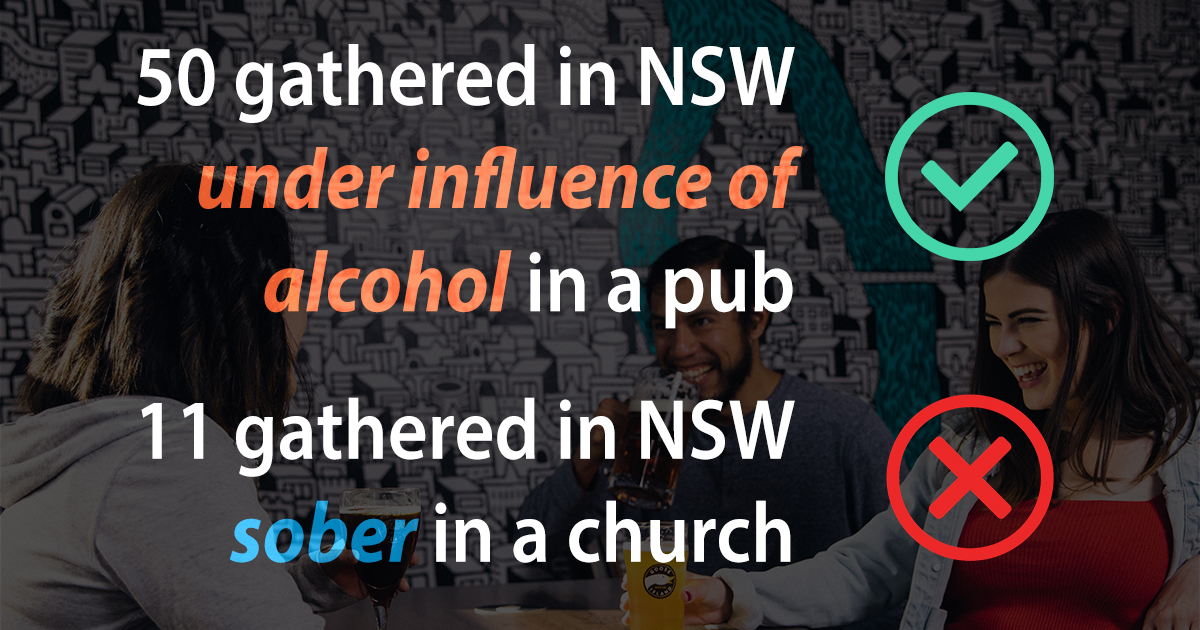
NSW restrictions meme for website4

Pressure is building on NSW Premier Gladys Berejiklian to end her discriminatory COVID-19 church crackdown.

Over six thousand people have signed a petition launched by the Catholic Archdiocese of Sydney on May 27.

Presently in NSW fifty people can meet at hospitality venues. But as few as eleven people are prohibited from meeting at a church.

“Churches have cooperated at every stage with the Government’s public health directives during this pandemic,” Archbishop Anthony Fisher OP said.

“We understand that the shutdown was necessary to flatten the curve, but it came at a cost – not only to the economy, but also to the spiritual and mental health of our people.

“They miss gathering for worship and praying in a sacred space. I am at a loss to explain to Catholics in Sydney why our reasonable requests to the government are not being granted. 

“Contrary to what has been said throughout this pandemic, we do not consider church attendance to be non-essential; indeed, nothing is more essential than the practice of our faith,” reads the petition.

“Catholics are not asking for special treatment, we are asking for equal treatment.

“This unequal treatment of religious worship leads us to ask whether the Government is listening to the concerns of Catholics and other people of faith or indifferent to the effect the closure of our churches is having on people during these difficult times.

“The freedom to practice faith is necessary for human flourishing and a great contributor to the common good.” 

FamilyVoice Australia National Director Peter Downie said, “Governments have been heavy-handed and unjust in their treatment of churches during the COVID-19 crisis.”

Reflection on Acts 18:1-17

Scripture

One night the Lord spoke to Paul in a vision and told him, “Don’t be afraid! Speak out! Don’t be silent! For I am with you, and no one will attack and harm you, for many people in the city belong to me.”

Observation

Paul moves to Corinth where he meets Priscilla and Aquila, Jewish believers from Rome. Paul testifies to the Jews about Jesus, but many of them oppose him. He decides then to leave the Jews and focus on the Gentiles.

One night, Paul has a vision of the Lord in which He tells him to not be afraid, but to continue speaking out. Paul then stays in Corinth for the next year and a half.

A change of governor emboldens the Jews. They bring Paul to him for judgement, but he expresses no interest in the case.

Application

The Lord’s exhortation to Paul is a word we should take note of.

“Don’t be afraid!” We can so easily be intimidated by opposition or disagreement. Satan is the author of fear. We must not allow fear of people to hold us back.

“Speak out!” It is not enough to let our lifestyle be our witness. Our testimony is in the words we speak. Our actions must be consistent with the gospel, but people need to hear the message. Faith comes by hearing.

“Don’t be silent!” We must not stand by and see injustices and crimes go unpunished. We must not be silent when people slander the church or the name of Jesus. Silence is an easy option, but should not be the option for christians.

The Lord encouraged Paul with the assurance that there were many followers of Jesus in that city. This sounds like the words of the Lord to Elijah when he thought that he was the only person in Israel still faithful to the Lord.

When we feel like we are alone in standing up for Jesus, it is good to be reminded that we are not alone.

Prayer

Lord please help me to be bold and speak your message, even when I feel isolated or alone. Amen.

J. Lee Grady: Why Is the Gift of Speaking in Tongues So Awkward?

J. Lee Grady: Why Is the Gift of Speaking in Tongues So Awkward?

be-quiet-1139693662
This Pentecost, don’t apologize for the secret of the apostle Paul’s power just because it’s awkward. (Aaron Amat via Getty Images)

From Charisma

Churches across the world will commemorate the day of Pentecost this next Sunday, whether they meet online or in their buildings. Most will celebrate the need for the Holy Spirit’s power, and they might read Acts 2:1-4, which tells how the Spirit’s flame rested on all the disciples who prayed in the upper room that day.

But when they read verse 4 (NASB)—”And they were all filled with the Holy Spirit and began to speak with other tongues, as the Spirit was giving them utterance”—some people will shift in their seats or clear their throats. This aspect of Pentecost makes people uncomfortable. We don’t know what to do or say about tongues. It’s just too weird for most people.

It was awkward for me too, when I first heard about it. I’d never met a Pentecostal. Speaking in tongues wasn’t part of my church tradition, and I had never heard anyone do it. In fact, the first person I heard speak in tongues was myself, when I was baptized in the Holy Spirit in 1976!

Since then, I have prayed for countless people to be filled with the Holy Spirit. I don’t force them to speak in tongues. I just warn them that it might happen, since it happened in Acts 2.


Several years ago, when I was teaching at a ministry school, a 22-year-old guy from Maryland asked if I could pray with him. He had heard me share how I was baptized in the Holy Spirit at age 18, and he wanted the same experience.

This young man, Eric, understood that he already had the Holy Spirit living inside of him. But he knew that Jesus offers us more. He knew the baptism of the Holy Spirit is a second experience in which the fullness of God’s divine power anoints us for ministry.

I explained to Eric that speaking in tongues makes no sense in the natural. It actually sounds like gibberish, yet the Bible says praying in the Spirit strengthens us profoundly (see 1 Cor. 14:2, 4). I laid hands on Eric and asked Jesus to fill him with divine power and to release the Holy Spirit’s language as a manifestation of the overflow.

Nothing dramatic happened at that moment, but I told Eric to remain expectant. I’ve learned that oftentimes, the release of the Spirit comes more easily when people are alone and not distracted by people standing around. I encouraged him to go home and pray some more.


A couple of days later I received a message from him, letting me know that a small miracle had occurred in his life. He wrote: “Thank you for praying for me to speak in tongues. That night was interesting because phrases started to pop into my head. I began speaking the phrases, and by the next night I was speaking in tongues as I was falling asleep. Now, every moment that I am not worshipping, praying, eating or speaking to someone, I am practicing this gift. Praise God!”

Many of us fall into the trap of downplaying speaking in tongues, even after we’ve received the gift ourselves. We may consider it divisive (and it certainly can be when it is abused) or we’re embarrassed because it seems fanatical to our friends or family members.

Yet when I read the apostle Paul’s comments on the issue, I realize that speaking in tongues was a key component of the New Testament church. Not only did tongues play a fundamental role on the day of Pentecost when the church was born, but this strange gift also fueled Paul’s personal zeal. The same apostle who wrote the book of Romans and preached to Caesar wrote: “I thank God, I speak in tongues more than you all” (1 Cor. 14:18). Paul most likely prayed in tongues for hours at a time.

Paul also instructed the Corinthians: “Do not forbid to speak in tongues” (1 Cor. 14:39). He knew that even though some people might be tempted to misuse this gift (and this is usually why people restrict it), we must never shut it down.

Eliminating the gift of tongues can have a direct impact on the flow of the Holy Spirit’s anointing in the church. If you forbid tongues or pretend this gift is not needed today, you might as well flip a breaker switch and turn off all the lights.

Speaking in tongues doesn’t make us holier than anyone else. And if we don’t exhibit love and Christian character, Paul said it becomes a useless gift comparable to a noisy gong (see 1 Cor. 13:1). But when stewarded properly and tempered with humility, this seemingly insignificant gift becomes an invisible spiritual weapon.

I’m not saying we should showcase tongues in church gatherings, scream at people in tongues or make people feel like misfits if they haven’t experienced the gift. (We must forgive immature Christians for doing those things.) When the Corinthians put tongues on the platform and turned their meetings into chaotic circus sideshows, Paul rebuked them sternly.

But the same apostle who warned his followers not to flaunt tongues in public also spent countless hours praying in tongues privately—because it’s a vital source of spiritual power that we must never neglect. This Pentecost, don’t apologize for the secret of the apostle Paul’s power just because it’s awkward. We need the Holy Spirit’s power like never before.

The Kingdom Of God Is An Enclave

Recently, while on youtube, I came across this fascinating video about enclaves.

An enclave is an area in a country that is governed by another country, an island within a nation’s borders. Although the video relates to Pakistani enclaves within India and vice versa, they pop up all over the place.

One of the weirdest enclaves is a railway line which belongs to Belgium but passes through Germany. A ribbon of land a few metres wide in Germany is Belgian territory. Either side of the railway is Germany.

An example closer to home is Jervis Bay on the NSW South Coast. Parts of that area are governed by NSW, but other parts are governed by the Jervis Bay Administrative Authority which, I think, is now an agency of the ACT Government.

Many enclaves are the results of historic anomalies. Sometimes a population of migrants may end up in a region of another country and become so dominant that they demand to be governed by their homeland. Sometimes extended wars result in population movements and the subsequent settlement terms require parts of the country to be ruled by their former enemy.

This all got me thinking about another enclave- God’s Kingdom.

The Kingdom of God exists wherever a person decides to follow Jesus. From that time on, they are subject to the laws of God’s kingdom rather than the culture of the people around. We are still obviously bound to obey our civil rulers, but only in as far as those laws do not contradict God’s rules. This was established early on in the church when Peter and John were ordered not to talk about Jesus, but they responded, “Do you think God wants us to obey you rather than Him? We cannot stop telling about everything we have seen and heard.” (Acts 4:19-20)

In most Western countries, there generally is not a huge area of disagreement between christians and government at the moment, because of our strong christian heritage.

One area that is changing is the whole attitude to sexuality and reproduction. In Australia, the Government legislated to allow same sex marriage. This was an area of great disagreement between churches and government. Christian ministers were given an exemption from discrimination law to allow them to marry only a man and a woman.

Most christians would say that it would be wrong for an unmarried couple to move in together or to engage in sexual intercourse before marriage. That is considered by many in the wider community to be an odd belief.

Most christians would believe that there is absolute truth, that morality and ethics are absolute, that we should live in obedience to God’s law. These ideas are all contrary to what many people believe.

So, increasingly christians are in a kind of enclave. The values of God’s Kingdom are very different to those of the world. Every day we need to decide whether we follow the ways of Jesus or the ways of the world.

Reflection on Acts 17:16-34

Scripture

“God overlooked people’s ignorance about these things in earlier times, but now he commands everyone everywhere to repent of their sins and turn to him.”

Observation

In Athens, Paul follows his normal practice of visiting the local synagogue to talk about Jesus with the Jews. He also debates with the philosophers.

He is taken to the town council to address them. He talks about God’s purpose for the nations and urges them to repent of their sins. The councillors are bemused by Paul’s talk of the resurrection.

A few people become believers, despite the generally negative response.

Application

Even when people are hostile or apathetic about the gospel, we are still responsible to proclaim the message.

Paul did what he could to express the gospel in the language that the leaders in Athens could relate to. He spoke to philosophers and city leaders, and just a few responded positively.

But those few started a congregation, a faith community. Those few would not have been saved if Paul had not shared the gospel.

In Australia we face a very similar situation. People generally are apathetic or even hostile to the gospel. It does not fit into their world view. People are comfortable in their sins and see no reason to change.

Regardless of this, Paul’s warning is still true. God has ignored people’s sins in the past, but that does not mean He will always withhold judgement. We need to continue to warn people that they must repent of their sins and turn to God.

We need to make sure also that we are living lives of repentance, continually turning to God. Our lives must confirm the truth of our words.

Prayer

Lord I pray for my friends and family today. May they come to know your grace, turn away from their sins and follow you. Amen.

Don’t Agree Things Are a Pain in the Butt Unless You Want a Pain in Your Butt

From Mark Virkler’s blog

Don’t Agree Things Are a Pain in the Butt Unless You Want a Pain in Your Butt – By Linda Burton


Last summer as we were moving furniture, I felt my lower back go out of place.  I fell to the floor crying out, “My back, my back.”  As I lay there I prayed, “Lord Jesus, please lay Your hands on my back and heal it.”  In a little bit I was able to get up and move about with discomfort but not intense pain.  Then every day I noticed less discomfort and more flexibility. 


In December, I started feeling pain in my lower back and sciatic nerve in my right leg.  It was in the same place as the injury last summer so I believed it was coming from that.  I started doing exercises to strengthen my lower back and to relieve the pain.  After three weeks, the pain was still very intense and not getting better.  At this point I began questioning if there was something else going on. 

I went to Jesus and quieted myself, turned to vision, tuned to the flow of the Spirit and journaled.  I asked Jesus what the root of this pain was.  I saw and heard Him laughing.  He asked, “Did you not agree with your daughter that some things in life are a real pain in the butt?”  Immediately I remembered her making that statement and my agreeing.  Oh my! Oh my!  Jesus then said, “I just gave you what you asked for!”  I saw the twinkle in His eyes and He chuckled.

Needless to say, I immediately confessed, repented and asked forgiveness for making this agreement.  When I awoke the next morning, the pain was gone and has not come back.

Jesus said, “Beloved, words come easily and agreements are made without thought.  In the Kingdom, every word is of great importance, for good or evil.  Listen to the words of your heart as you also listen to others.” 

The issue my daughter was referring to was “more month than provisions.”

Soon after this experience, my daughter called and in the conversation she said, “Mom, I just don’t know how I am going to pay the electric bill.” As we were talking, she exclaimed, “I just paid the electric bill online and we have $10.00 left in the bank account! I didn’t think we even had enough.”  Together we raised a hallelujah and praised our mighty God for His provision of more than enough.  Things are still financially tight but there continues to be more than enough! 

            Our loving holy Papa, You are so incredibly amazing. Your majesty, goodness, and loving kindness bring us to a deep sense of awe of You!  We thank You that You are our faithful God that goes before us and prepares the way for us.  As You prepare the way, Your light illumines the way we are to go.  You never lead us astray or down a dark dead-end alley.  You are never too late or too early.  Everything about You is perfect.  Thank You for who You are in us and for who we are in You.

            May we have soft and pliable hearts that respond to Your loving touches.  May we not be so busy or distracted that we forget to come and sit at Your feet and spend time with You.  May we regularly take time to celebrate life as sons and daughters of The Most High God!  Thank You, Papa, thank You! We love You!

Prayer Application for breaking agreement with lies

Examples of lying agreements to be aware of and to renounce: Pain in the neck, sick to my stomach, never enough, I cannot succeed, I am a victim of…, I am sick with …, etc. 

Discernment: Lord, are there negative agreements or judgments I have made against self, others or circumstances which are now binding me and keeping me from Your bountiful provision and full health? Remind me of them. Show me what they are and how they have affected my life. Lord, speak to me Your truths which counter these lies of the enemy so I can speak them over my life. Journal out what He speaks.

Confession and repentance: I confess and repent of my sin of embracing these lies, and of living in judgment against myself, others and circumstances. I release  judgments against myself, others and circumstances which have affected my life, and acknowledge that You can and do work all things out for good (Rom. 8:28). I ask You, God, to forgive me, and I receive Your forgiveness. I forgive myself for participating in this sin.

Action: I break off the power of these word curses, and command all connected demons to leave in Jesus’ name. Jesus, cleanse the cellular memory of this trauma. Lay your hands on the ailing body part and speak health, healing and release to it, thanking God for setting you free and restoring you to full health in Jesus’ name. Jesus, I speak in faith that by Your stripes I am healed. I speak to these damaged cells to be restored in Jesus’ name. Function normally, in Jesus’ name.

The Translation Wars

The Translation Wars

From time to time images like this pop up on social media with the claim that the NIV (New International Version) doesn’t want you to know about salvation and that verses such as the ones above have been deliberately left out.

Often this is linked to the fact that the NIV is published by Harper-Collins which is owned by Rupert Murdoch, and which also publishes the Satanic Bible. Therefore there is a conspiracy to deceive christians.

It is true that the verses in question, along with a bunch of other verses in the New Testament, are missing from the modern translations of the Bible. Usually, they are omitted from the main body of the text and put in the footnotes with a comment like “Some old manuscripts have “For the Son of Man came to save that which was lost.”

It is not just the NIV, but all modern translations such as the New Living Translation. We can’t blame this on Rupert Murdoch, or the satan worshippers at Harper-Collins.

So what is going on?

The King James Version of the Bible arose in the years following the Reformation. At the time the only widely available versions of the Bible were in Latin. The Catholic Church did not want people reading Scripture in their own language because they might interpret it incorrectly and be led into error. But the Reformers wanted people to get scriptures in their own language so that they might find Jesus and salvation.

The King James Version was published in 1611 to meet this need to produce an English version of Scriptures. There had been earlier versions of Scripture published in English, but they were translations of the Latin version. The KJV was a direct translation from the original Biblical languages of Hebrew (Old Testament) and Greek (New Testament).

The invention of the printing press also made it possible for the first time to mass produce the Bible, and make it available to people who could read and who had the money to buy it.

The KJV was based on the “textus receptus” or “received text” of the New Testament. It was the best reconstruction of the original Greek text available at the time.

In the 400 years since the KJV was first published, there have been discovered thousands of manuscripts and text fragments of the various books that we today call the New Testament. These were scattered right around the Middle East and northern Africa.

Most ancient documents we are lucky to have one or two whole texts. With the New Testament , we have an abundance of them.

What we call the New Testament was not standardised until about 367, although all of the books of the New Testament were written by about 100. For a long time smaller collections of Paul’s letters or individual gospels circulated by themselves.

Before printing was invented, to distribute a document, it literally had to be copied by hand. Not only that, paper products were expensive so often animal hides or other flat surfaces were used. And there were no standard page sizes as we have now.

How do you mass produce a gospel or a letter without printing presses? You can sit a dozen people in a room taking dictation as one person reads their copy of the book. Errors sometimes creep in as people mishear what was said. Sometimes the person reading the text or making their own copy would add an additional sentence or a whole section that they thought would fit there.

Scholars over the years have tried to work out what is the best version of the text, that is the closest version to what Paul and the other authors originally wrote. Their desire is that people can have the most accurate version of the text originally inspired by the Holy Spirit. The current accepted version is often called the Nestle-Aland, third edition, named after two of its editors.. This is the version most often used by more recent translations into the English language.

It turns out that some of the verses incorporated in the textus receptus and carried into the King James Version were not in the most original versions of the Greek text. There are not a lot of these verses and they do not substantially change the gospel message contained in the Bible.

This whole process is animated by a desire to get the Word of God distributed as widely as possible, so that people can find Jesus.

The early church distributed hand-copied letters and gospels to as many places as possible because they loved the Lord.
The Reformers produced a version of the Greek text of the New Testament because they loved the Lord.

English scholars produced a translation called the King James Version so that ordinary people could read the Bible because they loved the Lord.

Scholars in the nineteenth and twentieth centuries took the thousands of manuscripts discovered in the intervening years and updated the Greek text to try to get as close as possible to the original text because they loved the Lord.

Various English translations have been published using these improved Greek originals because the translators want people to understand the Bible, because they love the Lord.

Whenever people imply some sort of diabolical conspiracy on the part of the people who devote their lives to making God’s Word available to all, they are in fact committing the worst kind of sin.

Do not believe those who say the King James is the only reliable Bible. There are many very good translations available, so use one which is understandable to you.