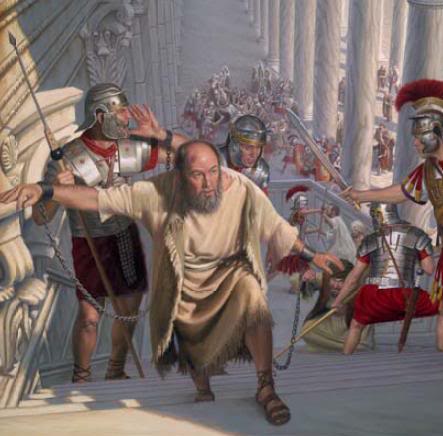
As Paul reached the stairs, the mob grew so violent the soldiers had to lift him to their shoulders to protect him.
Observation
Paul goes to see James and the elders of the Jerusalem church. He tells them everything that happened on his missionary journeys.
The elders report that in Jerusalem some of the Jews there have been telling the believers that Paul has been telling Jewish believers that they no longer have to follow the Law of Moses. To correct this misinformation, they arrange for Paul to go to the Temple with four believers who have completed a vow.
When they arrive at the Temple, some agitators start a riot over Paul’s presence. The Jews start beating Paul. Word reaches the Roman military leader, and he dispatches a platoon to quell the riot.
Unable to find out the cause of the trouble, the commander orders Paul to be taken to the fortress. As they arrive there, Paul asks for permission to address the crowd.
Application
It seems that wherever Paul went trouble soon started. This is not because of anything that Paul did that was inherently wrong. It was from jealousy and fear that people started to become violent.
The riots were started by the same kinds of people who start riots in our own day. There were two factors explicitly mentioned here.
1. False information. Information was spread about Paul’s ministry to both Jews and Gentiles. They claimed he was telling Jewish believers to abandon their traditions and customs. This was not true.
False information is often a flash point for violent behaviour.
2. False accusations. The agitators claimed that Paul had brought a Gentile into the Temple. People made assumptions about Paul’s actions.
It is easy to manipulate people by feeding them false information and then making false charges.
Jesus is the Way, the Truth and the Life. Satan is the father of lies. Follower of Jesus must make sure that we always speak truth rather than lies.
Prayer
Holy Spirit speak your truth into my heart. Give me discernment so that I can always distinguish truth from deception. Amen.
When it was clear that we could not persuade him, we gave up and said, “The Lord’s will be done.”
Observation
Paul and his companions resume their travel, heading for Jerusalem.
In Tyre, the believers prophesy by the Holy Spirit, imploring Paul not to go to Jerusalem.
In Caesarea, they stay at the home of Philip. A man named Agabus comes from Judea and performs a prophetic act. He declares that Paul will be bound by the Jewish leaders in Jerusalem and handed over to the Gentiles.
Everyone pleads with Paul to not go on, but he is determined. He is willing to be imprisoned, even to die, for the sake of the Lord Jesus.
Finally they arrive in Jerusalem where they are warmly welcomed by the brothers and sisters.
Application
Paul had such a strong conviction that he needed to go to Jerusalem, under the direction of the Holy Spirit that nothing, not even a series of prophetic words and actions, would deter him.
Sometimes we can think that if we get a prophetic word spoken over us or directed towards us then we have to follow that word.
In this case, the prophecies were only confirming what Paul knew was the way ahead. He knew that jail, possibly death, awaited him in Jerusalem. The prophecies along the way only served to confirm what God had already told him.
Prophecy and the other gifts of the Holy Spirit are nor meant to be prescriptive. They should not tell us definitively what to do. They are just part of the information that God gives us to help us follow Him.
The response to prophecy always has to be left to the individual, guided by the Holy Spirit.
Prayer
Lord, I thank you for all the gifts of the Holy Spirit, including prophecy. Help me, Lord, to have wisdom in understanding and applying prophecy. Amen.
Here is my commentary on Ephesians 2:10. I am publishing these once or twice a week, but you can read all of the available articles at our web-site, http://www.new-life.org.au
Ephesians 2:10
For we are his workmanship created in Christ Jesus for good works, which God prepared beforehand, that we should walk in them.
In the previous verse, Paul stated unequivocally that we are not saved by good deeds, but now he tells us that we are saved for good deeds. Salvation comes first, then the good deeds, God’s deeds.
There is a certain strand of Christianity that constantly emphasises the sinfulness of people, even those who are born again. It is important that we recognise that even as followers of Jesus we can sin. The problem comes when we start to take on board the message that we are not good enough, that we will never make it.
Here is the amazingly good news. We are God’s workmanship. Literally the Greek term means a masterpiece. The word is poiema from which we get the word poem.
Before we were saved we were created in God’s image. We were knitted together inside our respective mothers. We are, just in terms of our physical construction, an amazing creation. Then add in our awesome mental capabilities and our ability to make wise decisions and our moral judgement- you are a work of art! Sin messed things up, like oil poured over a Rembrandt. But God has now cleaned that up and restored us to the original state.
Even better than that, God has restored you into a pre- sin state and marked you with His Holy Spirit. What an amazing work of art!
People speak of their awe at seeing the Sistine Chapel with all its art surrounding on every side. As a redeemed child of God, you are a work of art, a masterpiece of Gods creation.
We are Gods masterpiece, created in Christ Jesus. Being born again means that we are created anew. The part of us that was dead has come to life. the part of us that was stained by sin has been recreated. The overwhelming, never-failing grace of God, passed on by Jesus makes us a new creation.
We get to have a new start, a purpose in living that should galvanise us and put a spring in our step every day.
We are created in Christ for the good works that God has prepared for us.
it’s not about “pie in the sky when you die.” It’s not about basking in the glory until we are promoted to Heaven.
No, we have been born again for God’s good works. We are God’s workmanship created to do his work.
We are not created to do good works generally, although there is no harm in that. God has created us in Christ for His good works. We are created for a mission, for God’s mission.
Some people are activists who will support any cause that they think is a good thing. They run themselves ragged doing good works, but they may not be doing God’s good works.
Each disciple needs to ask God, “What is my purpose in being created and recreated in Christ?” He has a specific purpose for us. Everything else is just punching at the air .
Each of us has been created for good works that were prepared for us long ago. Before we were born, God had a plan of what He was wanting us to do. He moulded us and shaped us for these deeds.
We often get this the wrong way round. We think that there are things we can do, missions or community work that is already there. We were not created to fill a gap. There are deeds created for us to do, prepared before the beginning of time. Our job is to find these deeds, not volunteer to do good things.
God’s pre-prepared deeds give our life purpose. We must not get distracted by everybody else’s life purpose and so miss out on the thing God has prepared for us to do.
The idea of walking in these deeds suggests a long-term commitment. Each of us has a vocation or calling that determines our reason for being. When we find that vocation, we cannot do anything other than walk in it or stick with it.
Each of us has a different vocation. That is why the church is called a body. When everyone uses their spiritual gifts and their natural talents to fulfil the good deeds that God has created for them to do, then the church explodes with energy and vitality. Every member of the church is working together in their own mission in order to collectively fulfil the mission of the church.
Key points in this verse:
You are God’s masterpiece
We are saved for good deeds and not by good deeds
God has prepared a mission for each one of us
We are most fulfilled when we are walking in the mission God has called us to
When every believer walks in their calling together, the mission of the church becomes highly effective
“My life is worth nothing to me, unless I use it for finishing the work assigned to me by the Lord Jesus- the work of telling others the Good News about the wonderful grace of God.”
Observation
Paul and his companions travel to Miletus. Paul is determined to travel to Jerusalem in time for Pentecost.
While in Miletus, Paul calls for the elders from Ephesus to come and see him. He recounts how he worked among them, sharing the Good News about Jesus and encouraging people to repent.
Paul is bound for Jerusalem, not knowing what to expect there. The Holy Spirit has told him that suffering and jail lie ahead. He encourages the elders to guard their flock and to be on the lookout for false teachers who will come in like vicious wolves.
They all pray together, crying in sadness at the knowledge that they will not see one another again.
Application
Paul considered his life as worthless, unless he completed the task to which he had been assigned, that is telling people the Good News about salvation.
For people without a knowledge of eternity, it makes sense to live life to its fullest and enjoy life as they can. For christians, this is folly because we know that we must give an account to the Lord of how we spend our lives.
Not everybody is a Paul- an apostle called to travel the world sharing the gospel and planting churches. Not everybody is called to be in a full time paid ministry position.
We are all called to serve the Lord and to give our lives as an offering to Him. We need to find from Him what is our calling, our assignment in the Kingdom.
We are not here to live for our own pleasure. God has a unique role for every one of His people to fulfil.
Prayer
Thank you Lord for the knowledge that you have made me for a purpose. Please help me to walk in that purpose today and every day. Amen.
On the first day of the week, we gathered with the local believers to share the Lord’s Supper. Paul was preaching to them, and since he was leaving the next day, he kept talking until midnight.
Observation
After the uproar in Ephesus, Paul resumes travelling through Greece and Macedonia, ending in the city of Troas.
While there, he meets with the local believers. He preaches right through the night. A young man named Eutychus falls out of his seat on the window sill and dies. Paul picks him up and tells the others he is alive.
Application
People often wonder what worship was like in the early church. From this passage, and others in the New Testament, we can infer at least three things.
Firstly, the church met on the Lord’s Day, that is Sunday, from very early on. That is in contrast to the Jews who met on the Sabbath, that is Saturday.
There are many explanations put forward for this, but the simplest is that it seemed appropriate to set aside the day of the Resurrection as the special day for christian worship.
Secondly, they shared the Lord’s Supper. The Lord’s Supper, or Holy Communion, is a focal point for worship. The early church celebrated the Lord’s Supper every Sunday to remember the central distinctive message of the gospel that Jesus died for our sins.
Thirdly, preaching was very important. Maybe we shouldn’t preach all night as it can be fatal. The proclamation of the Good News and the teaching of Scripture is vital. We live in an era where people have short attention spans, but we should not dismiss the power of the spoken word.
Prayer
Lord teach me how to worship you and hoe to listen to the preaching of your word. Amen.
“But as you have seen and heard, this man Paul has persuaded many people that handmade gods aren’t really gods at all. And this is not only here in Ephesus but throughout the entire province.”
Observation
Paul feels compelled by the Holy Spirit to go on to Macedonia, and so he sends Timothy and Erastus to prepare the way for him.
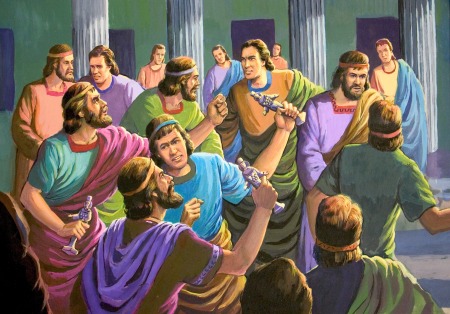
In Ephesus a riot breaks out because the silversmiths are seeing their businesses decline due to people following Jesus rather than the local “god” Artemis. The mob seizes some of Paul’s companions and takes them to the amphitheatre.
Eventually the mayor convinces them to disperse and take Paul and his friends to the local court if they think a crime has been committed.
Application
In these riots, as in the current ones happening in the United States, people can be convinced to join in for very different reasons (sometimes no reason at all). A grievance can be twisted or co-opted by outside forces.
Some people were concerned about their loss of income from the decreased demand for idols. Others were concerned because the honour of Artemis is being undermined by Paul’s preaching.
Christians can become a threat to vested interests, whether religious or financial, and even find themselves being targeted because of the changes the gospel brings.
In Australia, it is easy to see how a revival might reduce the demand for alcohol and illegal drugs. It is possible that people who profit from these things might become violent towards christian leaders.
What an honour it would be if we could get to a place where the church is so effective in its mission that we are a threat to harmful businesses. What an honour it would be to see society- wide change happening because of the gospel.
This is happening in many parts of the world today. We pray that it will happen here also.
Prayer
Lord it is awesome to think that christians can multiply so quickly that they become a threat to some people. Send revival to this land, Lord, so that we might be a part of such a great movement of your Spirit. Amen.
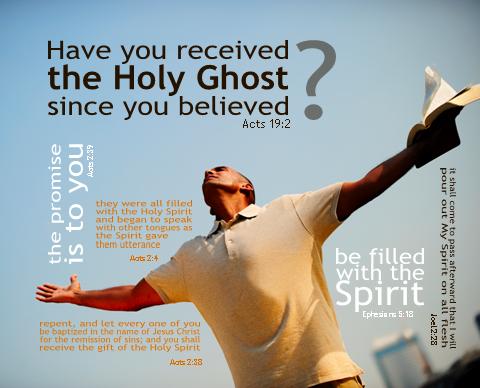
Then, when Paul laid his hands on them, the Holy Spirit came upon them, and they spoke in other tongues and prophesied.
Observation
Paul travels to Ephesus, where he meets some believers. He asks them if they received the Holy Spirit. They had not even heard of the Spirit and had only been baptised in John’s baptism. Paul baptises them in the name of Jesus, and they receive the Holy Spirit, speaking in tongues and prophesying.
Paul starts teaching in the synagogue, but is rejected there, so he holds daily meetings in a Greek philosophy hall. He also performs many miracles.
Some Jews who try to use Paul’s and Jesus’ names to cast out demons are beaten up be a demonised man. The spirits say, “We know Paul and we know Jesus, but we don’t know you.”
Many people are saved. A great bonfire of books of sorcery is lit to celebrate the change of heart of many pagans.
Application
Some believers who had been taught by Apollos are found by Paul to have not received the Holy Spirit. Their teaching and their conversion were deficient.
How did Paul know there was a problem? Perhaps he exercised the spiritual gift of discernment. Perhaps there was something about the way they spoke or prayed.
Paul baptises them in water in the name of Jesus and lays hands on them to receive the Holy Spirit. They then speak in tongues and prophesy.
When we receive the baptism in the Holy Spirit, there will always be a manifestation, a sign of the Spirit’s presence. The gift of tongues is given as a sign of the Holy Spirit as well as a language for prayer. This was one of the first signs on the Day of Pentecost that the Holy Spirit had been poured out.
Some christians still fail to experience the fullness of the Holy Spirit because they have not been taught correctly. This is not to say that they are unsaved; they are living a less than ideal life.
Prayer
Come Holy Spirit and fill every part of me. Let my speech be surrendered to you in tongues, in prophecy, and in testimony. Amen.



 New Life Narrabri