Reflection on Romans 5:12-21

Scripture

For the sin of this one man, Adam, brought death to many. But even greater is God’s wonderful grace and his gift of forgiveness to many through this one man, Jesus Christ.

Observation

Adam’s sin brought death to everyone because we all sin. People sinned before the law was given and everyone died.

Adam is a representative of Jesus Christ. Adam’s sin brought death to many. But Christ’s death brings life and forgiveness of sin. Through Adam’s sin we are all condemned, but through Christ’s obedience we are all made righteous.

God’s law is given to make us see the reality and the extent of our sin. As people sinned, God’s grace abounded in forgiving their sins.

Application

Everyone sins. It doesn’t matter how good we are in human terms, the fact is that we are all sinners.

Our DNA is corrupted by the sin of Adam. Sin is our inheritance and our heritage.

Sin separates us from God who is the source of life. So our bodies wear out and die. This is not how it was meant to be.

Just as Adam’s one act of sin brought death to all people, so Christ’s one act of obedience brought life to all people. God sees the sacrifice of Jesus as a suitable payment for our disobedience and He grants us forgiveness.

When we are forgiven by God, we can once again draw near to Him and receive eternal life.

Ultimately, the choice is ours. Do we want to remain rebellious sinners headed for the torment of hell? Or do we want to receive the free gift of life through Christ and ensure that we will go to eternal joy in heaven?

Prayer

Lord, you lay out a stark choice for us with no shades of grey. Thank you for setting me free from sin and for the promise of eternal life. Amen.

Good News For Pollution Reduction

From the University of Sydney

Engineers use electricity to clean up toxic water


Powerful electrochemical process destroys water contaminantsUniversity of Sydney engineers have used electricity to clean up heavily polluted industrial wastewater. They hope the findings will help wineries, pharmaceutical manufacturers and other industries that must comply with strict wastewater regulations.

Julia Ciarlini Junger Soares showcasing her work at the University of Sydney. The researchers used an advanced oxidation process that eliminated stubborn organic aqueous pollutants. Credit: Julia Ciarlini Junger Soares, University of Sydney

A team of engineers may be one step closer to cleaning up heavily contaminated industrial wastewater streams. 

Researchers from the School of Chemical and Biomolecular Engineering developed an electrochemical oxidation process with the aim of cleaning up complex wastewater that contained a toxic cocktail of chemical pollutants. 

“Our study, published in Algal Research, involved industrial wastewater that had been heavily contaminated with a cocktail of organic and inorganic species during a biofuel production process”, said Julia Ciarlini Junger Soares, who is completing a PhD in Chemical and Biomolecular Engineering under the supervision of Dr Alejandro Montoya.

The wastewater, which contained carbon, nitrogen and phosphorus, was generated in a pilot plant, designed by the team for the production of biofuels using naturally abundant microalgae.

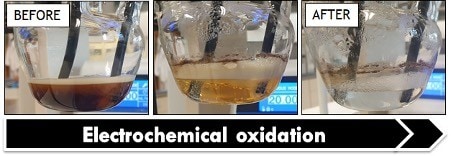
The process involved treating wastewater with electricity using specialised electrodes. They discharged electricity, then drove oxidation reactions near the electrode surfaces, transforming the organic contaminants into harmless gasses, ions or minerals.

“We have employed an incredibly powerful process that eliminates even the most persistent non-biodegradable pollutants, such as pharmaceuticals and pesticides, as well as various classes of organic compounds that can be found in many industrial effluents,” she said.

The water before, during and after treatment. Credit: Julia Ciarlini Junger Soares, University of Sydney 

“The process is relatively simple, does not require the addition of chemicals or severe operation conditions, and does not produce additional waste streams.

“Wastewater is a significant issue for our environment, as well as for many industries who use substantial volumes of water in their processes, such as in reactions, transport, and washing and cooling. Finding suitable solutions for reuse or disposal is often very challenging and costly. 

“The electrochemical method that we used can be readily applied to industries that must comply with strict regulations for wastewater disposal, such as pulp and paper processing, wineries, as well as pharmaceutical production facilities.

“Worldwide, researchers are investigating methods for the development of biofuels from algae. Developing alternatives for the treatment and reuse of this industrial effluent is a hot research topic and can bring opportunities for energy and resource recovery within a circular bio-economy framework.”

The team will soon carry out research focused on specific contaminants to better understand the chemical transformations that take place during electrochemical oxidation and will upscale the process.

A 2017 UNESCO report found that the opportunities from exploiting wastewater as a resource were vast, and that safely managed wastewater is an affordable and sustainable source of water, energy, nutrients and other recoverable materials. 

Covid Models Were Wrong, and Modellers Unwilling to Learn!

From the University of Sydney:

Did COVID-19 models get it wrong? Professor Sally Cripps explains


Leading statistician analyses COVID-19 modellingRenowned University of Sydney statistician, Professor Sally Cripps, examines the efficacy of COVID-19 modelling as part of an online analysis with colleagues from Stanford University and North-Western University.

Did COVID-19 models in the United Kingdom and the United States get it wrong?

As part of an online discussion between an international group of researchers, including Stanford University Professor of Medicine John P.A. Ioannidis and Northwestern University statistician, Professor Martin A. Tanner, University of Sydney statistician Professor Sally Cripps discusses the efficacy of the two countries’ COVID-19 modelling efforts, with recommendations on how countries – including Australia – can better prepare for uncertainty.

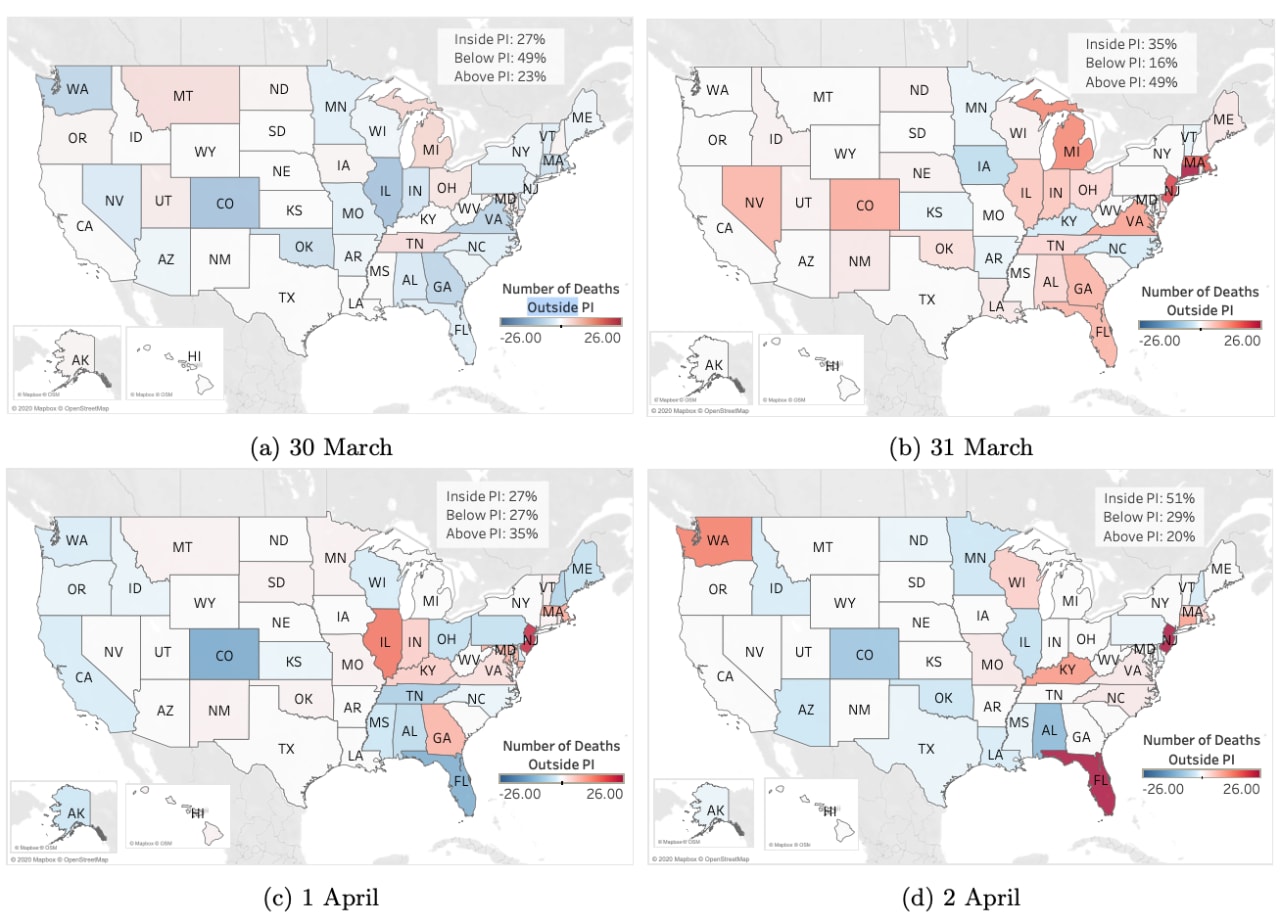
In April, Professor Sally Cripps alongside US colleague, Professor Martin A. Tanner found that over 70 percent of US states had death rates that were inconsistent with IHME predictions. Credit: Centre for Translational Data science. 

COVID-19 models got it wrong in that they failed to forecast with any degree of accuracy daily death counts even when the forecast was for one day in advance. In addition they failed to accurately quantify uncertainty,” said Professor Cripps, who is the Director of the University of Sydney Centre for Translational Data Science and the ARC Industrial Transformation Training Centre for Data Analytics for Resources and Environments

“But that doesn’t mean all modelling is bad or ineffective. In fact, what this scenario represents is an opportunity to learn and do better. Modellers have tried to justify their faulty models rather than learn from their mistakes.” At the outbreak of the COVID-19 pandemic, societal lockdown was the sensible thing to do. Australia acted swiftly in that regard, but now we need to find a way out. 

“At the outbreak of the COVID-19 pandemic, societal lockdown was the sensible thing to do. Australia acted swiftly in that regard, but now we need to find a way out.

“Though lockdowns minimise COVID-19 deaths, there are many studies which show that lockdowns increase domestic violence, as well as increase deaths from cancer and heart attacks.

“We need to develop models which have multi-criteria functions that allow governments to better understand a measure’s effect across all of our society.

“We also need access to reliable data, and models that are validated and continuously reappraised for their performance in real-time.”

As of 26 June 2020, COVID-19 had claimed almost 125,000 lives in the United States and over 43,000 in the United Kingdom.

DISCLOSURE:

Professor Cripps conducted an analysis on the efficacy of COVID-19 modelling efforts as part of an ongoing online discussion with international colleagues, Stanford University Professor of Medicine John P.A. Ioannidis and Northwestern University statistician, Professor Martin A. Tanner. The discussion has been published by the International Journal of Forecasters

Ephesians 2:22

Here is my commentary on Ephesians 2:22. I am publishing these once or twice a week, but you can read all of the available articles at our web-site, http://www.new-life.org.au

Ephesians 2:22

And in him you too are being built together to become a dwelling in which God lives by his Spirit

God is building something from the believers. it is described as a household, then a temple, now a dwelling place for God.

The word “you” here is plural, that is all of the believers not just one. All the believers in Ephesus of being built together in this project of God .

This is a big project. Sometimes the project might contain modules or parts which first have to be constructed from smaller components. A cupboard might come as a flat pack, and first must be built from its component parts. Only then can it take its place in the house.

The church is being built into a temple or a dwelling place for God. Our individual congregations are being designed to take their place in the church.

So we are being built together. The module is being constructed so that it can be slotted into its correct place .

We have to play our part by being community. We are being built together. For this to happen, I must learn to get on with, and to love unconditionally, those other people in the congregation.

We cannot claim to love one another if there are people we cannot talk to or we dislike. Being built together means that we have to learn to love. Being built together means that I have to learn to make room in my life for the bumps and irregularities in the lives of those around me, accommodating people who are different .

The outcome of this is a dwelling place for the Holy Spirit.

Most of us are accustomed to the idea that, as individuals, we are vessels of the Holy Spirit. When I first gave my heart to the Lord, the Holy Spirit came into me. I became a dwelling place for the Holy Spirit .

Paul is saying that we together are meant to be a dwelling place for the Holy Spirit. Together we are the Temple of God. This is something much bigger .

The concept of synergy is that the whole is greater than the sum of its parts. You are worth more then the basic chemicals that comprise your body. Your house is much more than a pile of bricks and timber stacked on a plot of ground .

In the same way, the church is more than a collection of believers. God is building a dwelling place, a place where He can abide and stay.

As all the individual Christians- bearers of the Holy Spirit- take up their rightful place in the church, God makes it something much greater. Whereas one person could not hold the glory of God, perhaps one billion can. While one person can carry a simple expression of God’s majesty, a billion can carry that many and more expressions of God’ majesty.

God’s plan was never to just redeem individual sinners. His plan was always to build those sinners into something greater- a tabernacle, a temple, a dwelling place.

God is dwelling with his people, in his people, among his people. He is not up there, out there, or any other place than right here where the people of God are right now.

If my prayers rise up to cover my household, then the prayers of christians in my town cover the city, and the prayers of believers in all the world cover the globe. The prayers of Gods people construct a net or tent of God’s presence. As we come together in Christ, the presence of God transforms the world as it transforms us.

The world becomes the Lord’s footstool by the prayers and worship of Gods people together.

Key points in this verse

  • We are being built together
  • The church is bigger than our congregation
  • God is transforming the world as he transforms us

Reflection on Romans 5:1-11

Scripture

God showed his great love for us by sending Christ to die for us while we were still sinners.

Observation

Having been made right with God, we have peace with Him because of what the Lord Jesus Christ has done for us. He has brought us into this place of undeserved privilege where we can confdently look forward to sharing God’s glory.

When we were lost in sin, Christ came at the right time and died for sinners. We have been made right with God through the blood of Jesus.

Application

Christ died for us while we were still sinners. He didn’t wait until we were good enough.

Historically this is true for us. Christ died 2000 years ago, long before anyone now living was even born.

It is true also experientially. I know that Christ died for me long before I became a friend of God.

It is true that while I still hated God, He continued to love me. While I was still proudly atheistic and toying with Marxist philosophy, Jesus came into my life and washed me with His love. On one night in May 1976, I had a vision of Jesus that melted away every argument I had ever had against christianity. In that instant, I realised that I wasn’t fighting against a system of thought, but against a Person- and that Person loved me with an undying eternal love.

While I was fighting Him, Jesus was loving me. While I was denying Him, He was working in my life to bring me to a place of repentance.

How true it is that Christ died for us while we were still sinners. He never gives up on us.

Prayer

Thank you Jesus for dying for me wile I was still a sinner. Thank you for your great love for me and for all people. Amen.

Ephesians 2:21

Here is my commentary on Ephesians 2:21. I am publishing these once or twice a week, but you can read all of the available articles at our web-site, http://www.new-life.org.au

Ephesians 2:21

… in whom [ie Christ] the whole structure is joined together and grows into a holy temple in the Lord.

Christ is the cornerstone (v.20) of the temple or household that is being built. It is in him that this household is held together.

Paul uses this word “in” twice to refer to our relationship with Christ. Given the building illustration, this seems odd. A structure rests on the cornerstone, which in some ways shapes it and directs it, but the structure is never “in” the cornerstone.

Paul is trying to remind us that, despite the metaphor of the church that he is using here, our connection with Christ is relational. In a building not every brick rests directly on the cornerstone. Indeed a particular brick maybe some distance from the cornerstone. The church, however, is an organic product. it is “in Christ”, and every member of the church also is “in Christ.” This is relational language not structural language.

Christ is not just the foundation stone, he is the mortar that holds the structure together. He is not in the corner of the building. He is the glue that holds the building together.

As individuals come to know Jesus and seek to serve him, They will also love their fellow Christians. ”A new commandment I give you that you love one another” (John 13:34). Love for Jesus translates into love for one another. So the church is built on Jesus’ love.

The church grows as it grows in Christ. if we love him, and relate to him, and obey him, the world will know that we are his followers. They, or at least some of them, will be attracted to the Good News and will want to be a part of this household.

The growth happens regardless of any church growth or evangelism programs. iI happens because the church is ”in Christ.” it is our relationship with Jesus that gives the power to make disciples, not any human plan. This is not to deny that believers need training and encouragement in evangelism. But real church growth is based in our knowledge of Jesus, not in our activity for him.

Here is a mystery. The household grows into a temple. When the church is in Christ what seems small and unremarkable grows into something that is prominent and central.

A Temple is:

  • A focal point for worship in the city
  • The place where God’s presence is specifically located
  • A place dedicated to God for his purpose, that is, holy
  • Replace for sacrifice
  • A place to encounter God

So the household of God, a small unit of believers, grows into something that is visible to all and recognised by all.

When the church remains in Christ, He builds the temple according to his plan and purpose.

The word “grow” suggests this is an ongoing process. Builders know when the project is completed. They look at the plans, maybe consult with the owner, and conclude that it is finished.

This growth into the temple in Christ is not finished. It cannot be, at least on this side of eternity.

There will always be more people to reach. There will always be a need to turn believers into disciples, passive Christians into active co-workers .

And so the church grows and will continue to grow until Jesus returns, and the mission is completed.

Key points in this verse:

  • God is building a structure on Christ the cornerstone. and on the prophets and apostles.
  • We must remain in Christ
  • It is Christ who determines what the shape of the church is
  • The growth of the church is organic growth
  • The growth and the mission of the church continue. It is a work in progress.

Reflection on Romans 4:11-24

Scripture

Abraham never wavered in believing God’s promise. In fact, his faith grew stronger and in this, he brought glory to God. He was fully convinced that God is able to do whatever he promises.

Observation

For Abraham, circumcision was a sign that Abraham already had faith, and that God had already accepted him. Abraham is therefore the spiritual father of all who have faith, regardless of whether they have been circumcised.

God’s promise is a gift and it is received by faith. Even when there was no reason for hope, Abraham kept hoping, despite his great age.

Abraham grew stronger in his faith. He was convinced that God could keep His promise. This is for our benefit that we too will believe that trough Jesus Christ God makes us right with Himself.

Application

Paul tells us that Abraham never wavered in believing God’s promise. Yet we know that Abraham and Sarah did try to move things along with Hagar. Perhaps Abraham reasoned that this was God’s way of bringing the promise to fruition.

Regardless of this, it took a miracle to see the promise come to pass. Over the time before and after Isaac was born, Abraham trusted the Lord, growing in faith as he waited.

I have a few promises that I am waiting for God to fulfil. I can rationalise them or try to make them happen, but this always fails and, if anything, makes things worse.

The answer, I think, is to trust that God keeps His promises. Do not waver in trust and do not try to make it happen.

The other factor is prayer- lots of prayer. My prayer is life is not as sturdy or fervent as it needs to be. In order to see God’s promises fulfilled, I have to draw near to Him.

Prayer

Father, please help me to trust you for your promises to be delivered. Work in me Lord, so that I can devote my self to prayer. Amen.

From “The Courier”

Great news about Angie Pattison’s work.

Research on native foods earns award nomination

Research on native foods earns award nomination

Researcher at Sydney University Plant Breeding Institute Dr Angela Pattison was surprised to learn last week that she had been nominated in the ‘Connecting Communities’ category of the 2020 NSW/ACT Regional Achievement and Community Awards.

Winners will be decided on September 23 and a gala presentation dinner held on November 20.

The Awards started in 2002, with the purpose of encouraging, acknowledging, and rewarding the valuable contributions individuals, communities and businesses are making throughout regional NSW and the ACT.

Dr Pattison has embarked on a project to study pre-colonial indigenous agriculture and the development and application of native grasses and grains.

Dr Pattison’s work, which has been underway for several years, has earned her the award nomination.

As part of her work, researchers and members of the Aboriginal community gathered at Tulladunna Reserve at Wee Waa in September last year to explore a new future for native grasses and grains, traditional foods of indigenous communities for thousands of years.

A feature of the day was the cooking of ‘Johnny cakes’ made from native grains, and some from wheat flour.

Dr Pattison’s work on native foods has drawn strong support. and she has a vision for the future of what can be a valuable industry.

“Dr Pattison, has a vision to create an Indigenous Foods Research Park for north west NSW and southern Queensland at Narrabri,” her nomination said.

“The ‘Food Park’ will unite local people from all walks of life with an interest in investigating and using native plant food species.

Read the full article at The Courier

Reflection on Romans 4:1-10

Scripture

People are counted as righteous, not because of their work, but because of their faith in God, who forgives sinners.

Observation

In human terms, Abraham was the founder of the Jewish nation. He did not become acceptable to God by his good works but because he believed God.

When we work, our wages are not a gift. But forgiveness comes as God’s gift when we have faith in Him.

This blessing has nothing to do with being circumcised. Abraham was counted as righteous by God before he was circumcised.

Application

The heart of the christian faith is that we are freely forgiven by God through faith in Christ’s death for us on the cross.

We cannot earn God’s favour because the debt of our sin is too great. If God’s standard of behaviour is perfection, then even if I can live up to a perfect life from today, that doesn’t make up for my previous bad deeds.

It is like paying a debt to a so-called loan shark. No matter how much you pay back, the interest is always greater.

People think that God judges us by weighing up our good deeds against our bad deeds. But our good deeds can never be good enough to cancel out the bad ones.

Although we can frame the discussion in terms of good and bad deeds, or righteousness and sin, the truth is that God’s heart is about love. He doesn’t care about what you do for Him; He cares about whether you love Him.

When we approach God on this basis and ask Him to do away with the sins that separate us from Him, then He instantly takes away the guilt and shame of our sin.

Prayer

Lord, I have nothing to offer you, but I come with my life as a sacrifice. Please forgive me for the things that I have done wrong and help me t love you with all my heart, mind, soul and strength. Amen.