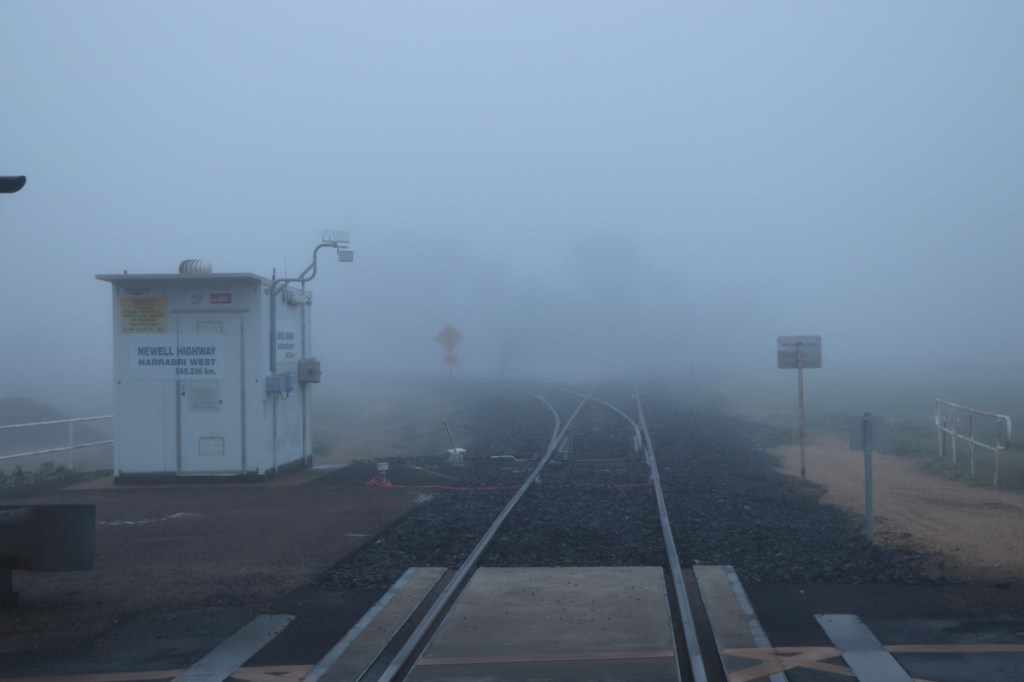
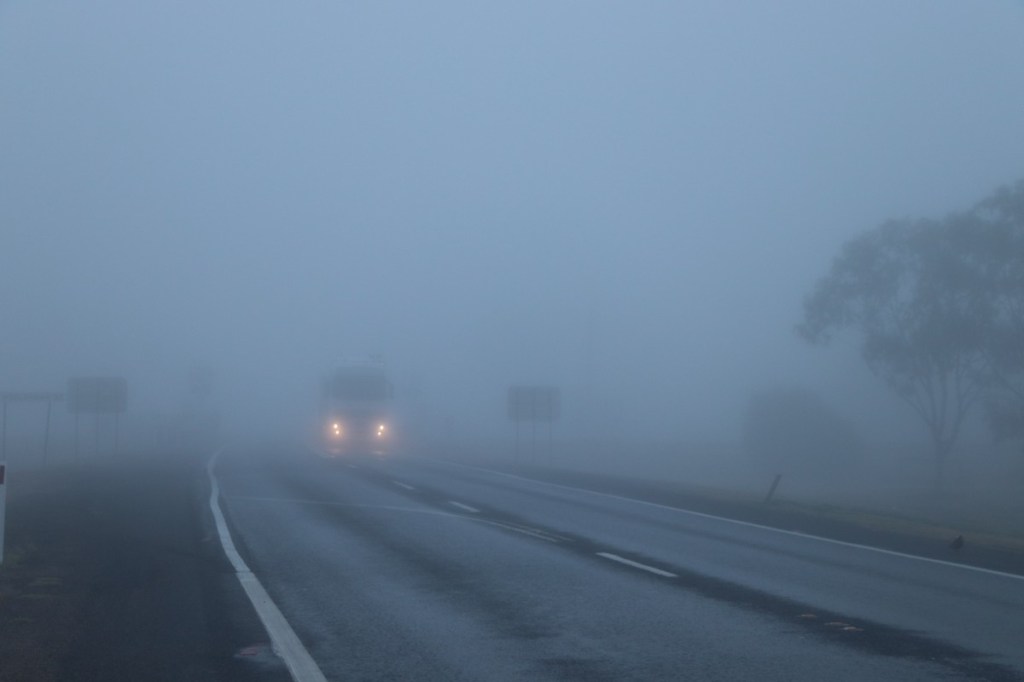
It was a delightfully foggy morning in Narrabri today. Fog is always good as it means there is plenty of moisture in the air.
The visibility was down to about 50 metres which is about as thick as fog gets around here.
It was a delightfully foggy morning in Narrabri today. Fog is always good as it means there is plenty of moisture in the air.
The visibility was down to about 50 metres which is about as thick as fog gets around here.





Here is my commentary on Ephesians 2:16. I am publishing these once or twice a week, but you can read all of the available articles at our web-site, http://www.new-life.org.au
Ephesians 2:16
… and might reconcile us both to God in one body through the cross, thereby bringing the hostility to an end.
Christ has abolished in His flesh the Law so as to create one new man from the Jew and Gentile, making peace by reconciling us to God in one body.
God’s plan is to bring reconciliation of all people to Himself through Christ. This applies to Jews and Gentiles specifically, but to all people more generally.
If we are untied with Christ, then we must be one with each other. There can be no hostility between people who claim allegiance to Christ. That is the theory. The truth is that we are all still in the process of crucifying the old nature, and so we can find ways of developing and expressing hostility to our brothers and sisters in Christ.
If Jews and Gentiles are truly reconciled to God through Christ, the walls of hostility must come down.
It is not clear from the words whether Paul is referring to the physical body of Christ on the cross, or to the church as the body of Christ. Both explanations are possible.
Jews and Gentiles, all the people who are saved, are reconciled to God through the body of Christ crucified on the cross. There is no way to sugar coat this. The cross was horrible and offensive, and people still try to minimise it, but it is the body of Christ that brings people to God. The price is paid for us on the cross. Our sins are forgiven, and we are brought back into relationship with the Father.
The body is also a metaphor for the church, which Paul uses often. In the church we see people of every tongue and tribe worshipping together and fellowshipping together. People with Ph D’s and people who never finished high school, men and women, all can come to the Body of Christ and fond peace with God.
Whichever way we choose to interpret the “one body” it is the cross that is at the centre of it all. Without the cross there is no forgiveness of sins for anyone. Without the cross we are still in darkness and heading for hell. Without the cross there is still the dividing wall of hostility between Jews and Gentiles.
It is the cross that changed things, that changes us.

Scripture
I am not ashamed of the Good News about Christ. It is the power of God at work, saving everyone who believes- the Jews first and also the Gentile.
Observation
Paul thanks God for the believers in Rome, whose faith is being talked about throughout the world.
He prays often for them and for their needs. He especially prays for the opportunity to be able to visit them.
So far, Paul has been prevented from going to Rome, but he longs to go and work among them.
Application
The gospel is God’s mighty power at work, bringing salvation to both Jews and Gentiles.
Paul is clear in his writing that there is no distinction in the way God deals with people. There is not one pathway for Jews and another for Gentiles. We are all saved by faith in Christ.
This is the power of God at work. We are brought from a place of condemnation to a place of reconciliation with God. We know it is true because our hearts yearn for relationship with God.
God came into the world to reveal to us His great love for us. He died to set us free from death and sin.
The preaching of the gospel is powerful to change lives because it is empowered and endorsed by the Holy Spirit. The words of the gospel are brought to life by the confirmation in our hearts by the Holy Spirit.
God’s mighty power breathes life into souls that were dead and washes away all of our sin, guilt and shame.
Prayer
Thank you Father for the power of the gospel. Thank you for sending Jesus into the world to pay for my sins. Amen.
Scripture
The Good News is about his Son. In his earthly life he was born into King David’s family line and he was shown to be the Son of God when he was raised from the dead by the power of the Holy Spirit. He is Jesus Christ our Lord.
Observation
The letter is from Paul, a slave of Christ set apart to proclaim the Good News to the Gentiles. The Good News is about Jesus Christ.
We are called by God to belong to Christ. We are loved by God and called to be His holy people.
Application
The Good News is all about Jesus Christ God’s Son.
Jesus was born into the family line of King David. He is the descendant of David of whom it was promised would reign on the throne for ever.
Jesus is both human- the Son of Man- and the divine Son of God. While He is forever part of the Trinity, He has also uniquely lived among us ad knows what it is like to be a person.
In that sense, Jesus is like us. He was tempted and tested just as we are. He faced every human weakness and overcame it all.
Finally the people nailed Him to a cross, seeking to remove His sinless perfection from them. His death on the cross became the sacrifice which takes away the sins of the world.
But death could not hold Him down. The resurrection demonstrated to the whole world that Jesus Christ is the Son of God.
Prayer
Thank you Lord for calling me into your kingdom and into the family of believers. Amen.

This is week 3 of my test of “Vibrant.”
Each week I have been adding 10 ml of “Vibrant” to my tank when I do my usual weekly water change.
This week I think the growth of algae and cyanobacter has stabilised. As far as I can see, everything is similar to where it was last Monday.

I would have expected a much bigger growth of cyanobacter and the black “sticky” algae.
It appears that the Vibrant is having an effect.
This is great news for the cotton industry and for wormkind!
From the ABC:
Look closer and you’ll see lines of white, woolly material.
It’s cotton trash, the residue leftover from processing, and it has long been a problem for Australia’s multi-billion-dollar cotton industry.
But as the saying goes, one man’s trash is another’s treasure.
To Adrian Raccanello, cotton residue is the backbone of his burgeoning composting business.
“It’s got a lot of properties,” the former viticulturist said.
“The broader the mix of organic material, the better the end product.”
In the past year, Mr Raccanello has trucked out about 50,000 tonnes of high-grade fertiliser.
Soon he expects to produce 200,000 tonnes annually.
Much of it is going back onto the region’s cotton fields in the form of fine, granular worm castings.
The business began as a bare field in a vast paddock adjacent to the Rivcott Cotton Gin at Carrathool, in southern New South Wales, in 2010.
The aim was to find a way to turn thousands of tonnes of cotton residue into fertiliser.
The secret was getting the right mix, one that could maximise a natural asset: earthworms.
So Mr Raccanello won some contracts to process domestic organic waste from regional towns, such as Mildura and Wagga Wagga.
He blended the waste with cotton trash and carefully tended his rows of waste material to ensure optimal conditions for worms.
He soon found the perfect recipe, and so was born a unique compost product that will soon be available to the retail market as well.
“We basically just feed the top 4 to 6 inches [10 to 15 centimetres],” Mr Raccanello said.
“Then the worms work their way through it and just break it down.
Some cotton gins have their own composting programs in place for cotton residues, but in a good year, there’s simply too much to handle.
Local cotton grower Peter Tuohey is thrilled to see the Carrathool venture succeeding.
“The gin produces thousands of tonnes of the cotton residue and Worm Tech have been able to take that product and convert it into a very, very valuable commodity that we buy off them and spread back out on the land,” Mr Tuohey said.
“So it’s really waste to resource,” added Mr Raccanello.
It’s rather startling what this unseen underground army of worms is capable of chewing through.
Cotton trash is fibrous and left out in the weather, it sets into hard mounds that can take years to decompose, between eight and 10 years in its natural state.
“We’re combining it with other waste to give it diverse ingredients and we’re doing it in about eight weeks,” he said.
His plan to dramatically upscale the business means he’s seeking more organic waste from municipal councils across southern Australia.
“We want to be a receptacle for untapped organic waste,” he said.
Once, people thought he was mad when they saw him alone amongst the cotton trash heaps in the midst of winter. Others simply thought he would fail.
Now those same people are lining up to buy his organic fertiliser.
“I haven’t had to advertise, it’s all been word of mouth,” Mr Raccanello said.
Watch this story on ABC TV’s Landline at 12:30pm on Sunday, or on iview.
Here is my commentary on Ephesians 2:15. I am publishing these once or twice a week, but you can read all of the available articles at our web-site, http://www.new-life.org.au
Ephesians 2:15
“… by abolishing in his flesh the law of commandments and ordinances, that he might create in himself one man in the place of two, so making peace.”
We are used to saying that Christ took our sins on his body on the cross, here Paul is saying something far more radical. Christ took the law with all of its commandments and regulations, and put it to death on the cross.
Jesus dealt with our guilt by destroying the power of the law to condemn us. If there is no law, there can be no transgression and no condemnation.
Every year politicians add more and more laws to our law books. There are so many now, some of them contradictory, so that it is impossible for any person to know all the laws that might apply to them, much less to know if they have broken the laws.
Just in driving a vehicle, the laws have become so many and so varied that most people break the law every day.
Paul says that in respect to the Jewish law, the law of God, Christ abolished the law in his flesh.
What freedom this brings to us, knowing that we are no longer bound by laws of sacrifice and diet. When we break those laws we are no longer under judgement because the laws are no longer in existence. Christ abolished them.
The early church had to wrestle with the question of whether the Gentiles who became Christians first had to become Jews. Did the uncircumcised have to belong to” the circumcision” to be acceptable to God? No,the Law had been abolished in Christ.
The result of the abolition of the law was the abolition of the distinction between Jews and Gentiles. If a Jew was the person who obeyed (or tried to obey) God’s law, then where there is no law there is no distinction between the two, other than perhaps cultural differences.
When it comes to salvation, when it comes to God, both Jews and Gentiles are in the same boat. They are “one new man.”
If the law has been abolished by Christ, Jewish people cannot be saved by the Law. Like Gentiles, they can only be saved by grace through faith in Christ. And many have been.
The” one new man” that Paul talks about here is the Christian Jews together with the Gentiles who follow Christ. Whether Jew or non-Jew, it is faith in Jesus that saves us, and it is faith in Jesus that unites us.
By abolishing the law in his flesh, Jesus is made peace between the two factions. There can no longer be any debate, conflict or hostility between the two as we are all brothers and sisters in Christ.
Where there is family, there is peace
The calls were out this week saying that koalas will be extinct in New South Wales in 30 years. But they didn’t mention that Koalas thrive and multiply so fast that in the right conditions scientists talk of ‘plagues’. On Kangaroo Island last year, there were so many koalas, the South Australian government has been trying to sterilize or relocate thousands of them over the last twenty years. Periodically scientists even discuss whether we have to cull them (the horror!).
They’ve survived twenty megafires in 200 years. They can recover. Ponder that Koalas were only introduced to Kangaroo Island in the 1930′s but by the 1990′s there were 14,000 of them and even though they are considered a tourism asset they are also considered a problem and pest too.
“Nearly everything you have read or heard about koalas, is wrong” — Viv Jurskis

Koalas favorite snack | Photo by pen_ash
Viv Jurskis is a veteran forester and fire expert who studied them for years. He’s written The Great Koala Scam, Green propaganda, junk science government waste and cruelty.
Jurskis estimates that thanks to European settlers there are more koalas now than there were 250 years ago.
He describes how koalas have been booming and busting for two centuries. Before the first fleet arrived, koalas were so rare that the new settlers didn’t even see one for fifteen years! But after the indigenous cool burns programs stopped, dense forests grew which were choc-full of tender new shoots that koalas love to eat. So koala populations would flourish and boom right up until a fire wiped them out. In other areas farmers cleared land, but the “paddock” trees would get sick and resprout continuously, which also worked out pretty well for koalas. So koalas boomed in the valleys too. Sooner or later a drought would come and the valley koalas would starve and get sick themselves.
Jurskis recommends we use koala rescue funds to start doing better forest management with cool burns so the megafires don’t incinerate the next oversupply of koalas. It’s a man-made cycle of pain and suffering.
You’d think The Guardian and The ABC would be able to give us a more rounded view, especially since they covered the boom stories and the Koala Wars. Here’s the ABC in 2002:
Scientists say the only solution to this crisis is to begin culling Koalas. Against the scientists are people who believe we need to be creating more habitats or the koalas. The Australian Koala Foundation are planting wildlife corridors to link koala habitats. But the scientists say this is just going to feed the problem – wherever the koalas have been introduced they thrive and eventually destroy their habitat.
Last year gave up sterilizing them to stop the plague on Kangaroo Island:
A report from a parliamentary inquiry has recommended the state’s environment minister make an immediate decision to declare koalas, western grey kangaroos, long-nosed fur seals and little corellas overabundant in some areas. The committee heard that sterilisation of the Kangaroo Island koala population had had little success.“Population numbers on the Island continue to rise and their impacts are threatening its biodiversity,” the report says. — The Guardian, 12th July 2019
Read the rest of the article here



 New Life Narrabri