Because Jesus took care of everything at Calvary, I owe Him my trust when things do not look good or according to what I felt was promised to me. Bill Johnson

Because Jesus took care of everything at Calvary, I owe Him my trust when things do not look good or according to what I felt was promised to me. Bill Johnson
This week at Kids’ Cell we remembered the story of Jesus at the Beach (John 21:1-14).
After we heard the story and saw some videos, we went to the house next door, where Tim had a fire ready, and we had some good quality beach food.



Scripture
“A prophet is honoured everywhere except in his home town and among his own people.”
Observation
Jesus tells more parables. The parables of the buried treasure and the precious pearl show us that the kingdom of heaven is worth giving up everything in this life for.
The parable of the fishing net teaches us that there will be a great judgement at the end of the age.
Jesus then goes to his home town of Nazareth. People there refuse to accept Him. They refuse to believe in Him, so He can only do a few miracles.
Application
Jesus was respected as a teacher and miracle worker everywhere except in Nazareth. There, for some reason, they decided that the proverb was true that “nothing good comes from Nazareth.” They knew His family, so He couldn’t be anything special.
This quest for novelty goes on today. People are still more impressed by a visiting preacher than by their own pastor, even when they say the same things.
Frustrating as it may be for the local pastors, it it is an unfortunate trait of many people.
We must not fail to honour our leaders who put in years of faithful service. We must not have more faith in the anointing on a visiting preacher than the anointing on a young person who grew up in our church.
If we fail to see the Holy Spirit at work in a person, regardless of where they come from, Jesus will not be able to do many miracles among us.
Prayer
Father, please overcome my prejudices. Help me to see your Spirit working on everyone who seeks to serve you. Amen.
Ann Voskamp writes about work and worship.

He was 22 and I was 21 when we bought the farm. It was April 26th — 25 years ago this week.
When one of the travelling feed salesman pulled into the farmyard that first spring, he rolled down his pick-up truck window, and hollered to the Farmer: “Hey, your dad around?”“How someone sees you doesn’t get to change how you see your dream.”
“I’m sure he is — over at his farm,” the Farmer grinned and it took that sales guy more than a beat or two to realize that the baby-faced boy, not looking a day over 16, was the man of this land, trying to make a go of this dirt on his own. How someone sees you doesn’t get to change how you see your dream.
We worked 18 hours day and scrounged to buy flats of Kraft Dinner when it was on sale and I picked rocks with a baby strapped on my back and on our second wedding anniversary we got out of the barn in time to see the sunset across the fields and I told the Farmer that’s all I’d ever need: If we walked into the barn before sun-up, if, now and then, we could finish up evening chores and walk out of the barn before sun down.
This is the part of the story where the hustlers tell you that this is the dream that hard work built — but this is not that story, because this world doesn’t work like that.
Read the rest here
When I truly believe nothing is impossible for God and nothing is impossible for those who believe, I will respond to that inward conviction of the heart by recognizing I carry solutions for the death, loss, and destruction that plagues humanity. When I find them, I must take the risks necessary to see the situation changed for the glory of God. Bill Johnson
God made him who had no sin to be sin for us, so that in him we might become the righteousness of God. 2 Corinthians 5:21 NIV https://2corinthians.bible/2-corinthians-5-21


Scripture
“The kingdom of heaven is like a mustard seed planted in a field.” It is the smallest of all seeds, but it becomes the largest of garden plants; it grows into a tree and birds come and nest in its branches.”
Observation
Jesus tells two more parables- the parables of the mustard seed and the yeast. The kingdom starts off small, but becomes something big and visibly significant.
Jesus always used stories and parables to explain the hidden things.
The disciples ask Jesus to explain the parable of the weeds in the field, which He does. Jesus explains that it is a parable about the judgement of the wicked.
Application
The kingdom of God is like a mustard seed. It seems to be tiny and insignificant. Over time, it grows into something great.
Despite what our secular media would have us believe, christianity is growing around the world at a phenomenal rate. Over a quarter of the world’s population claims to be christian. In some places, notably China, the church is growing so quickly that it is becoming a threat to the power of the ruling Government.
When the N.S.W. Government was easing Covid restrictions, the churches were at first ignored. Within hours, after much prayer and lobbying, churches were allowed to reopen along with pubs and restaurants.
People overlook God’s kingdom because they think it just doesn’t matter, or sometimes because they hate God and His people.
Jesus tells us that the Kingdom grows so big that the birds of the air come and nest in it. From the previous parable about the seeds and the soil, we may assume that the birds represent the devil. People who are not saved, even people who are followers of satan not Jesus, will infiltrate the church. We must always be on the look out for these wolves in sheep’s clothing.
Prayer
Thank you Father for the Kingdom. May I see your church as it really is- in all its glory as well as its limitations. Amen/
Great article at faithgateway.com about addiction and how our brains rewire themselves.

Michael John Cusick2 days ago
Like sand on a beach, the brain bears the footprints of the decisions we have made, the skills we have learned
—Sharon Begley, Newsweek Science Editor1
Restart and reboot yourself. You’re free to go.
—U2, “Unknown Caller”2
“I know it’s not really true,” said Manny, “but it seems as if my brain has been conditioned by porn. I’ve tried everything and nothing helps.”
“Why do you say it’s not really true?” I asked.
“It’s like saying, ‘It’s not really my fault,’” he answered. “I can’t blame anyone or anything else for my problem. I’m supposed to trust God, right?”
“What if your brain really is conditioned to need porn?” I asked. “And what if acknowledging that meant that you were actually exercising faith?”
“Well, that would be pretty cool,” he said, chuckling. “I wouldn’t feel like such an absolute loser.”
My conversation with Manny is not unlike talks I’ve had with many men who have sincerely pursued recovering from porn addiction but who have not yet realized that porn physically changes the brain. Without understanding porn’s impact on the brain, too many men either quit trying to change or carry unnecessary guilt and shame when their spiritual zeal and willpower aren’t enough.
Any discussion about compulsive use of pornography is incomplete without understanding these physical changes. God created human beings in physical bodies, and David wrote of his own creation in the womb that he was “fearfully and wonderfully made” (Psalms 139:14). So are we. Defining ourselves and our problems in only spiritual terms not only is unbiblical but also hinders our recovery.
In the last decade, the field of neuroscience has exploded our understanding of the human brain. Recent discoveries have profound implications on treating various addictions and psychological disorders, and pursuing physical and emotional well-being. The consistent theme is that contrary to conventional wisdom, our brains are highly changeable.
When you fly on a major airline, your journey begins with a preflight announcement, which includes a review of the emergency procedure card in the back pocket in the seat in front of you. That card gives you important instructions about how to escape to safety in the event of emergency. You aren’t asked to master the finer details of airplane safety; you’re given basic instructions that could save your life if something goes wrong. My goal in this chapter is to give you the back-pocket version of how porn affects your brain, and how you can use this information to break free from porn’s grip on your brain.
Back in the day, a popular public service announcement on television touted the dangers of drug use. “This is drugs,” a man began, as the screen showed a sizzling skillet. “This is your brain on drugs,” the voice-over continued, as an egg is cracked into the hot skillet and is instantly fried. “Any questions?” the PSA concludes.3 Its meaning is clear. Behavioral addictions, like porn, affect the brain just like drugs—in all major respects.4
*
One of the most profound discoveries in understanding the brain involves the concept of neuroplasticity. This is the idea that our brain changes as the result of experience. Porn changes the brain in an undesirable way. The man who doesn’t watch porn, or is not yet addicted, has yet to develop sensitized “weed-whacked” pathways. But the porn neuropathways of a man whose brain is addicted are weed-whacked and trampled down so that they have become the path of least resistance. But your brain can be changed in a positive and healthy direction. Rewiring your brain allows it to unlearn the addictive patterns and relearn impulse control. This occurs as the addictive “gotta have it” pathways are weakened and the “think about it” pathways are strengthened. Here’s how you can begin rewiring your brain.
What you think about is ultimately what you become. What we once called “the power of positive thinking” is increasingly backed by scientific evidence. The more attention your brain pays to a given input, the stronger and more elaborately it will be wired and retained in the brain.5 When we give our attention and focus to good things, like peace, joy, and self-control, our brains rewire themselves in a way that allows us to experience those good things. Wouldn’t it make sense, then, to be intentional about what we give ourselves to?
With this in mind, consider the words of the apostle Paul: “Finally, brothers and sisters, whatever is true, whatever is noble, whatever is right, whatever is pure, whatever is lovely, whatever is admirable—if anything is excellent or praiseworthy—think about such things” (Philippians 4:8 UPDATED NIV).
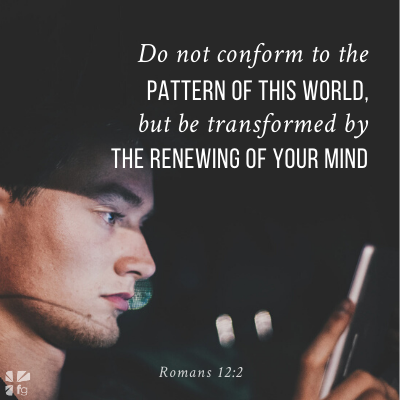
When Scripture exhorts us to set our minds on good things, it concerns more than just the well-being of our souls. It also affects the well-being of our brains. Our neural circuitry forms itself around whatever we give our attention and focus to. That’s why Paul connected our transformation with the renewing of our minds: “Do not conform to the pattern of this world, but be transformed by the renewing of your mind” (Romans 12:2).
In the next chapter I discuss how you can practice focusing on what is pure, lovely, and admirable, in a way that rewires your brain to its original setting before porn—but better.
The famous philosopher, novelist, and poet Johann Wolfgang von Goethe was right. We are shaped and fashioned by what we love. Certainly this applies to our brains. The life focus of a man struggling with porn leads to tunnel vision. When a man views porn on a regular basis, his passions are held captive, and he forfeits the ability to direct his life in the way he would otherwise choose.
Many men realize the importance of pursuing their passions. What is life-giving to your soul? What relationships have been affected by your use of porn? What enjoyable activities have stopped? Of all possible alternative passions, exercise is the most crucial. Studies show that exercise increases dopamine receptors, therefore helping to rewire the brain.6 Another study showed that the number one behavior associated with successful substance abuse recovery was exercise.7 If you have not been physically active in the past with some form of exercise, it’s important that you begin. Don’t assume you have to join a health club or sign up for the Ironman Triathlon. You can walk, hike, or ride a bike. Take the stairs instead of the elevator.
Recent attention has been given to children and adults who suffer from NDD, or nature deficit disorder, as a result of spending too much time online or engaged in electronic media. Avoid this disorder by interacting with the outdoors in the sunshine, fresh air, and natural beauty of God’s creation. Get out and move! Pursuing alternative passions expands your horizons and rewires your brain at the same time.
Studies show that repeated behaviors, over time, cause structural changes in the brain. These changes can be negative—causing compulsion and addiction. Or they can be positive—rewiring the brain so the stimuli of porn and lust are no longer a reflexive reaction. Repetition helps lock behaviors in the brain in the same way an athlete develops muscle memory. Or consider a concert pianist. When performing, he never thinks, Now I will reach my left hand exactly seven inches to the right while simultaneously moving my right hand two inches to the left. Instead, the pianist’s brain has learned to bypass the conscious cognitive step and follow a learned response.
So be encouraged. Your struggle with porn is a learned response, in many ways, just like the skills of a pianist or athlete. Your brain can unlearn, and it can change.8
Excerpted with permission from Surfing for God: Discovering the Divine Desire Beneath Sexual Struggle by Michael John Cusick, copyright Michael John Cusick, 2012.
 New Life Narrabri