Wealth, honour and life
Here is my commentary on Ephesians 5:6. I am publishing these once or twice a week, but you can read all of the available articles at our web-site, http://www.new-life.org.au
Ephesians 5:6
“Let no one deceive you with empty words, for because of these things the wrath of God comes on those who are disobedient.”
Paul wants us to beware of those who seek to deceive with empty words. The wrath of God will be poured out on those who are disobedient and continue to practise the various sins he has previously listed .
Empty words are words that have no substance to them. They are soothing phrases or comforting words, which ignore the reality of sin in the Christian community.
We can be deceived in matters of doctrine or lifestyle by outright lies. There have been many of these in the history of the church, and the church has had to deal with them vigorously. For example, early heresies about the nature of God, and of Jesus Christ were debated at great lengths in the councils of the church before definitive decisions were made.
If a preacher comes along and says that Christ was not truly human, then we know that they are trying to deceive us. If a pastor proclaims that it is acceptable to have two wives or be unfaithful to your spouse, we know that this is deception.
Empty words are different because they are seductive rather than obviously untrue. At times they may be true in general, but the application might be twisted. “ God wants the best for you” is true, but this does not mean He wants you to have the best houses, cars, or clothes.
Some preaching is little more than inspirational speaking in a christian disguise. The so-called “ feel good message” or “ seeker sensitive sermon” is deceptive because it does not address sin, redemption, or fellowship with the Lord.
In contrast to “ empty words” Paul told the Corinthians that he did not come to them with mere words alone but with the preaching of the Cross and with the power of miracles (1 Corinthians 2:1-5).
The danger of fairy floss preaching is that it lulls believers into thinking that they are leading a godly life while continually walking in habitual sin.
The wrath of God will fall on those who are disobedient.
Does this mean that God may judge his children? How can anyone be sure that they are saved?
The original Greek of this verse says “ he wrath of God comes on the children of disobedience.” In other words, there are people who might portray themselves as children of God who are in fact children of disobedience.
When we continue to walk in habitual sin that the Spirit of God and the Word of God have brought to our attention, then it is possible that we are not truly born again. This is not referring to the occasional stumble, but to a whole- hearted embrace of sin that we have carved away from the life of righteousness .
Jesus said that there will be people who worked miracles in His name, prophesied or cast out demons yet he never knew them. (Matthew 7:21-23).
This point is crucial. We live in an age when many people have been raised in church or who have prayed a prayer at a meeting to receive Jesus, but they have never entered a life of surrender to Christ. Consequently, their life is as sinful and rebellious as any non- christian. Our deeds reflect our hearts. A good tree produces good fruit, and a heart surrendered to Christ will produce spiritual fruit.
Those who have not given their hearts to the Lord, in the deepest sense of that phrase, are subject to the wrath or judgement of God. They will not be saved unless they repent and ask God for forgiveness in the name of Jesus and then live entirely for Him.
Do not be deceived by empty words and improper promises. God will not be mocked.
Scripture
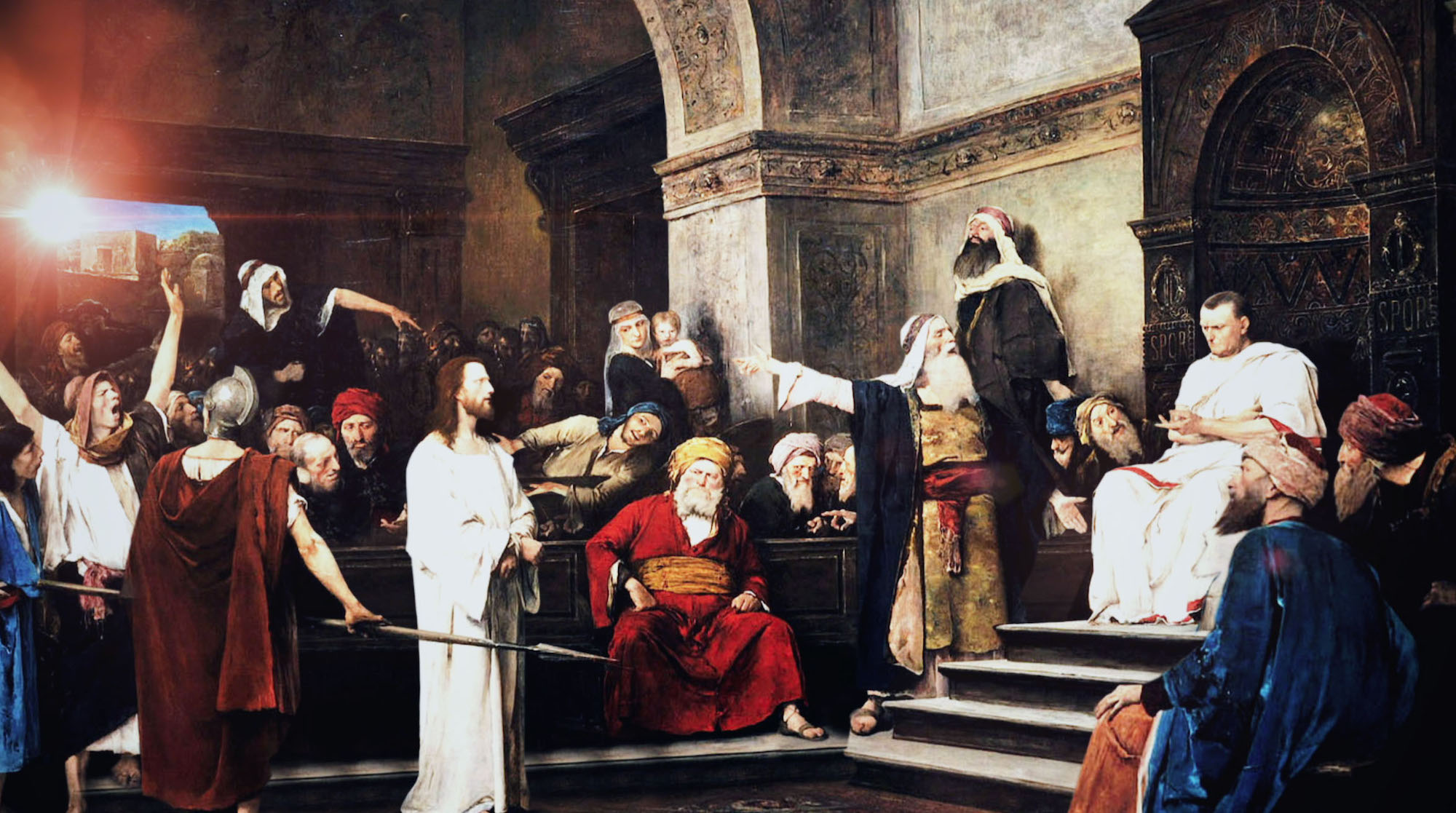
Then they began to spit in Jesus’ face and beat him with their fists. And some slapped him, jeering, “Prophesy to us, you Messiah! Who hit you that time?”
Observation
Judas comes with a mob of men to arrest Jesus. They grab Him, but one of the disciples pulls out a sword and slashes off the ear of the High Priest’s slave.
Jesus says, “Those who use the sword will die by the sword.” He could call up thousands of angels to rescue Him, but then He would not die in order to fulfil the Scriptures.
Jesus is taken to Caiaphas the High Priest. They try to find a reason to have Jesus crucified, but even the false witnesses cannot agree on their lies.
They accuse Jesus of blasphemy and beat Him and spit on him.
Application
How awful it is that people should so seriously abuse the Son of God.
As I read this passage again just now, I am struck by the vile hatred in the hearts of these people. It is as if they are possessed by the devil, and this outpouring of hatred is satan working through them.
It is interesting (and sad) that they, the so-called Holy Men jeer at Jesus. They mock His ability to prophesy, but He knew beforehand who would slap Him.
They jeered at His role as the long- awaited Messiah, the Holy One of God who was to rescue God’s people. When the Messiah is before them, He wasn’t what they wanted or expected.
They mocked him, knowing that there really was something different about this man; something different about the miracles, the healings, the authority with which He taught.
So they spat in the face on the Son of God.
Prayer
Lord, I confess that there are times in my life when, in my sin and unbelief, I spit in your face. Please forgive me for my arrogance and anger towards you. Amen.

So often, people speak about the mountain, the problem, the sickness or disease when Jesus clearly says to us in Matthew 17:20 that we are to speak to the mountain. “Because of your unbelief; for assuredly, I say to you, if you have faith as a mustard seed, you will say to this mountain, ‘Move from here to there,’ and it will move; and nothing will be impossible for you.”
As a healing evangelist people say they want to speak to me about their healing, but what I often find out is that what they really want to discuss with me is about the sickness, the disease, the weakness, or the problem. And as I try to teach them about God’s healing power, and how to activate it in their lives they continue to go back to the disease. This scenario is a prime example of someone that speaks “About”, and “Not to” that mountain.
When we speak “About” the sickness we magnify it with our words. We actually give it more power, more strength inside our bodies. It is like when a man verbally beats down his wife, eventually his daily beating breaks her down, and he reaps what he sows, a sick relationship. The physical body responds the same way. It will become weak and sick as we continue to speak ill words over it. And I doubt that is what we desire.
Our Lord, Jesus Christ teaches us that “If we have faith as a mustard seed, we will say “To” this mountain to ‘Move from here to there’, and it will move.” If this mountain standing in front of you is sickness you will say to it, “Get out of my body in Jesus’ name”. If you believe in the power of the words you speak it will happen.
It all comes down to two things, the first being responsibility, and the second is choice. In Isaiah 53:4-5 he Great Physician, Jesus Christ has already released His healing power for us. But just as it is with the gift of Salvation so too is this great gift of healing that our Lord gave to us by the power of His shed blood.
But [in fact] He has borne our griefs, and He has carried our sorrows and pains; yet we [ignorantly] assumed that He was stricken,
struck down by God and degraded and humiliated [by Him]. But He was wounded for our transgressions, He was crushed for our wickedness [our sin, our injustice, our wrongdoing]; the punishment [required] for our well-being fell on Him, and by His stripes (wounds) we are healed, Isaiah 53:4-5, AMP.
This healing promise must first be believed and then it can be received into our bodies. But it is a choice to believe or not to believe, this is part of our free will. And with free will comes great responsibility. And when we are responsible with God’s promises and choose to believe in God’s promise we reap the blessing of all of His benefits.
Bless the Lord, O my soul; and all that is within me, bless His holy name! Bless the Lord, O my soul, and forget not all His benefits:
Who forgives all your iniquities, Who heals all your diseases, Who redeems your life from destruction, Who crowns you with lovingkindness and tender mercies, Who satisfies your mouth with good things, so that your youth is renewed like the eagle’s, Psalm 103:1-5, NKJV.
God gives to us His promise for healing, and He also tells us what we must do, “Believe”, and then we speak words of faith “To” and “Not about” the disease. And when we follow His instruction His promise comes to pass, and we are healed.
I needed to get out on the bike this morning. The constant covid panic has been building up the stress levels in my body and brain. It wasn’t the best weather for riding, but I had to do it, and now I feel ready to get into the day. 😁

Abiding means staying, waiting, and remaining. It’s a continuous thing. It’s not instant. I’ve learned in my life that abiding in God’s presence will totally transform your relationship with your Saviour, your Bridegroom, and your King, and it will empower you to bring the kingdom with mighty signs and wonders. Carol Arnott


 New Life Narrabri