Freedom
Gary DeMar answers the question: Why hasn’t the Lord come yet?”

That’s the question being asked on the Christian Post website. Here’s the first paragraph:
Many believers are anxious for Jesus’ return and, in the natural, some feel God is postponing His return despite knowing that the scriptures, such as 2 Peter 3, teach that God is not slow, but is patient, not wanting anyone to perish, said Jeff Kinley and Todd Hampson of the “Prophecy Pros Podcast.” Kinley and Hampson emphasized that Jesus hasn’t yet returned because the Lord is giving “humanity a chance to repent before He returns.”
Why keep history going if it’s all about continued repentance? It seems to me that if this is the argument, why didn’t Jesus return to wrap up everything in the first century? That way, fewer people — by the billions — would never have to repent of anything since they never would have been born.
Like so much of Bible prophecy speculation, many who traverse the topic miss the timing factor built into most prophetic texts.
What is going on in 2 Peter 3? Peter, under the inspiration of the Holy Spirit, describes what was taking place before their generation passed away (Matt. 24:34). There were scoffers who were ridiculing the prophecy made by Jesus as recorded in Matthew 24, Mark 13, and Luke 21.
Know this first of all, that in the last days mockers will come with their mocking, following after their own lusts, and saying, “Where is the promise of His coming? For ever since the fathers fell asleep, all continues as it was from the beginning of creation” (2 Peter 3:3–4).
Peter and those to whom he wrote were living in the last days, that is, the last days of the old covenant order that began with Adam and ended with the finished work of Jesus on the cross, His resurrection, and ascension. For a generation a warning went out to the Jews to repent. Those who denied that Jesus was the promised Messiah and placed their faith in the stone temple and its planned obsolescence sacrificial system would be caught in the threatened conflagration because they believed God would rescue them from the war machine of the Romans. The rescue came 40 years earlier, and those who believed did not die when the Roman armies march on the city of Jerusalem and dismantled the temple stone-by-stone.
Some believers were impatient and left the faith as James Jordan’s point out in his comments from his commentary on Matthew 23–25 to be published by American Vision:
Indeed, Peter says that these men would “follow their own lusts,” language similar to “eat and drink with drunkards” in Matthew 24:48. As the epistle of Jude, 2 Peter 2, and the later letters of Paul make clear, some of the Christian teachers and disciples also fell away and began to mock and live wantonly.
The temple was still standing. In fact, it was more glorious than ever with the rebuilding process started by King Herod I (the Great) in 19 BC and completed in AD 63, seven years before it was destroyed as Jesus predicted it would be (Matt. 23:38, 24:1–2). Jesus was its ultimate and lasting incarnation (John 2:13–22).
In 1 Peter 4:7, we read: “The end of all things is at hand.” Whatever “things” Peter had in mind, notice their end was “at hand,” that is, near for him and his readers (James 5:8). Jay Adams writes the following:
In six or seven years from the time of writing, the overthrow of Jerusalem, with all its tragic stories, as foretold in the book of Revelation and in the Olivet Discourse upon which that part is based, would take place. Titus and Vespasian would wipe out the old order once and for all. All those forces that led to the persecution and exile of these Christians in Asia Minor—the temple ceremonies (outdated by Christ’s death), Pharisaism (with its distortion of the O.T. law into a system of works-righteousness) and the political stance of Palestinian Jewry toward Rome—would be erased. The Roman armies would wipe Jewish opposition from the face of the land. Those who survived the holocaust of A.D. 70 would themselves be dispersed around the Mediterranean world. “So,” says Peter, “hold on; the end is near.” The full end of the O.T. order (already made defunct by the cross and the empty tomb) was about to occur.[1]
Peter defines the time parameters of the last days after the people witnessed a series of manifestations of the Holy Spirit and their effect on the disciples: “For these men are not drunk, as you suppose, for it is only the third hour of the day; but this”— the events you saw with your own eyes and heard with your ears—“is what was spoken of through the prophet Joel: ‘And it shall be in the last days,’ God says, ‘That I will pour forth of My Spirit upon all flesh’”[2] (Acts 2:15–17a).
The “last days” were a present reality for the New Testament church made up of Jews who embraced Jesus as the Messiah and believing Gentiles. The gifts of the Spirit were hard evidence that the last days had arrived.
Read the rest of the article here
Your eyes are a gateway to your heart and mind. You must guard them, like King David, who said in Psalm 101:3: “I will set nothing wicked before my eyes.” Terry Law

Scripture
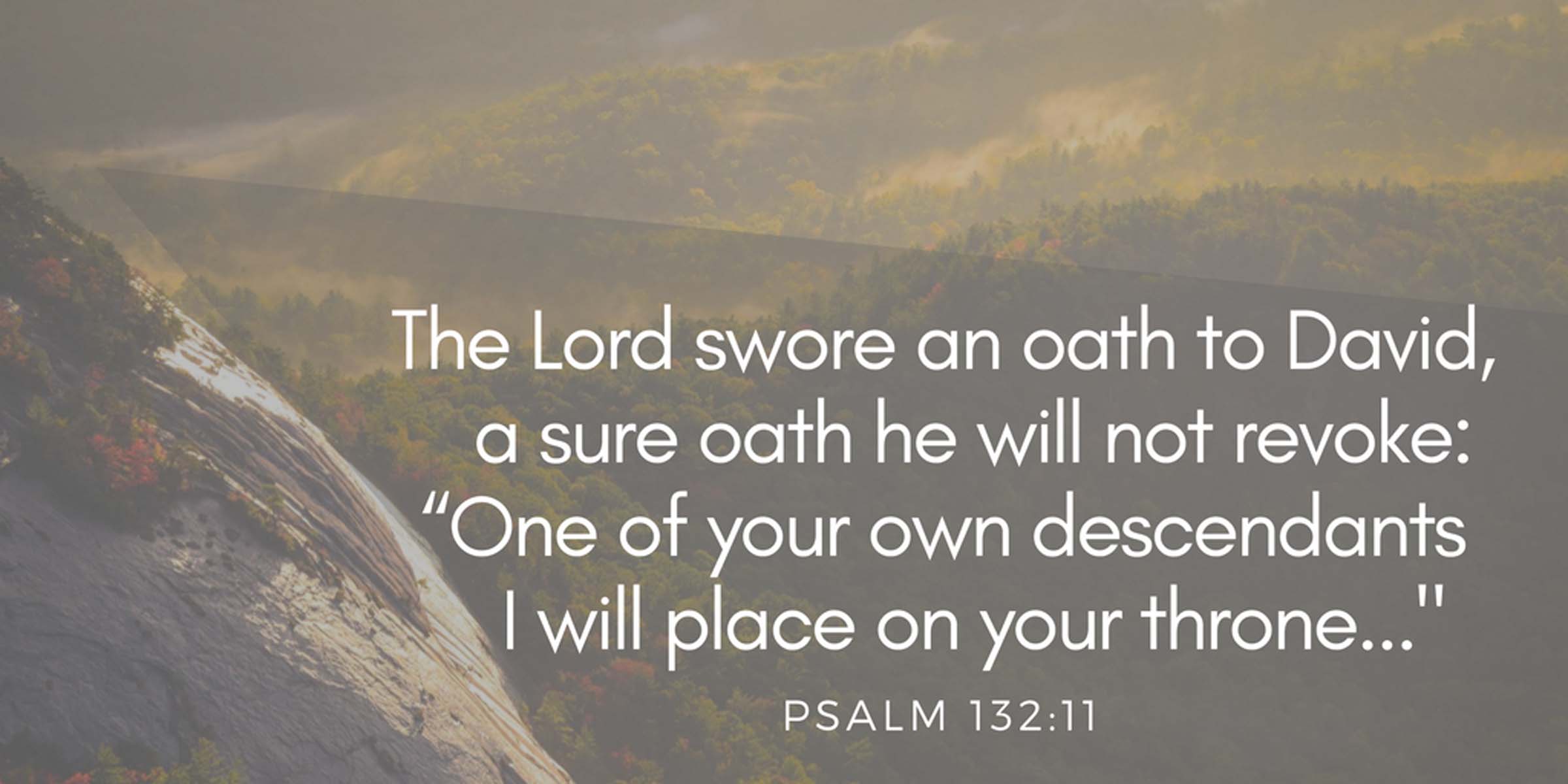
The Lord swore an oath to David
with a promise he will not take back
I will place one of your descendants on your throne
If your descendants obey the terms of my covenant
and the laws I teach them
then your royal line will continue for ever and ever.
Application
What an awesome promise the Lord made to King David!
At first sight it seems to be saying that the Lord promised David an eternal dynasty. We assume in the natural that the promise is for a succession of descendants to sit on the throne for a very long time.
With the eyes of the spirit, we see that this is about Jesus, the one descendant who reigns for ever.
King Jesus will rule over all things, even defeating the last enemy, death itself. Every part of creation will kneel at the feet of Jesus and proclaim “You are the King of Kings!”
Then those who followed Him in this life will go on to live with Him for ever. Those who served their own desires will be condemned to the Lake of Fire.
Eternal life or eternal death.
Loyalty to the eternal king brings life forever.
Prayer
Lord Jesus, you are the everlasting King. I worship you and adore you. Thank you for the promise of eternal life. Amen.

Could it be that we live in two worlds, not just one? Could it be that the “mid-heaven,” the arena of conflict, intersects with earth somewhere between our ears? Terry Law

Here is my commentary on Ephesians 6:17. I am publishing these once or twice a week, but you can read all of the available articles at our web-site, http://www.new-life.org.au
“Take the helmet of salvation, and the sword of the spirit, which is the word of God.”
We are told to take, or receive, the helmet of salvation. The helmet is obviously important to protect the head. A blow to the unprotected head can easily kill or render unconscious a soldier. This form of protection is vital.
salvation, in the sense of our redemption from sin by Christ’s death on the cross, is the first meaning of this phrase. To even get into the battle and to be spiritually alive, we need to first be saved. A person foolish enough to enter the battle without salvation will suffer a fate similar to that of the seven sons of Sceva (Acts 19:13-16).
The helmet of salvation protects our thought life after we are saved. Our thoughts are being constantly filled with ideas from outside. Some of these come from the Holy Spirit. Others come from human sources such as the media, entertainment, philosophy, politics, and so on. Still others come from demons seeking to undermine our determination to fight for the Lord.
When I first came to know Jesus, at the age of 18, I was excited to find out more about my relationship with God. I filled my mind with the Bible and with Christian books. The helmet of salvation protected my thought life from ideas opposed to God’s ways by filling my mind with His Word.
Over time we can tune out the Holy Spirit and allow other thoughts to enter our thinking. These might be thoughts about compromise, doubts, pleasure, or outright temptation to sin. If we allow these thoughts to take root in our mind, then our relationship with God can be destroyed.
To take the helmet of salvation means that we allow the Holy Spirit to direct our thinking. This might take self-discipline on our part as we learn to say “No” to thoughts that originated in the flesh or from demons.
If we allow our thinking to be corrupted by satan, it is every bit as fatal to our spirit as a blow to the head can be to the body. This helmet of salvation is vital.
Along with the helmet of salvation, we need to take up “the sword of the Spirit, which is the word of God.”
This connection between God’s Word and a sword is not unique to this passage. In Hebrews 4:12, we are told that “ the word of God is alive and active, sharper than any two-edged sword.” Revelation 1:16 describes Jesus as holding seven stars “ and from his mouth came a sharp, two-edged sword.”
The word of God is a powerful tool that the Holy Spirit uses to bring discernment and judgement to the heart. Like the helmet of salvation, this sword brings our thinking into alignment with God’s purposes.
The word for “sword” used in Ephesians 6:17 is makaira, a razor sharp sword used in close combat. The sword is an offensive weapon not a defensive implement like a shield or helmet.
We need to remind ourselves that the fight is against powers, principalities, and demons. Too often the Bible has been used as a bludgeon to bash people into acquiescence. We can quote the Word of God to condemn, humiliate, or repel people we do not like.
The proper use of the Word in warfare is against the spirits, that is, in prayer. We pray the promises of God; we command demons to flee on the basis of Scripture; by faith we speak things into being.
When the Bible is used to bring the power of salvation then it is used effectively as the sword of the Spirit. The word of God, properly, passionately, and pastorally preached is a powerful weapon in evangelism.
The phrase “ the word of God” can also be used in regard to spoken words brought through the agency of the Holy Spirit – words of knowledge, wisdom, faith, and prophetic words are amongst these. We should not think that Paul is exclusively thinking of Scripture in this verse. In 1 Corinthians 14, he speaks of how prophecy and tongues should be used in christian gatherings in order to bring the unbeliever to a place of repentance.
 New Life Narrabri