Rode out to Eulah Creek, a lovely rural locality consisting of a hall and a cemetery, this morning.

Rode out to Eulah Creek, a lovely rural locality consisting of a hall and a cemetery, this morning.
So, Jesus grew up in and around a commercially vibrant region, a conduit from the ancient empires of the East to the more modern Mediterranean ports that served as connections to Greece and Rome. Jerry Bowyer
Looking a little unsettled today.
Galilee was quite distinct from Judea. It was under separate political jurisdiction, a fact Pilate tried to use to get rid of the political hot potato of Jesus’s trial. Jerry Bowyer

The last few weeks have brought terrible events in which large numbers of people have lost everything, some even dying.
On February 24th Russia invaded Ukraine, wreaking death and destruction right through the much smaller nation. Then on the 28th, much closer to home, floodwaters rolled through Lismore and many other towns on the NSW North Coast.
Both these events were, in some ways, expected. That doesn’t reduce the shock or the devastation of the destruction that takes place.
In both situations it has been inspiring to see the ways that ordinary people have moved to serve their neighbours in the midst of chaos.
We intuitively believe that our homes are places of safety, and that we are protected there. We derive a lot of security from the belief that our possessions will help us cope with anything life will throw at us.
What happens when it all gets taken from you by force or by nature? Where do you turn for your security then?
In Psalm 27, King David writes: “The Lord is my light and my salvation – so why should I be afraid? The Lord is my fortress, protecting me from danger, so why should I tremble?”
Our response to devastating situations shows where we put our trust.
God doesn’t promise to protect us from floods and fire, but He does promise to go with us through tough times, and give us peace in the middle of chaos.
The recent invasion of Ukraine by Russia has generated a lot of excitement among end times enthusiasts. Could this be the start of the stirring of God and Magog? Could Israel be next on Russia’s agenda?
A lot of the speculation has its roots in the end times hysteria of the 1970’s when the then Soviet Union was incorrectly labelled by the likes of Hal Lindsey (“Late Great Planet Earth”) as the “rush” and the Gog and Magog of Ezekiel 38-39. These chapters describe an attempt to destroy the Jewish people, an attempt that the Lord thwarts and turns back on Gog and Magog.
Some people have argued that there is no historical record of such an event given in Scripture or even in subsequent history. They argue that it must therefore refer to the end times.
So let us take a closer look at where we might find help with understanding these matters.
In Ezekiel 38:2, the Lord says to Ezekiel “Son of man, set your face against Gog of the land of Magog, the chief prince of Meshech and Tubal.”
The Hebrew word rushtranslated in the NIV as “chief” literally means chief or head. Everywhere it appears in the Old Testament it is translated with that meaning.
However, some prophetic writers have taught that it means, in this passage only, “Russia” on the basis of the sounds of the word. They say the passage should be translated as something like “… the prince of Russia, of Meshech and Tubal.”
It is odd that in dozens of uses in Scripture this word means “chief” but at this place, we are meant to see it as a reference to Russia.
In modern Hebrew, the nation of Russia is written not as “rush” but as “russiya”.
To equate “rush” with Russia is the same sort of ignorance which might lead a person to expect the land of Turkey to be the home of the bird of the same name.
Proponents of the Russia theory claim that they are vindicated by Ezekiel 39:2 where Gog is dragged from “the far north”. Look at a map, they say. Where else could it be but Russia?
But if we read the text, it describes Gog as “chief prince of Meshech and Tubal” in both 38:2 and 39:2, not of Russia. These regions were actually to the north of Israel! We might not think of them as “the far north” with our global perspective, but to the Israelites they would have been considered that way.
Ezekiel prophesied from about 593 BC to about 571 BC. Just before this period, in 597 BC, Nebuchadnezzar had captured Jerusalem and taken many of the leaders and skilled workers into captivity in Babylon. In 539, Cyrus of Persia conquered Babylon.
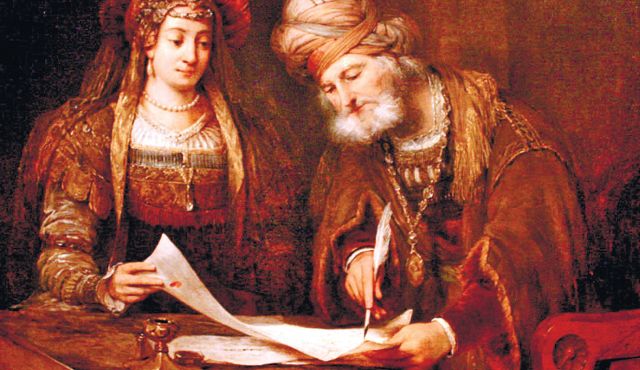
About 50 years later the Book of Esther tells of a plot by Haman to kill all of the Jews throughout the Persian Empire. At that time King Xerxes ruled over 127 provinces stretching from India to Ethiopia (Esther 1:1).
In Esther 3:1, we read, “After these events, King Xerxes honoured Haman son of Hammedatha, the Agagite, elevating him and giving him honour higher than that of all the other nobles.”
As the story of Esther unfolds, Haman tricks Xerxes into issuing a decree that cannot be cancelled. This decree says that on a particular date, every Jew was to be killed and their goods plundered. Esther and her uncle Mordecai persuade Xerxes to issue another edict granting the Jews the right to defend themselves and to kill anyone who attacked them. Haman is hanged on the gallows he had prepared for Mordecai, and Mordecai is promoted to the position previously held by Haman.
Haman is described as an Agagite, that is a descendant of Amalek, one of the most persistent and troublesome of Israel’s enemies. Interestingly, there are ancient manuscripts of the book of Esther where the word “Agagite” is written as “Gogite” because the words are nearly identical when written in Hebrew.
In Ezekiel 39:11 and 15, the place where the army of Gog will be buried is the valley of Hamon-Gog and the nearby city will be called Hamonah. Both these place names come from the same root word as Haman.
When we see that Haman is a “chief prince” who gathers an armed force from across the Persian Empire (virtually the whole of the known world) in order to destroy the people of Israel, the identity of Haman in Esther with Gog in Ezekiel becomes apparent.
People who try to identify prophetic events with current geopolitical upheavals always make the mistake of allowing the newspapers to determine their understanding of the Bible. It should be the other way around: we interpret world events, politics and our own lifestyles through the instructions of the Bible.
At various times the identity of Gog and Magog have been seen as the Goths, the Huns, the Islamic Empire, the Turks, Native Americans and most lately the former USSR and present day Russia. There is a tendency to identify the geopolitical “bad boys”of the current age as Gog.
When Ezekiel was prophesying, he was not talking about the last days of planet Earth. No, he was referring to events that would threaten God’s people in the next generation.
We should be no more impressed by this prophetic fulfilment that occurred within decades of Ezekiel’s death than we would be by some fulfilment two thousand years later. The fact is that God is the Lord of history, and that should give us great hope as we face the uncertain days in front of us.
In order to understand difficult passages such as Ezekiel 38-39, we need to have a solid biblical understanding, allowing the Bible to interpret the Bible.
If you want to read a far more detailed account of this interpretation of Ezekiel 38-39, I recommend Gary Demar’s book “Why The End Of the World Is Not In Your Future” available from americanvision.org

Scripture
“Do you think those Galileans were worse sinners than all the other people from Galilee?” Jesus asked. “Is that why they suffered? Not at all! you will perish, too, unless you repent of your sins and turn to God.”
Observation
Jesus is informed that some Galileans were murdered by Pilate in the Temple. He asks if they think these particular people were worse sinners than others. He tells them they too will perish unless they repent of their sins.
Similarly, the people who perished when a tower fell on them in Jerusalem were no worse sinners than anyone else.
Jesus then tells a parable about a man who planted a fig tree in his garden. He was disappointed by its lack of fruitfulness. Finally, he tells his gardener to cut the tree down. The gardener asks the owner to give the tree another chance; he will take special care and fertilise it, and it should do better the next year – if not, they can cut it down then.
Application
A common response to feeling convicted about sin is to compare ourselves to other people. We might think we are not as bad as that person. If someone is struck down by tragedy, we might wonder if they did something to deserve it.
Jesus rightly draws our attention to ourselves. We need to repent of our own sins and turn to God rather than wondering about the sins of others. Yes, other people do bad things too, but that does not make us righteous.
God is not slow to punish sinners. The parable of the barren fig tree shows that He is always wanting to give us another chance to repent.
But the time will come when the last chances run out, and we have to give an account to God for our sins.
Prayer
Thank you Lord for your loving kindness. You always show grace to those who turn to you. Thank you. Amen.
Another perfect morning in Narrabri!

But God had not forgotten them. In other words, God was consciously taking into account the history of regional differences between the northern and southern kingdoms in His plans for the life of Jesus. The difference was, among other things, the difference between the makers of wealth and the takers of it. Jerry Bowyer

Scripture
The temptations in your life and no different from what others experience. And God is faithful. He will not allow the temptation to be more than you can stand. When you are tempted, he will show you a way out so that you can endure.
Observation
The ancestors who went through the wilderness were guided by a cloud moving ahead of them. They were baptised in the sea and in the cloud. A rock followed them, providing water in the dry places.
The history in the wilderness is given as a warning to us in the end times. They celebrated by indulging in pagan revelry and 23,000 died in one day. They put God to the test and died of snake bites. They grumbled against God and were destroyed by an angel of death.
The temptations we face are no different to what others experience. God is faithful. He will not allow us to be tempted beyond what we can stand. He will show us a way out so we can endure.
Application
We often think that our temptations are unusually strong, and that is why we fail. We live in a society that is obsessed with sex, possessions, and pride. These things are all around us and make it hard to stay faithful to Christ. But many societies have shared the same obsessions and perversions.
C.S. Lewis reminds us that temptation only seems strong when we give in to it. When we resist and overcome it, we realise how ludicrously weak it is.
Temptation only has the power over us that we yield to it.
Even in our greatest struggles, God is with us. The Holy Spirit provides a way to stand and and endure. We have the Holy Spirit in us, and so we have direct access to the Holy One who makes us holy.
Prayer
Lord, I confess to you my weakness in withstanding temptation. I give in far too quickly. Please help me to stand firm in you. Amen.
 New Life Narrabri