Another beautiful spring morning.
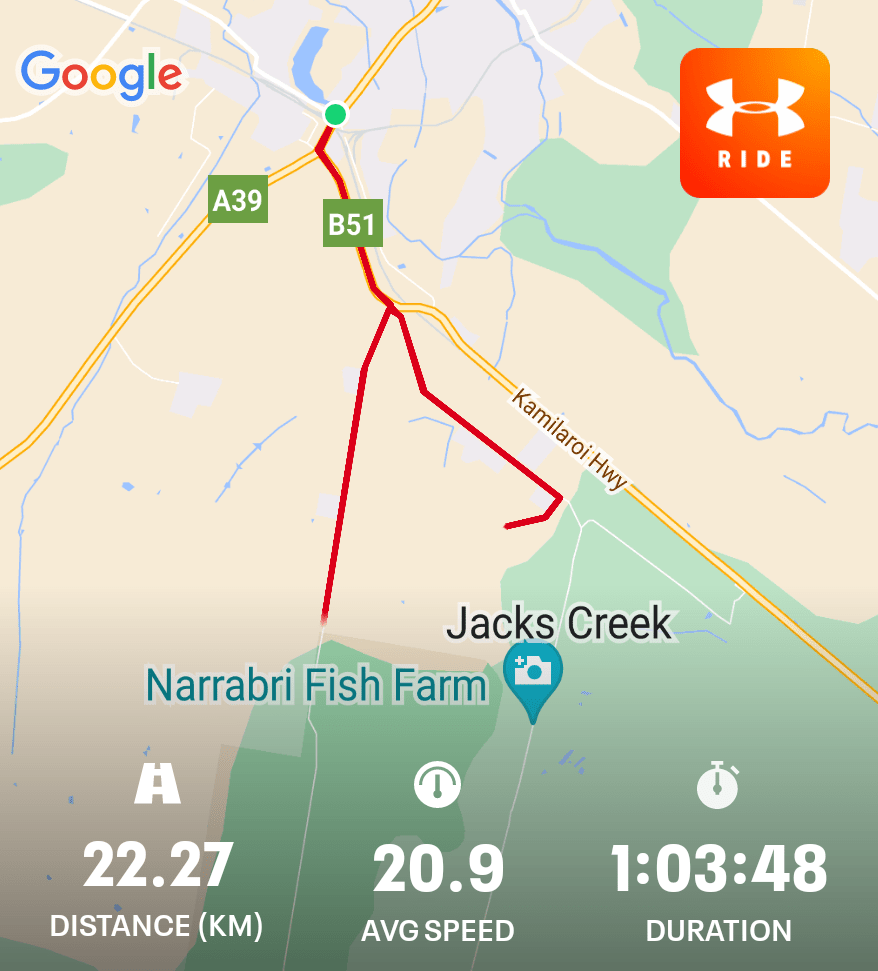
Another beautiful spring morning.
To imagine the early history of Christianity, we would do much better to use the standard map of the world that was regularly offered in medieval times. In these older pictures, the then-known continents of Europe, Africa, and Asia all appeared as more or less equal lobes conjoined at a central location, which was Palestine, with Jerusalem at its center. This image made splendid theological sense, in that Jesus’s sacrificial self-giving occurred at the very center of the world that he was saving.

Eulah Creek is looking amazing at the moment! Often it is dry or just a little dribble.
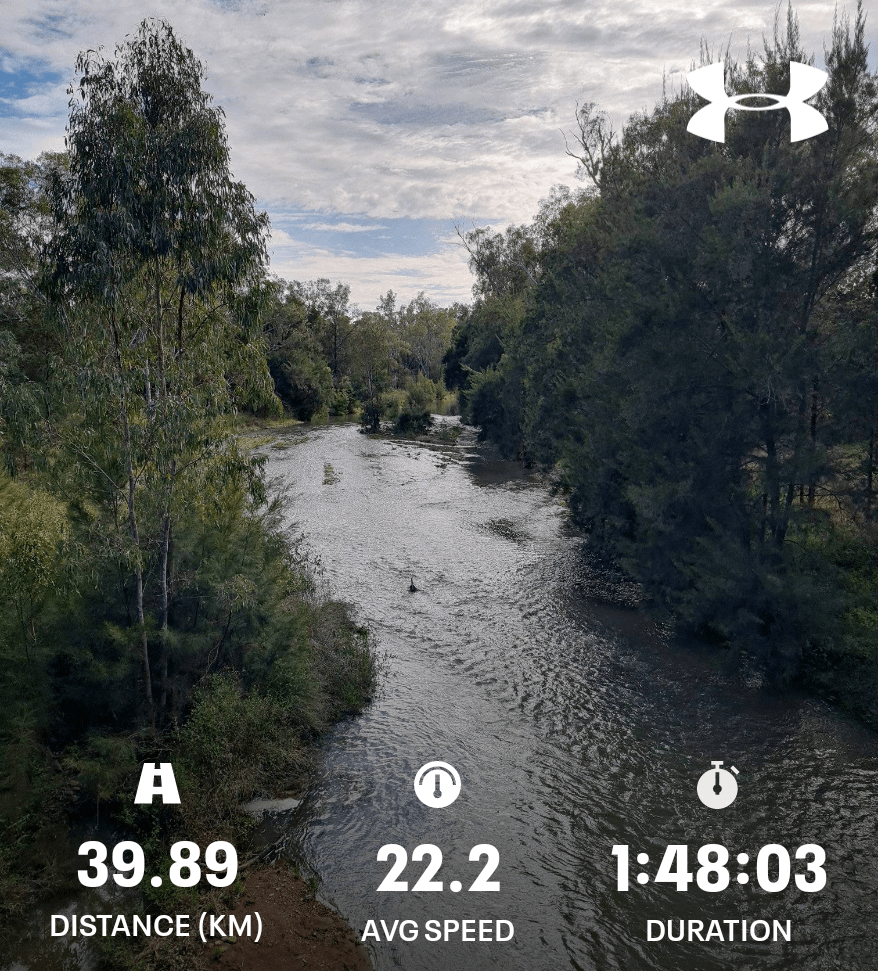
Jo Nova reports the astounding find of corals way above current sea levels. Maybe we could restore those coal fired power stations, burn some fossil fuels and restore the reef.
The remnants of a long gone coral reef are not in the water here, but on top of the cliff. This is what real climate change looks like:
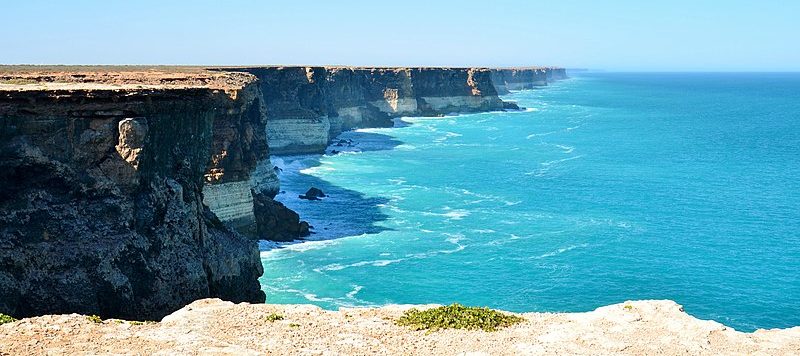
The whole coral reef is now 100 m out of the water | Bahnfrend |
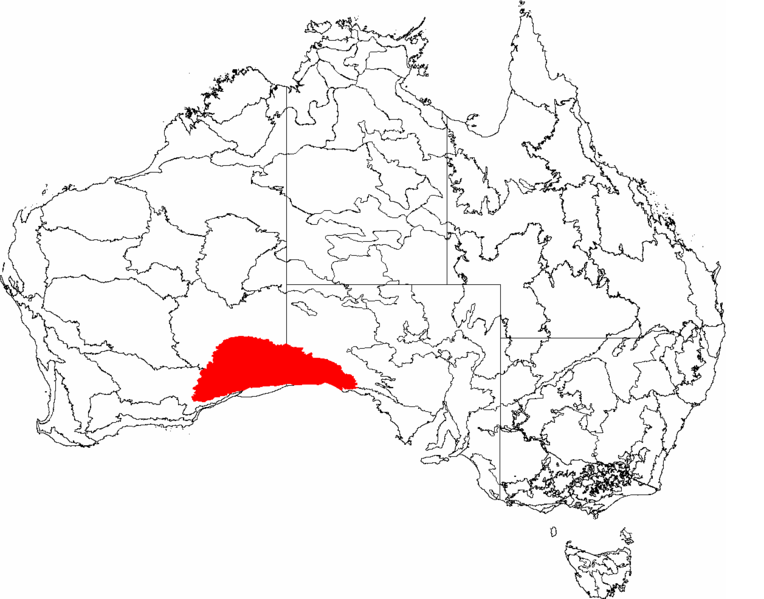
The Nullabor Plain.
It turns out the high plateau desert called the Nullarbor was once a coral reef. It’s a thousand kilometer stretch without a tree that’s now about 100m above sea level. Obviously it’s a wilderness that’s begging to be restored to its true Miocene glory. The question is whether we can put on enough solar panels to save this reef, or if we can melt the Antarctic and raise the oceans…
Researchers looking at satellite images spotted a suspicious looking dome and ring (below) . They figured out it was not a meteor crater but probably a former coral atoll. It’s about one kilometer across and corals built this (probably) 14 million years ago. Tectonic shifts lifted the land out of the ocean. If only the polyps had put in a carbon tax?
The Nullarbor is a bit special because the surface is well preserved. There is not a lot of rain, no rivers to speak of, humidity is low, storm surges don’t wash over it and sediments don’t settle on it. Plus the nearest glaciers are in New Zealand.
““So even though it’s exposed, it’s kind of like a land that time forgot … the erosion is so slow, [these features] get preserved for millions and millions of years, kind of capturing a snapshot of how environments were at different times.” —WA Today
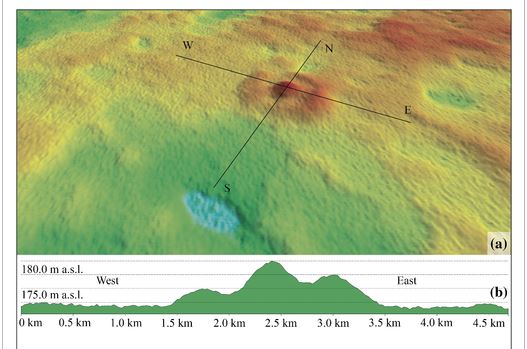
Coral Dome, remnant, Nullabor Australia
Once fish frolicked in the afternoon sun among the anenome here. Now there is saltbush.
This is the kind of climate change we need to teach children at schools. Geological, not Gretalogical.
Imagine the effect if students knew almost nothing was permanent, life was adaptable, and the climate changed all the time.

The remnants of a 14 million year old reef
ScienceAlert:
Most of Australia is now arid and dry, with vast inland deserts. Millions of years ago, though, during the Miocene, the continent was teeming with life; not just dense, thriving forest ecosystems, but huge inland seas.
The ocean that covered the Nullarbor started to dry up around 14 million years ago, exposing the shallow-water limestones deposited during the middle Cenozoic.
That means the Nullarbor is effectively a clean record of geological processes and features dating back to the Miocene.
“Evidence of the channels of long-vanished rivers, as well as sand dune systems imprinted directly into limestone, preserve an archive of ancient landscapes and even a record of the prevailing winds,” Barham says.
“And it is not only landscapes. Isolated cave shafts punctuating the Nullarbor Plain preserve mummified remains of Tasmanian tigers and complete skeletons of long-extinct wonders such as Thylacoleo, the marsupial lion.”
That’s not all. “At the surface,” adds Barham, “due to the relatively stable conditions, the Nullarbor Plain has preserved large quantities of meteorites, allowing us to peer back through time to the origins of our Solar System.”
Lipar et al (2022) Enigmatic annular landform on a Miocene planar karst surface, Nullarbor Plain, Australia, Earth Surface Processes and Landforms. https://doi.org/10.1002/esp.5459
From Daily Declaration:
Daily Declaration by Guest Writer

If we are to rely on e-vehicles to transport our soldiers through warzones, the Australian Defence Force is certainly doomed. Perhaps we should consider an even more environmentally-friendly, natural means of transport.
Last month, amid great fanfare, an electric version of the battle-tested Australian Bushmaster (a concept E-Protected Mobility Vehicle) was launched in Adelaide.
The original, diesel-powered Bushmasters built in Bendigo served in the Afghanistan theatre. So impressive were they that allied combatants including the Netherlands and Britain purchased 120-plus of them.
Currently, 20 Bushmasters are en route to active service with the Ukrainian Army. Other defence force customers of the Bushmasters include New Zealand, Fiji, Japan and Indonesia.
The diesel-powered vehicle has an operational range of 800 kilometres.
So, now, an all-singing all-dancing concept electric prototype is ready for Army trials. It is anticipated that these e-Bushmasters will be silent and not generate the heat signature of a diesel vehicle.
According to your ABC News of August 11, it is anticipated that the e-vehicle will have an impressive operational range of 1,000 kilometres.
That is not yet the case, according to the Defence Department’s release of August 19, which says: “The first version has about a 100-kilometre range, but a planned larger battery should increase this to 350 kilometres. There’s also work to mount small external generators, increasing the range to about 1,000 kilometres.”
A small detail missed in the media hype was that the e-vehicle could not drive to the Adelaide launch. This was confirmed by the Minister’s office, which said the e-vehicle was transported from Newcastle (NSW) on the back of a motorised vehicle.
The e-vehicle is a child sired by the Army’s “Power and Energy Paper” of March 2020.
The lithium battery utilised in the e-vehicle features high-speed recharging; about three hours at an EV station; or, if the crew pull up outside a farmhouse and use the household plug, about seven hours.
An inconvenient feature of the large lithium battery is that if a bullet or shrapnel pierces its casing, the crew will probably be roasted alive. If it should happen in dense scrub, there is the possibility of a bushfire.
A convoy of E-Bushmasters rolling at 100 kilometres per hour from Melbourne to Sydney (870 km) would, with nine stops at EV points, take 36 hours (1½ days) to arrive; while the same 870-km trek in outback South Australia, Queensland, Western Australia or the Northern Territory stopping at farms to recharge would take 72 hours (three days). Diesel-powered Bushmasters can cover the same distance – with driver breaks every two hours – in about 11 hours (half a day).
But do not despair; Assistant Minister for Defence Matt Thistlethwaite said the electric Bushmaster is part of building a “future ready” Army.
Standard Operating Procedure for an army field-force convoy movement is to place the slowest vehicles in the lead. A worry for any convoy commander if he was moving a mixed convoy of motorised and e-vehicles would be the requirement to halt every 100 kilometres to recharge the electric units.
Moreover, not all e-vehicles would stop at the same location because some might “run out of puff” after 90 kms, others at 95 kms, or 98 kms, well short of the recharge point. A convoy with 20 e-vehicles would require a recharge point with 20 EV stations or 20 power points at a farm.
A timely lesson for the Army comes from the Gloucestershire Constabulary, which boasts the largest full electric fleet in Britain, 91 vehicles. Its problem is simple: the force cannot respond to crime because the batteries “keep going flat”.
Police and Crime Commissioner Chris Nelson said officers had experienced problems finding recharging facilities in the county as the e-vehicles “run out of puff”, and staff needed to change police cars.
Police Scotland invested £20 million ($A34 million) providing 23 stations with e-vehicles but no EV charging points. When their vehicles were plugged into the station’s regular power point, the latter blew up. Now the e-vehicles are left at council car parks overnight with officers reverting to combustion-powered vehicles.
The e-Bushmasters engaged in a limited conflict in the remote outback or even in rural areas and “running out of puff” would certainly meet the Army’s “silent” criterion.
While it is easy to criticise a work in progress, any correspondent worth his salt should provide an interim workable solution that will work until the Army’s R&D e-vehicles are perfected before we face an invasion or shortage of liquid fuels.
Luckily, there is a solution to this self-defeating “carbon-constrained economy” nonsense: the camel.
Australia has (perhaps) a million feral camels roaming the Outback. Australian soldiers rode camels into battle during World War I in the Mesopotamia campaigns. Camel trains were used in remote Australia as each animal could carry 100 kilograms of stores, or be harnessed in teams to haul wagons.
In a military emergency, camel teams could haul “out-of-puff” e-vehicles to the nearest power point. A good camel will travel at five km/h; so, she’ll be right, no urgency; the troops can wait.
The Army’s use of camels would be an innovative carbon-reduction “work in progress” of Labor’s Climate Change Bill, now before the Senate, and would easily impress the UN’s climate barons and other assorted global-warming alarmists.
___
By Tony O’Brien.
Originally published at News Weekly.
Photo: Assistant Defence Minister Matt Thistlethwaite inspects the electric-powered Bushmaster armoured vehicle.
Even at the height of the missionary endeavour , non-Western converts very soon absorbed and adapted the religion according to their own cultural needs. Philip Jenkins
A beautiful morning after a couple of rainy days. It was a great ride if you overlook being whacked on the head multiple times by several magpies.

While the laws of individual nations lasted only as long as the nations themselves, Christendom offered a higher set of standards and mores, which alone could claim to be universal. Philip Jenkins

Scripture
Dear friends, even though we are talking this way, we really don’t believe that it applies to you. We are confident that you are meant for better things, things that come with salvation.
Observation
Ground that soaks up the rain and bears a good crop for the farmer has God’s blessing. But if a field is useless, the farmer will burn it.
Even though the author is talking like this, he says that he doesn’t believe it applies to them. They are meant for better things, to walk in the fullness of salvation.
His great desire is that they continue to care for other believers. They will be following the example of those who inherit God’s promises.
Application
Sometimes Christian leaders can seem harsh and unloving to their followers. The leaders themselves can be discouraged because their people seem so far behind where they should be.
This is because many leaders have high ideals for their churches. They love God passionately and have such a close relationship with the Lord, and they want everyone to be in the same place they are so that they can have the same joy.
I sometimes am tempted to feel that way about my congregation. I fell let down sometimes by people who don’t live up to my expectations.
But then I think seriously about them, and I see people who love the Lord as passionately as I do, who use their gifts to bless other people, who share the gospel with unbelieving friends, and who give generously to the church and to missions.
Like the writer to the Hebrews, I have to say, ” I don’t really believe that this applies to you.” Of course, we all have room for improvement, but that is the Holy Spirit’s job, not the pastor’s.
Prayer
Thank you Father for the privileges of salvation and of serving you. Thank you for my brothers and sisters you share the journey with me. Amen.

 New Life Narrabri
.jpg)