Carp are a terrible plague in Australian waterways. There is a control measure being considered, but is now the right time to introduce it?
From National Geographic:
Is it time to unleash carp herpes?
By Ivor Stuart, Charles Sturt University; John Koehn, Charles Sturt University; Katie Doyle, Charles Sturt University, and Lee Baumgartner, Charles Sturt University•January 30, 2023
A school of common carp (Cyprinus carpio).Image credit: shutterstock
Exploding carp numbers are ‘like a house of horrors’ for our rivers.
With widespread La Niña flooding in the Murray-Darling Basin, common carp (Cyprinus carpio) populations are having a boom year.Videosof writhing masses of both adult and young fish illustrate that all is not well in our rivers. Carp now account for up to90%of live fish mass in some rivers.
Concerned communities are wondering whether it is, at last, time for Australia tounleash the carp herpes virusto control populations – but the conversation among scientists, conservationists, communities and government bodies is only just beginning.
Globally, the carp virus has been detected inmore than 30 countriesbut never in Australia. There arevalid concernsto any future Australian release, including cleaning up dead carp, and potential significant reductions of water quality and native fish.
As river scientists and native fish lovers, let’s weigh the benefits of releasing the virus against the risks, set within a context of a greater vision of river recovery.
A house of horrors for rivers
Carp are a pest in Australia. They cause dramatic ecological damage both here and in many countries. Carp werefirst introducedin the 1800s but it was only with “the Boolarra strain” that populations exploded in the basin in the early 1970s.
Assisted by flooding in the 1970s, carp have since invaded92%of all rivers and wetlands in their present geographic range. There have been estimates of up to357 million fishduring flood conditions. This year, this estimate may even be exceeded.
Carp are super-abundant right now because floods give them access to floodplain habitats. There, each large female can spawn millions of eggs and young have high survival rates. While numbers will decline as the floods subside, the number of juveniles presently entering back into rivers will be stupendous and may last years.
The impacts of carp are like a house of horrors for our rivers. They cause massive degradation of aquatic plants, riverbanks and riverbeds when they feed. They alter the habitat critical for small native fish, such as southern pygmy perch. And they can make the bed of many rivers look like the surface of golf balls – denuded and dimpled, devoid of any habitat.
Adult carp usually search for food at the bottom of rivers, stirring up sediment and creating dimples on the riverbed. Image credit: Ivor Stuart, Author provided
Most strikingly, this feeding behaviour contributes to turbid rivers, reducing sunlight penetration and productivity for native plants, fish and broader aquatic communities.
Carp truly are formidable “ecosystem engineers”, which means they directly modify their environment, much likerabbits. Their design leads to aquatic destruction of waterways.
We know when their “impact threshold” exceeds88 kilograms per hectareof adult carp, we see declines in aquatic plant health, water quality, native fish numbers and other aquatic values. At present, we expect carp to far exceed this impact threshold. For river managers, the challenge is to keep numbers below that level.
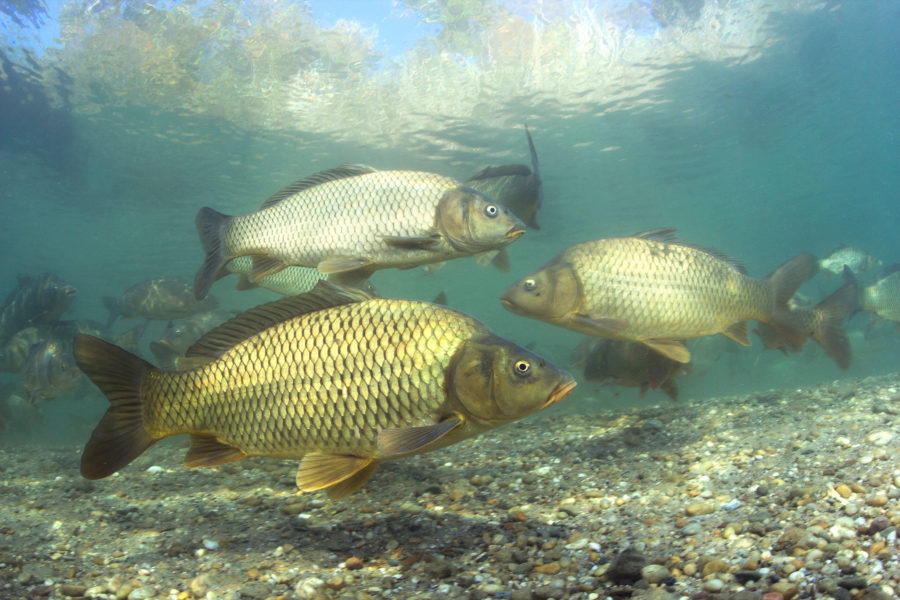 A school of common carp (Cyprinus carpio). Image credit: shutterstockExploding carp numbers are ‘like a house of horrors’ for our rivers.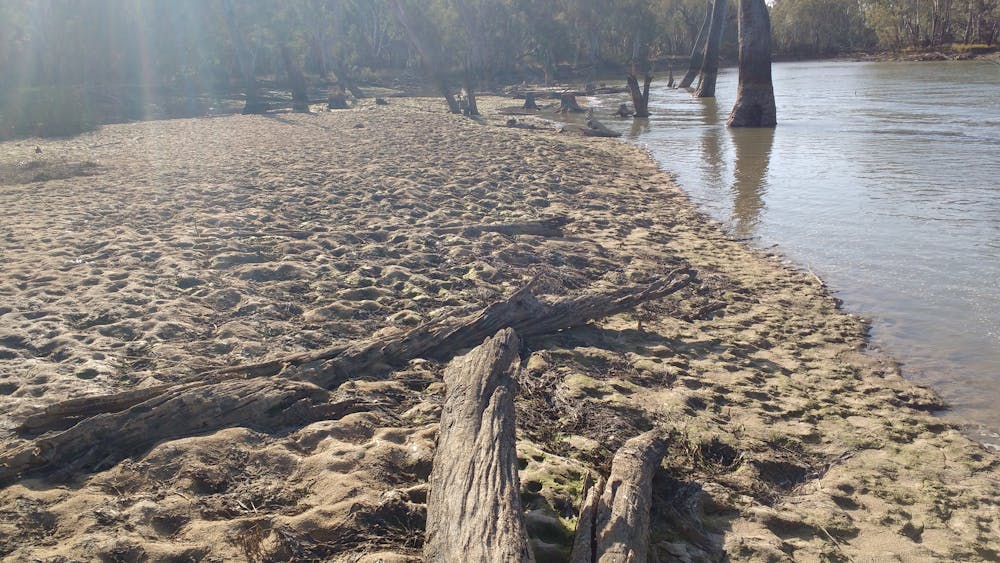
 New Life Narrabri