Reflection on Matthew 15: 1-20

Scripture

” Anything you eat passes through the stomach and then goes into the sewer. But the words you speak are from the heart – that is what defiles you.”

Observation

Some Pharisees and teachers of the law come to Jesus and ask why he violates their traditions regarding hand washing before eating. Jesus turns the question back on them. While the law teaches us to honour our parents, they teach that they can sidestep the law by offering to the priests what they would have given to the parents .

Jesus then tells that it is not what goes into their mouths that makes them unclean, but what comes out of their mouths. What we eat passes through our body, but the words that come from our mouths reveal what is in the heart. and those sinful words and thoughts lead to a catalogue of sin .

Application

The words that we speak reveal what is in our hearts. We can do all kinds of religious activities, but if our hearts remain unclean, then we are not acceptable to God.

There are many people in churches who have not given their hearts to the Lord. There are many pastors who have never surrendered to God.

It doesn’t matter how good you are on the outside, it is the state of your heart that God looks at.

Our words will indicate where our heart is at. In that sense, our words render us unclean before the Lord.

Prayer

Lord, please cleanse my heart from every sinful desire or tendency. I surrender my life to you. Make of me what you desire. Amen.

Quote For The Day

Broadly speaking, miracles are divine interruptions into human affairs. Miracles are beyond our reach, our ability, our effort, our capacity, our strength. They are “beyond human” and beyond our human capacity to reason; thus, they are divine. Tammy Hotsenpiller

Reflection on Matthew 14:22-36

Scripture

Jesus spoke to them at once. “Don’t be afraid”, he said. “Take courage. I am here.”

Observation

Jesus sends the disciples back across the lake in a boat. Jesus goes up to the hills to pray.

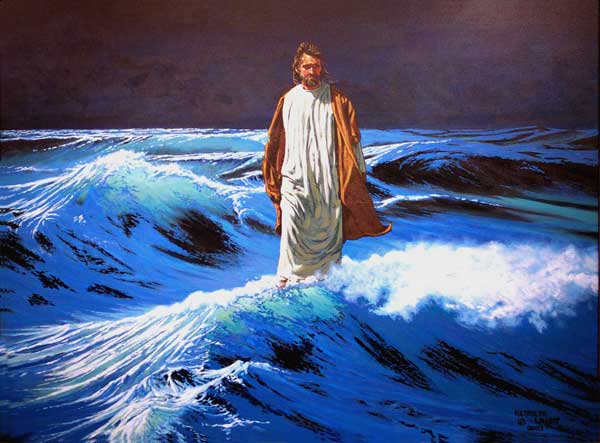
A strong wind arises on the lake, and the disciples are afraid. About 3 o’clock in the morning, they see Jesus walking on the water towards them.

Jesus calls to them to reassure them that He is not a ghost. Peter calls to him,“Lord, if it is really you, tell me to come to you on the water.”

So Peter walks to Jesus on the water. When they get back in the boat, the storm calms.

Application

In the gospels, boats can often be seen as a symbol of the church. Here, the boat is being assaulted from every direction by wind and waves. To get to Jesus, Peter does something brave and unexpected – he leaves the safety of the boat and steps into the storm.

Sometimes, to find Jesus we have to temporarily leave our comfortable safe place, to go in faith to be with Him.

The test that Peter put out is brave. “Lord, if it is really you command me to come and walk on the water.”

Traditionally, we use safe tests of God’s will. But here, Peter lays his life on the line to know Jesus.

Finally, we have the words of Jesus: “Take courage. I am here.”

Whenever we are afraid or feeling under great pressure, we need to listen to Jesus. Peace comes from hearing the voice of the Lord.

Prayer

Thank you Lord that you meet us in stormy places, in scary places. Please help me to look to you, my Lord and Saviour. Amen.

Reflection on Matthew 14: 13-21

Scripture

Jesus took the five loaves and two fish, looked up towards heaven, and blessed them. Then, breaking the loaves into pieces, he gave the bread to the disciples, who distributed it to the people.

Observation

When Jesus hears the news about John the Baptist’s death, he crosses the lake in a boat to be alone. But a huge crowd follows him on foot. Jesus is full of compassion so he heals their sick.

The disciples become concerned about feeding the people. They tell Jesus to send them away so they can buy food. But Jesus tells the disciples to feed the people.

Jesus takes five loaves and two fish; He blesses them and breaks them before passing them to the disciples to distribute.

Everyone has enough to eat and there is far more left over than they started with.

Application

I am fascinated by this story of God’s provision for people. They had just one boy’s lunch, and Jesus gave them enough to eat – 5000 men plus women and children- and an abundance of leftovers.

In my experience, God is not stingy in his provision. When we focus on serving Him and obeying His word, He gives us more than enough. I have experienced this for many years. There have been times where we have had just enough, but there have been times when we have had an abundance. Even in the tough times, we always managed to be generous to others and tithe to our oversight We used to say that if you kept the money moving fast enough, you never noticed that there was not enough to go around

God is mighty in provision

Prayer

Thank you Lord for providing not just what I need, but enough to share with others as well. Amen.

Quote for the Day

Praising God with a pure heart means we must let God cleanse our hearts from impure motives and hidden designs. We have to experience the dying to self so that we can live again in Christ in newness of mind and spirit. Merlin Carothers

Book Review: Boards That Make A Difference by John Carver- Third Edition Published 2006 by Jossey-Bass

When I left my denomination to plant an independent church, I was determined to have the minimum of committees and unnecessary unproductive meetings. My previous denomination had a beautiful structure of councils and committees at various levels of authority. Between the meetings of these groups and the communication of the decisions of these groups, there was a lot of work being done that contributes little to the core business of the church which is to make disciples and preach the Good News.

John Carver is an expert in the leadership of non-profit organisations and other community groups. He argues for a model of governance in which the Board (the generic term he uses for the leadership group of an organisation) sets the minimum boundaries for itself which will ensure that the interests of the “owners” are preserved while pursuing their vision. Everything else is delegated to the management via a CEO or equivalent.

Carver argues that most CEO’s will feel empowered by a Board that sets them free to be creative in the way that they pursue the mission of the organisation without having a Board breathing down their neck and second guessing their decisions.

In Carver’s model, which he calls Policy Governance, boards should concern themselves with 4 areas in the life of the organisation:

  1. Ends Policies- that is what the organisation is here for . What is the vision of the organisation? What difference will we make in the world? In broad terms, how do we get there?
  2. Executive Limitations Policies- what is not OK in pursuing our vision? Can the CEO break the law in order to make things happen? Can we run a sweat shop as a fund raiser?
  3. Board- Management Policies- how do the board relate to management and vice versa?
  4. Governance Process Policies- these are decisions about how the board goes about doing its own job.

These policies are written down and can be set out in a page or so of narrative.

In this approach, the Board goes about setting the “big picture” parameters of the organisation instead of getting bogged down in finances, HR policies, and all of the other things that get boards and committees bogged down. Everything else is passed down to management to control.

What I like about this book is that it pursues a minimalist vision for governance that can be adapted to a wide range of different groups. It is almost a universal model for governance. For churches, this fits in with the apostolic model that emphasises the gifting of pastors and other leaders, while allowing for oversight and correction where things go off track.

“Boards That Make A Difference” is well argued and is readable. The topic might seem dry and uninteresting, but to everyone who is involved in leading organisations, it will be inspiring.

Carver has also written a book about how to implement this Policy Governance model, “Reinventing Your Board.” I look forward to getting onto that and thinking about the organisations that I am involved with.