No matter where a Christian is placed, they should faithfully approach their work with an enthusiasm and energy that assume the Lord Jesus is sovereign over every organisation. Within this context, they need to be ready to share their faith gently and respectfully with anyone who asks (1 Pet 3:15). Stephen Judd et al
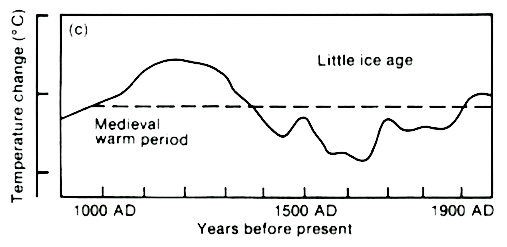
Climate panickers think that if it’s summer, it must be the hottest ever. The Medieval Warm Period was warmer than where we are now, and no nasty coal and oil to blame then.
European heatwaves: Soldiers died in the heat in 1160, Rivers ran dry in 1303, animals fell dead in 1393
By Jo Nova
Medieval “climate change” was filled with heatwaves, droughts, and crop failures
One thousand years ago, “rivers ran dry under the protracted heat, the fish were left dry in heaps and putrefied in a few hours.” Men and animals venturing in the sun in the summer of 1022 fell down dying.”
It was so hot in 1132 that the rivers ran dry and “the ground was baked to the hardness of stone”. Around 1200 at the Battle of Bela “there were more victims made by the sun than by weapons”. In 1303 and 1304, the Seine, the Loire, the Rhine, and the Danube could all be crossed with dry feet, and they dried up again in 1538-1541. In 1393 and 1394 the crops were “scorched up” and “great numbers of animals fell dead”. In 1625 in Scotland, it was so hot “meat could be cooked merely by exposing it to the Sun.”
And so it goes — history that was known in the 1800’s appears to be disappearing, leaving us with a generation of snowflakes who think they are the only humans who ever faced hot weather. They with their airconditioned bedrooms, mobile phones and filtered water.
In 879, agricultural laborers, who must have been as tough as nails, were struck down after “just a few minutes in the sun”.
They’ve been rubbing out the Medieval Warm Period ever since. Even though Hubert Lamb did the graph in 1982, scores of different proxies have gone on to support it on every continent. References at the link above plus at the tag Medieval Warm Period.
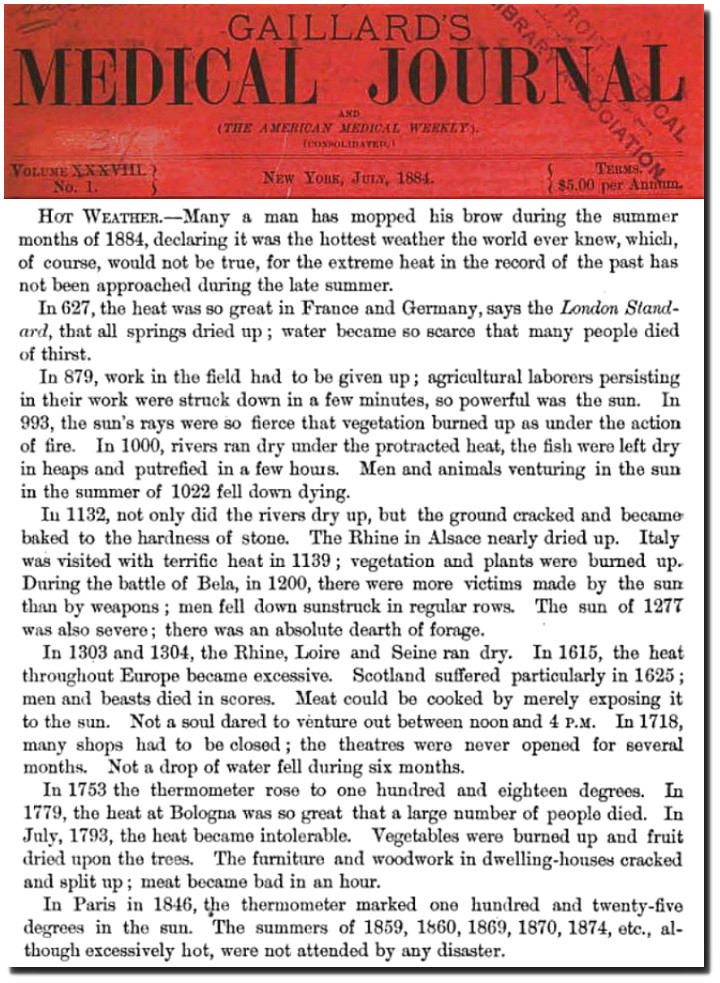
“Hot Weather.—Many a man has mopped his brow during the summer months of 1884, declaring it was the hottest weather the world ever knew, which, of course, would not be true, for the extreme heat in the record of the past has not been approached during the late summer.
In 627, the heat was so great in France and Germany, says the London Standard, that all springs dried up; water became so scarce that many people died of thirst.
In 879, work in the field had to be given up; agricultural laborers persisting in their work were struck down in a few minutes, so powerful was the sun. In 993, the sun’s rays were so fierce that vegetation burned up as under the action of fire. In 1000, rivers ran dry under the protracted heat, the fish were left dry in heaps and putrefied in a few hours. Men and animals venturing in the sun in the summer of 1022 fell down dying.
In 1132, not only did the rivers dry up, but the ground cracked and became baked to the hardness of stone. The Rhine in Alsace nearly dried up. Italy was visited with terrific heat in 1189; vegetation and plants were burned up. During the battle of Bela, in 1200, there were more victims made by the sun than by weapons ; men fell down sunstruck in regular rows. The sun of 1277 was also severe; there was an absolute dearth of forage.
In 1303 and 1304, the Rhine, Loire and Seine ran dry. In 1615, the heat throughout Europe became excessive. Scotland suffered particularly in 1625 ; men and beasts died in scores. Meat could be cooked by merely exposing it to the sun. Not a soul dared to venture out between noon and 4 p.m. In 1718, many shops had to be closed; the theatres were never opened for several months. Not a drop of water fell during six months.
In 1753 the thermometer rose to one hundred and eighteen degrees. In 1779, the heat at Bologna was so great that a large number of people died. In July, 1793, the heat became intolerable. Vegetables were burned up and fruit dried upon the trees. The furniture and woodwork in dwelling-houses cracked and split up; meat became bad in an hour.
In Paris in 1846, the thermometer marked one hundred and twenty-five degrees in the sun. The summers of 1859, 1860, 1869, 1870, 1874, etc., although excessively hot, were not attended by any disaster.”
The renowned English academic C.S. Lewis is even more blunt: ‘Theology is practical … if you do not listen to Theology, that will not mean that you have no ideas about God. It will mean that you have a lot of wrong ones.’ Stephen Judd et al
“Did John’s authority to baptise come from heaven, or was it merely human?”
Observation
Jesus returns to the Temple, and the priests and elders demand to know by what authority He is teaching and performing miracles. Jesus replies with another question: Did John’s authority come from heaven or from men? The leaders are unable to answer this question because they are afraid of people’s reactions.
Jesus then tells a parable about two sons. Their father asks them to go and work in his vineyard. One son says, “Yes” but doesn’t go out, but the other son says “No” but later changes his mind to go out anyway.
Jesus goes on to say that the tax collectors and prostitutes will go into the kingdom of heaven ahead of the religious leaders, because they repented but the leaders refused to do so .
Application
Religious people can get hung up about who can do what in the church. Can women preach? Can lay people lead the sacraments?
We need a certain amount of order in any human organisation, even the church. but that is human authority not heavenly authority.
The Jewish leaders were obsessed with which rabbi Jesus learnt his teachings from. They could not, or would not, see that his authority was not like the rabbis but from the Father.
He has been given all authority in heaven and on earth. He passes that authority onto us, the church.
Specifically, Jesus authorises ass to go and make disciples of the nations, to teach them what He has shown us, and to baptise. He has authorised us to heal the sick and cast out demons, as well as preaching the good news.
As believers, we need to claim that authority that Christ has given us and to use it daily for the glory of our Father.
Prayer
Lord Jesus, thank you for the authority that comes from heaven to me. Please help me to understand this and to use it. Amen.
Fatherlessness is a growing problem in the Western world. Whether caused by divorce and broken families, or by deliberate single parenting, more and more children grow up in Australia without fathers. Concerned groups have argued that a mother and father are crucial in the raising of children. Father absence has been shown to be detrimental to the well being of children. The following is a summary of the evidence for the importance of fathers and mothers.
One expert from Harvard medical school who has studied over 40 years of research on the question of parental absence and children’s well-being said this:
“What has been shown over and over again to contribute most to the emotional development of the child is a close, warm, sustained and continuous relationship with both parents. Yet this vast body of research is almost totally ignored by our society. Why have even the professionals tended to ignore this research? Perhaps the answer is, to put it most simply, because the findings are unacceptable.”
Educational performance
A number of studies show that children from mother-only families obtain fewer years of education and are far more likely to drop out of school than children from intact families. For example, American children from intact families have a 21 per cent chance of dropping out of high school whereas children from broken families have a 46 per cent chance.
Moreover, the presence of fathers seems to strongly impact on the educational performance and intelligence of children. Research shows that school children who became father-absent early in life generally scored significantly lower on measures of IQ and achievement tests.
One study examined the academic records of more than 18,000 students. The researchers concluded that “one-parent children on the whole show lower achievement in school than do their two-parent classmates”.
Criminal involvement
Studies show a connection between delinquent and/or criminal behaviour, and broken families. One study found that girls in divorced families committed more delinquent acts (e.g., drug use, larceny, skipping school) than their counterparts in intact families.
A British study found a direct statistical link between single parenthood and virtually every major type of crime, including mugging, violence against strangers, car theft and burglary.
A 1987 study of adolescent murderers discovered that 75 per cent of them had divorced or never-married parents. Another study of violent rapists, all repeat offenders, found that 60 per cent came from single-parent homes.
Or consider a study that tracked every child born on the Hawaiian island of Kauai in 1955 for 30 years. It found that five out of six delinquents with an adult criminal record came from families where a parent – almost always the father – was absent.
One study even arrived at this startling conclusion: the proportion of single-parent households in a community predicts its rates of violent crime and burglary, but the community’s poverty level does not. Neither poverty nor race seem to account very much for the crime rate, compared to the proportion of single-parent families.
Involvement with drugs
Offspring from non-intact families are more likely to engage in drug and alcohol use than offspring from two-parent families.
Fathers, it seems, play a particularly important role in prevention of drug use. A 1987 UCLA study pointed out that inadequate family structure makes children more susceptible to drug use “as a coping mechanism to relieve depression and anxiety.” Another study concluded that, although “mothers are more active than fathers in helping youngsters with personal problems…with regard to youthful drug users, the father’s involvement is more important.” Among the homes with strict fathers, only 18 per cent used alcohol or drugs at all. In contrast, among mother-dominated homes, 35 per cent had children who used drugs frequently.
Psychological/emotional well-being – mental and physical health
Studies show that the absence of a parent contributes to many forms of emotional disorder among children, especially anger, rebelliousness, low self-esteem, depression, and antisocial behaviour.
Children of divorce make up an estimated 60 per cent of child patients in clinical treatment and 80 to 100 per cent of adolescents in in-patient mental hospital settings. From nations as diverse as Finland and South Africa, a number of studies have reported that anywhere from 50 to 80 per cent of psychiatric patients come from broken homes.
Marriage is an important factor in all of this. Indeed, one of the most consistent observations in health research is that married people enjoy better health than those of other marital statuses. Compared to married men and women, the divorced and separated suffer much higher rates of disease morbidity, disability, mental neuroses and mortality.
A study of countries like Japan, Sweden, England, Singapore and New Zealand found that “in all cases, despite any differences in marriage behavior that may exist, married persons experience a lower mortality rate” compared to single, divorced and widowed peers.
Suicide rates also tend to be higher amongst those from broken homes. A 1987 study linked the increase in suicides in America to the proliferation of single-parent households. Another study found that youths who attempted suicide differed little in terms of age, income, race and religion, but were more likely to live in nonintact family settings.
Children having children
Children from mother-only families are more likely to marry early and have children early, both in and out of wedlock, and are more likely to divorce. Also, age at the first marriage will be lower for the children of divorced parents who marry, when sex, age, and maternal education are controlled.
For example, a recent British study found that girls brought up by lone parents were twice as likely to leave home by the age of 18 as the daughters of intact homes; were three times as likely to be cohabitating by the age of 20; and almost three times as likely to have a birth out of wedlock.
Conclusion
Broadly speaking, several trends can be observed from the evidence: 1) a child’s development, by every indicator, is best served in the context of a natural, two-parent home; 2) the absence of a parent seems more devastating for a child than poverty or bad neighbourhoods; and 3) single-parent families are more likely to produce a new generation which has the same or even worse problems than the last.
I was going to go to Haire Drive, but roadworks created some traffic congestion. I did a U-ie and headed back to town, then out to the north around Bunnings before following the highway home. A chilly southerly wind increased the pleasure. #cycling #Narrabri #Biketooter
A cold breeze made riding less than ideal but a nice trip to the telescope. Some places have garden gnomes, but here they park old dishes around the property. #cycling #Narrabri #Biketooter





 New Life Narrabri