It is worth noting that foundational motivations and the traditions and practices that derived from them are as important as documented mission and vision statements, which are a comparatively recent phenomenon. Most, if not all, founders of organisations that identify as Christian were very much ‘do-ers’ of the word (see Jas 1:22), so their vision will be seen in actions and deeds rather than documents. Stephen Judd et al
Organisational faithfulness is concerned with the ways in which an organisation participates in God’s ongoing mission. It relates to how things are structured and organised, and the general orientation of strategy and management of employees towards the goals of creating life-bringing business enterprises. Stephen Judd et al
“You can pray for anything, and if you have have faith, you will receive it.”
Observation
This follows on from the cleansing of the Temple. Now, the blind and the lame come to Jesus, and He heals them. The children in the Temple are crying out, “Praise God (literally, Hosanna) for the Son of David!” The leaders are indignant.
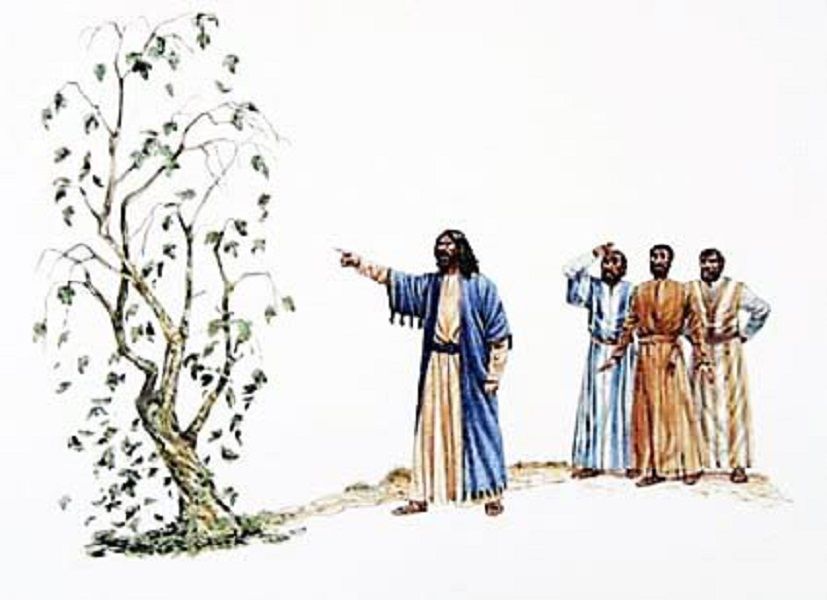
The next morning, as Jesus returns to Jerusalem from Bethany, He sees a fig tree. He expects to find some figs. When he discovers the tree has no fruit, he curses it, and it withers immediately.
Jesus tells His disciples that if they have faith and do not doubt, they can do things like this. We can pray for anything by faith and receive it.
Application
Jesus says things that seem too definite, too open-ended for our taste. We always want to hedge His promises and water them down.
Jesus says that we can pray for anything and, if we have faith, we will receive it. There are no limitations, no ifs and maybes. It is like this: Faith → prayer → receive
He isn’t promising to fill our selfish desires or to grant what is physically impossible such as the ability to leap safely from tall buildings.
Faith is about trusting in Jesus, and that is based in relationship. The promise is not a blank cheque to get everything that we think we should have. It is more of a promise that what we need in our walk with Jesus, He will supply.
Faithfulness relates to both trust and loyalty: Christians trust in the hope of the gospel even when that hope cannot immediately be seen, and Christians are loyal to God in all things – including our business transactions. Or at least they should be! Stephen Judd et al
Scripture The crowds that went ahead of him and those that followed behind shouted,”Hosanna to the Son of David! Blessed is he who comes in the Name of the Lord! Hosanna in the highest!”
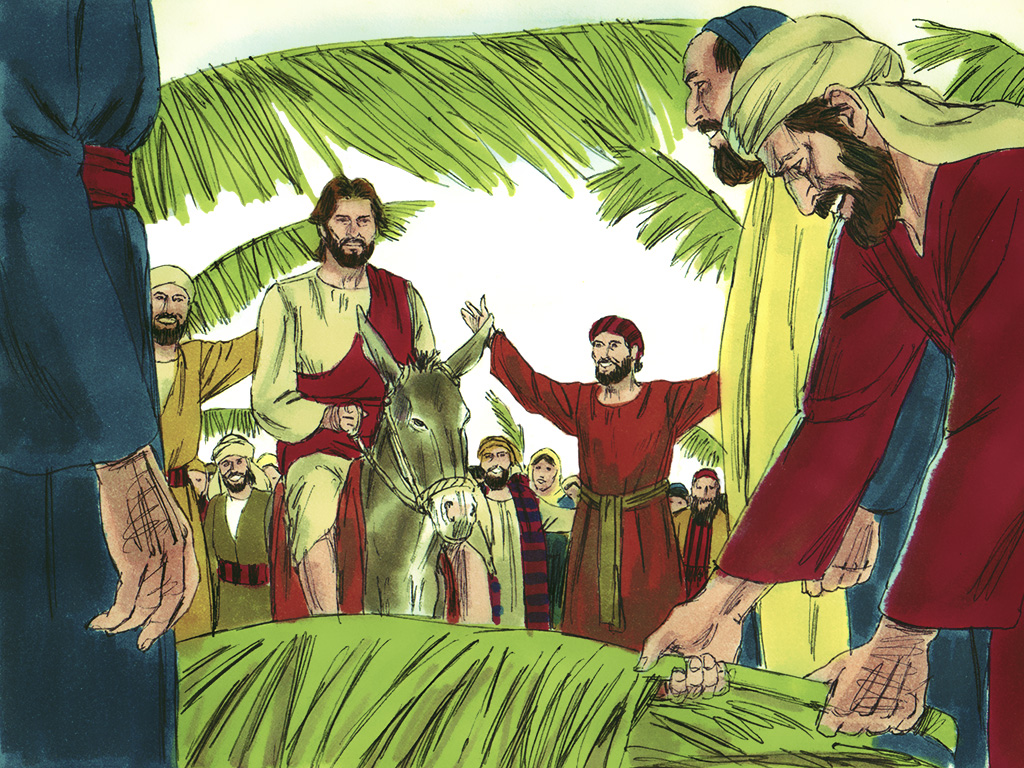
Observation At the town of Bethphage, Jesus sends two of the disciples ahead to collect a donkey and its colt. He tells them that if anyone asks what they are doing, they should say, “The Lord needs them.”
This is done in order to fulfil the prophecy of Zechariah chapter 9 .
Jesus rides the donkey into Jerusalem, and the crowds cheer him on. They spread their clothes and palm branches on the road.
Jesus goes to the Temple and drives the money changers and sacrificed sellers away. He says to them, “My Temple will be called a house of prayer, but you have turned it into a den of thieves.
Application The crowds shouted praises to the Lord. Yet shortly, in a matter of days, some of the same people, at the stirring of the scribes and Pharisees, would be calling for his death. How can this be?
Some, no doubt, had no clue about what was really happening or who Jesus was. They were just there for the spectacle. There are people in churches all over the world who have no clue about who they claim to be worshipping. They praise God with their lips, but not with their hearts.
There would have been true followers of Jesus in this crowd. They would be devastated by the events of Holy Week, but then set on fire by the resurrection.
There were some in the crowd who were looking for the wrong Messiah. They were hoping that Jesus would save the nation from its occupation by the Romans. The term “Hosanna” had been used as a nationalistic cry for a long time. The Son of David, of course, was the heir to David’s throne. Jesus was this Messiah also, but his main purpose was to free humanity from the power of sin.
Prayer Father, your love for us is so great that you keep pouring affection onto us even when we don’t understand it. Please help me to draw near to you by faith. Amen
However, Jesus is not a system of moral rules and values. Rather, he is a person. Representing and relating to a person is quite different from representing or relating to a principle or a value. Rules and values may ensure that God is to an extent glorified by the overall moral approach of the organisation, but that does not make the organisation in and of itself Christian. Rules and values may be necessary, but they are clearly not sufficient. Stephen Judd et al
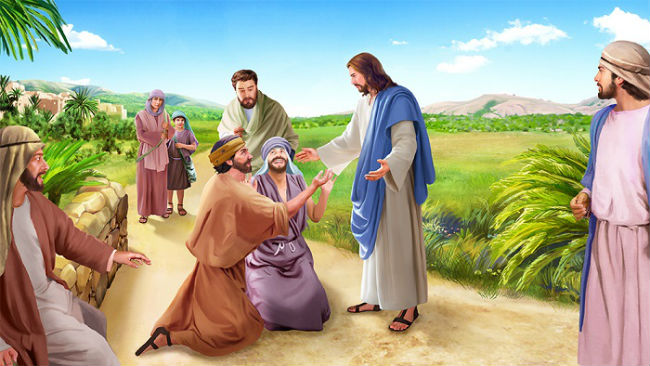
Jesus and the disciples leave Jericho. Two blind men sitting by the road call out to Him.
The crowd tries to quieten them, but they persist in calling for Jesus to have mercy on them.
Jesus asks them what they want from Him. They reply that they want to see. Jesus is moved with compassion. He touches their eyes and immediately they can see.
Application
I am often amused by the way Jesus asks people watch they want of him. These men were blind, so it should be obvious what they want.
By getting them to state there needs, Jesus effectively forces them to focus their faith on the one thing they need. They are not asking for money or food, but for healing. They want to see.
Often, when we pray we ask God in generalities. We don’t see what the real need is, what faith needs to be applied to.
We might have faith to move mountains, but God wants us to state which mountains to move and to where.
Our praying needs to be specific so that we can apply faith to a specific need and a specific action by the Lord.
Prayer
Lord, please help me to have the faith to address the mountains in my life and to see them moved. Help me to have faith to open my eyes to spiritual reality. Amen.
It’s been said, the true measure of any society can be found in how it treats its most vulnerable members. In our society today, none are more vulnerable than a newborn babe — and yet under the guise of “healthcare” and “human rights,” none legally suffer worse treatment.
A senate hearing in Canberra was told that within the span of a decade, between 2010 and 2020, more than 700 babies were left to die after botched abortion attempts in Victoria and Queensland alone.
Sky News host James Macpherson said the revelation should be a “national scandal.”
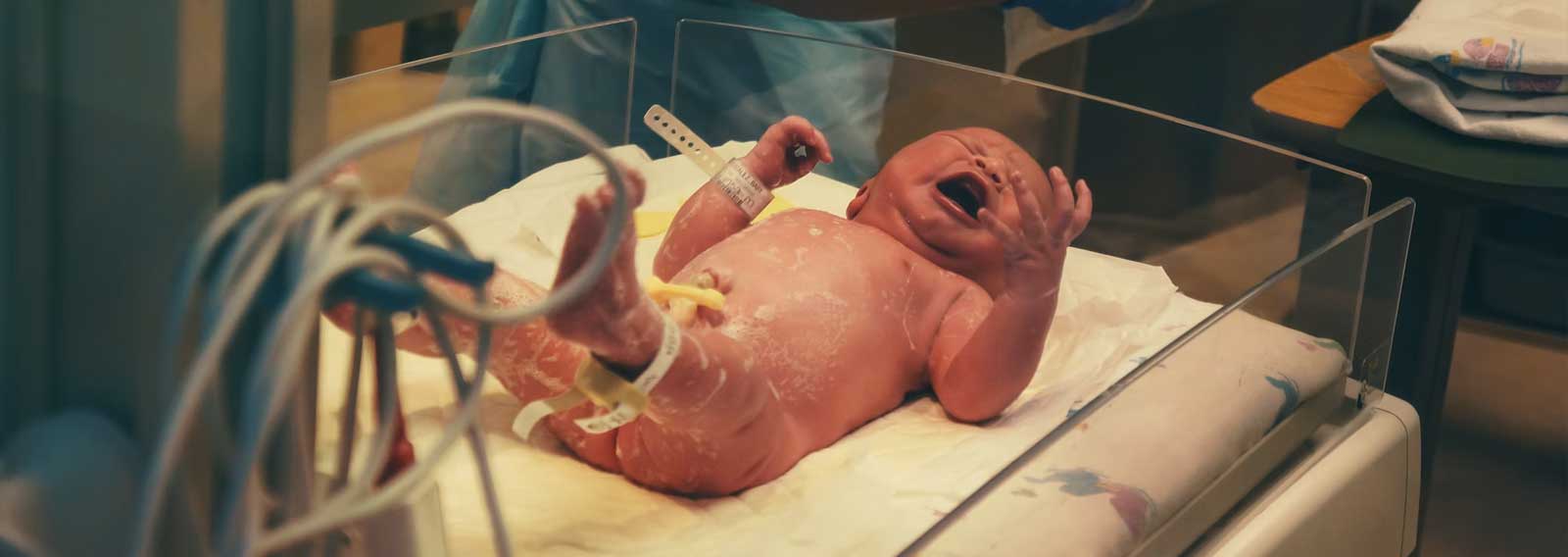
Currently, there exists no obligation for abortion providers to offer any assistance to a baby who survives a failed abortion attempt. Infants born alive are left to die, with their time of death eventually documented when they stop grasping for life.
Senator Alex Antic, Senator Matt Canavan, and Senator Ralph Babet put forward the Children Born Alive Protection Billin November last year requiring abortionists to provide medical care for all babies born alive.
Senator Canavan suggested Australia is in violation of the UN Convention of the Rights of the Child, of which it is a signatory.
Article 6 states, “every child has the inherent right to life,” while Article 24 says governments must “ensure the provision of necessary medical assistance and health care to call children.”
Senator Antic said, “A child that survives an attempted termination of pregnancy should be entitled to the same level of medical care and treatment as any newborn child.”
Former Federal MP George Christensen attempted to introduce a similar bill to Queensland in 2021 that would ensure children born alive during botched abortions would receive the same life-sustaining medical treatment afforded to any other baby.
Christensen sounded the alarm in February 2021, warning Parliament that hundreds of babies are being born alive and left to die as a result of abortions.
“I have recently watched the testimony of a midwife who was present at the birth of a baby after an abortion,” Christensen told his colleagues. “She was told to take a photograph for hospital records and when the flash went off the child started breathing.”
Christensen said no medical intervention was provided and the baby was left to die.
“This happens in hospitals and abortion clinics across the country on more of a regular basis than we would like to think, and what the abortionists would like to admit,” he added.
Christensen had the Parliamentary Library undertake further research on the matter, and found:
According to the publication Victoria’s Mothers, Babies and Children, there were a total of 1,626 late-term (20 weeks or later) abortions in Victoria, resulting in 198 live births between 2012 and 2016 (approximately 12%).
In Queensland, an ABC report stated there were 204 terminations with live birth outcomes between 2005 and 2015.
In Western Australia, as of 19 May 2017, a total of 27 cases of abortion procedures resulting in a live birth have been reported between July 1999 and December 2016. Of these, 21 were at 20 weeks gestation or later.
Christensen said his statistics do not paint the full picture as the matter is under-reported. Tasmania, the Northern Territory, New South Wales, and the ACT do not publish abortion statistics.
“What is very clear is that this is not rare, as abortionists have claimed,” he said. Adding, “We are in breach of some of our international obligations.”
On 9 February 2023, the Senate referred the Human Rights (Children Born Alive Protection) Bill 2022 to the Community Affairs Legislation Committee for inquiry and report by 1 July 2023. On 16 June 2023, the Senate granted an extension of time for reporting until Thursday, 31 August 2023.
As Lincoln Brown recently put it in The Spectator: “Our elected officials will soon vote on a question that everyone knows does not require a vote – the question of whether an innocent and helpless, though unwanted, baby must be saved, or whether it may be discarded in the name of ‘wellbeing.’”
We cannot understate the importance of the outcome. The vote will reveal whether our elected officials regard human life as an immutable right bestowed by our Creator or a privilege that is granted and revoked at the arbitrary will of those in power.

 New Life Narrabri