The Namoi River are Tariaro is stunning today. A nice ride to Turrawan and Tariaro on a near perfect morning. #cycling #narrabri #Biketooter

The Namoi River are Tariaro is stunning today. A nice ride to Turrawan and Tariaro on a near perfect morning. #cycling #narrabri #Biketooter
A coach’s effectiveness depends on his or her relationship with Jesus Christ. Joel Comiskey

Scripture
We think you ought to know, brothers and sisters, about the trouble we went through in the province of Asia. We were crushed and overwhelmed beyond our ability to endure, and we thought we would never live through it. In fact, we expected to die. But as a result, we stopped relying on ourselves and learned to rely only on God, who raises the dead.
Observation
Paul describes the troubles he and Timothy went through in the province of Asia. They were crushed beyond their ability to endure. Then they stopped trusting in their own abilities and trusted only in God.
God rescued them from mortal danger, and He will do it again. The Corinthians help by praying for them.
Paul says with confidence that he has lived with God-given holiness and sincerity. His letters have been straightforward with no hidden messages. When Jesus returns, they will be as proud of him as he is of them.
Application
Paul faced great opposition, even to the point of being close to death. That sounds scary, but it had the effect of forcing him to rely on God’s grace and not his own ability.
There is a saying that God will not send us anything that we can’t handle. That is not true. God does it all the time. He does promise that He will not send us anything too big that He can’t handle its.
The Lord is wanting too deepen our trust in Him. We face many trials in our life, some small but others seem huge at the time. In it all, God invites us to trust Him more. As we grow in our ability to trust the Lord, through smaller tests,He sends bigger tests to deepen that trust
Whatever tests I face today, Jesus is with me.
Prayer
Thank you father for the assurance that you will give me victory in every trial. Please help me to trust you. Amen.
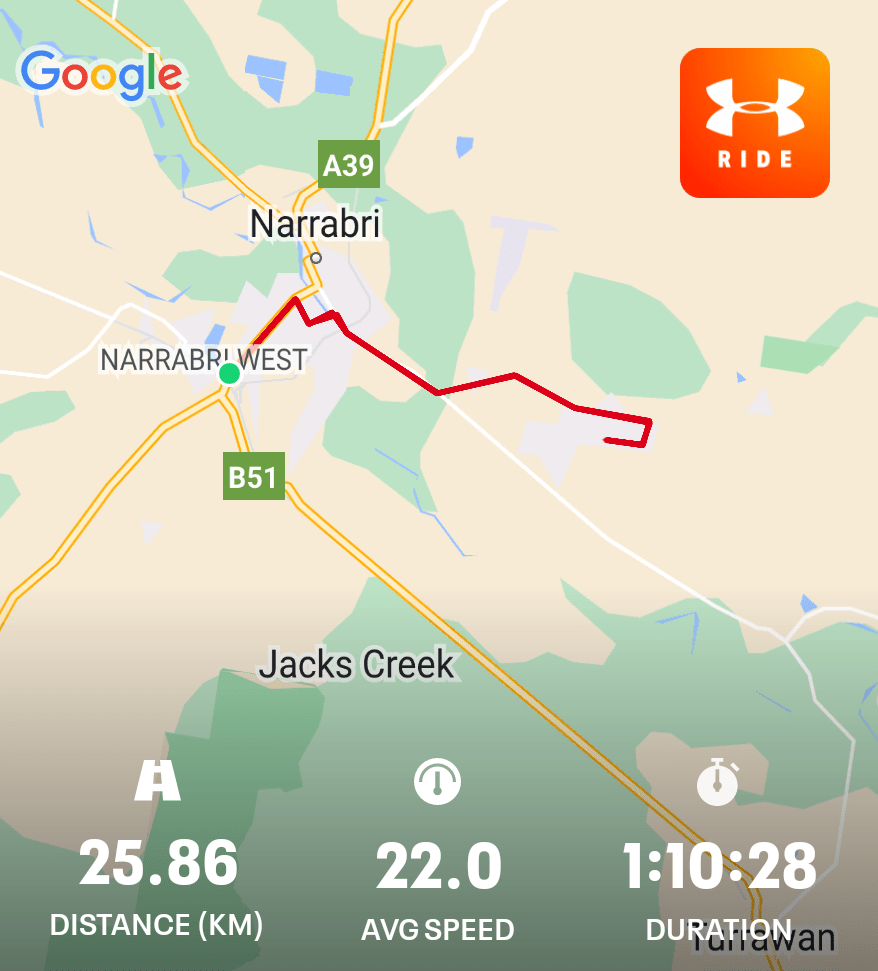
Another beautiful spring day. I rode to Haire Drive this morning. #cycling #narrabri #Biketooter
A cell coach encourages, nourishes, and challenges cell leaders to grow and multiply their cell groups. Joel Comiskey
Scripture
All praise to God, the Father of our Lord Jesus Christ. God is our merciful Father and the source of all comfort.
Observation
Paul was chosen by the will of God to be an apostle of Christ. He writes, with Timothy, to the church in Corinth and to all the saints in Greece.
God is our Father and He is the source of all comfort. He comforts ui in our troubles so that we can comfort others when they are troubled.
The more we suffer, the more God pours out His comfort on us. When Paul is weighed down with troubles, God comforts him , and he is able to pass on the same comfort to others. As the Corinthians share in Paul’s suffering, they will also share in his comfort.
Application
God is our merciful Father and the source of all comfort.
God is our Father. Jesus taught us to pray, “Our Father.” God is strong, mighty, and loving. He wants to see us thrive and grow in his love.
He is merciful. That mean that, because of the death of Jesus on the the cross, we now know forgiveness for our sins. Mercy means that our failings,,are acknowledged but put aside. We do not have to pay the penalty because Jesus did that.
God the Father is the source of all comfort. This is not a common word in the Bible. I looked up the Greek word and it has the same source as the word used for the Holy Spirit – paraclete. The Holy Spirit is described in John’s gospel as the comforter.
This is not talking about a comfortable chair or a soft bed. God comforts us in our sufferings and in our disappointments. He does not take away the pain of living in a sinful and broken world, but He comes beside us and reminds us of His presence. In that way He brings us comfort.
Prayer
Merciful Father, you are the source of all comfort. Please remind me to look to you when I am experienced distress of any kind. Amen.
Another perfect morning for riding! I rode out to Bunnings and around the edge of town then to Riverbend. Even the magpies seem happy today :blush: #cycling #Narrabri #Biketooter

The goal of Christian coaches is to move people toward Jesus Christ. The Christian coach strives to lead people forward to conform with Jesus Christ, knowing that the ultimate crown is the one that will last forever (1 Corinthians 9:25). Joel Comiskey

Scripture
“And be sure of this: I am with you always, even to the end of the age.”
Observation
The eleven disciples go to the mountain in Galilee where they see Jesus and worship him.
Jesus gives them the Great Commission. He has been given all authority on earth; therefore the disciples are to go and make disciples of all the nations. They are to baptise in the name of the Father, the Son, and the Holy Spirit. They are to teach their disciples to obey all of Christ’s commands.
He will be with us always, even to the end of the age.
Application
We are to go to the world and make disciples of all nations. That doesn’t mean that I personally have to go to all the nations. But it does mean that I have to go to whatever nation God has called me to.
I have no sense that God is calling me to go anywhere geographically, other than where I am right now. To go into the world for me means that I find ways of going into my community, connecting with unbelievers and not just the saints.
The promise of Jesus is that wherever we go to fulfil that commission, He will always be with us. Whether it is remote Australia, a big city, or a small town, Jesus is always with me. When He sends me for short-term mission trips overseas, He is with me there also.
There are some religions that believe that different territories belong to different gods. We see that in parts of the Old Testament. But Jesus is Lord of all the earth.
There are no places that are more or less sacred than other places. Some places are put to holy uses, and some places are put to evil purposes. But Jesus is the Lord of every place.
Prayer
Thank you Lord for this promise that you are always with me. Help me to shine your light in the dark places. Amen.
Jo Nova writes:
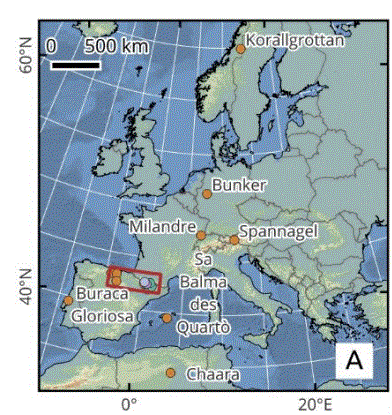
Thanks to David Whitehouse at NetZeroWatch who has found a remarkable paper: Pyrenean caves reveal a warmer past
The new study on stalagmites in caves of the Pyrenees shows that modern climate change is nothing compared to normal fluctuations in the last 2,500 years, when it was at times much hotter, colder, and more volatile. Rapid shifts between temperatures were common.
The researchers looked at 8 stalagmites in 4 caves and local lake levels, but they also compared their results with other European temperature proxies and reconstructions and the pattern is consistent across the region. The Roman Warm Period was much hotter than today, and for hundreds of years as well, even though coal plants were rare. Apparently, there was a reason Romans were dressed in togas.
The Dark Ages were very cold, especially around 520 – 550AD — which may be related to what the researchers call a “cataclysmic” volcanic eruption that took place in Iceland in 536AD. It was followed by two other massive volcanoes in 540 and 547AD. This effect is apparently visible in European tree rings which showed “an unprecedented, long-lasting and spatially synchronized cooling”.
Indeed, the researchers declare that volcanoes and solar variability appear to be the main drivers of the climate in SouthWestern Europe.
So finally we see one long continuous proxy record from ancient Greek times right through until 2010. The big question is why these sorts of studies are not done everywhere and all the time. It’s not like we don’t have plenty of caves with stalagmites to analyze. If the climate really was “the biggest threat to life on Earth” why are these extraordinary datasets not the top item on the wish-list of every institution that claims they cares about the climate?
There will be more to say on this remarkable paper:
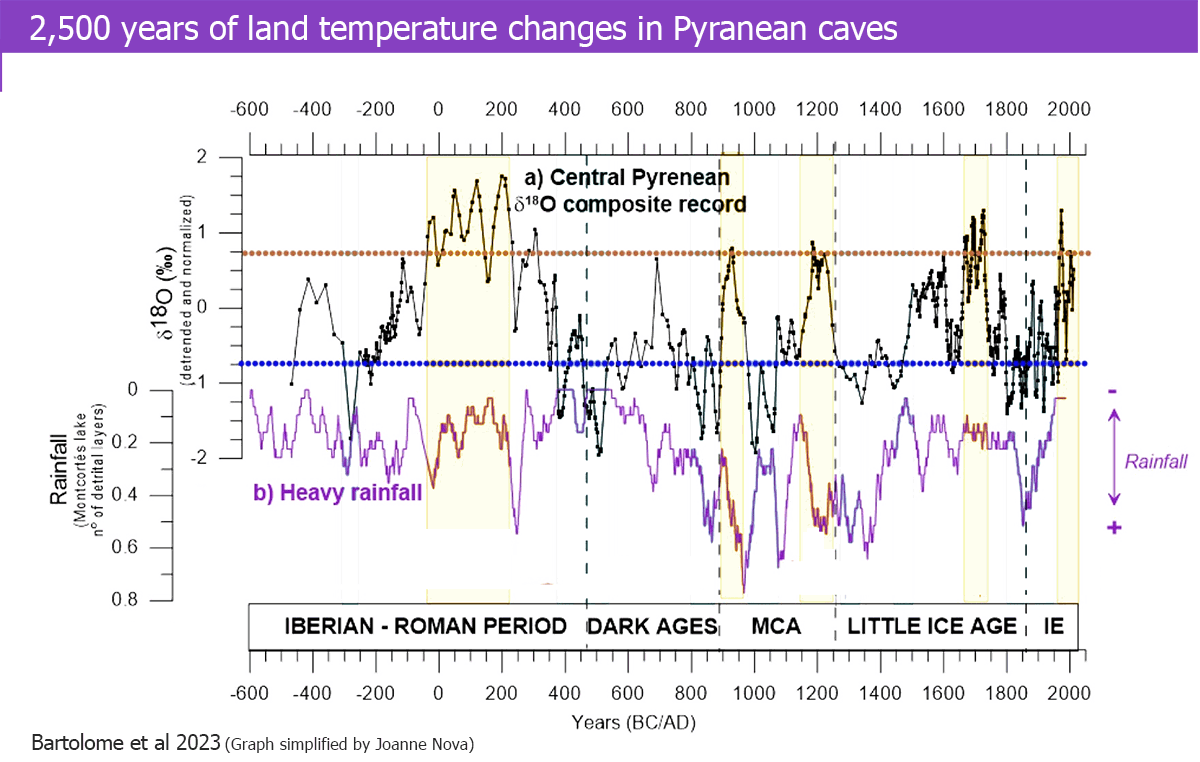
Click to enlarge. Oxygen isotopes are used to estimate temperatures.
Some passages from the paper discuss how these results match other studies from Europe
The cold event at ca. 540 AD (the coldest of the speleothem record) may be related to a cataclysmic volcanic eruption that took place in Iceland in 536 AD and spewed ash across the Northern Hemisphere, together with the effect of two other massive eruptions in 540 and 547 AD (Sigl et al., 2015). An unprecedented, long-lasting and spatially synchronized cooling was observed in European tree-ring records associated with these large volcanic eruptions, corresponding to the LALIA period (Büntgen et al., 2016).
Some passages from the paper discuss how these results compare with many other studies from Europe and with stark moments in history.
5.2.2. Temperature variability in W Europe and the W Mediterranean during last 2500 years
There are very few high-resolution speleothem records in Europe covering the CE (Comas-Bru et al., 2020). We compare the Central Pyrenean speleothem composite with nine selected speleothems records in Europe and northern Africa which cover with robust chronology and decadal resolution the last 2500 years (Fig. 5). One of these records is interpreted as NAO variability (Baker et al., 2015), three are paleo-precipitation reconstructions (Ait Brahim et al., 2019; Cisneros et al., 2021; Thatcher et al., 2022) and the other five are reflecting paleo-temperature variations (Affolter et al., 2019; Fohlmeister et al., 2012; Mangini et al., 2005; Martín-Chivelet et al., 2011; Sundqvist et al., 2010). Considering these differences in the interpretation and the fact these records are from different regions with different climates (from Sweden to Morocco), dissimilar profiles of paleoclimate variability can be expected. Still, some features are comparable and can be discussed to obtain a super-regional picture.
A. The Roman period in Europe-W Mediterranean. In Europe, and particularly in the Mediterranean region, the RP is well-known as a warm period (e.g., McCormick et al., 2012). The average sea-surface temperature in the western Mediterranean Sea was 2°C higher than the average temperature of the late centuries (Margaritelli et al., 2020). Our composite, with high values of normalized 18O values during the whole RP, and particularly from 0-200 AD, agrees with the scenario of warm temperatures (Fig. 5i). Speleothem data from the Balearic Islands (Cisneros et al., 2021) indicate a transition from humid to dry conditions along the Iberian-RP (Fig. 5c). The dry period at the end of the RP in the Balearic record, appears in agreement with a new speleothem record from northern Italy (Hu et al., 2022), suggesting that the observed drying trend was a possible contribution to the collapse of the Roman Empire in 476 AD. Record from Morocco (Ait Brahim et al., 2019), contrarily, marks a humid trend at the end of the RP (Fig. 5d). Similarly, an increase in humidity was observed in southern Iberia during the Iberian-Roman Period (Jiménez-Moreno et al., 2013; Martín-Puertas et al., 2009) thus reflecting a large spatial heterogeneity in precipitation during the RP when comparing records from the north and south of the Mediterranean basin.
REFERENCES
Bartolomé, M., Moreno, A., Sancho, C., Cacho, I., Stoll, H., Haghipour, N., Belmonte, Á., Spötl, C., Hellstrom, J., Edwards, R. L., and Cheng, H.: Reconstructing land temperature changes of the past 2,500 years using speleothems from Pyrenean caves (NE Spain), Clim. Past Discuss. [preprint], https://doi.org/10.5194/cp-2023-54, in review, 2023.
 New Life Narrabri