Ten Reasons All Australians Can Rejoice at the Voice Referendum Result

From The Daily Declaration:

The Daily Declaration
referendum result

Ten Reasons All Australians Can Rejoice at the Voice Referendum Result

The Yes campaign and the corporate media might be in mourning, but in truth, the referendum result is a win for all Australians. Here’s why.

The result of the weekend’s referendum was known within an hour or so of polls closing. Australians emphatically voted against constitutionally enshrining an Indigenous Voice to Parliament.

Nationally, just 39.3 per cent affirmed the proposition, while a whopping 60.7 per cent made known their disapproval. Every state rejected it, along with the Northern Territory, home to the highest proportion of Indigenous residents in the nation.

The result was as definitive as the opinion polls had suggested. Once postal votes are accounted for, the No vote will likely swell some more.

The referendum debate subjected Australians to months of bickering and division. With some campaigners cynically framing the debate as a de facto empathy test or a vote on the value of Indigenous lives, the referendum took an especially heavy toll on many Aboriginal Australians.

However, as the dust settles on Saturday’s result, what are the positives all Australians can take away from our nation’s 45th referendum?

1. Indigenous Equality Reaffirmed

In 1967, over 90 per cent of Australians voted in favour of including Indigenous people in the census and empowering the federal government to legislate for Aboriginal people. That referendum took place in a decade that saw the full political equality of Aboriginal Australians affirmed, including their right to vote and stand for political office.

Almost 60 years later, Australians were effectively asked if Indigenous Australians should receive unequal political rights via a permanent race-based advisory body in Canberra. Their resounding rejection of the 2023 proposal race was a conspicuous reaffirmation of the 1967 referendum.

Thus, for more than five decades, our nation’s body politic has maintained remarkable consistency in its belief in the fundamental equality of all Australians, regardless of race. Put another way, the majority of the nation believes Aboriginal and Torres Strait Islander Australians do not need to be pandered or condescended to for the simple reason that they are already our equals.

2. National Unity Fortified

While the referendum debate was deeply divisive, the eventual outcome was clear and resounding. A hefty majority of Australians agree that there are far more constructive ways to address Indigenous disadvantage than the one recently offered.

Note that a constitutionally-enshrined advisory body in Canberra was not the only thing rejected on Saturday. The Uluru Statement from the Heart — the political manifesto behind the Voice — effectively argued for two competing Australian sovereignties.

“The invasion that started at Botany Bay is the origin of the fundamental grievance between the old and new Australians,” the document argues. “Our sovereignty preexisted the Australian state and has survived it.”

Two competing Australias, divided along ethnic lines, perpetually battling for the upper hand in Canberra? It was a recipe for an ugly but permanent national division. Whether or not most voters were aware of the Uluru Statement’s more radical aims, they have repudiated it — and future generations will thank them.

3. Identity Politics Rejected

Over the last decade, we have seen a concerted effort from many quarters to reduce people to their physical attributes, and reward or hinder them accordingly.

Identity politics is a reductionistic way of viewing the world, and an anaemic way of viewing our fellow human travellers, who are made in God’s image as one-of-a-kind individuals.

Cultural Marxism has taken this a step further, using race to categorise people as “oppressed” and “oppressor”. Western Marxists have been very successful at weaponising Indigenous people against Western institutions which — ironically — have been uniquely successful at protecting their dignity and equality in law.

It is a credit to voters and a blessing for Australia that such a strong majority have resisted this cynical ploy, choosing to view Indigenous Australians as individuals, not avatars of a political cause.


Read the rest of the article here

Reflection on 2 Corinthians 8:1–15

Scripture

Whatever you give is acceptable if you give eagerly. And give according to what you have, not what you don’t have.

Observation

Paul encourages the Corinthians to give generously to support the church in Jerusalem. The churches in Macedonia gave generously, even though they are poor. They gave far more than they could afford. They begged Paul repeatedly for the privilege of sharing in the gift.

Paul wants to encourage the Corinthians to continue in this gift of generosity. They started a year ago, now they should finish. He wants the eagerness they showed in the beginning to be matched in their giving now. The amount of money is not as important as their attitude.

Application

I believe that tithing, that is giving a tenth of your income to your local church, is a basic christian practice that leads us into a range of freedoms. While the tithe is “required”, we also have the freedom to give above and beyond this.

Whenever we are giving to others, it is our attitude that is important. We should always be eager to share from our prosperity to meet the needs of other people.

In that sense, it doesn’t matter how much or how little we give, as long as it is done with joy. The worst thing in the world is to give reluctantly, or worse, with bitterness. That just undermines any goodness our gift might contain.

I know of some business people who practise aspirational tithing. That is, they give 10% of where they would like the business to be at in twelve months’ time. That is a good attitude to have, but it is not expected that anyone should do this unless God calls them to do so. Paul tells us that we should give according to what we have, not what we don’t have.

God wants us to be generous, even sacrificial in our giving to others.

Prayer

Lord, please grow me in this area of generosity. Help me to give freely to others. Amen.

Today’s Sermon

The sermon for October 15th 2023 is now available on the New Life web site.

In this sermon, which is based on Genesis 1:1-2, John 21:245 and Revelation 22:12-13, Kelvin talks about Knowing That You Work For God’s Kingdom.

Click here to listen on your browser, here to download the mp3

The Voice Is Silenced

Yesterday, Australia voted in a referendum to change our constitution to include a so-called Voice to Parliament. The Voice would have been effectively a third chamber of Parliament that represented the concerns of indigenous people, able to veto any legislation or executive action of the Australian Government.

This referendum will go down as Australia’s Brexit moment. As with the Brexit vote in the UK, the ordinary people of Australia told their elite overlords to get out of identity politics and the “woke” agenda and start listening to the people who pay for all this stuff.

There are many reasons why the Voice is wrong in principle, including the following:

  • It gives one group of people extra rights not enjoyed by others
  • The aboriginal industry has over 1000 groups paid for by tax payers already
  • In Parliament, the proportion of indigenous Members and Senators exceeds the proportion of the general population. If they cannot be a “Voice” to the Government, (their job description is literally to represent the interests of their electorate), then who can?
  • The Voice would not solve the problems of remote aborigines who are the 20% who comprise the gap between mainstream Australia and indigenous Australia
  • The Voice would just be a talk fest for the inner city elites who already have plenty of platforms to voice their grievances

In Australia, constitutional change is difficult to achieve. As well as getting a national majority in favour, proponents must also win a majority in a majority of states (i.e. 4 out of 6 states). To achieve that, history shows that both sides of politic need to be actively in favour. In this case they weren’t.

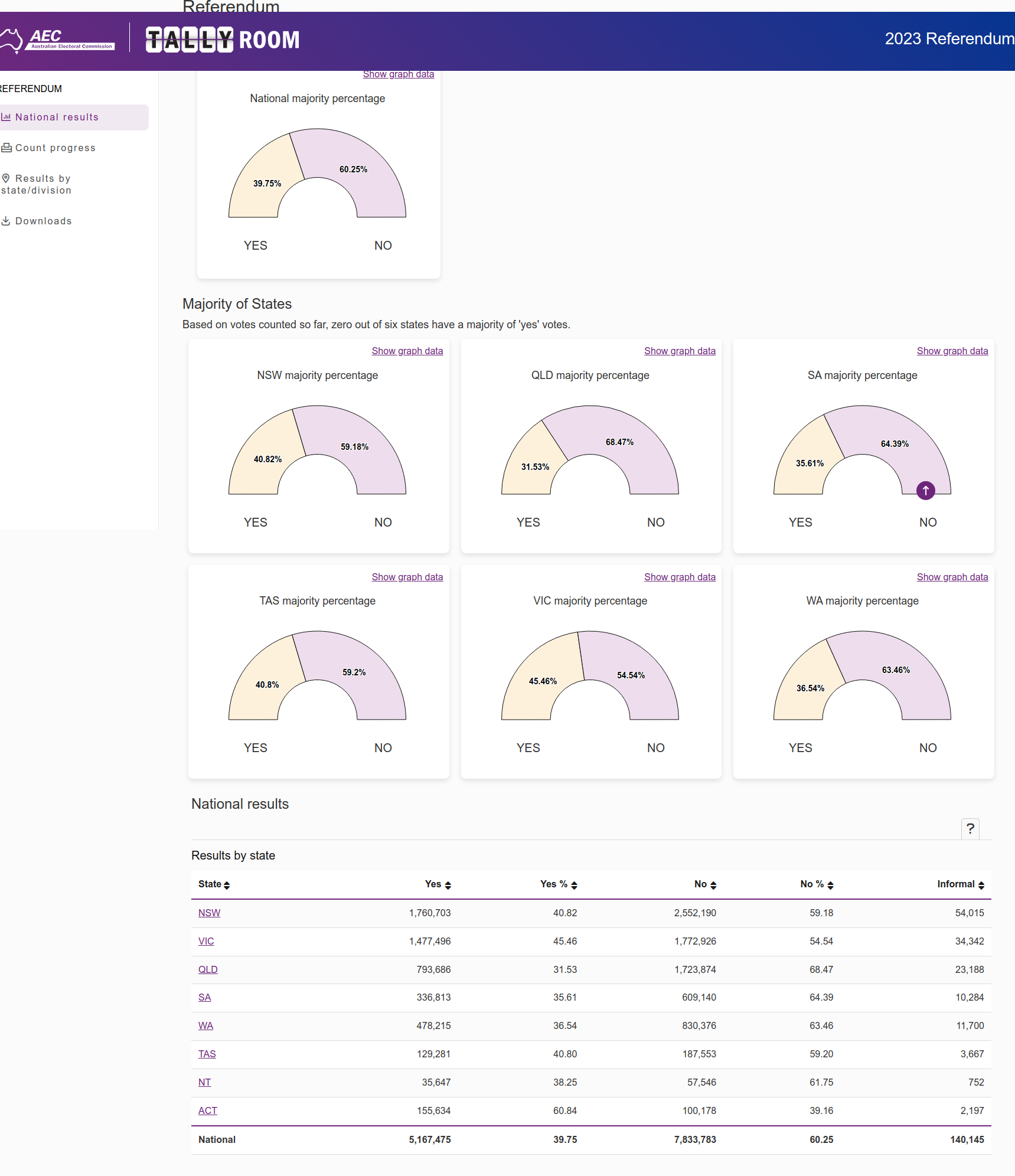
So here are the results from the AEC web site as of close of counting on Saturday night. The vast majority of votes have been counted, but the result cannot be officially declared for two weeks until postal votes are included.

Overall, the vote was about 60% “No” nationally and in every state. Even Victoria, the wokest state ended up 54% “No”. Early in counting, it almost looked like it would be about 50-50, but the later counting brought it more into line with the rest of the country.

Interestingly SA and WA which were the two states that the “Yes” campaign had to win to ensure the majority of states, they had an even greater “No” vote. In other words, the more people saw of this proposal, the more likely they were to reject it.

If you go to the last line in the table you see the ACT vote. They were the exact opposite of the rest of the country- 60% “Yes”. The Canberra bubble is the cause of most of the problems in this country. Dominated by the bureaucracy, the ACT is exactly out of step with the rest of the nation. It must surely be time to dismantle Canberra- that would be a constitutional change that could get through.

Reflection on 2 Corinthians 7: 8- 16

Scripture

For the kind of sorrow God wants us to experience leads us away from Ssn and results in salvation. There’s no regret in that kind of sorrow. But worldly sorrow, which lacks repentance, results spiritual death.

Observation

Paul is not sorry that he sent his severe letter to the Corinthians. He was sorry at first because he caused them pain. But the pain caused them to repent and change their ways, so Paul is now glad.

Godly sorrow leads us away from sin and towards God. But worldly sorrow has no repentance and results in spiritual death.

In the case of the Corinthians, godly sorrow produced earnestness and zeal.

Titus was also happy about the way they received him. Paul’s boasting to Titus about the Corinthians proved true.

Application

There are two ways in which we can be sorry about sin – the world’s way and God’s way.

In the world’s way, people may be sorry even remorseful for their sin. This relates to the consequences of being caught or feelings of guilt. They might be sorry for their sins, but do not relate it to God. Worldly sorrow leads to death it misses repentance.

Repentance is the acknowledgement that my sin is offensive to God. The Greek word means literally to change our thinking. What we once considered to be good or pleasurable we now recognise is evil in God’s eyes. Therefore we make a decision to leave that sin in order to stop displeasing God.

Godly sorrow contains this idea of repentance. We recognise that our sin separates us from God, and we desire to return to fellowship with Him.

We need to repent of our sins daily. This is not a one-off at the start of the journey, but a life long process of course corrections as we seek to follow the Lord.

Prayer

Dear Lord, I recognise that my sins are offensive to you. I repent now and ask you to forgive me Amen.