Blue bottles and other stingers

Now one of the longest-held beliefs about bluebottles has been debunked

 
Thousands of them wash up on Australian beaches every summer but scientists have only just discovered that there’s more than one species of bluebottle on the planet.
Until recently the bluebottle or Portuguese man o’ war was believed to be a single species known by the scientific name Physalia physalis.
For decades, scientists operated under the impression that these jellyfish known for their painful sting drifted across oceans all over the world.
 
Bluebottles invasion on Newport Beach after days of north east winds Photo nick Moir 18 jan 2019
Scientists have only just discovered that there’s more than one species of bluebottle on the planet. (Nick Moir)
Now those beliefs have been utterly debunked.
New research from Yale University has proven the existence of at least four distinct species of bluebottle with their own unique appearance, genetics and distribution.
A number of Australian researchers at Griffith University and the University of New South Wales (UNSW) also contributed to the study, including Griffith’s Professor Kylie Pitt, who was shocked by what it uncovered.
 
“One in six Australians have been stung by a jellyfish and most of those stings are due to bluebottles, and we didn’t even know that we had different species,” she said.
“Here’s a species that causes so many problems along the Australian coast, and we still know so little about it.”
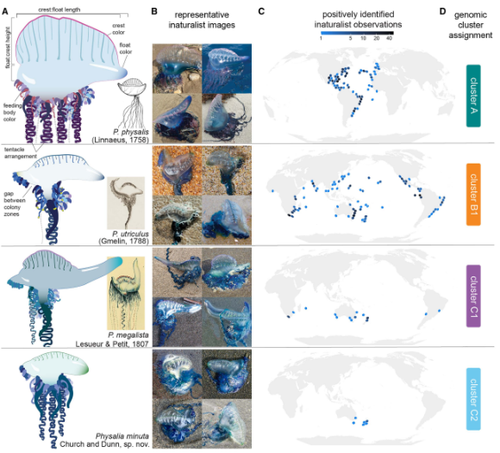
As well as the Physalia physalis, the study proved the existence of the previously proposed Physalia utriculus and Physalia megalista.
It also identified a whole new species called Physalia minuta, which is found in the waters near New Zealand and Australia.
The study proved the existence of at least four distinct bluebottle species.
The study proved the existence of at least four distinct bluebottle species. (Supplied)
Thankfully, the discovery of additional bluebottle species does not mean there will suddenly be more jellyfish washing up on Australian beaches.
“Your experience at the beach won’t change,” Pitt promised.
Associate Research Scientist at Yale University Samuel Church led the study, enlisting scientists from around the globe to collect bluebottle samples from their local beaches.
Samples from more than 150 animals were sent to Yale, where researchers analysed their genetics.
Everyday Australians also played a part in the project, though they may not have known it.
As well as studying information and samples collected by scientists like Pitt, the Yale research team analysed thousands of citizen-science photos.
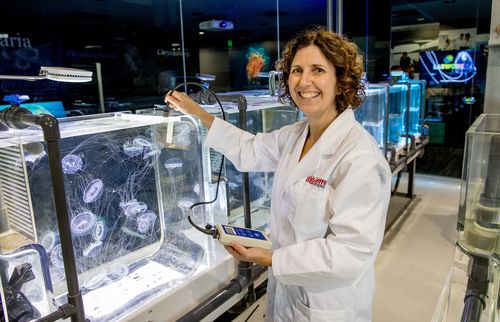
Kylie Pitt was among the Australian researchers who contributed to the game-changing study.
Griffith’s Professor Kylie Pitt was among the Australian researchers who contributed to the game-changing study. (Supplied)
The images were taken from iNaturalist.org, an online social network for nature-lovers where they can upload photos of flora and fauna they’ve seen in the wild.
The website also serves as a “crowdsourced species identification system and organism occurrence recording tool” and was an invaluable resource for the bluebottle study.
There are currently more than 20,000 images of bluebottles on the site, including more than 3000 listed as having been taken in Australia.
“There are hundreds and hundreds of photographs and records of bluebottles from all around the world,” Pitt said.
“So as part of this project, we extracted all the photos and we tried to allocate them to the different species that we identified, based on the way that they look.”

Today’s Bike Ride

Even though the temperature was a degree warmer, the breeze made it feel older. My body struggled a little today so I finished a little short. It was nice to be out in the sunshine though. I rode along Mount Kaputar Road #cycling #Narrabri #Biketooter
Quote for the Day

But if a prophet or pastor presumptuously claims apostolic office, they trample on holy ground, are blindly ignorant of the authority of Christ who alone can commission apostles, and undermine the progress of the church and other leaders in pursuing apostolic grace. John Alley


Reflection on 1 Peter 1:22-2:3

Scripture

For you have been born again, but not to a life that will quickly end. Your new life will last forever because it comes from the eternal, living word of God.

Observation

We were cleansed from our sin when we first came to faith in Jesus, so we must live in that clean nature by loving other Christian brothers and sisters.

We have been born again to eternal life, not to a life that will end. People are like grass, but the word of the Lord, the good news, lasts forever.

We must get rid of all evil behaviour, and instead crave pure spiritual milk so that we will grow into the fullness of salvation.

Application

When we put our trust in Jesus, we were born again or born of the Spirit. This new life in Christ is not for this earthly life only. The new life is everlasting.

This means that we must live for eternity, not for the present. Our eyes must be fixed on Jesus, not on earthly things.

And so we have to make a conscious decision to put away sin. Everything that separates us from God must go. This is a lifelong process in which God convicts us and redirects our passions and desires.

Positively, it means we must crave the pure spiritual milk that brings us to mature discipleship. This refers to the word of God, the Scriptures. We need to read the word daily, and regularly hear the word of God preached, as well as studying the word in small groups.

When we do these things and learn to place our attention on Jesus, then we will grow into maturity in the faith.

Prayer

Lord, you have shown me how to grow in you. Please help me to be disciplined in my study of your word and in the thoughts of my heart. Amen.