
Every good gift is from God…
Apostles are given specific measures of authority because their calling into the service of Christ will bring confrontation with high-level beings in the spirit realm. John Alley



Apostles always will feel the burden to lead the five-fold ministers of Christ into relationships of deep love and harmony and always appeal to believers everywhere regarding their hearts toward each other. John Alley


Scripture
God gave these four young men an unusual aptitude for understanding every aspect of literature and wisdom. And God gave Daniel the special ability to interpret the meaning of visions and dreams.
Observation
At the beginning of the exile in Babylon, King Nebuchadnezzar orders his chief of staff to bring to the palace some of the young men of Judah’s leading families. They are to be trained in Babylonian culture and wisdom, and they are to be fed from the royal kitchen.
Daniel is determined not to defile himself by eating unclean food. So he asks for permission to only eat vegetables and drink water. When the chief is staff is reluctant to do this, Daniel persuades him to give them a 10 day trial At the end of the 10 days. Daniel and his friends look healthier than those who were not on the restricted diet.
God blesses Daniel and his three friends with an aptitude for learning. To Daniel, he gives the ability to interpret dreams. The king consults these four men whenever he needs particular wisdom and balanced judgement.
Application
Daniel and his fellow exiles, found themselves thrust into a deeply pagan culture, Daniel, Meshach, Shadrach and Abednego end up in the pinnacle of the culture, the Royal Palace.
It seems that God gifted these four men with great wisdom and learning, This would position them to affect the way the whole empire was administered. Rather than being shaped by the culture, they were there to shape the culture.
God gives each person a particular place to shine His light. He also gives us each the gifts and abilities that we need to fulfil that purpose.
Let us find the place. God has appointed for us and be there as the culture shapers He calls us to be.
Prayer
Thank you, Lord, for your unique place and purpose. Please help me to be your witness in the place that you have called me to be. Amen
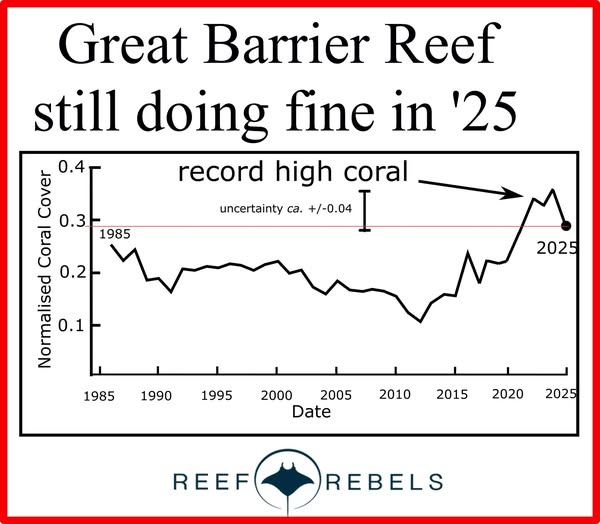
My article from The Australian this morning below. But first, AIMS are agreeing that the reef is coming off record highs so the small drop should be viewed in that context. However, much of the media is still reporting the drop as a disaster.
The latest 2025 statistics on the amount of coral on the Great Barrier Reef (GBR) show the reef is still doing fine despite having six allegedly cataclysmic coral bleaching events in the last decade. There should be no coral at all if those reports were true.
The normalised coral cover dropped from a record high number of 0.36 down to 0.29, but there is still twice as much coral as in 2012. The raw coral cover number for all the last five years has been higher than any of the previous years since records began in 1985. However, when one considers the uncertainty margin, the present figures are not significantly different from many of the previous years.
The Australian Institute of Marine Science collects coral data on around 100 of the 3000 individual coral reefs of the GBR. Analysis of the data at smaller scales shows the GBR is doing what it always does – change. There is a constant dynamic as cyclones, starfish plagues and bleaching events dramatically kill lots of coral in small areas, while it quietly regrows elsewhere.
Guess whether the ‘science’ institutions emphasise the death or regrowth.
The institutions often justify this embarrassingly high coral cover as just “weed coral”. But the type of coral that has exploded over the last few years is acropora, which is the most susceptible to hot-water bleaching. How can we have record amounts of the type of coral that should have been killed, again and again, from bleaching? The acropora takes five to ten years to regrow if it is killed.
There are two conclusions that must be drawn. First, not much coral has been killed by climate change bleaching – at least not compared to the capacity of coral to regrow. Second, the science institutions are not entirely trustworthy, and are in need of major reform.
And not just with regard to GBR or climate science. It is well recognised that most areas of scientific study are suffering a problem of reliability, which is damaging the reputation of science itself. It is well accepted that around half of the recent peer-reviewed science literature is flawed. Is there any other profession with such a high failure rate?
This last point has been noted in the United States, where American science is going through a process of genuine revolution. Scientists who were once victimised and ostracised have been appointed to lead science and medical research institutions. Among the more notable and encouraging appointments have been Professor Jay Bhattacharya who famously opposed the groupthink on Covid lockdowns, especially for children. He is now head of the National Institutes of Health and is proposing radical changes in the funding methodology to break the cycle of groupthink. He is also changing funding rules to encourage bright young scientists with new ideas rather than the present system which rewards older scientists who are wedded to conventional wisdom, and often enforce groupthink. In short, Bhattacharya is encouraging dissenters.
The US Department of Energy recently released a report on whether the conventional wisdom on climate change is entirely defensible. It is written by five eminent scientists, all with spectacular careers, who have consistently challenged the view that climate change is an existential threat. Their report includes data about GBR that shows there is little to worry about. Significantly, it systematically addresses many other aspects of Climate-Catastrophe Theory, such as wildfires and deaths from extreme weather events. And it points out the oft-ignored fact that carbon dioxide is a wonderful plant fertilizer which has already increased crop yields and plant growth.
Most importantly, rather than shutting down critics, the report’s writers are actively encouraging criticism, which they will respond to.
Science progresses through argument, logic, and quality assurance systems that make sure debate always takes place. Groupthink kills science, and groupthink is being challenged like never before in the US.
This revolution seems a long way off for Australia. But it will come, simply because US science, and science funding, dominates all other countries.
Imagine if Professor Ian Plimer, Australia’s most famous climate sceptic, was in charge of our climate science funding. Or if I were in charge of the Great Barrier Reef Marine Park Authority. Sounds crazy. But that is what has effectively happened in the US.
Australia’s science agencies would do well to contemplate whether they need to change their ways before the revolution comes to these shores. Better to adapt before the scientific guillotine falls.
Peter Ridd is an Adjunct Fellow at the Institute of Public Affairs.

Here Paul provides more detail: Christ is the chief cornerstone for the foundation of an eternal temple that God is building, and apostles and prophets also are part of this foundation. John Alley
 New Life Narrabri