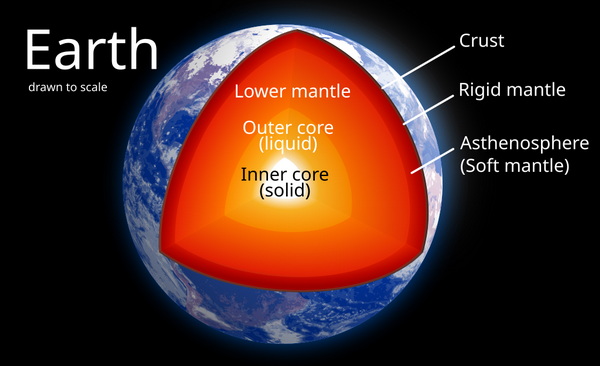
The more we find out about the earth, the more it is clear that it is very cleverly designed for the purpose of supporting life.
From Creation Evolution Headlines:
Earth’s Core Is Fine-Tuned for Surface Habitability
New simulations of the Earth’s core
indicate extremely precise conditions
for its formation, exposing flaws in
cosmological evolutionary theory
Magnetic Miracles
Earth’s Inner Core and the Glory of God
by Sarah Buckland-Reynolds, PhD
A landmark study by four UK scientists, published this month in Nature Communications, unveils yet another striking geoscience discovery that points to fine-tuned design and challenges long-held evolutionary assumptions.

Constraining Earth’s core composition from inner core nucleation (Wilson et al, Nature Communications, 4 Sept 2025).
As it turns out, this latest example of fine-tuned design was beneath our feet all along: within the Earth’s inner core.
The Research
Researchers, Wilson et al from the University of Oxford, Leeds, and University College London, simulated the conditions required for Earth’s solid inner core to form, resulting in it’s present structure, temperature and magnetism. After testing numerous combinations of elements, the team found that core nucleation and crystallization would only occur with precisely 3.8% carbon in its makeup; otherwise, Earth’s core would have remained molten.
Comparative simulations showed that no other elemental mix could sustain a stable magnetic field, leaving the planet vulnerable to solar wind and charged particles—potentially even stripping away its atmosphere. Despite beginning from evolutionary assumptions of an initially molten core—and acknowledging unaccounted complexities—Wilson et al.’s research nonetheless points powerfully to fine-tuned design and raises fresh challenges to long-standing evolutionary views on Earth’s core formation.
The Core of the Matter: Functionality Beyond the Depths
Research into the Earth’s core is highly relevant, as the role of its size, state and composition is known to directly impact Earth’s habitability. Research on Earth’s core is vital, since its size, state, and composition directly affect the planet’s habitability. Earth’s magnetic field—essential for preserving the atmosphere, deflecting harmful solar wind, and guiding migratory species—depends on the core’s composition, which drives convection in the outer core.
According to cosmological evolutionary theory, Earth’s core began in a molten state, due to radioactive heating. Yet for the inner core to crystallize, a precise mechanism was required. To address this, the researchers drew on seismology and melting-point data, which indicate that the core is less dense than pure iron. This suggested that Earth’s present magnetic strength depends on a mixture of elements. The authors acknowledged, however, that multiple possible combinations remain consistent with traditional constraints, leaving some ambiguity.] However, their research found that of all simulated possibilities, only a 3.8% carbon composition (with a supercooling temperature of 266K) could account for the processes of nucleation and the estimated present size of the Earth’s core.
Even without challenging the unobservable assumption of an initially molten core, this article demonstrates that the very existence of the solid inner core requires a finely tuned chemical composition for today’s geophysical processes to function. Although the Scriptures are not clear about the solid vs. molten state of the Earth’s core at creation, this discovery shows that a precise composition of the core would have been necessary to give rise to the magnetic properties of Earth that life relies on. In an evolutionary framework, the question arises: How did nature “know” the amount of each element required for the core to produce the thermal profile necessary for Earth’s magnetism?
Read the rest of the article here
 New Life Narrabri