An American Theme Park Tells the Christmas Story

From godreports.com

Snoopy ice show at Knott’s: A Christ-centered moment brings wild applause


By Mark Ellis —

Scene from ice show (sixflags.com)

As the sun dipped low over Buena Park, my wife Sally noticed a long line of people forming outside the Walter Knott Theater for the latest production of “Snoopy’s Night Before Christmas.”

We jumped in line with our son and daughter-in-law and two granddaughters, with low expectations for a free, ice-skating Peanuts show in a secular theme park.

Within minutes my heart was overflowing with delight, not only because of the spectacular skating, but also its meaningful content.

In an age when many Christmas productions tiptoe around the real reason for the season, Knott’s has done something courageous: they’ve let Linus take center stage and quote the Gospel of Luke verbatim, exactly as he did in the immortal 1965 TV special, A Charlie Brown Christmas.

Under the skilled direction of the incomparable ice show team at Knott’s, the Peanuts gang glides across the 5,000-square-foot Royal Welcome Ice Stage in a delightful retelling of Clement Clarke Moore’s famous poem. Snoopy dreams of sugarplums (and perhaps a certain Red Baron), Woodstock flits about in panic, Charlie Brown frets over Christmas meaning something more than commercial fuss, and Sally still wants “tens and twenties.” It’s all charming, funny, and impressively skated.
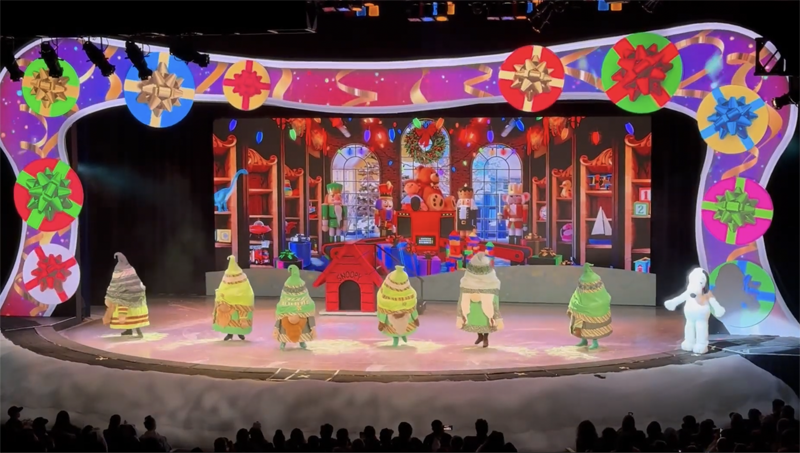
Scene from 2024 show (YouTube screenshot)

But then came the moment that may have caught many by surprise in the audience, including my wife and me.

The lights dimmed. Linus, wrapped in his trademark blue blanket, skated to the center of the rink with the same quiet confidence millions of us remember from childhood. The orchestra fell silent. And in his gentle, endearing voice he proclaims:

“And there were in the same country shepherds abiding in the field, keeping watch over their flock by night. And, lo, the angel of the Lord came upon them, and the glory of the Lord shone round about them: and they were sore afraid…”

Word for word. Luke 2:8-14, King James Version, just as Charles Schulz insisted on 60 years ago when network executives tried to cut it from A Charlie Brown Christmas.

In 2025, in a major American theme park, with thousands of families from every background watching, Linus finishes with the line that has brought tears to generations: “And that’s what Christmas is all about, Charlie Brown.”

The audience erupted in wild applause — the biggest response of the evening. In an era when the meaning of Christmas is obscured, here was a humble beagle and his blanket-carrying friend declaring the story of Christmas without apology, the Scripture undiluted, without a single content warning.
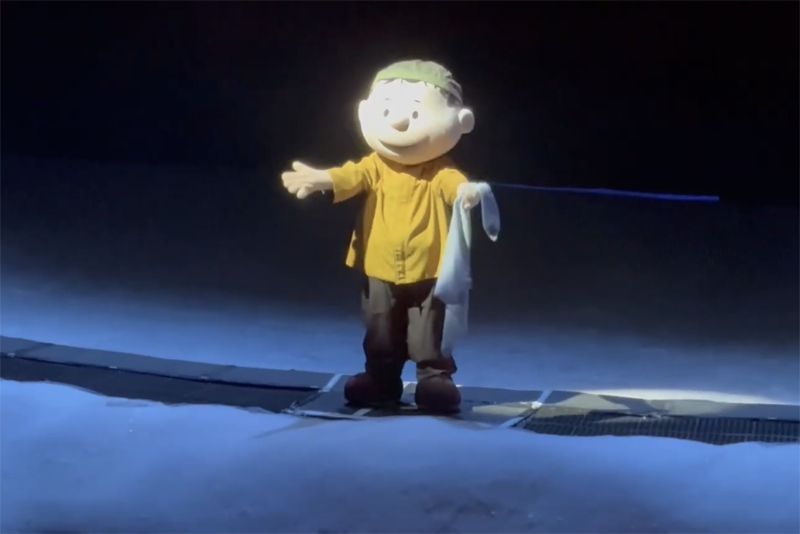
Linus recites from Luke 2 in 2024 show (YouTube screenshot)

The decision to include Linus quoting the Gospel of Luke verbatim comes from the creative team at Knott’s Berry Farm (specifically the entertainment division under Cedar Fair/Six Flags) in collaboration with Peanuts Worldwide LLC, the company that now owns and licenses the Peanuts intellectual property.

However, that scene is a loving and deliberate homage to Schulz’s original insistence in 1965. When CBS executives tried to remove Linus’s recitation of Scripture from A Charlie Brown Christmas, Schulz famously replied, “If we don’t tell the true meaning of Christmas, who will?” and refused to budge.

Because that moment is now considered inseparable from the Peanuts legacy—and is protected as a core element of the brand—modern licensed Peanuts Christmas productions (including the Knott’s ice show, the stage musical, and some theme-park parades) almost always retain the Luke 2 reading when Linus appears in a Christmas context.

The rest of the show features spectacular spins, lifts, and jumps set to arrangements of Peanuts classics, with Snoopy stealing many scenes. Yet everything circles back to that sacred midpoint. The skating is world-class (several performers have Olympic and Disney on Ice credentials), the costumes sparkle under the colored lights, and the storytelling is tight—perfect for families with short attention spans.

When the finale arrived and snow gently fell inside the open-air theater, I found myself thanking God for Charles Schulz, a devout Christian who refused to let the networks remove the Scripture from his special, and now, decades later, for Knott’s Berry Farm choosing to honor that same conviction.

While Schulz himself had no hand in the current Knott’s production (he died 24 years before the current version opened), the inclusion of the biblical Christmas story is a direct result of the stand he took six decades ago.

“Snoopy’s Night Before Christmas” is a bright, unashamed proclamation that Jesus is still the heart of the Christmas message. Bring your kids and grandkids and let Linus point them that enduring truth.

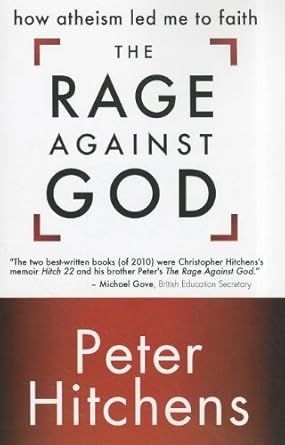
Quote for the Day

No doubt it would be easier to fight if we were better armed. But in recent times it has grown clear that in my own country the Christian religion is threatened with a dangerous defeat, by secular forces that have never been so confident. Peter Hitchens

Reflection on Colossians 4:1-6

For many years I have used the SOAP (Scripture- Observation-Application- Prayer) method for my devotional reflections. This has been good, but I have lately felt the need to embrace dialoguing with God in my devotions. For decades I have regularly listened to the Holy Spirit using Mark Virkler’s “4 Keys to Hearing God’s Voice”. These are

Stop – still your mind

Look – visualise Jesus with you. Where is He? What is He doing?

Listen – tune into the thoughts in your mind that flow from the Holy Spirit

Write – write down what you believe the Lord is saying to you.

Later- check that what you write lines up with Scripture, and if necessary, seek counsel from trusted christian friends.

For further thoughts on hearing God’s voice check my blog article. https://newlifenarrabri.blog/2024/12/09/how-to-hear-god-mark-virklers-4-keys/

Reflection on Colossians 4:1-6

Scripture

Live wisely among those who are not believers and make the most of every opportunity. Let your conversation be gracious and attractive, so that you will have the right response for everyone.

Observation

Paul encourages us to devote ourselves to prayer with an alert mind and a thankful heart. He urges the Colossians to pray for him also so that he will have many opportunities to proclaim the message about Christ.

We must live wisely among unbelievers, using the opportunities God gives us. Our conversations. must be gracious and point people to Jesus.

Application

It’s not enough to have the right answers or the slick gospel message. We are surrounded by people who’ve heard the message and either not understood it or else have not believed it.

The answer is not just to rehash the facts about the gospel. We must live out the gospel by allowing God to transform our hearts. Then we will be able to, with gentleness and joy, touch the heart of our neighbours.

That is not to say there is no place for words. If we do not give people a reason for the hope that we have they will just assume we are “nice” people or “religious” without wondering why.

There will be conversations, but they should be gracious and not badgering.

Journalling

Lord. What do you want to say to me about this passage?

Keith, the power of my Spirit alive and active in my followers is the source of graciousness and power in witnessing.

Some people assume that my word is sufficient to bring people to repentance No, repentance, is a gift of my grace and of my Spirit. You cannot evangelise effectively without the Holy Spirit. This is why every Christian needs to be constantly full of the Holy Spirit and listening carefully to me.

Climate Crisis? What Climate Crisis

From wattsupwiththat.com

By Andy May

In a new paper by Gianluca Alimonti and Luigi Mariani, they argue that the public needs a proper definition of precisely what a climate crisis is to make rational decisions about how to address potential climate change threats (Alimonti & Mariani, 2025). They propose a set of measurable “Response Indicators” (RINDs) based on the IPCC AR6 Climate Impact drivers (IPCC, 2021, pp. 1851-1856).

Their intent is to switch from subjective perceptions of possible dangers to quantifiable metrics. Potentially this could put climate change debates on track and ensure that both sides are arguing about the same thing as opposed to talking past each other due to each of the debaters arguing from different definitions. It might also lead to real solutions to real problems, rather than flights of ideologically-based fancy.

The IPCC defines climate impact drivers (CIDs) as climate events that affect society. The impact on any affected society can be detrimental, beneficial, or neutral (IPCC, 2021, p. 1770). They define 33 categories of CIDs and have found that most of them have not emerged from the expected range of natural variability.

Alimonti and Mariani examined the EM-DAT disaster database, managed by the Centre for Research on the Epidemiology of Disasters from the year 2000 to the present. In this period, they detected no trend in deaths due to weather-related disasters. Just as important, there were clear improvements in global health over the period, once the growth in population was accounted for.

Temperature-related mortality accounts for 8% of the total weather-related deaths, of these 91% were due to cold and 9% to excess heat. From 2000-03 to 2016-19 cold related deaths decreased by 0.5% and heat related deaths increased by 0.2%, very small changes.

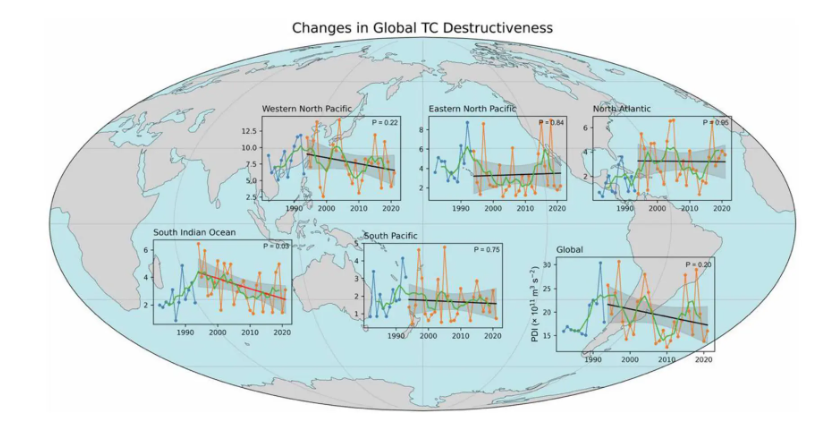
As Alimonti and Mariani’s Table 1 indicates, most measures of their climate change response indicators show no change, including cyclones, drought, floods, and wildfires. They show global GDP is improving, as is food availability.

The paper emphasizes that the reduction in climate-related deaths can be partially attributed to improvements in civil protection systems (levees, seawalls, forest management, etc.) which demonstrates that adaptation to climate change often proves more effective than mitigation. Most objective measures of the human-welfare impact of climate changes show no change, and most of the rest show improvement or an ambiguous impact, rather than detrimental effects.

The paper is worth the time to read; it is time for less subjectivity and more harder objective measures of the impact of climate change.