Gift and Work

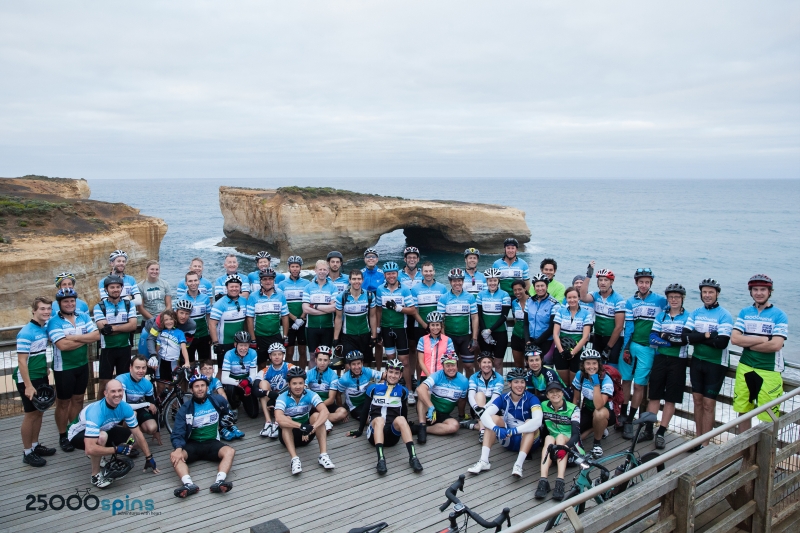
I was putting on my shirt prior to going for a bike ride the other day when I noticed something that shocked me. The shirt was a commemorative shirt from a charity bike ride that I participated in along the Great Ocean Road. We rode a total of a little under 300 km from Geelong to Warrnambool over three days.

What shocked me was the date on the shirt- February 2006. It can’t possibly be ten years ago!

I have many fond memories of that ride – the beautiful scenery, iconic locations such as Bells Beach and the Twelve Apostles (now reduced to nine) at Port Campbell, and the hard slog of the final morning when the unrelenting westerly breeze made riding so difficult.

I have never been athletic or sporty in any way, so this ride in my late 50’s was a once in a lifetime event.

I felt at the time that this was a gift from God. When I saw the Facebook ad I just really felt like I wanted to do this. It seemed that the Lord was saying “You can do this.” That decision led to months of training to get my body used to riding 100 km in a day, and then the hard work of the actual ride.

I was talking to somebody recently about a business expansion he is considering. It seems a little bit crazy, but he knows that God is in this project. He has a peace that it is right to do it, but that doesn’t take away from the work of doing the evaluation and planning and then executing it.

God has given every person the gift of eternal life. It’s a free gift in the sense that you cannot earn it by your own efforts. But it comes with a price tag that you have to put Jesus first in your life decisions.

He gives us the chance of a new start, but we have to live out the new life. He shows us what to do, but we still have to do it.

The Bible says, “If you openly declare that Jesus is Lord and believe in your heart that God raised him from the dead, you will be saved.”

Take hold of that promise, and start living for God today.

Terry Somerville: A New Wind Is Blowing

A NEW WIND IS BLOWING

A New Wineskin Is Here

Mark 2:22

“And no one puts new wine into old wineskins; else the wine will burst the skins, and the wine is spilled, and the skins will be destroyed: but new wine is put into fresh wineskins.”

Dear Friends,

History demonstrates that when God awakens His people in repentance and holiness,  it often leads to remarkable social transformation

revival is followed by a reformation.

What begins in the Church produces changes in the community and the marketplace.

In the Welsh Revival, for example, police forces had nothing to do, grog shops closed, and the mine horses would not obey the drivers who had stopped using profanity—they didn’t recognize clean language.

But today, we seem stuck. We experience church revival while the country perishes.

Lets look at the historic and current pattern of revival.


An Old-Time Revival

  • Prayer
  • The Spirit of God moves in a whole community
  • The Gospel is communicated in some way
  • People repent, believe, and live differently
  • The community is transformed
  • Revival transmits to another community and transforms it as well.
  • The nation is transformed — reformation

Acts 19:18–20
“Many also of those that had believed came, confessing, and declaring their deeds… So mightily grew the word of the Lord and prevailed.”

God is still moving powerfully today—but revival now seems trapped inside the four walls of the church.

That’s an OLD WINESKIN problem.
 

A Modern Western Revival

  • Prayer
  • The Spirit of God moves in a church
  • The Gospel is communicated
  • People repent, believe, and live differently
  • The local church is changed
  • The local community is largely unaffected
  • Revival mainly transmits to other churches
     

IMPLICATIONS

Modern culture is entirely different than it was even fifty years ago.

Our society is no longer formed primarily by geographical communities, though most of us live in cities. Past revival methods mostly work inside church culture.

Local revival cannot touch those who shape the conscience and conduct of a society. They now live in a different kind of “community.”

Our culture is created through copper, fiber, satellites, wireless systems, and screens.
We now live inside vast virtual communities shaped by television, the internet, mass media, the corporate marketplace, big government—and now AI-generated illusions of reality.

A global culture is saturating us.

Our new society permits a constant flow of wickedness that we often feel powerless to restrain. Most of the time, we’re just on the receiving end of a sewer pipe.

Psalm 11:3
“If the foundations be destroyed, what can the righteous do?”

Revival does not spread the way it once did. One hundred years ago, when a community shared a common culture, revival would permeate it. This still happens in some places—parts of Africa, for example—but not here.


THE NEED FOR A NEW WINESKIN

The Church needs a new wineskin to carry the new wine and bring the Kingdom of God into this culture.

That means new authority—locally and nationally—within the areas that actually create culture.

The Lord has been preparing a gigantic Gospel net that transcends national marketing systems, media platforms, and political boundaries, and can touch the heart of a nation.

It features a return to relationships, with the power of God released in the marketplace.

The shift has been a long time coming—but it will be right on time.

Habakkuk 2:14
“For the earth shall be filled with the knowledge of the glory of Jehovah, as the waters cover the sea.”


A NEW WINESKIN IS HERE


1. From Organizational to Relational

The Church is moving from an organizational way of being to a relational one.
Relationship must be recovered—even in a virtual world.

John 13:35
“By this shall all men know that ye are my disciples, if ye have love one to another.”


2. From A Focus On Ministries to Jesus and His Bride

The focus is moving from ministries and organizations to Jesus Himself and being His Bride. Who we are is becoming as important as what we do.

Ephesians 5:27
“That he might present the church to himself a glorious church… holy and without blemish.”


3. From Superstars to Everyone Ministering

Ministry is shifting from a few platform superstars to everyone walking in power.

Ephesians 4:11–12
“…for the perfecting of the saints, unto the work of ministering.”
Acts 1:8
“Ye shall receive power, when the Holy Spirit is come upon you…”


4. From Buildings to Relationships

The location of ministry is moving from church buildings to personal relationships in the marketplace and social networks.

Acts 8:4
“They therefore that were scattered abroad went about preaching the word.”


5. From Skill to Presence

The power of ministry is moving from skill and charisma to the presence of God Himself, anointing everyone by the Holy Spirit.

Zechariah 4:6
“Not by might, nor by power, but by my Spirit, saith Jehovah of hosts.”


6. From Performance to God’s Glory

The passion of ministry is moving away from idols—platforms, positions, performance—and toward God’s glory being seen.

John 12:43
“They loved the glory that is of men more than the glory that is of God.”
1 Corinthians 10:31
“Whatsoever ye do, do all to the glory of God.”


7. From Teaching to Impartation

Preparation for ministry is moving from teaching alone to impartation, from knowledge to anointing and holiness.

2 Timothy 1:6
“Stir up the gift of God which is in thee…”
Hebrews 12:14
“…the sanctification without which no man shall see the Lord.”


8. From Control to Servanthood

Leadership is shifting from organizational control to servanthood and honor.

Mark 10:42–45
“Whosoever would become great among you, shall be your minister…”


9. From Corralling to Commissioning

Vision is moving from pastors safely corralling the flock to apostles leading the flock as an army.

Joel 2:7
“They run like mighty men… they break not their ranks.”


THE GLOBAL “FISH NET”

God is taking us into the next GLOBAL phase, new wineskin and all.

In the 1990s, God began deep character preparation. Now the culture and practice of the Church is undergoing massive change.

1 Peter 4:17
“For the time is come for judgment to begin at the house of God.”

A great—and often unpleasant—pruning has taken place over the last decade.

  • Holiness is rising
  • Mixture is being purged
  • Intimacy with God is increasing
  • Renewal is lifting religious burdens
  • Love and relationship are becoming foundational again

The prophetic is rising with authority.
Prayer is increasing—identificational repentance, spiritual mapping, and warfare prayer.

Millions of ordinary believers are ascending alongside institutions and “super ministries.”
Less emphasis on denominations. More on the whole Body of Christ.

Apostolic authority is being released to take territory for the Kingdom of God.

2 Corinthians 10:3–5
“The weapons of our warfare are not of the flesh, but mighty before God to the casting down of strongholds.”


A FINAL WORD

The Lord is judging man-made structures of church and ministry that are devoid of the life of God.

In the past, God forged sharp arrows—individual ministries—and fired them into strongholds.

Now, in a multicultural, multi-channel, multi-choice world, God is preparing a vast net—millions of believers casting together across the land.

Into this moment, God is releasing new strategies for our time.

New wine requires new wineskins.
And new wineskins are here.
The Bible- God’s Word

1. Introduction

In 2 Timothy 3:16, we are told that all Scripture is inspired by God. In Hebrews 4:12, we are told that the word of God is like a sharp sword, that it is active and alive.

What do we mean when we say that the Scriptures are inspired by God?

At the very least it must mean that God has led the people to write what they wrote. They may or may not have been aware that the Holy Spirit was directing their thoughts, but in some way this was what happened.

Some of the Bible was contextual, such as the letters. There was a problem at some church, so Paul sent a letter to correct the community and direct them in a more helpful path.

2. Old Testament

The Old Testament consists of 39 books and is divided into 3 parts- Torah or Law, Writings and Prophets. There are about 29 authors in total, although the authorship of some books or parts of books is uncertain.

Moses lived around 1500 BC, while Micah, the last of the prophets, lived around 450 BC, and 1 & 2 Chronicles were written around 400 BC.

There were many other religious writings that were honoured by different Jewish communities. These communities were scattered all around Middle East, Europe, North Africa, even into Asia.

Eventually rules were established: the original had to be in Hebrew,it had to claim to be inspired by God, the author had to be a recognised prophet or leader, and the writing had to be consistent with the rest of Scripture.

By Jesus’ time the Old Testament as we have it was pretty much accepted.

In the days before the printing press was invented, all books had to be copied by hand. A group of educated religious leaders called “Scribes” carefully copied every word on a scroll. There were tables that listed how many times each word appeared on each scroll. On completing a scroll, the scribe had to count how many times each word occurred in his cope and compare it with the table. If he made even just one mistake he tore it up and burned it, and then started again.

3. New Testament

There are 27 books in the New Testament , written by 8 or so authors, depending on whether you think Hebrews was written by Paul, and how many people named John wrote the books of Gospel, 1,2,3, John, and Revelation

The New Testament was written in Greek, the language of commerce. Most people knew some Greek as well as their own local language, so writing the texts ni Greek assured that many people would understand it.

The New Testament consists of three parts: Gospels + Acts, Letters, Revelation.

There is a little dispute about the exact dates of composition of some of the books, but it can be argued that they were all completed by 70 AD, that is within 40 years of the death and resurrection of Jesus, and before the destruction of Jerusalem and the Temple.

The rules for canonicity in the New Testament were similar to that of the old: books had to be of apostolic origin, that is written by an apostle or someone close to an apostle, they had to have orthodox teaching, and be recognised by the church as divine Scripture.

Various collections started circulating around the church very early The Canon (the recognised list of books) started developing by the end of first century and was completed by 200 AD.

4. Preservation of Text

Ancient documents were not easily copied or preserved. Every document had to be copied by hand. We can imagine that over the course of hundreds of years, documents could be lost, destroyed by flood or fire, or just fall apart from age.

For example: Plato lived about 400 B.C. We have just 7 copies of his work dating to AD 900, a twelve hundred year gap from the tome of writing to the earliest existing manuscript.

Aristotle lived about 300 B.C. We have 49 copies of which the earliest dates to 1100, that’s a gap of 1400 years.

Contrast this with the abundance of biblical source documents.

Old Testament. The Dead Sea Scrolls comprise over 900 manuscripts including nearly all of the Old Testament. In Cairo a warehouse was found containing 250,000 Hebrew pieces of manuscripts dating from about 800 A.D.

New Testament. We have 9600 copies, some dating back to about 130 A.D., that is within 60-70 years. We also have 19000 copies in other languages like Latin, Aramaic

There is nothing like it in ancient literature for either the quantity of sources or for the closeness of the documents to the time the original was first written.

It is all very well having lots of copies, but are they accurate? Well from all of these sources, they are 99.5% accurate, that is they agree with each other that much. This is for both the New and the Old Testament. Not only that but no variations affect our understanding of God, salvation, heaven, hell.

From all of this we can be very confident that the versions of the Greek and Hebrew texts are very similar to the originals.

5. What does it mean?

God has spoken in many ways, through many people.

Prophets heard God’s voice, spoke it out, wrote it down.

Apostles wrote letters, accounts of life and ministry of Jesus etc. Their authority was such that their words are the Word of God.

God worked hard to make sure that this book is trustworthy as His living word to us.

The Bible is a very special book. It is God’s letter to us, carefully copied and preserved, then translated so that we can read it in our own native language.

Reflection on Mark 6:45-56

Scripture

“Don’t be afraid,” he said. “Take courage. I am here.”

Observation

Immediately after the feeding of the 5,000, Jesus sends the disciples to go across the lake to Bethsaida. He goes up into the hills to pray.

Later that night, the disciples are in the middle of the lake, struggling against the wind and waves. About three o’clock in the morning, Jesus walks on the water towards the boat. The disciples are terrified thinking He is a ghost.

Jesus tells them, to take ciyrage and not be afraid. He climbs into the boat, and the wind stops blowing.

Jesus and the disciples Land at Gennesaret. Crowds of people gather around Him, bringing sick people. Wherever He goes, Jesus heals all who are sick.

Application

The disciples were afraid, firstly, of the storm but also because they thought Jesus was a ghost coming to destroy them.

Jesus’ first words to them are words of comfort and encouragement. “Don’t be afraid! Take courage! I am here!”

Fear is closely related to faith, except that fear trusts that something bad will happen. Fear is a kind of negative faith that says, “God will not save us.”

There is a type of evil spirit that thrives on and generates fear in a person. It will cause us to be anxious and lock us up in phobias.

“Take courage” means that we take a big breath and face up to the chaos. We take a hold of faith and declare, “My God is greater than the storm.”

We can do all this because we know that Christ is with us. We are never alone because Jesus is at our right hand.

Listen.

Lord, how, can I learn from this experience to face up to the storms that may come my way?

Keith, you can be sure that storms will come your way. The enemy is always looking for ways to sink you and to destroy your faith.

Know this: I am with you always. I will never leave you or forsake you. When the storm is at its most ferocious, here I am with you.

Trust me. Rest In Me. Do not let fear or stress gain a foothold.

Reflection on Mark 6:20-44

Scripture

They all ate as much as they wanted, and afterwards, the disciples picked up twelve baskets of left over bread and fish. A total of 5,000 men and their families were fed from those loaves.

Observation

When the disciples return from their ministry tour, Jesus says they should find a quiet place and rest for a while.

They cross the lake on a boat, but the people see them leaving and run around the lake to meet them. Jesus has compassion on them because they are like sheep without a shepherd.

Late in the afternoon, the disciples want to send the people away to get food. Jesus tells them, “You feed them.”

They find five small loaves of bread and two fish, and bring them to Jesus. Jesus has the crowd sit down on the grass. He takes the bread and fish, blesses them and breaks them, giving them to the disciples to distribute them.

After feeding 5000 men plus women and children, they have twelve baskets of leftovers

Application

I marvel at a God who can feed 10,000 or so people with one person’s lunch and have much more left over than what He started with. This is not too hard for the Creator of the universe, but it does boggle our little minds.

For many years I was in a place where we did not have much to live on. Yet, God provided more than enough. While we did not in theory have enough to live on, we were able to thrive and give generously to others.

The key is to be in the place God has called you to be doing the work that he has called you to do.

When we put God’s kingdom first, then He provides all the other things that we need and much more.

Listen

Lord, it really does defy my thinking when I see these miracles of provision, but I know you are willing and able to give all that we need.

Keith, I have always provided more than enough for people who commit themselves to trusting and obeying me.

Those stories of nuns and others who lived just on the communion bread and no other food, these stories are true. Their faith was simple. They knew that I had called them to live this way and they knew that I could supply what they needed.

You have experienced this in your own life.

The key is to keep your eyes on me. Follow my lead and everything will be provided for you.

“Mindfulness” and “Meditation” Can Be Harmful

Christians have long warned that Eastern meditation techniques can lead to demonic oppression. Emptying your mind is an invitation for evil spirits to fill the void.

There is increasing scientific evidence that “mindfulness” can lead to mental illness such as depression and anxiety, that is letting in spirits of mourning and fear.

From “Science alerts”

Meditation And Mindfulness Have a Dark Side We Rarely Talk About

Health24 February 2026

ByMiguel Farias, The Conversation

A high contrast image showing a silhouetted human meditating by the ocean at sunset(guruXOOX/Canva Pro)

Since mindfulness is something you can practice at home for free, it often sounds like the perfect tonic for stress and mental health issues.

Mindfulness is a type of Buddhist-based meditation in which you focus on being aware of what you’re sensing, thinking, and feeling in the present moment.

The first recorded evidence for this, found in India, is over 1,500 years old. The Dharmatrāta Meditation Scripture, written by a community of Buddhists, describes various practices and includes reports of symptoms of depression and anxiety that can occur after meditation.

It also details cognitive anomalies associated with episodes of psychosis, dissociation, and depersonalisation (when people feel the world is “unreal”).

In the past eight years, there has been a surge of scientific research in this area. These studies show that adverse effects are not rare.

2022 study, using a sample of 953 people in the US who meditated regularly, showed that over 10 percent of participants experienced adverse effects that had a significant negative impact on their everyday life and lasted for at least one month.

A masculine person meditating on a couch
(Egoitz Bengoetxea Iguaran/Canva Pro)

According to a review of over 40 years of research that was published in 2020, the most common adverse effects are anxiety and depression. These are followed by psychotic or delusional symptoms, dissociation or depersonalisation, and fear or terror.

Research also found that adverse effects can happen to people without previous mental health problems, to those who have only had a moderate exposure to meditation and they can lead to long-lasting symptoms.

The western world has also had evidence about these adverse effects for a long time.

In 1976, Arnold Lazarus, a key figure in the cognitive-behavioural science movement, said that meditation, when used indiscriminately, could induce “serious psychiatric problems such as depression, agitation, and even schizophrenic decompensation”.

There is evidence that mindfulness can benefit people’s well-being. The problem is that mindfulness coaches, videos, apps, and books rarely warn people about the potential adverse effects.

Read the rest of the article here