In 1979 the Lord woke me up with a booming bass voice (the only time I have ever heard God as a booming bass voice!) and said, “Mark, get up, I want to teach you how to hear My voice.” This was after six months of intense searching to answer the question of how I could hear God’s voice. I sat bolt upright in bed, wide awake. Then I lay back down and said, “You can teach me here.” He again said, “Get up and go to your office! I am going to teach you to hear My voice.”
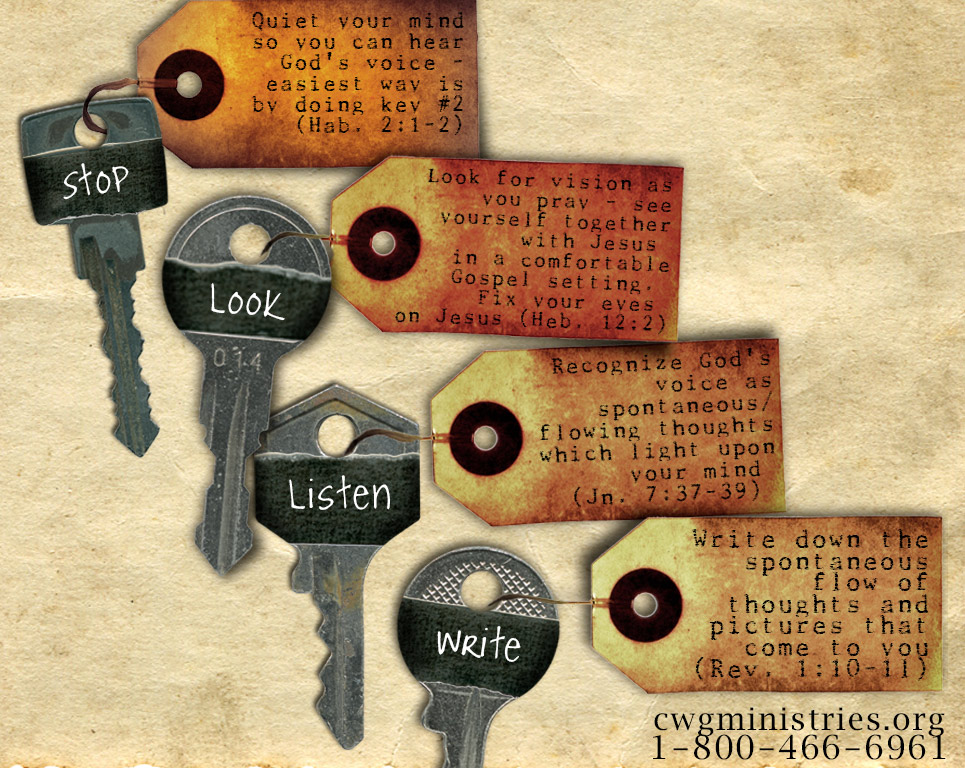
So I got up, went to my office, and He showed me that Habakkuk did four specific, simple things to hear God’s voice (Hab. 2:1,2). They are: stop, look, listen and write.
- Stop – Become still– “Went to my guard post” means he quieted himself down to listen and hear.
- Look – Look for vision – “Kept watch to see” means he was looking for vision.
- Listen – Recognize God’s voice as spontaneous thoughts – “What He will speak to me” means he recognized God’s voice. We define God’s voice as flowing or spontaneous thoughts, because John 7:37-39 says the Holy Spirit within is sensed as flow. Likewise God’s vision is flowing pictures.
- Write – Two-way journaling – “Record the vision” means he wrote down the flowing words and flowing pictures (visions) that were coming to him.
If you think about it, this is what we naturally do when conversing with a friend. We stop thinking about other things and put our focus on them; we look at them; we listen carefully; and when it is important, we write down what they are saying so we don’t forget it. It is completely normal and accepted to record words that we consider important, as for example, a stenographer would do in a courtroom. We are simply saying why not apply these steps to our conversations with God? Are not the words of our Lord to us the most important words we will ever hear?
So Who Else in Scripture, Besides Habakkuk, Used These Four Keys?
It is now 35 years later, and I hear the Lord speaking within me that I should take note that the four keys that Habakkuk used were used by others throughout Scripture, from Genesis to Revelation. So let’s take a look at ten individuals in the Bible who used these four keys and wrote over half the Bible.
The Apostle John used the same four keys when he wrote the book of Revelation. In Rev. 1:9-11 we see:
- Stop – “I was in the Spirit on the Lord’s day”
- Listen – “I heard a voice behind me saying”
- Write – “Write in a book”
- Look – “what you see”
King David was a man after God’s own heart and he certainly used the same four keys:
- Stop – “Be silent my soul before Him” (Ps. 62:1).
- Look – “I have set the LORD continually before me; Because He is at my right hand, I will not be shaken” (Ps. 16:8); “I saw the Lord always in my presence; for He is at my right hand” (Acts 2:25) means he saw the Lord with the eyes of his heart, with him constantly.
- Listen – After King David would quiet himself (i.e. Selah), God would speak. “Hear, O My people, and I will speak; O Israel, I will testify against you; I am God, your God” (Ps. 50:7).
- Write – David journaled out the details of the Tabernacle, and as he did, he said it was the Lord’s hand upon him (1 Chron. 28:19). In addition, he recorded many of his prayer times in the Psalms.
How about the Apostle Paul, did he also use these four keys?
- Stop – “… appeared to Paul in the night” (Acts 16:9)
- Look – “Was caught up into Paradise” (2 Cor. 12:4)
- Listen – “Heard inexpressible words” (2 Cor. 12:4)
- Write – Paul prayed for revelation (Eph. 1:17,18; Col. 1:9), and then wrote Ephesians and Colossians which are both FULL of divine revelation. I am convinced his epistles record the revelation Paul received from God during his prayer times.
How about Abraham, the Father of Faith – did he use the four keys?
- Stop – “A deep sleep fell upon Abram” (Gen. 15:12,13)
- Look – “The word of the LORD came to Abram in a vision…” (Gen. 15:1)
- Listen – “Now the LORD said to Abram, ‘Go forth from your country…’” (Gen. 12:1)
- Write – Since Genesis 15 was written by Moses, I am going to assume that Abraham recorded it in some way so it was available later for Moses to draw upon.
Moses used the four keys (Ex. 3:1-5).
- Stop – Moses said, “I must turn aside…”
- Look – He looked and behold the bush was burning.
- Listen – God called to him from the midst of the bush and said…
- Write – Moses wrote out this experience in the book of Exodus.
Did Isaiah use the four keys when he heard God’s voice?
- Stop – He wakens me morning by morning (Isa. 50:4)
- Look – “The vision of Isaiah the son of Amoz concerning Judah and Jerusalem, which he saw” (Isa. 1:1)
- Listen – For the LORD speaks… (Isa. 1:2)
- Write – Obviously he is writing it down, as that is how we got the book of Isaiah.
Jeremiah used the four keys to receive from the Lord.
- Stop – Jeremiah was a priest who was ministering before the Lord (Jer. 1:1)
- Look – “What do you see, Jeremiah?” … “I see a rod of an almond tree.” (Jer. 1:11)
- Listen – “The word which came to Jeremiah from the LORD, saying” (Jer. 30:1)
- Write – “’Write all the words which I have spoken to you in a book’” (Jer. 30:2)
Ezekiel used the four Keys (Ezek. 1:1-4).
- Stop – “While I was by the river …”
- Look – “As I looked, behold, a storm wind was coming …”
- Listen – “the word of the LORD came expressly to Ezekiel …”
- Write – He wrote the book of Ezekiel.
Daniel used the four keys.
- Stop – As he lay on his bed (Dan. 7:1)
- Look – “I was looking in my vision by night” (Dan. 7:1)
- Listen – “I approached one of those who were standing by and began asking him the exact meaning of all this. So he told me and made known to me the interpretation of these things” (Dan. 7:16)
- Write – He wrote the dream down (Dan. 7:1)
Peter used the four keys.
- Stop – “I was in the city of Joppa praying” (Acts 11:5)
- Look – “I saw a vision, an object coming down like a great sheet” (Acts 11:5)
- Listen – “I also heard a voice saying to me, ‘Get up, Peter; kill and eat.’” (Acts 11:7)
- Write – We have a biblical record of his encounter.
These biblical writers composed 663 chapters of the 1189 chapters in the Bible (over 50%). That is not to say that the rest of the writers didn’t also use these four keys. If we explored the Minor Prophets and discovered they also used the four keys of stop, look, listen and write that would add another 68 chapters to the total.
 New Life Narrabri