The Prettiest Sea Slugs Use Crystals in Their Skin as ‘Pixels’ of Colour

Nature05 April 2026

From sciencealert.com
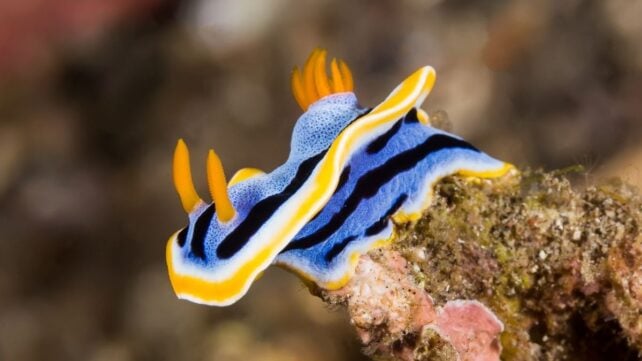
The Prettiest Sea Slugs Use Crystals in Their Skin as 'Pixels' of ColorNudibranchs such as Chromodoris annae stand out for their vibrant colors and varied shapes. (SirWat/iStock/Getty Images)

Nudibranchs are the jewels of the underwater world.

That’s not just a nice metaphor: Scientists have now discovered that the vibrant colors of sartorial sea slugs really are made up of thousands of tiny crystals embedded in their skin.

Biologists had long assumed that the eye-catching colorways sported by nudibranchs arise from pigment, the same way a toucan’s beak packs in its many hues, for instance.

But with a background in materials science rather than biology, researcher Samuel Humphrey of the Max Planck Institute of Colloids and Interfaces suspected that there was a lot more to these multi-colored molluscs than meets the eye.

By taking a closer look at six different species of nudibranchs, Humphrey and his collaborators have confirmed that pigments are not the only ‘paints’ in a nudibranchs’ pallet.

“We were surprised to find that nudibranchs use structural colors,” Humphrey says.

“Using this elegant color generation mechanism, these beautiful animals are able to generate an astounding array of colors from a single material.”
The Prettiest Sea Slugs Use Crystals in Their Skin as Pixels of Color
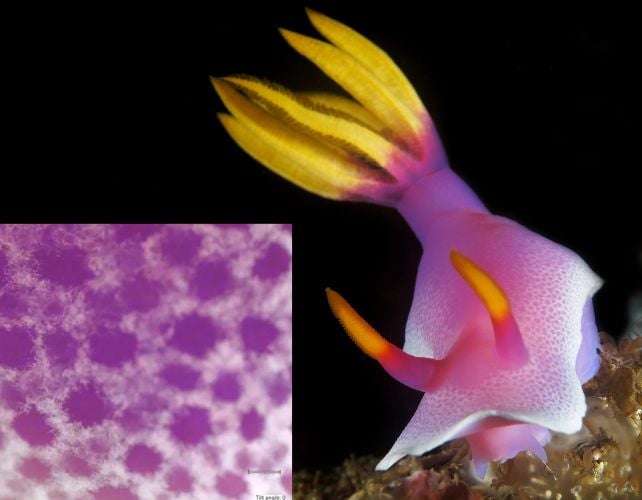
Hypselodoris bullockii and a highly-magnified view of the ‘pixels’ that make up its color. (Randi Ang/Moment Open/Getty Images. Inlay: Samuel Humphrey/MPI of Colloids and Interfaces)

Structural color is an effect of light reflecting off microscopic structures of a material. It’s seen in insects, chameleons, plantsseaweeds, and even oil slicks and bubbles.

Pigments, on the other hand, produce color by absorbing certain wavelengths of light and reflecting others, based on the chemical composition of the material, rather than its structure.

Yet, many colorful effects are achieved by combining pigment with structural color.

A male peacock’s tail, for instance, is pigmented brown, but because of the way microscopic structures in the feathers interfere with light, we see iridescent blues, greens, and purples, made all the more vibrant by their dull brown base.

In nudibranchs, it turns out, the structural color is formed mainly by nanocrystals of guanine molecules. The way these crystals are arranged, their length and angles, determines the particular color seen on a nudibranch’s skin.
The Prettiest Sea Slugs Use Crystals in Their Skin as Pixels of Color
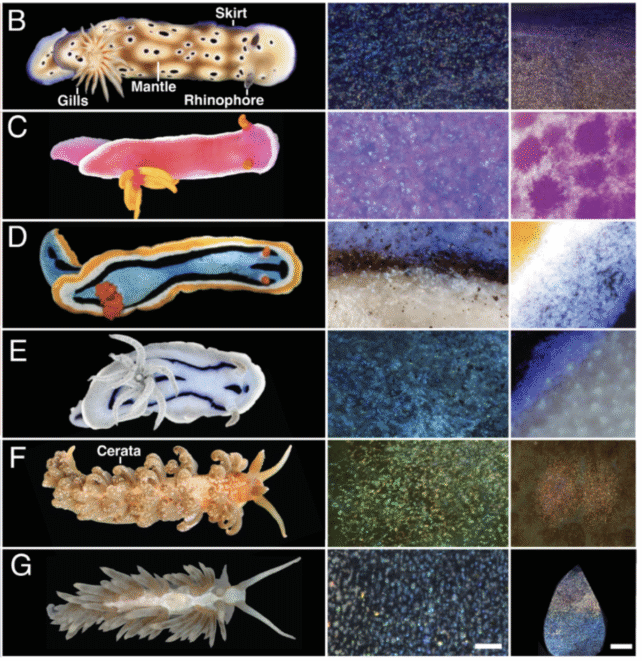
Digital microscope images showing structurally colored granules in H. tryoni, skirt (B), H. bullockii mantle (C), C. annae skirt (D), C. willani mantle (E), S. neapolitana ceras (F), and B. stephanieae ceras (G). (Humphrey et al., PNAS, 2026)

But usually, structural color is associated with iridescence, like the glitter of a butterfly’s wing or the sparkle of a jellyfish’s tentacle.

Part of the reason it’s so surprising that nudibranchs use structural color at all is that their markings often appear matte, flat, and bold – the qualities we usually associate with pigment-based color.

Humphrey and team found an answer to this as well.

Subscribe to ScienceAlert's free fact-checked newsletter

In a nudibranch’s skin, the guanine nanocrystals are stacked in layers within individual ‘pixels’ dotted across the surface.

If all the crystals within those pixels were neatly ordered and exactly identical, we would see an iridescent effect, but a degree of randomness in each pixel’s nanostructure helps to ‘flatten’ the color.

“They therefore reflect light of the same colors in very different directions, so that the colors do not shimmer like those of butterflies, but appear matte,” says Humphrey.

The guanine crystals allow nudibranchs to display bold, bright colors across the entire visible spectrum with just a few ‘tweaks’ of that structure between species.

Related: Scientists Recreate Rare Pigment Behind Octopus ‘Superpowers’

The discovery could explain how this family of animals have managed to evolve such a dazzling diversity of colors and patterns among themselves – and it could inspire new materials for human use, too.

“We often draw inspiration from nature when developing new materials and techniques,” says physicist Silvia Vignolini, also from Max Planck.

“It might be possible to develop sustainable colors based on the same principles which are used by nudibranchs.”

As if we could ever be as well-dressed as a nudibranch.

The research was published in Proceedings of the National Academy of Sciences.
Butterfly Paradise

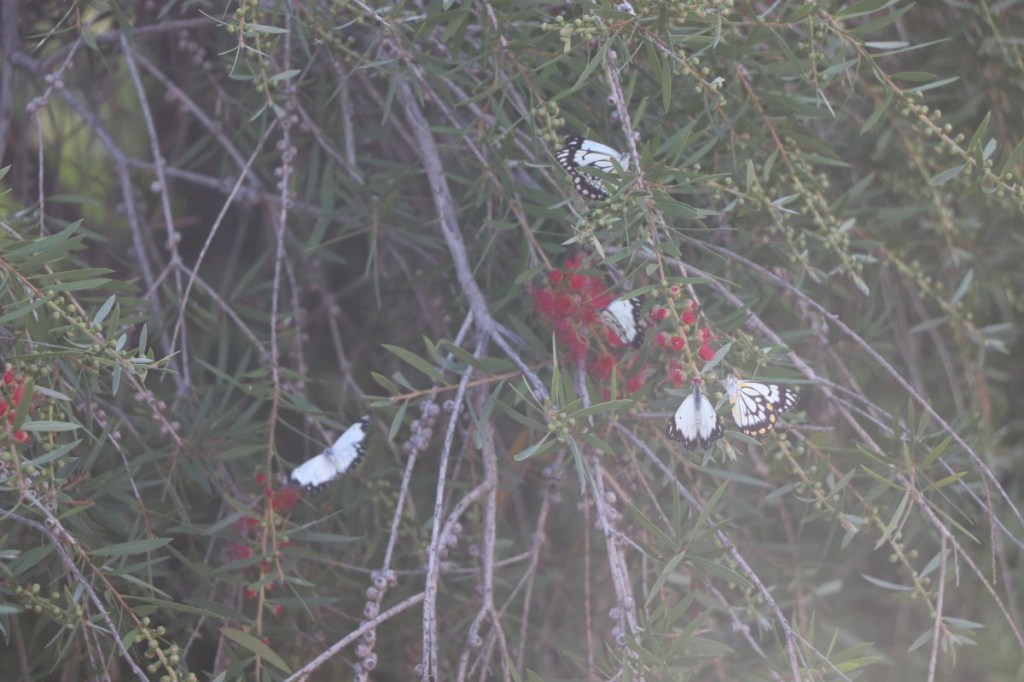
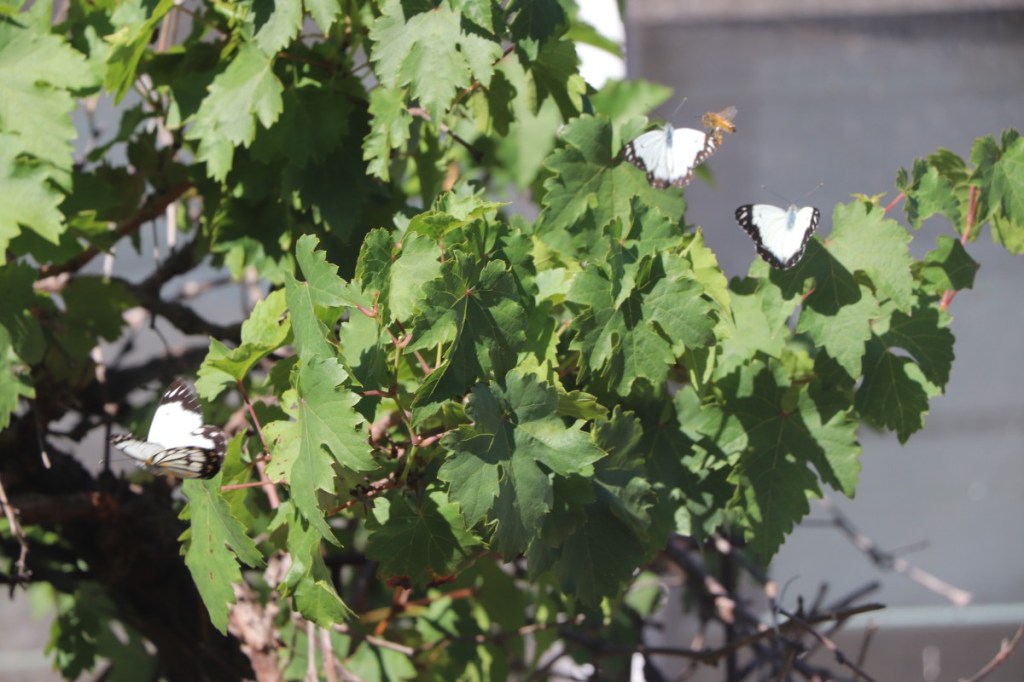
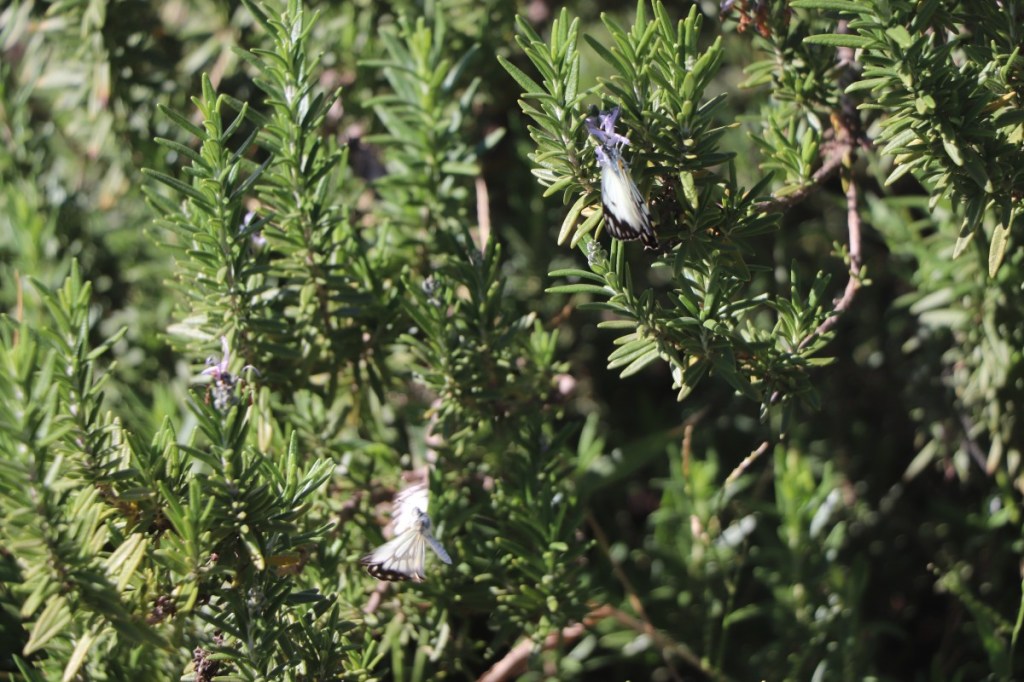
The return to good rainfall after a couple of years of drought has certainly inspired the local butterflies to get breeding. It is like being in one of those tropical butterfly farms in our garden.

Although the white ones are most prolific at the moment there are others as well. At one stage I found myself in a swarm of maybe 100 butterflies all fluttering by me.

I Like Turtles


turtle

A great journalistic triumph on the ABC this morning was the report on the all female hatching of green sea turtles at the northern end of the Barrier Reef. The study was funded by US weather agency NOAA , the Australian Government and WWF (the World Wildlife Fund), a notorious pusher for climate change propaganda. The research was carried out by scientists (I would use that word cautiously) from James Cook University, another institution devoted to the climate religion.

Anyway, using DNA samples from turtles in the wild they were able to trace where they hatched from and deduced that all turtles from the northern end of the reef born last year were female. We know that the warmer the environment the more likely the hatchlings are to be female.

The journalist asked a very wise question, “How much have temperatures here increased?”

There was a pause while the scientist was obviously thinking “Crap! We haven’t thought this through.” Eventually she said “We know that the average global temperatures have increased by 0.8 degrees since the 1880’s and we need to do more to fight climate change.”

We don’t know how the temperatures have changed at the place where the turtles are hatching, but they are obviously under threat because temperatures in other paces have increased a little since the Little Ice Age.

Being the modern journalist at the ABC, there was no pressing of the point.

Also I was intrigued by other questions that were not asked like:

  • How are the turtles at the other breeding sites doing? Are they producing males who then mix in with the wider population?
  • What role does habitat destruction play in the health or otherwise of the turtle population?
  • Since they were only measuring older turtles and working backwards, is it possible that there were in fact many males produced but something other than slightly higher temperatures was killing them?
  • Is it possible that the last two years of warmer than average temperatures were caused by something other than “climate change”?
  • If we stopped all CO2 production tomorrow would the turtles notice the supposed change in temperature?
  • How did the sea turtles survive the Medieval and Roman Warm Periods, not to mention other geological periods when temperatures were much higher?

Here is the problem for environmentalists. If you think that climate change explains everything that is bad in nature, then if there are other causes for bad outcomes focusing on “fixing” the climate will kill the very things you are trying to save.

What a pity we can’t get proper journalists and scientists to ask the necessary questions.

Amazing: Plants Adapting to Increased CO2

The CSIRO has found that plants around the world are absorbing more CO2 and doing it more efficiently than ever before. As the concentration of CO2 rises in the atmosphere all kinds of plants are growing faster, but using relatively less water to do so.

This confirms the satellite images showing that the world is greening.

Rising carbon dioxide is making the world’s plants more water-wise

Land plants are absorbing 17% more carbon dioxide from the atmosphere now than 30 years ago, our research published today shows. Equally extraordinarily, our study also shows that the vegetation is hardly using any extra water to do it, suggesting that global change is causing the world’s plants to grow in a more water-efficient way.

Water is the most precious resource needed for plants to grow, and our research suggests that vegetation is becoming much better at using it in a world in which CO₂ levels continue to rise.

The ratio of carbon uptake to water loss by ecosystems is what we call “water use efficiency”, and it is one of the most important variables when studying these ecosystems.

Our confirmation of a global trend of increasing water use efficiency is a rare piece of good news when it comes to the consequences of global environmental change. It will strengthen plants’ vital role as global carbon sinks, improve food production, and might boost water availability for the well-being of society and the natural world.

Read the full article here

The Amazing Wax Worm Eats Plastic!

This is amazing!

From the ABC

Wax worms biodegrade plastic bags at ‘uniquely high speeds’, study finds

Posted about 3 hours ago

Scientist and amateur beekeeper Federica Bertocchini picked parasitic wax worms from the honeycomb of her beehives and left them sitting in a plastic bag.

When she returned to the bag, it was riddled with holes and many of the worms had escaped.

It was that chance discovery that led her to collaborate with scientists at the University of Cambridge in England to unearth the possibility of using worms to munch through the world’s plastic problem.

The team discovered the wax worm, a caterpillar commercially bred for fishing bait, has the ability to biodegrade polyethylene — a type of plastic used to make shopping bags — at uniquely high speeds.

The degradation rate was extremely fast compared to other discoveries, like plastic-eating bacteria, the study published in Current Biology found.

When the team exposed about 100 wax worms to a plastic shopping bag, holes started to appear after 40 minutes, with a reduction of 92mg after 12 hours.

To compare: plastic-eating bacteria biodegraded plastic at a rate of 0.13mg a day, and it takes 100 to 400 years to degrade polyethylene in landfill.

Analysis showed the wax worms transformed the polyethylene into ethylene glycol, a chemical used to make polyester and anti-freeze.

The team of three scientists said the discovery could lead to a biotechnological approach to plastic pollution.

People around the world use about 1 trillion plastic bags each year, the study said, and more than 45 million tonnes of polyethylene plastics are produced annually.

“The caterpillar produces something that breaks the chemical bond, perhaps in its salivary glands or a symbiotic bacteria in its gut,” said Cambridge University’s Paolo Bombelli said.

“If a single enzyme is responsible for this chemical process, its reproduction on a large scale using biotechnological methods should be achievable.”

Wax has similar chemical structure to plastic

Wax moths lay their eggs inside hives where the wax worms grow on beeswax.

The worms are known for living like parasites in bee colonies and damaging hives by eating their wax comb.

Researchers said breaking down plastic and beeswax required similar types of chemical bonds.

“Wax is a polymer, a sort of natural plastic, and has a chemical structure not dissimilar to polyethylene,” Ms Bertocchini, from the Spanish National Research Council, said.

When the team mashed up the worms and smeared them into plastic they had similar degradation results to when the caterpillar “ate through” the plastic.

“The caterpillars are not just eating the plastic without modifying its chemical make-up. We showed that the polymer chains in polyethylene plastic are actually broken by the wax worms,” Mr Bombelli said.

“The next steps for us will be to try and identify the molecular processes in this reaction and see if we can isolate the enzyme responsible.”

Nature More Diverse Than We Know

So a scientist thinks that there could be 10 times as many species of plants and animals than we know.  This not only demonstrates the huge creativity of the Creator God, but it also puts the lie to all those ads by such mendacious groups as WWF and their ilk who make claims such as “70% of all animal species have died”- if we don’t even know how many there are now, how can we even guess at such a percentage?

From the ABC

Number of plant and animal species could be 10 times greater, Flinders University professor says

Posted about 2 hours ago

The number of different plant and animal species in the world may be 10 times greater than we think, according to a professor from Flinders University.

An Australian team has written to the journal, Nature, claiming the estimate of 8.7 million species could be just a fraction of the true figure.

Professor Mike Lee, an evolutionary biologist with the South Australian Museum and Flinders University, said it was a “known unknown”.

“Knowing how many different forms of life live on earth is probably one of the most fundamental questions a scientist can ask,” he said.

“Despite 300 years of taxonomy, there’s still vast disagreements and estimates range between 3 million and 100 million.”

Professor Lee said the processes to determine different species used to be quite superficial.

“What we’ve done in the main is look at animals with the naked eye, and sort them into piles, and each pile we think is a new species,” he said.

“But when we look at the piles really, really closely, using genetics, it turns out each pile isn’t really just a homogenous set of individuals.

“They might be very similar, but nonetheless subtly different species.”

Number of species in the world could be up to 90 million

He believes the real number could be closer to 90 million, and that is important for conservation efforts.

“If we thought there was only one African elephant, we might not be concerned that all the elephants in the forest were going extinct, because we might think there’s plenty of the same thing out on the savanna,” Professor Lee said.

“But of course if you know there’s two different species, and the African forest elephant is a unique and irreplaceable genetic and conservation resource, then you’d be really concerned if it’s going extinct.”

Professor Lee said it was not reassuring that there might be more species out there, because they could also be falling extinct without our knowledge.

His letter to Nature was co-written by Paul Oliver from the Australian National University.