WHAT MAKES A CHURCH GROW? UK RESEARCH SHOWS IT IS ENTHUSIASM FOR EVANGELISM

From “Eternity

There is a definite pattern in which church networks or denominations are declining or growing in the United Kingdom according to statistician John Hayward, a retired university maths lecturer.

His paper has been covered by The Times and reproduced by Christian websites like Anglican.ink.

Some churches are growing numerically in the UK, Hayward finds.

He has used the last five years of statistics to calculate the growth rate for churches. He finds that the Free Church of Scotland (Presbyterian) is growing slowly at less than 1 per cent a year, and the Vineyard network (a pentecostal network) is growing the fastest at 6 per cent a year.

Most of the churches founded before 1900 are declining – United Reformed at more than 4 per cent and the Church of England and Methodists at about 3 per cent a year.
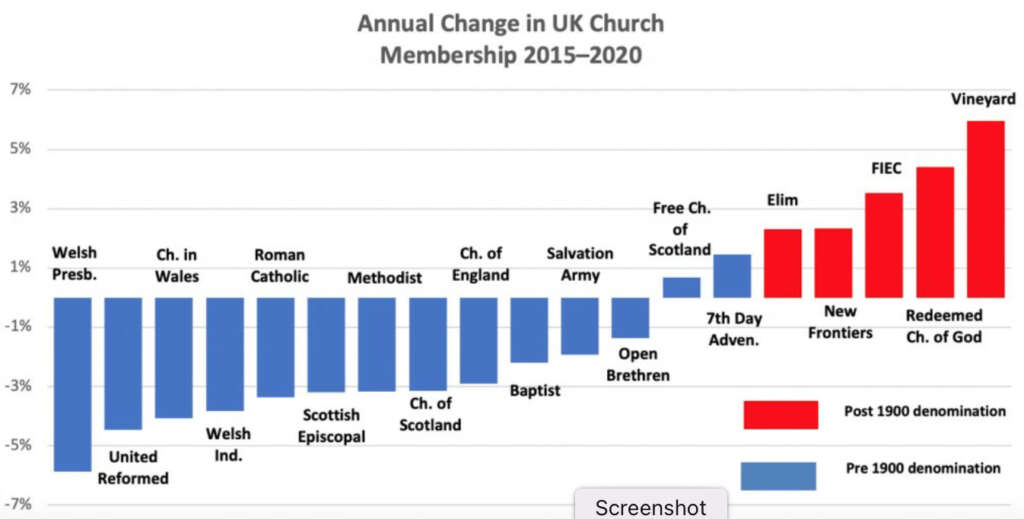
“Both decline and growth rates have stayed constant over many decades,” Hayward writes. “I could have presented a similar chart 20 years ago! The main factor in church decline is the lack of conversions. These churches then get older, and their losses get worse due to higher death rates. Why have the declining churches been unable to increase conversions? How have the growing churches been able to sustain conversions?”

It is about enthusiasm

We have become used to the statistical language of an “R” rate during Covid. Hayward uses membership numbers to calculate the “R” rate for churches.

“For churches, I call it the ‘Reproduction Potential’. If this number is less than one, enthusiasts fail to reproduce themselves, conversions are too weak and the church dies out (the shaded region, figure 2). If the reproduction potential is greater than one, conversions are strong enough to counter losses and the church may grow.”
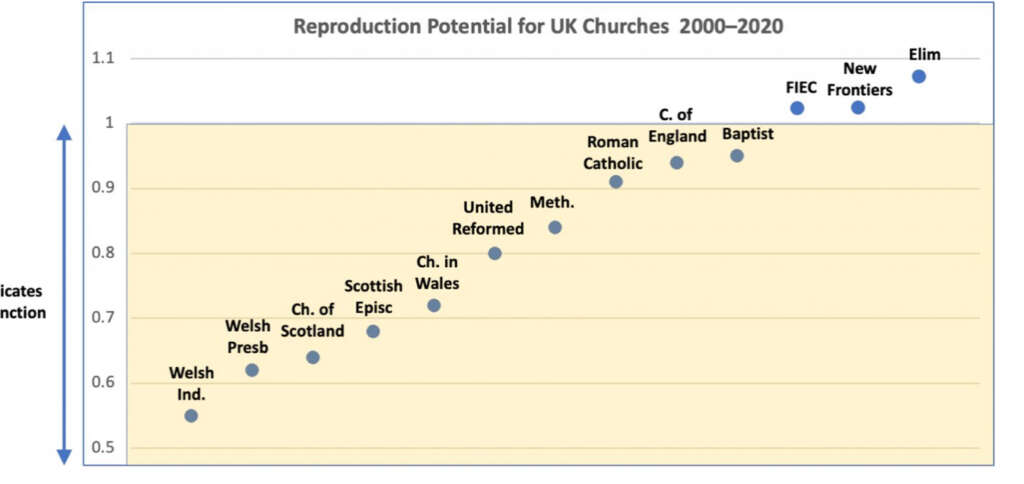
This graph is based on membership stats from 2000 to 2020.

How many people get converted depends on what he calls the “Limited Enthusiasm Model”. To stretch the Covid analogy, this indicates how many Christians are infectious spreaders of the good news.

“Three churches are increasing their numbers of enthusiasts: FIEC [Fellowship of Independent Evangelical Churches, conservative evangelicals [similar to the Australian group of the same name], Newfrontiers [Pentecostal] and the Elim Pentecostal Church,” Hayward notes. “Although their R numbers are only just over one, that is typical for social diffusion. If they maintain this potential to convert, they could reach five times their current number by the end of the century. But they would have to keep this value for 80 years. Quite a challenge!”

Will some churches cease to exist?

Hayward predicts most pre-1900 churches are in big trouble and headed for extinction. He sees the Baptists and the Church of England as the best placed to survive in this group, but with significantly reduced numbers.

He believes it is possible to predict extinction dates for one group of churches: those which are ageing.

“Membership data for ageing churches follow a downward straight line. [The graph below] shows a typical straight-line decline, predicting the United Reformed Church will become extinct by 2038.
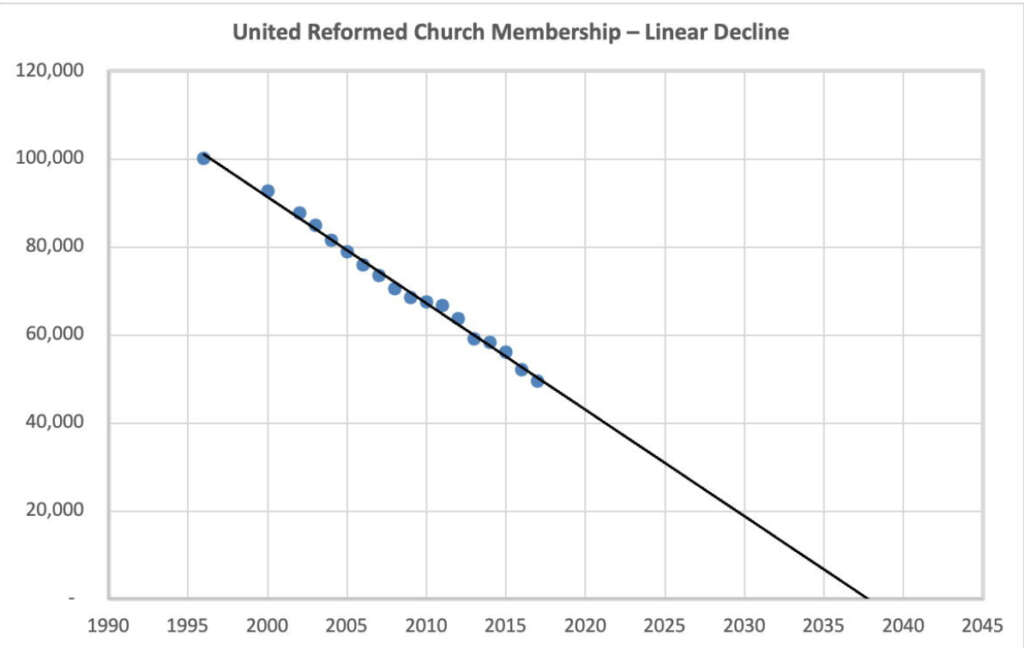
Churches with an R number less than one have time to turn around before extinction. Hayward suggests urgent prayer for revival. The Baptists and Open Brethren have until the end of the century. Catholics and the Church of England until 2060 or so.

The flavour of the church affects decline and growth

According to Hayward’s stats, the evangelical denominations and networks are more likely to grow, and more liberal/progressive ones decline.
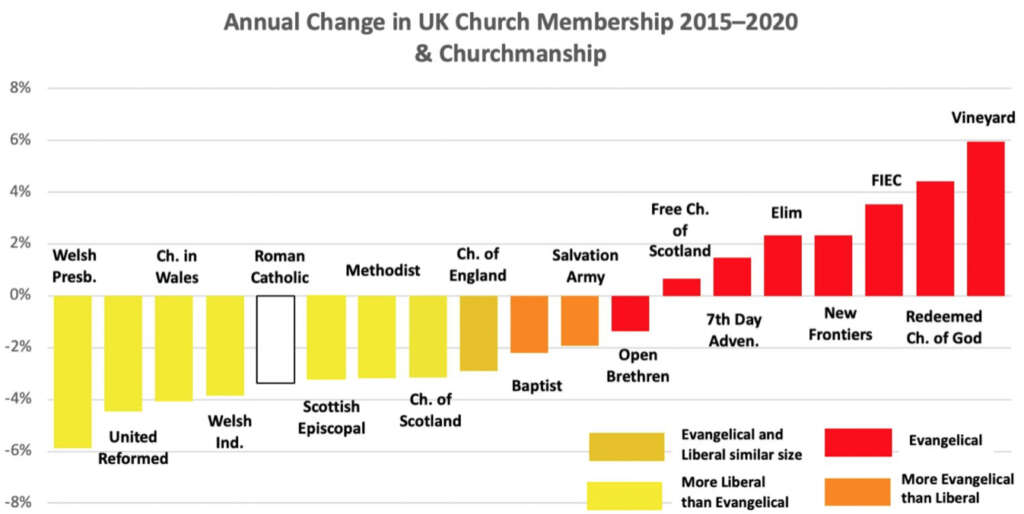
All the evangelical groups in Hayward’s lists of denominations and networks are growing, bar the brethren. Mixed (liberal/progressive and evangelical) and liberal/progressive churches are declining. In the graph, he has analysed the relative amount of evangelical presence in the mixed churches, and there appears to be a connection between growth and decline.

Hayward believes that God’s blessing may shift from older denominations to fresher proclaimers of the gospel.

“These products of the Reformation and Puritan times have run their course. They have fulfilled God’s purposes and are no longer part of his plan. The Church of England will cease to be a national church, and the Churches of Scotland and Wales will disappear by the middle of this century. Instead, God will work through the next cycle of denominations – Pentecostal and evangelical ones – picking up the pieces left by the extinct historic churches.”

It’s Not What You Think: The Best, Least Expensive Way To Grow Your Church

Phil Cooke writes:

It’s Not What You Think: The Best, Least Expensive Way To Grow Your Church

I’ve been visiting some remarkable churches lately. I’m talking about churches that were growing before the pandemic, then embraced the digital world during the pandemic, and now are back growing again after the pandemic.

In every case, they cited one powerful tool for growing the church – and it’s a tool that doesn’t cost a thing.

Related: TV Evangelist Salaries and Perks: is Nepotism in Ministry Okay?

Word of mouth.

That’s right. The fastest growing churches in America are growing because their people tell their friends about it. They recommend it. They can’t wait to share what’s happening.

From a purely marketing perspective, a 2019 report by Edelman discovered that 63% of consumers between 18 and 34 years old said that they “trust what influencers say about brands much more than what brands say about themselves in their advertising.” In other words, they trust their friends more than they trust advertisers. Other research reveals that what we call “seeded” marketing campaigns (those that use influencers to discuss brands online and with friends) can increase sales by up to 18%.

When people talk about something, their friends listen. And like I said, it doesn’t cost anything, but there’s one critical thing that needs to happen before word of mouth advertising kicks in:

There needs to be something happening at your church that gets people talking.

It happened to Jesus on a regular basis:

Matthew 4:25: Large crowds followed Him from Galilee and the Decapolis and Jerusalem and Judea and from beyond the Jordan.

Matthew 8:1: When Jesus came down from the mountain, large crowds followed Him.

Mark 5:21: When Jesus had crossed over again in the boat to the other side, a large crowd gathered around Him; and so He stayed by the seashore.

There’s plenty more but you get the idea. Those crowds didn’t come to hear Jesus because of the billboards, social media campaigns, or TV commercials. They came because they wanted to see what everyone was talking about.

What’s happening in your church that gets people talking? Are lives being changed? Are people experiencing God? Are they discovering something that’s been missing in their lives?

For all the church growth programs, marketing strategies and advertising, we too often forget the simple fact that when things are happening at your church that gets people talking, they invite their friends.

What will it take to get people talking about your church? Whatever it is, it’s time to start…

Chinese President ‘Terrified’ by Surge of Christianity, Fears Church Will Be 300 Million-Strong Within a Decade

From Caldronpool

The President of China is reportedly ‘terrified’ by the surge of Christianity across the nation and fears a 300 million-strong uprising within a decade.

Dr Ron Boyd-MacMillan, director of Strategic Research at Christian charity, Open Doors, told Express that Xi Jinping is becoming increasingly concerned about the growth of the Christian Church in China, which could reach 300 million people by 2030.

“We think the evidence as to why the Chinese Church is so targeted, is that the leaders are scared of the size of the Church, and the growth of the Church,” Dr Boyd-MacMillan said.Advertisement

“And if it grows, at the rate that it has done, since 1980 and that’s about between seven and 8 percent a year, then you’re looking at a group of people that will be 300 million strong, nearly by 2030.

“And, you know, the Chinese leadership, they really do long term planning, I mean, their economic plan goes to 2049, so this bothers them. Because I think if the Church continues to grow like that, then they’ll have to share power,” Dr Boyd-MacMillan added.

Last year, an international Christian watchdog organization for persecuted Christians worldwide, warned that the persecution of Christians in China is set to rise in 2021.

In its annual Persecution Trends survey, Release International warned that persecution is thriving in Communist China, which has gone unchallenged by the international community due to increased dependence on trade.

According to the organization’s partners: “The government of President Xi Jinping is increasing its ‘clean up’ of anything that does not advance the communist agenda. They appear to believe that they can achieve this by systematic opposition.”Advertisement

Release International’s website notes: “Tough new laws controlling religion have been imposed. Non-registered churches have been raided and closed in 2020, and increasing numbers of registered churches have been made to install CCTV cameras and put up posters proclaiming communist ideals and beliefs.”

The organization went on to accuse China of exploiting the pandemic in an effort to tighten restrictions on underground church gatherings.

Bob Fu of ChinaAid said: “The Chinese Government is trying every way to take advantage of the virus by increasing the crackdown against Christian churches. It has accelerated particular campaigns, such as the forced removal of crosses.”Advertisement

It’s estimated that there is currently between 60 to 100 million Christians in China.