
Let me hear of your unfailing love…
Scripture
They were completely amazed and said again and again, “Everything he does is wonderful. He even makes the deaf to hear and gives speech to those who who cannot speak.”
Observation
Jesus travels around the Gentile areas including Decapolis, the Ten Towns. A deaf mean with speech problems is brought to him, and the people beg Jesus to heal him.
Jesus takes the man away from the crowd. He’s puts his fingers in the man’s ears and puts spit on his tongue. He looks up to heaven and says, “Ephphatha”, which means “Be opened.”
Jesus tells the crowd not to tell anyone, but they spread the news. The man is instantly healed.
Jesus tells the crowd not to tell anyone, but they spread the news. They are amazed by what Jesus does.
Application
As much as Jesus was happy to heal people, His main concern was to preach the kingdom.
Some of the people were more interested in the wonders of the miracles than in the person of Jesus, or the message of salvation, They worshipped the sign rather than the person the miracles pointed to
We see that in the contemporary church at times. Crowds are attracted to the prophets and healing ministers. They want a “word” or a “miracle,” but they are less concerned with living for Jesus.
Some people, feeling under pressure from other people’s expectations, fake the prophecies and miracles. Then there is a crisis of trust in the church.
That could be avoided If we remembered that it is all about Jesus.
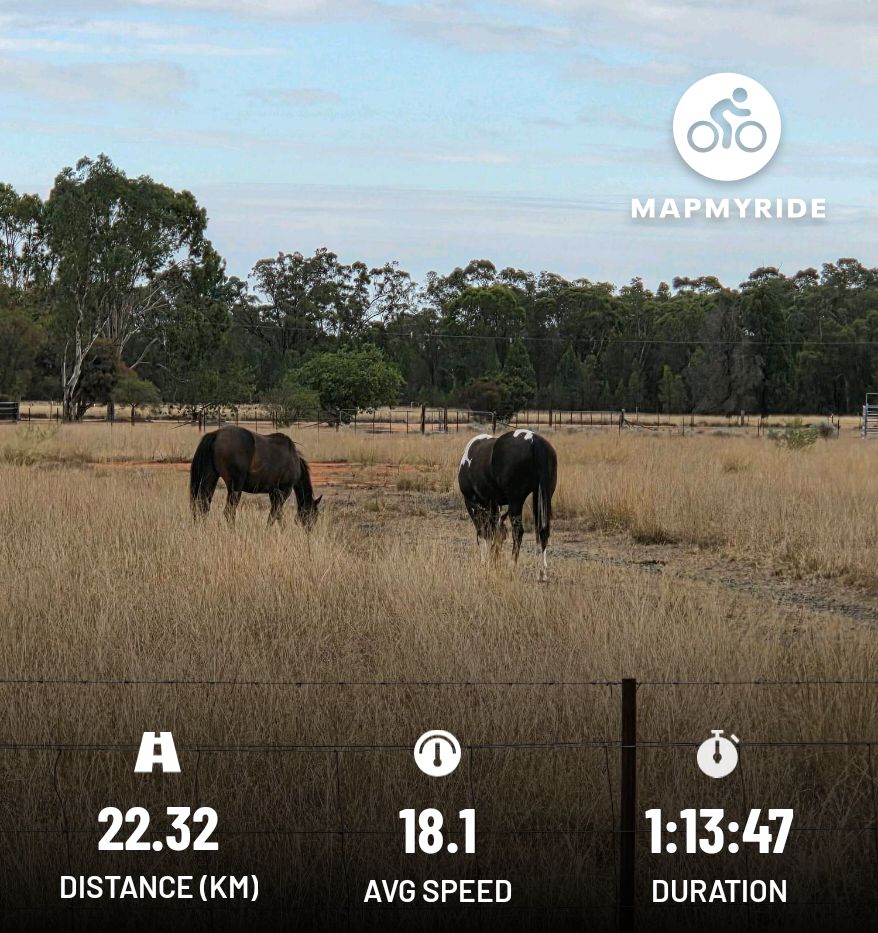
Overcast again, but pleasant enough to ride the bike. I rode to Jacks Creek and Gun Club Roads. #cycling #Narrabri

From Science Reports
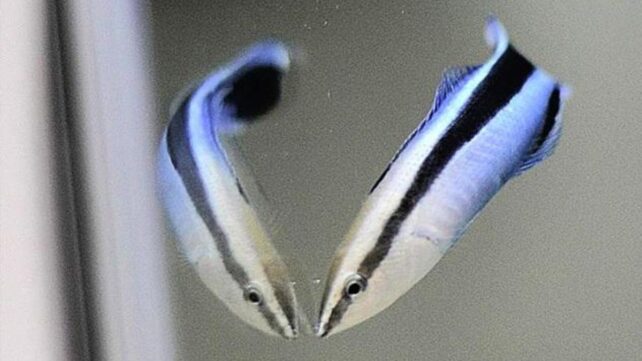
A cleaner wrasse in front of a mirror. (Osaka Metropolitan University)
A tiny fish has shown signs of a remarkable level of intelligence in mirror test experiments, not only recognizing itself in the reflection but also using a piece of food to explore how the mirror works.
Mirror mark tests are a standard scientific experiment used to explore animal self-recognition, gauging how similar other species’ intelligence might be to our own.
Fixing your smudged eyeliner on seeing your reflection is a clear sign of self-recognition. You know the smudge on your face is out-of-place, and you can use the reflection as a proxy for pinpointing exactly where to wipe the smudge away.
In theory, a reaction to an out-of-place mark in a reflection is assumed to be evidence of self-recognition for other animals as well. Chimpanzees, elephants, and dolphins are just some that have passed this mark test, which many regard as a sign of intelligence similar to our own.
The cleaner wrasse (Labroides dimidiatus) is a finger-sized marine fish that earned its name by eating the parasites and dead tissue it finds on other, larger fish. It was first reported to pass the mirror test in 2018.
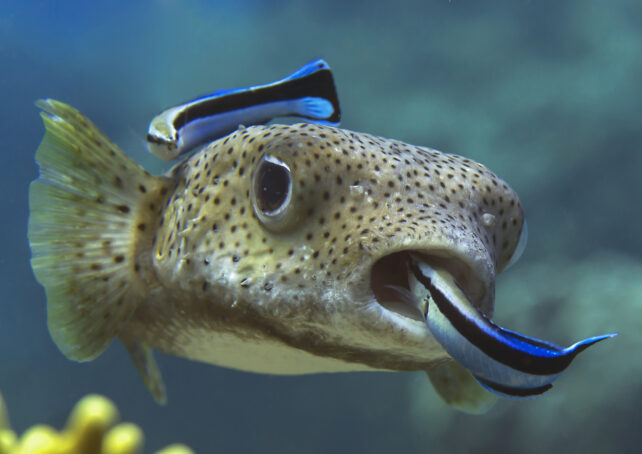
It’s not hard to see why the cleaner wrasse would make for a good candidate. Its modus operandi is cleaning stuff off fish, so perhaps if it saw a parasite-like mark on its own body, it would similarly be compelled to use the mirror to ‘freshen up’.
Though the 2018 study reported that the fish had passed, the mirror mark test’s founder, evolutionary psychologist Gordon Gallup, told New Scientist he believed the fish in these experiments were mistaking the marks on their own bodies for parasites on other fish.
Now, a team from Osaka Metropolitan University in Japan and the University of Neuchâtel in Switzerland has tweaked the experiment to test the wrasse’s self-awareness even further.
“In earlier cleaner wrasse mirror studies, the procedure was typically the fish see a mirror for several days, they habituate to it and stop reacting socially, and a mark is added,” animal behavioralist Shumpei Sogawa from Osaka Metropolitan University in Japan explains.
“In this study, the order was reversed; the fish were marked first, then the mirror was introduced for the first time. The fish were likely aware of something unusual on their body, but they couldn’t see it. When the mirror appeared, it immediately provided visual information that matched an existing bodily expectation, hence scraping occurred much faster.”
While it’s far from a perfect control, this goes some way to improving the initial experimental design, giving the fish time to identify the ‘parasite’ on their own body before encountering their reflection.
The scientists were surprised by how fast the fish reacted in these new experiments: on average, they tried to rub off the ‘parasite’ within about 82 minutes. This, they say, implies self-awareness before being exposed to the mirror.
After the fish had several days to get used to the mirror, the scientists noticed some performing an unusual behavior. They would pick up a little piece of shrimp from the bottom of the tank, carry it over to the mirror, and drop it.
As the mirror-shrimp fell in sync with the real thing, the fish followed the reflection closely, touching the mirror surface with their mouths.
Sogawa and team believe this is the fish’s way of exploring the mirror’s properties, using an object separate from themselves to better understand how the reflected images work.
This kind of ‘contingency testing’ and mirror tool use has been observed in several other species that failed the mark-based mirror test, including pigs, rhesus monkeys, manta rays, and corvids.
Related: Cephalopods Pass Cognitive Test Designed For Human Children
“The findings from this research will likely influence not only academic issues, such as revising evolutionary theory and constructing concepts of self, but also directly impact matters relevant to our lives, including animal welfare, medical research, and even AI studies,” says biologist Masanori Kohda, who was involved in both this new study and the original paper on cleaner wrasse self-recognition.
The team says these findings suggest self-awareness, once thought to be unique to great apes, is actually a skill that may have arisen in a much wider range of animals, including fish.
“Our results suggest that self-awareness evolved at a minimum with the bony fishes (450 million years ago) and is likely widespread across vertebrates,” they write.
The research was published in Scientific Reports.
Through our faith-eyes we can look at our situation from God’s perspective and know that our greatest ‘impossibility’ is a small thing for the Creator of the universe, for with God nothing is impossible! Retha McPherson


Scripture
She begged him to cast out the demon from her daughter.
Observation
Jesus leaves Galilee and goes to the region of Tyre. Although he tries to keep his location secret, word gets out. Right away a gentile woman comes and falls at his feet. She asks Jesus to cast a demon fomr her daughter.
Jesus teases her by saying Jesus teases her by saying, His first mission is to the Jews.
The woman replies that even the dogs eat the crumbs from the children’s plate.
Jesus commends her faith and tells her the the demon has left her daughter.
Application
Jesus’ authority is over all things and is available to all people.
No doubt this woman thought there was a process to go through. Often exorcisms were lengthy procedures and sometimes involved inflicting great pain on the victim. The idea was, that, by making the body uncomfortable, the evil spirit would be forced to leave.
Here, Jesus doesn’t even speak a command. His promise to the woman carries all the authority, of the Creator of all things including evil spirits, and it is sufficient to cause the demon to leave.
I have found from the times of spiritual warfare that I have engaged in, that a simple command, “Go in the name of Jesus” is enough.
The Holy Spirit in us is the presence of God, the authority of God.
Listen
Lord, is there more you need to say to me about this episode?
Keith, this lovely lady and precious daughter were involved in the making of purple dye, which that region was famous for.
They used dogs to find the snails that were the source of the dye, and these dogs were honoured in that town because they were a source of wealth. I talked to her about dogs, knowing that this was not insulting like it would have been in Israel.
The evil spirit had got in because of a gate way opened by idol worship. After that day, they never worshipped a false god again.
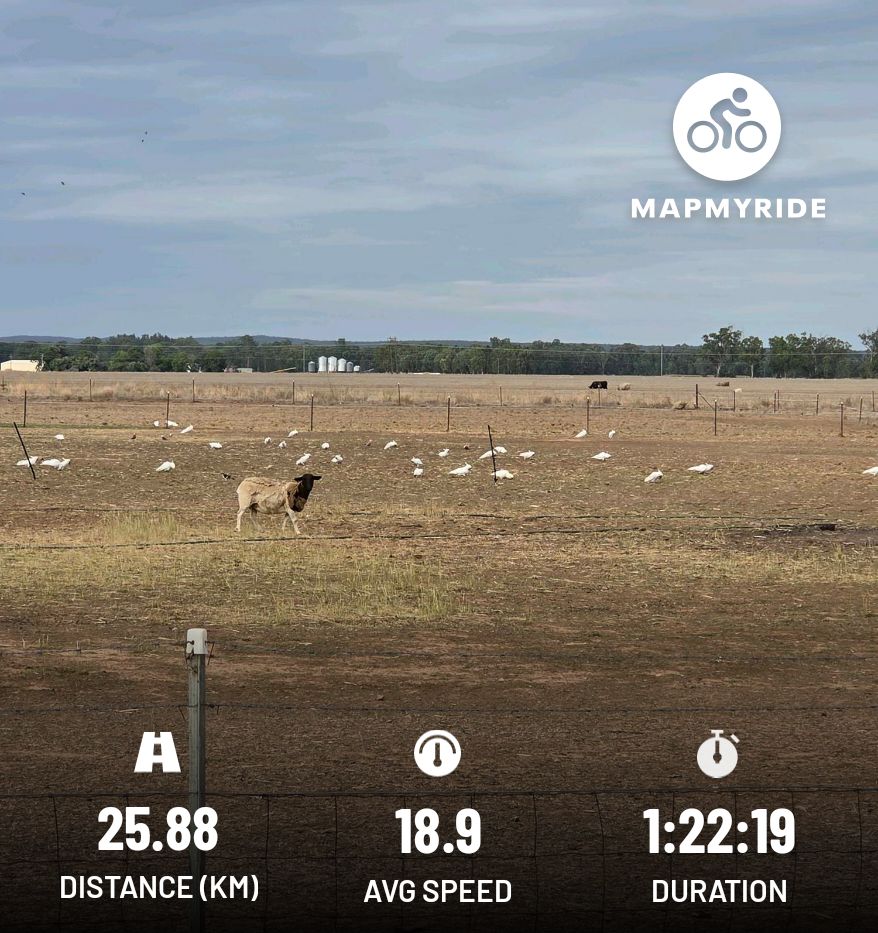
Somebody is growing a fine crop of cockatoos. They must have used good quality bird seed. It was a bit windy, but a pleasant ride to the end of Haire Drive. #Narrabri #cycling
 New Life Narrabri