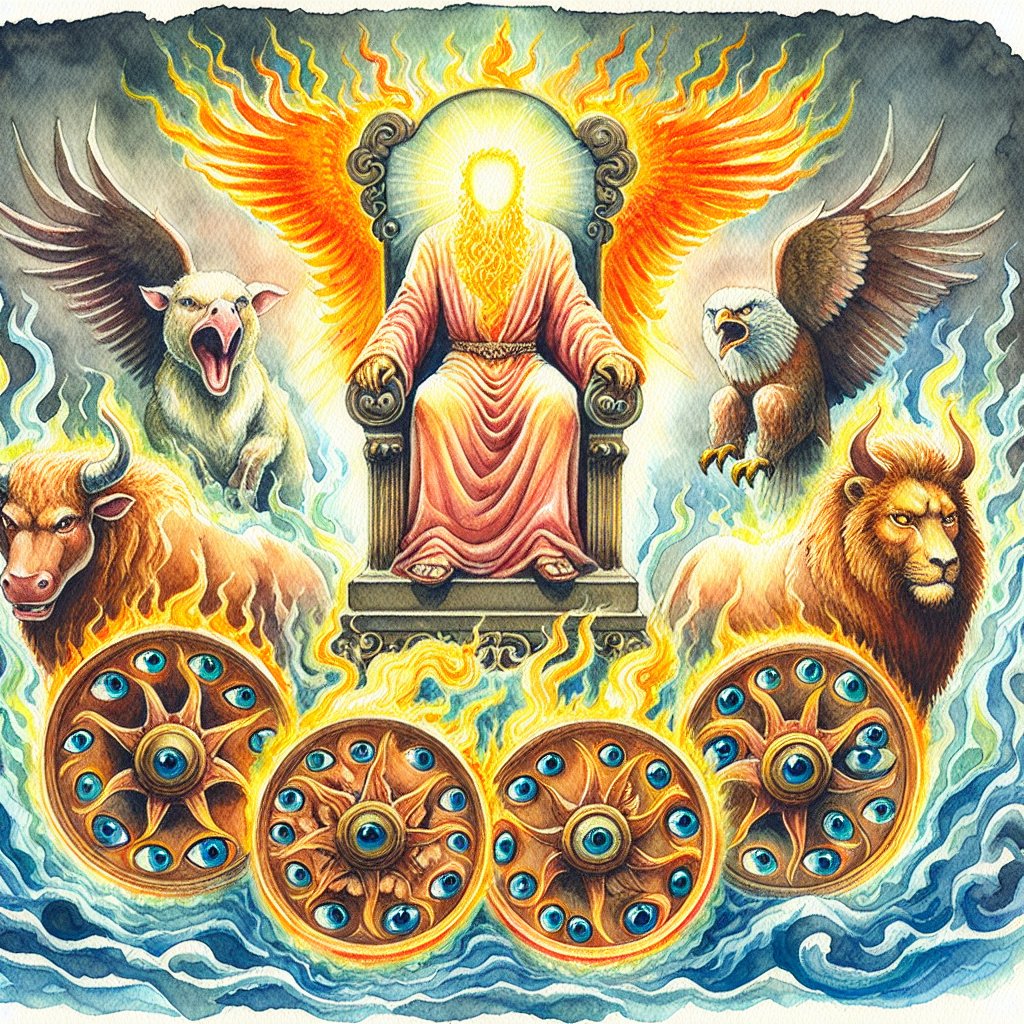
“For I am the Lord! If I say it, it will happen. There will be no more delays, you rebels of Israel. I will fulfil my threat of destruction in your own lifetime. I, the sovereign Lord, have spoken!”
Observation
The Lord tells Ezekiel to enact an exile. He is to bring a few items such as an exile would bring. He is to leave the house through a hole in the wall. As he walks away, he is to cover his face so he cannot see the land he is leaving.
Then Ezekiel is to explain this to the people. The people even Zedekiah will leave Jerusalem to go into exile. Even Zedekiah will leave through a hole in the wall carrying a pack. He will cover his face and not see the land he is leaving. He will be captured and taken away, but he will not see the land of the Babylonians.
People say that time passes and prophecies come to nothing. The Lord will change this proverb because whatever the Lord says will come to pass. There will be no delay. The time has come for every prophecy to be fulfilled.
Application
Whenever the Lord gives a prophetic message, it will come to pass. In fact, this was one of two tests that God gave to Moses to determine if a prophecy was really from the Lord.
There were many prophecies about the coming exile. These had not yet come to pass, so people were thinking the Lord was not going to act.
But the Babylonians did come and with them came famine, disease and death.
Everything the Lord does comes at the right time. If we believe God has said something and it seems to be delayed, it will happen at a time we do not expect and in a way that we could never have imagined.
Even when there is a prophetic word that is given, we must wait in faith, knowing that God will do what He says.
Listen
Lord, what do you want to say to me about this passage?
Keith, the key is to trust me and to know that I always keep my promises.
In its time I will do it swiftly. What seems to be slow and delayed is not. Every good thing that I have promised will come to pass.
The Wonders of Breastfeeding Commemorating World Breastfeeding Week
While breastfeeding has been an instinct and ability to many women post-pregnancy for millennia, many are unaware of the biophysical wonder that this process entails. In an attempt to call attention to the benefits of breastfeeding, August 1–7 has been designated as World Breastfeeding Week: a campaign led by the World Alliance for Breastfeeding Action (WABA) and supported by the World Health Organization (WHO), and the United Nations Children’s Fund (UNICEF). The official theme for 2026 is: “Breastfeeding for a Sustainable Start in Life: Strengthen What Works”, emphasizing the link between long-term health and the practice of breastfeeding.
Editorial: Human milk, nutrition and infant development, volume II (Francisco Perez Cano, Frontiers in Nutrition and Metabolism, 16 March 2026). Breastfeeding is much more than just an instinct. This article explores the scientific marvels of breastfeeding, its benefits for both infants and mother, and the inadequacy of evolutionary explanations for its complexity.
Interesting Facts About Breastmilk Comparing Humans with other Mammals
Mammals are defined by their ability to produce milk, and this trait is nearly universal across the class. There are about 6,500 recognized mammalian species, and virtually all of them produce milk to nourish their young. Among human populations in the USA, the Centres for Disease Control and Prevention (CDC) estimates that around 85% of babies are breastfed, but only 25% are exclusively breastfed through 6 months.
Breast milk is also one of the few foods in nature that can be described as nutritionally complete for the young of its kind. It contains proteins for growth, fats for brain development, carbohydrates for energy, vitamins and minerals for metabolic balance, and bioactive compounds that regulate immunity and digestion. This completeness underscores its role as the “gold standard” of infant nutrition.
While humans are among those classified as mammalian species given their lactation abilities, human breastmilk is distinct among mammals because it is specialized for slow, brain-centred growth rather than rapid physical development. It contains much less protein than cow’s milk, protecting infants’ kidneys while still meeting nutritional needs.
Its higher whey-to-casein ratio makes it easier to digest, and it delivers a full suite of immune factors (including antibodies, human milk oligosaccharides (HMOs), and living cells) that actively shape the infant’s microbiome and immune system. HMOs are a distinctive feature, as these complex sugars feed beneficial gut bacteria, block pathogens from binding to intestinal cells, and help train the immune system. In contrast, calves and lamb milk are denser in protein and fat, reflecting their need for fast growth and early mobility.
Another key difference lies in mineral bioavailability: although human milk has fewer minerals overall, they are absorbed more efficiently in human infants than those in cow’s milk. Human milk also contains tailored fatty acids such as DHA (docosahexaenoic acid: An omega-3 fatty acid critical for brain and eye development) and ARA (arachidonic acid: An omega-6 fatty acid that is essential for cell membrane structure, immune signaling, and growth, proportioned for optimal brain and eye development). In contrast, other mammals’ milk lacks active immune cells.
More Wonders of Human Breast Milk
One of the most astonishing features of breastfeeding is the breast’s ability to adjust both the volume and composition of milk according to the baby’s age, stage, and even health status. Scientific studies have shown that during feeding, tiny amounts of the baby’s saliva can flow back into the breast ducts. This process is known as retrograde milk flow, and it allows the mother’s body to “read” the infant’s immune status and tailor antibodies, white blood cells, and other protective factors in the milk.
Ongoing research into the unique properties of breastmilk continues to reveal new insights into just how important this production is for health. In a recent article titled: The human breast milk microbiome: a landscape review of its composition, origins, and impact on infant health (Rumiana Koynova-Tenchov), Archives of Microbiology. (22 June 2026), the unique microbiome systems from breastmilk, is described as “one of the earliest and most consequential sources of microbial colonization in the infant gut.” The consequences of missing these microbiomes are described as follows by the author:
“Disruptions to this microbial community have been associated with conditions such as infant colic, atopic disease, and obesity.”
These observations show that breastmilk is a highly responsive engineering architecture, as it signals the existence of a feedback loop between mother and child. While many animals produce milk, the adaptive immune tailoring through backflow is most clearly documented in humans. Although in animals, milk composition also changes across lactation stages, the fine-tuned immunological dialogue observed in human breastfeeding appears unique.
But how did such amazing engineering originate?
The Evolutionary Story of Breastmilk
From an evolutionary perspective, the story is that milk production originated in early synapsids (an ancient group of vertebrates thought to include all modern mammals and their extinct relatives defined by a distinctive skull feature: a single temporal opening behind the eye socket). According to the evolutionary timeline, this was over 200 million years ago. The theory goes that breastmilk production began as a skin secretion that kept eggs moist and protected, and that, over time, this secretion became nutritionally enriched, eventually evolving into true lactation. This adaptation is said to have allowed mammals to provide a consistent, internal food source, freeing them from dependence on external environments and giving their offspring a survival advantage.
Evolutionary literature also tries to explain the divergence in milk composition among mammals as having arisen through natural selection acting on offspring survival strategies. Human milk is said to have evolved to support slow growth, prolonged dependency, and intensive brain development, reflecting evolutionary pressures favouring long-term survival and cognitive capacity in a species with extended childhood. For other mammals, evolutionary literature teaches that milk composition diverged as a direct response to ecological pressures and life-history strategies, with each lineage optimizing lactation for its young’s developmental priorities.
However, in the context of the complexities of breastmilk, these evolutionary explanations raise many unanswered questions and concerns, including:
How does appealing to selection pressures account for the origins of breastmilk? (The fact is: There can be no selection without there being something to select from.)
How could the complexity and universality of milk across mammals have arisen by chance?
The precise tailoring of milk composition to each species’ developmental needs is far more reasonably interpreted as evidence of purposeful creation rather than evolutionary trial and error.
Benefits for Mothers
As much as breastfeeding is beneficial for infants, the benefits to the mother should not be overlooked, as it profoundly impacts maternal health. Among the benefits include the release of oxytocin during nursing stimulates uterine contractions, which helps the uterus return to its pre-pregnancy size and reducing postpartum bleeding. The energy demands of milk production contribute to gradual weight loss, aiding mothers in regaining their pre-pregnancy body composition.
Long-term benefits are equally significant. Women who breastfeed, especially beyond age 30, show reduced risks of breast and ovarian cancers. The protective effect is thought to arise from hormonal regulation and reduced lifetime exposure to estrogen. Breastfeeding also lowers the risk of type 2 diabetes and cardiovascular disease, making it a preventive health measure for mothers as well as a nurturing act for infants.
Breastfeeding and Sustainability
Given the mutual benefits between mother and child, the 2026 theme of World Breastfeeding Day is appropriate, emphasizing sustainability. After all, in addition to its biological benefits, breastfeeding is a natural, renewable resource requiring no additional packaging, no transportation, and no industrial processing. In a world grappling with resource scarcity, and health inequities, breastfeeding therefore stands out as a practice that surpasses synthetic options in both quality and sustainability. While some mothers face constraints in breastfeeding and must rely on alternatives, we also celebrate the fact that breastmilk offers a template for continuous improvement of alternatives available.
Blessings in the Bosom
It is amazing that scientists continue to discover new benefits of breastfeeding as an age-old practice. In breastfeeding we see God’s providence embodied, as the adaptive intelligence of breast milk, its completeness, and its protective power testify to divine wisdom.
As we celebrate World Breastfeeding Week 2026, we are invited to marvel at this gift, to strengthen the systems that support it, and to honour the God who designed it. Breastfeeding is indeed a glimpse of divine love expressed through the bond between mother and child.
Prayer is our link to God. Therefore, prayer is the most important activity in which we can engage. Prayer is supposed to be powerful, effective, and meaningful in our lives. Yet many times it is nothing more than a dutiful recitation of the items on our prayer list. We need to learn how to make prayer what it should be—a dynamic dialogue with the Lover of our souls. Mark Virkler
The sermon for August 9th 2026 is now available on the New Life web site.
In this sermon, which is based on Revelation 12:1-18, Margaret Bates talks about “The Power of Your Testimony.” She is joined by Matt Cochrane who shares his testimony of what Jesus has done in his life,
Click here to listen in your browser or to download the mp3