Love…
The claim that “Palestine” was hijacked by Israel inverts reality. It was the Arab world that hijacked the label, transforming it frrom a neutral geographic term into a weaponised political narrative. Danny Burmawi


Scripture
Then Jesus said, “I am. You will see the Son of man seated at the place of power at God’s right hand and coming on the clouds of heaven.”
Observation
Jesus is taken to the home of the high priest, where all the priests, elders and teachers have gathered. Peter follows at a distance and enters the high priest’s courtyard,
The Jewish leaders are trying to find something to condemn Jesus for. They arrange false witnesses, but they contradict one another. Finally, they have some men come to say that Jesus said he would destroy the temple and three days later make another one not made by human hands. But even these could not agree.
Finally, they ask Jesus to defend himself. He tells them that he is the Messiah and they will see him seated at God’s right hand and coming on the clouds of heaven.
The high priest says that they need no other witnesses. The Council determines that Jesus is guilty of blasphemy and must die.
Application
Jesus, in the middle of his trial, speaks succinctly about his identity,
The phrase ‘I am’ is in Greek, the translation of the Hebrew name for the Lord, that is Yahweh. He is declaring that he is God.
The Son of Man is a title for the Messiah.
He will sit at God’s right hand is a declaration that he is the King of Kings, the one who wields God’s authority in the world. This took place when Jesus rose from the dead and then ascended to heaven.
Jesus said he would come on the clouds of heaven. Some people say this is about the end times, but Jesus said those present would see it. “Coming on the clouds of heaven” is a term for divine judgment. This judgment happened when the Romans destroyed the city of Jerusalem, including the temple in AD 70.
The Jewish leaders rejected the Messiah they had been waiting for, and said God rejected them.
Listen
Lord, what do you want to say to me about this passage?
Keith, people do not like to think about my judgment of them. They treat me as some insignificant benevolent being. My love for them is real, but so too is my revulsion of sin. Every sin must be atoned for, either by the blood of Christ or the blood of the sinner.
These men knew this. They knew that Messiah would come and replace law with love, commands with grace, duty with joyous submission. They knew this. They knew the Scriptures, but they pursued narrow self-interest instead of pursuing Me. They rejected my Kingdom for the sake of man’s empire.
I have been seeing an increasing level of criticism of The Passion Translation lately. Here is one article that graciously summarises some of the key issues with this version or paraphrase of the Bible
Written By Dr. Michael Rydelnik
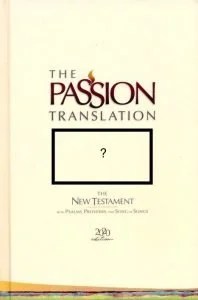
Was one of your New Year’s resolutions to read through the Bible this year—or maybe just to read more of it? People have asked me if it would be good to use a fairly new version called The Passion Translation this year. This is not the first time I’ve been asked about it.
On the first day of class recently, I told students they needed to bring a Bible to class every day, and then specified which versions were acceptable. One student said she read The Passion Translation and wondered if that would be okay for class. When I said no, she was deeply disappointed because she loves it so much. Since this version is gaining in popularity, I thought it would be good to go over the reasons we should put caution signs around this new version.
The Passion Translation styles itself as “a new heart level translation using Hebrew, Greek and Aramaic manuscripts that expresses God’s fiery heart of love to this generation, merging the emotions and life-changing truth of God’s Word.” It is the labor of love of Brian Simmons, who styles himself the “lead translator” of this project. From everything I can tell, he is a fine man who loves the Lord and sincerely wants to help people grow in the Lord. So, although I find The Passion translation deeply problematic, none of my criticisms of this version should be taken as disparagement of Brian Simmons personally. These critiques are about the translation not about the translator. So why be cautious about using The Passion Translation?
First of all, The Passion Translation is not even a translation but a paraphrase, and one that takes more liberties with the Scriptures than other paraphrases do. People use other paraphrases like the original Living Bible by Ken Taylor or Eugene Peterson’s The Message. Paraphrases have their place but they are problematic. By fashioning the words of Scripture into modern terms, they frequently veer away from Scripture. A good example of this problem is found in 1 Kings 20:11. In the NASB, it reads, “ Let not him who girds on his armor boast like him who takes it off,” but the Living Bible reads, “Don’t count your chickens before they’re hatched.” The paraphrase doesn’t hurt but it’s clearly interpretive. The problem occurs when a paraphrase uses its interpretive style to take liberties with the text and teaches a particular theological viewpoint. That’s what the Passion Translation does. Brian Simmons holds to an egalitarian view of men and women in ministry and marriage, and his paraphrase reinterprets the meaning of the words to reflect his own view. He also repeatedly uses words and phrases that are significant in the hyper-charismatic world, even when they’re not in the text of Scripture.
Second, The Passion Translation is an idiosyncratic version of the Scriptures. By that I mean, it veers from the normal approach to Bible translation which uses a team of scholars to check each other’s work. This way a translation doesn’t reflect one person’s distinctive perspective but the actual meaning of the words of Scripture. All translations require some sort of interpretation—but using a translation team guards a translation from weird or problematic translations. Although Brian Simmons identifies himself as the lead translator, there’s no mention of the other translators he’s leading. It’s the work of Brian Simmons and no one else. As a result, it contains his idiosyncratic views of the Bible and not a mainstream understanding of it.
Third, The Passion Translation uses the wrong manuscripts to guide it. Although it claims to be based on the Hebrew, Aramaic, and Greek, Simmons declares that the version’s unique translations are derived from the original Aramaic New Testament texts. Since the New Testament was written in Greek, what is he talking about? Well, he means that in the gospels, Jesus and all the other people there would have spoken Aramaic. So Simmons at times conjectures at what the Greek New Testament would have been had it been written in Aramaic. Then he uses that speculation to translate. Other times he uses the Syriac version, translated 500 years after the gospels, which is not even Aramaic, and calls this “the original Aramaic.” This approach is not a translation of the Bible but pure speculation. No other translation or paraphrase has ever done this before.
Fourth, The Passion Translation contains lexical errors, particularly in the Hebrew. The reason is that Simmons claims that he received a vision with guidance for translating the Hebrew words. The unique idea was that he should base the translation on Hebrew homonyms. A homonym is a word that sounds or is spelled the same but has different meanings. For example, in English, the word “pen” may mean an area where animals are kept or a writing instrument. We know which meaning by context. Simmons doesn’t recognize the meaning of a Hebrew word in context but claims that all the homonyms of the Hebrew words are correct and uses all of them with their multiple ideas in his translation. This special approach is unique to The Passion Translation because it is so wrong that no other translation would dare do it.
Finally, bizarre claims are made to justify The Passion Translation. For example, Simmons claims that the Lord came to him in a vision, touched his forehead and enlarged his brain, so he could understand the Bible as no one ever had before. When struggling with the Hebrew, Simmons claims an angel visited him and guided his translation. I suspect every seminary Hebrew student wishes that could happen. Simmons also claims that the footnotes of his Bible are inspired. Simmons may actually believe these assertions but they are so far-fetched and therefore, deeply concerning to me.
The Passion Translation is popular because of the way it makes people feel. But it’s far better to read the Scriptures themselves and only allow the actual, real meaning to affect our emotions. According to Hebrews 4:12, God’s Word alone is “living and active and sharper than a two-edged sword, and piercing as far as the division of soul and spirit, of both joints and marrow, and able to judge the thoughts and intentions of the heart.” It’s in the true words of the Bible itself that we find the power to renew our minds and change our lives. Let’s stick to that.
Just as Lebanon’s Christian sovereignty was rejected for daring to rule Islamic land outside of Sharia, so too Israel is rejected for daring to exist as a sovereign Jewish nation on territory once claimed by Islam. Danny Burmawi

Scripture
‘Why didn’t you arrest me in the temple? I was there among you teaching every day. But these things are happening to fulfill what the Scriptures say about me.”
Observation
Judas arrives in the garden of Gethsemane with a crowd of armed men. Judas had arranged to identify Jesus by greeting Him with a kiss. Judas goes to Jesus as arranged and the others grab Jesus to arrest Him.
Jesus asks him, “Am I some dangerous revolutionary that you come to arrest me like this?” Nevertheless, these things are necessary to fulfill the scripture”
Then all the disciples run away in panic. One of them, believed to be Mark, loses his robe in the chaos and runs away naked.
Application
Jesus challenges His captors by saying they could have arrested Him at any time, but they chose to come under cover of darkness, and in doing so, they fulfilled the scriptural prophecies.
Jesus was not just an innocent man who fell foul of the religious authorities. No, He was the promised Messiah, the Son of God, the presence of God in human form.
Jesus came into the world to die for sinful people. He paid the price so that we don’t have to.
The whole process of the arrest, the show trials, the suffering and crucifixion was all planned by God from the beginning. He is the Lamb of God who was slain from the foundation of the world.
Because God paid such a big price for the salvation of all people, then we can understand that He loves each one of us, with a love that is too big to really comprehend. All we can do is say, “Thank you, Lord.”
Listen
Lord, what do you want to say about to me about this passage?
Keith, this scripture is a reminder that even when I appear to be weak, I am still stronger than all of the plans of men. They could have come in the daytime, but they were scared of people. So like the sons of darkness that they are, they came at night.
Even outnumbered, I was stronger than all of them, because I am the Creator God. I chose to go to the cross willingly, not by being forced. It was always my plan.
I laid down my life. It was not taken from me. I laid it down so that all people from all nations and all times can understand that this is my love for them.

