Apostolic Summit 2022 – Session 1

Session 1- John Alley

“Kingdom Culture” is a phrase that is often used but not defined. Claimed that apostles will bring “Kingdom Culture”.

Something is missing in much teaching about the apostolic. People want to be “as one” but not be one.

Kingdom Culture

Nation of priests

Priesthood – represents God to men, men to God, offers sacrifices.

Ex 19:6 you shall be to me a kingdom of priests.

Rev 1:6. He has made us a people and priests

1 Peter 2:9

The believers were one in heart and mind Acts 4:32.

We must love one another as God has commanded

The more excellent way is the way of love and is the heart of the apostolic message, and of Kingdom Culture

When you get apostolic grace you move into higher levels of love.

The purpose of the moves of Holy Spirit is to bring maturity of love.

Apostles are here to move church from institutional to relational basis. This is the central purpose of apostolic movement.

Restoration of apostles is about the restoration of the apostolic nature of the church. It’s not about what we do but about how we relate. Submission is central.

You cannot come to maturity in Christ without a revelation of love. Without love, spirit of sonship and community we cannot get close to fullness of Christ. The role of apostles is to help church find this perfect love.

Reflection on 2 Timothy 4:1-8

Scripture

And now the prize awaits me – the crown of righteousness, which the Lord, the righteous Judge, will give me on the day of his return. And the prize is not just for me but for all who eagerly look forward to his appearing.

Observation

Paul urges Timothy to preach the word of God always, whether time is favourable or not. He is to patiently rebuke and encourage his people.

A time is coming when people will not want to listen to good teaching, but will look for teachers who will give the message they want to hear. They will reject truth and prefer myths.

Paul’s life is coming to an end, poured out like a drink offering to the Lord. He has fought the good fight and run the race. The Lord will reward him with a crown of righteousness, a prize that is not just for him, but for all who look forward to His coming.

Application

We have a huge future ahead of us. In our materialistic culture we find it so hard to think of anything beyond this physical life. But there is so much more that awaits us.

There is a prize for finishing the christian race. If we persevere to the end, we will get to heaven. We will enter an eternity of life and joy in the presence of God.

What we perceive dimly and occasionally we will see completely and for ever. The presence of God, which we experience sometimes with great excitement and as a concrete reality but other times we struggle to even think about, it will become as real as the sun and the moon. The light of God will outshine the noonday sun every day.

One day we will enter into God’s welcome, “Well done good and faithful servant.” What a great joy that will be.

Prayer

Thank you Lord for the assurance of eternal life and eternal happiness in your presence. Please help me to remember this coming prize even when my life is a struggle. Amen.

WHAT MAKES A CHURCH GROW? UK RESEARCH SHOWS IT IS ENTHUSIASM FOR EVANGELISM

From “Eternity“

There is a definite pattern in which church networks or denominations are declining or growing in the United Kingdom according to statistician John Hayward, a retired university maths lecturer.

His paper has been covered by The Times and reproduced by Christian websites like Anglican.ink.

Some churches are growing numerically in the UK, Hayward finds.

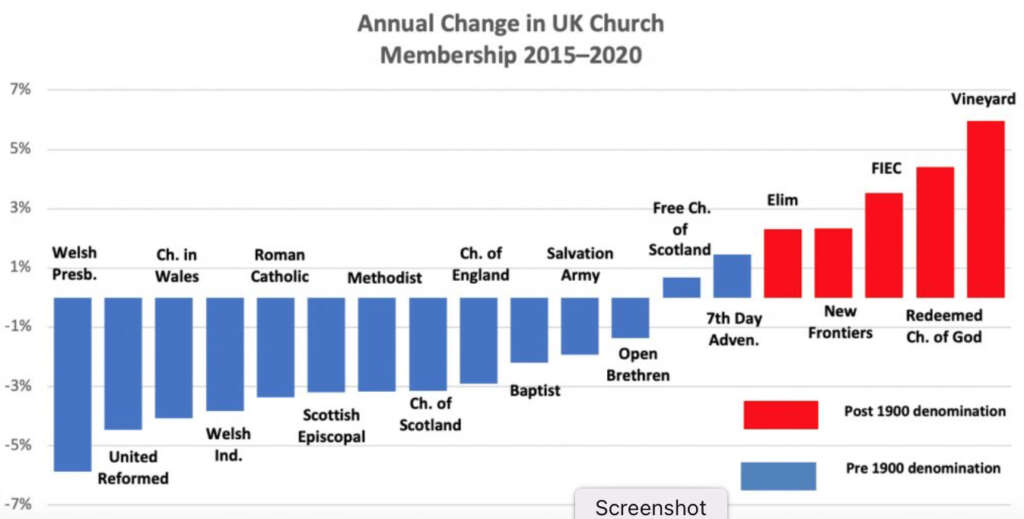
He has used the last five years of statistics to calculate the growth rate for churches. He finds that the Free Church of Scotland (Presbyterian) is growing slowly at less than 1 per cent a year, and the Vineyard network (a pentecostal network) is growing the fastest at 6 per cent a year.

Most of the churches founded before 1900 are declining – United Reformed at more than 4 per cent and the Church of England and Methodists at about 3 per cent a year.

“Both decline and growth rates have stayed constant over many decades,” Hayward writes. “I could have presented a similar chart 20 years ago! The main factor in church decline is the lack of conversions. These churches then get older, and their losses get worse due to higher death rates. Why have the declining churches been unable to increase conversions? How have the growing churches been able to sustain conversions?”

It is about enthusiasm

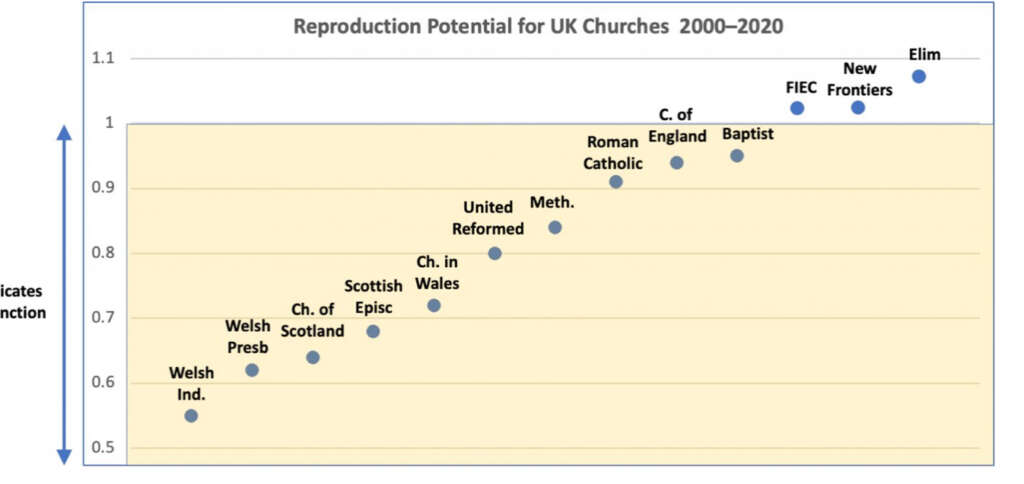
We have become used to the statistical language of an “R” rate during Covid. Hayward uses membership numbers to calculate the “R” rate for churches.

“For churches, I call it the ‘Reproduction Potential’. If this number is less than one, enthusiasts fail to reproduce themselves, conversions are too weak and the church dies out (the shaded region, figure 2). If the reproduction potential is greater than one, conversions are strong enough to counter losses and the church may grow.”

This graph is based on membership stats from 2000 to 2020.

How many people get converted depends on what he calls the “Limited Enthusiasm Model”. To stretch the Covid analogy, this indicates how many Christians are infectious spreaders of the good news.

“Three churches are increasing their numbers of enthusiasts: FIEC [Fellowship of Independent Evangelical Churches, conservative evangelicals [similar to the Australian group of the same name], Newfrontiers [Pentecostal] and the Elim Pentecostal Church,” Hayward notes. “Although their R numbers are only just over one, that is typical for social diffusion. If they maintain this potential to convert, they could reach five times their current number by the end of the century. But they would have to keep this value for 80 years. Quite a challenge!”

Will some churches cease to exist?

Hayward predicts most pre-1900 churches are in big trouble and headed for extinction. He sees the Baptists and the Church of England as the best placed to survive in this group, but with significantly reduced numbers.

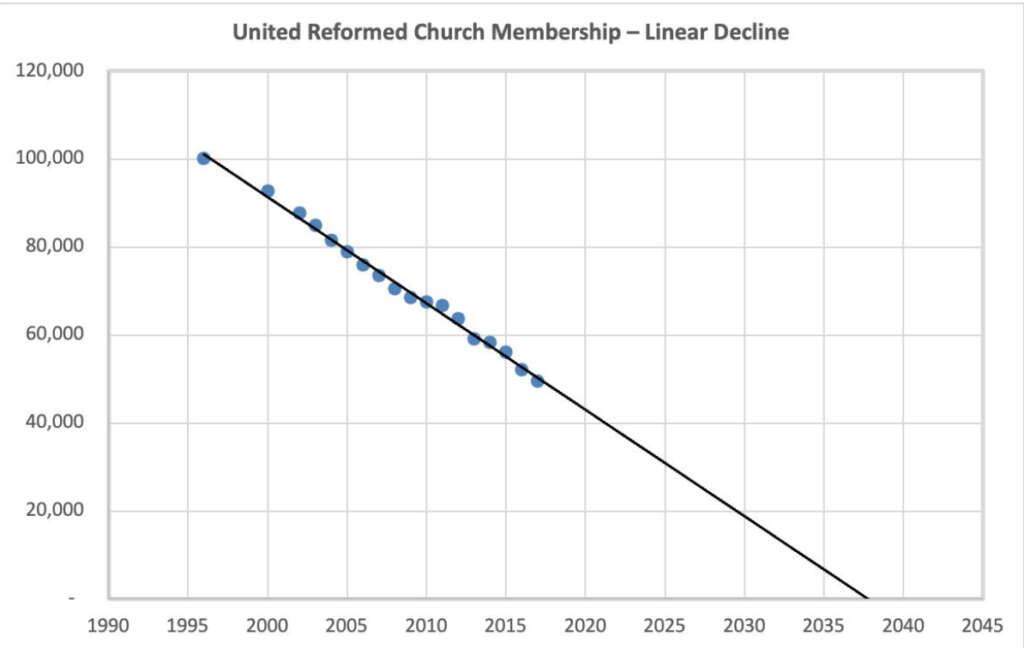
He believes it is possible to predict extinction dates for one group of churches: those which are ageing.

“Membership data for ageing churches follow a downward straight line. [The graph below] shows a typical straight-line decline, predicting the United Reformed Church will become extinct by 2038.

Churches with an R number less than one have time to turn around before extinction. Hayward suggests urgent prayer for revival. The Baptists and Open Brethren have until the end of the century. Catholics and the Church of England until 2060 or so.

The flavour of the church affects decline and growth

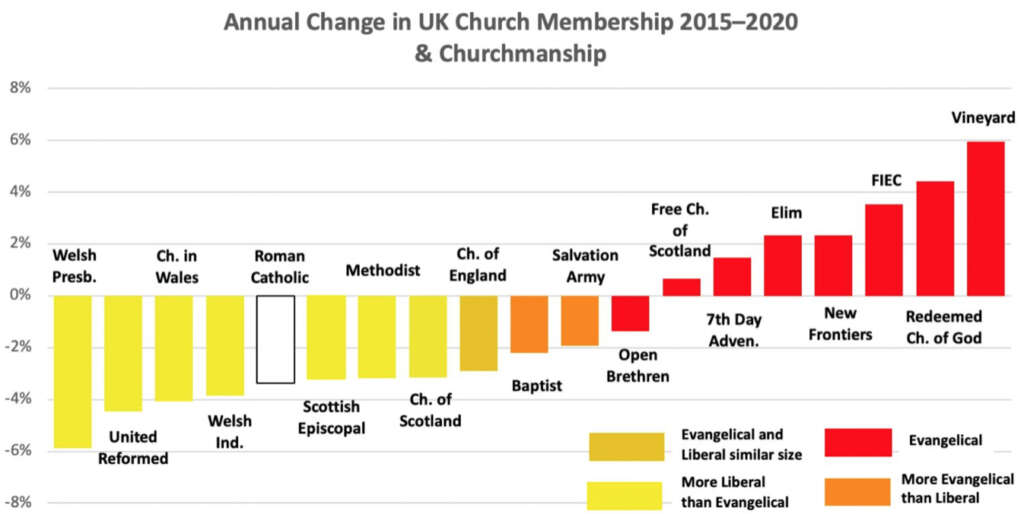
According to Hayward’s stats, the evangelical denominations and networks are more likely to grow, and more liberal/progressive ones decline.

All the evangelical groups in Hayward’s lists of denominations and networks are growing, bar the brethren. Mixed (liberal/progressive and evangelical) and liberal/progressive churches are declining. In the graph, he has analysed the relative amount of evangelical presence in the mixed churches, and there appears to be a connection between growth and decline.

Hayward believes that God’s blessing may shift from older denominations to fresher proclaimers of the gospel.

“These products of the Reformation and Puritan times have run their course. They have fulfilled God’s purposes and are no longer part of his plan. The Church of England will cease to be a national church, and the Churches of Scotland and Wales will disappear by the middle of this century. Instead, God will work through the next cycle of denominations – Pentecostal and evangelical ones – picking up the pieces left by the extinct historic churches.”

Reflection on 2 Timothy 3:10-17

Scripture

All Scripture is inspired by God and is useful to teach us what is true and to make us realise what is wrong in our lives. It corrects us when we are wrong and teaches us to do what is right.

Observation

Timothy knows Paul. He knows Paul’s faith and his purpose in life. He knows about the persecution that Paul has suffered at the hands of evil people and impostors.

Paul exhorts Timothy to be faithful in the things that he has been taught. Timothy has been taught the Scriptures since childhood, and these gave him the wisdom to receive salvation.

All scripture is inspired by God, and it is useful to teach us and correct us, as well as preparing us for every good work.

Application

All Scripture, the entire Bible, is inspired by God. The words that we read are God’s words to us. The understanding and wisdom that we gain our God’s wisdom.

The Bible is good to equip us for every good work in Christ. It shows us what is God’s message for the world. It teaches us the values and attitudes that we should carry in our everyday life.

The Bible is good for confronting our sins and destructive attitudes. It convicts us about where we have grieved God and teaches us how to repent and get back to friendship with God.

We need to read the Bible with the grace of the Holy Spirit. It is no good reading it with human reason. It is God’s Word, not just a human book, and so it must be interpreted to us by the Holy Spirit.

Prayer

Dear God, thank you for your special word, the Bible. Help me to read it and to receive the life-changing message it carries. Amen.