But Jesus didn’t trust them because he knew human nature. No one
needed to tell him what human nature was really like.
Observation
Jesus goes to Jerusalem for the Passover celebration. He sees the
merchants selling animals for the sacrifices and the money changers.
He makes a whip and chases the animals and the traders out of the
Temple.
The disciples remember the Scripture that says, “Passion for your
house consumes me.”
The leaders demand a sign that Jesus has done this under God’s
authority. He tells them if they pull down the temple, he will
rebuild it in three days. They don’t realise that he is talking
about His body.
Application
Many people were claiming to trust in Jesus, but He didn’t trust
them. He knew human nature.
People claim to be disicples of Jesus for all kinds of reasons.
Sometimes it is for social standing or to make business contacts.
Sometimes it is out of a religious spirit.
There
are many people who, to all outward appearances, are dedicated
christians. They believe the
gospel, and may even do many good works in the church. For some
reason the head knowledge of the facts of the gospel does not
translate to the heart. When pressure comes on, they don’t cope as
we might expect, because the outward behaviour has changed but their
heart has not changed.
When
Jesus comes in He changes our heart. Our life is changed for ever
from the inside out.
Nobody
can live the christian life out of their own strength. We need the
new heart and the new mind that only Jesus can give through the
indwelling Holy Spirit.
Prayer
Lord, I thank you for not just forgiving my sins but for giving me a
new heart. You are making every part of my life new. Thank you. Amen.
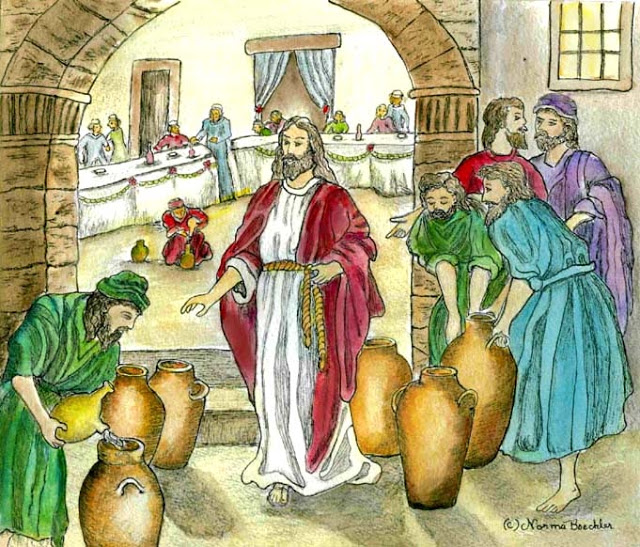
This miraculous sign at Cana in Galilee was the first time Jesus
revealed his glory. And his disciples believed in him.
Observation
Jesus and His disciples are invited to a wedding celebration in Cana
in Galilee. The wine runs out, and Mary, Jesus’ mother, tells
Jesus. She then instructs the servants to do whatever He tells them
to do.
Jesus tells the servants to fill with water the jugs used for
ceremonial washing. They do this, and when the water is sampled it is
found to have been changed into wine, in fact the best wine.
This is the first sign in which Jesus showed His glory.
Application
In the first chapter, the story is about people testifying about
Jesus. Now the focus changes to be about signs and glory.
Jesus revealed His glory through changing water into wine. That is,
the miracle pointed to the fact that Jesus is God, not just a human
religious leader.
Wine is a symbol of the Holy Spirit, for the joy and peace that come
from the presence of the Spirit in us. Jesus is the one who gives the
Holy Spirit to His disciples.
The wine is literally new wine and is a sign of the new things that
God is doing in His kingdom.
Turning water into wine without the benefit of grapes is truly a
miracle, and shows that Jesus is the Lord over creation.
All of this takes place at a wedding, the symbol of God’s ongoing
love and commitment for His people.
Jesus is Lord of all creation. He is the giver of the Holy Spirit and
the bringer of God’s Kingdom.
The disciples believed in Him as a result of this sign. Perhaps they
previously accepted that Jesus is the Messiah, a human being anointed
by God for the restoration of Israel. But after this, they believed
in their hearts that Jesus really is God’s Son.
Prayer
Lord, you take the ordinary things of life and make them
extraordinary. May my life today be a sign of your glory. Amen.
Then he said, “I tell you the truth, you will see heaven opened and
the angels of God going up and down on the Son of Man, the one who is
the stairway between heaven and earth.”
Observation
Philip goes and tells Nathanael that he has found the Messiah.
Nathanael is sceptical at first because nothing good comes from
Nazareth. But he goes with Philip anyway.
Jesus greets Nathanael with the words, “Here is a genuine son of
Israel.”
Nathanael is intrigued and asks Jesus how He knows about him. Jesus
replies, “I saw you under the fig tree when Philip found you.”
At this word of knowledge, Nathanael recognises that Jesus really is
the Son of God.
Application
This story illustrates a three step process for a person coming to
faith in Jesus:
1. Somebody brings a person to see Jesus,
2. There is a supernatural encounter
3.
The person recognises and confesses that Jesus is the Lord.
It is not enough for a person to come to a church service. They must
have a genuine encounter with the Lord.
Jesus goes on to reveal that He is the stairway to heaven. He enables
angels and people to ascend to heaven on Him.
This is clearly a reference to the encounter that Jacob had at Bethel
(“the house of God.”)
Jesus is the one who enables us to get to heaven. He is the one and
only way of salvation.
The way to heaven is not a religious observance or a belief system.
We can recite the Apostles’ Creed, learn the whole gospel of John
by heart, even fast for forty days. These are all good things, but
they will not, of themselves, get you to heaven.
The way to heaven is a person- Jesus Christ. When we put our trust in
Him, then we will be saved.
Prayer
Lord Jesus, through your death on the cross, you became the stairway
that joins heaven to earth. You are the Way, the Truth and the Life.
Amen.
Here is my commentary on Ephesians 1:9. I am publishing these once or twice a week, but you can read all of the available articles at our web-site.
Ephesians 1:9
“For he has made known to us in all wisdom and insight the mystery of His will , according to His purpose which He set forth in Christ.”
God has given us knowledge of His will and purpose in Christ.
Knowledge was important to the Greeks and to many in that culture. People still say to this day, “Knowledge is power.”
This applies not just to the human realm but also to the spiritual realm.
The early church faced multiple threats to its theology from groups collectively called Gnostics to whom knowledge was eternal life. There were many Gnostic sects which blended elements of various religious systems, but they had a common thread. The basic belief was that the physical world is evil and the heavens are pure, and we can only be redeemed by secret knowledge (gnosis) which allows us to ascend by a series of intermediaries of which Christ is just one. This knowledge is hidden from ordinary people (mystery), but this teacher or this group will lead you to knowledge and enlightenment.
Paul cuts down that line of thinking by saying God has made known to us these hidden mysteries and His plan and purpose in the person of Christ. We don’t need any more knowledge, wisdom or insight because Christ Himself is the revelation.
The mystery of God’s will is something that Paul writes about quite often. The word mystery means there is something that was in the past secret and unknowable about salvation, but this has now been revealed. The Jewish people had some understanding, but the revelation they had was not complete.
Now in Christ we have the full revelation, the unveiling of the mystery, the explanation of God’s purpose that was hidden for so long.
In Christ we have knowledge; the explanation and description of who God is and how we can be put right with Him.
There is no need for other knowledge, the Gnostic “knowledge”, because we have Christ to show us. He is the Way, the Truth and the Life. Whoever sees Him sees the Father. Whoever follows Jesus as Lord is granted entry into God’s Kingdom.
In Christ we have full wisdom. The Greeks pursued philosophy which is literally the love of wisdom. Wisdom would give them mastery of themselves and their destiny.
The problem with philosophy is that every team comes up with different answers. One team would say that you must deny the fleshly desires and live a frugal life. Another team would say that the best life is one in which we enjoy every good thing. Yet another team would say that wisdom comes when we learn to patiently endure all things in life whether good or bad.
Jesus’ message is all wisdom. “The Kingdom of God is here. Turn away from your sins and follow me.” This wisdom not only orders our earthly life, but guarantees eternal life to all who will follow Him.
In Christ we have true insight- the word here actually means a frame of reference. Christ sets all of our thinking right. He is the centre of our world-view. Since this is actually God’s perspective, that means that all of our thoughts about ourselves, about God, and about other people now line up with those of the Creator. We have a true world-view, a correct frame of reference, a clear lens through which to view the world around us.
In the past everything was “mystery”, hidden from us and unable to be discerned except through a lens that was distorted and out of focus. Now, in Christ, we see all things clearly.
All of this is according to God’s purpose set forth in Christ. There is a Kingdom that is world-wide in scope, bringing every person under its reign. Jews and Gentiles are to be united in their worship of the Lord and in their work for Him. One race swearing allegiance to Christ.
Christ’s purpose was not just to save some individuals, important as that is, but to bring all things in unity under Him, and then at the end to present it all to the Father.
Key points in this verse:
God has given us all revelation in Christ.
There is no need for secret knowledge to gain salvation
Christ is all we need.
There is a huge plan that is coming to fruition in Christ,
Scripture Andrew went to find his brother, Simon, and told him, “We have found the Messiah” (which means “Christ”).
Observation Two of John’s disciples meet Jesus, and John declares that Jesus is the Lamb of God. The disciples follow Him and remain with Him. One of these disciples is Andrew, who goes off to find his brother, Simon, telling him, “We have found the Messiah.”
The next day, Jesus goes off to Galilee, where He meets Philip and tells him, “Come and follow me.”
Application There are many ways in which people find Jesus. One of them is when trusted teachers, perhaps a pastor or other father in the faith, explains that Jesus is the “Lamb of God” for us.
Another way is to be introduced to Jesus by a friend or relative. They may not have all the answers, but they know Jesus is the Messiah. In their excitement they share the Good News about Jesus,
Some people find Jesus through a direct call from Him to “Come and follow me.”
Over and over we read in John’s gospel of people testifying to their experience of Jesus, and many people come to faith as a result.
When we think of evangelism it can seem to be a daunting task. What if I say the wrong thing? What if they don’t want to listen? What if they ask questions I can’t answer?
All we have to say is “Come and find Jesus the Messiah.”
Jesus’ message was also very simple. “The kingdom of God is here. Turn away from your sins and follow me.”
We don’t need classes to do this; we just need to do it!
Prayer Lord, many people have come to faith through a simple invitation. Help me to be like Andrew and tell people, “I have found the Messiah.” Please show me the people you are already working on, and give me boldness to speak for you. Amen.
Then
John gave this
testimony, “I saw the Spirit coming down from heaven as a dove and
remain on him. I would not have baptised him, except that the one who
sent me to baptise with water told me, ‘The one on whom you see the
Spirit come down and remain is the one who will baptise with the Holy
Spirit.”
Observation
The Jewish leaders send some priests and Levites to find out if John
is the Messiah. He denies bring the one.
Then Jesus comes by, and John testifies that Jesus is the Lamb of God
who takes away the sin of the world. John says that he saw the Holy
Spirit descend and remain on Jesus, and the Lord had told him that
Jesus is the baptiser in the Holy Spirit.
Application
Jesus is both the Lamb of God and the baptiser In the Holy Spirit,
The Lamb of God takes away the sins of the world. He has died to
bring atonement- forgiveness and reconciliation with God.
Jesus
is also the baptiser in
the Holy Spirit. He is the one who makes it possible for us to walk
in the power and grace of the Holy Spirit.
The
gifts of the Holy Spirit (1 Corinthians 12:7-11) are available to
every believer. We can minister to others in the same power that
Christ had. Even the Old
Testament prophets had nothing like the power that is available to
every ordinary follower of Jesus.
The
fruit of the Holy Spirit (Galatians 5:22-23) are also available to
every believer. The fruit produces in us the character of Christ, It
is the outward, visible sign of the grace of the Holy Spirit at work
in us.
The baptism in the Holy Spirit is not a one-off event, but a daily
filling, a daily relationship. As the power and grace of the Spirit
pour into us, they are meant to overflow into the lives of the people
around us, enabling us to be faithful witnesses of Christ.
Prayer
Holy Spirit fall afresh on me. Let me be so filled with you that
everywhere I go, people are touched by your presence. Amen.
Remember the hype a few years ago about “solar roads”? These were roads with embedded solar panels that would generate enough power to save the planet. It seems that, as any engineer can tell you, the real world is a much tougher place than a lab. Things get dirty and wear out so that you $6 million dollars investment in 1 km of road in a cloudy part of France might not be terribly effective.
Two years after the world’s first solar road — the Normandy road in France — was set up, it’s turned out to be a colossal failure, according to a report by Le Monde.
The road has deteriorated to a terrible state, it isn’t producing anywhere near the amount of energy it had previously pledged to, and the traffic it has brought with it is causing noise problems.
The original aim was to produce 790 kWh each day, a quantity that could illuminate a population of between 3,000 and 5,000 inhabitants. But the rate produced stands at only about 50% of the original predicted estimates.
Even rotting leaves and thunderstorms appear to pose a risk in terms of damage to the surface of the road. What’s more, the road is very noisy, which is why the traffic limit had to be lowered to 70 kmh.
Despite costing up to roughly $6.1 million, the solar road became operational in 2016.
Leaves fall on the road, then cars grind the leaves on the beautiful polymer surface. The road isn’t angled towards the sun, gets brutally hot, and both reduce efficiency. If the top polymer layer was thicker and tougher, less solar energy would get through. Planting trees beside the road would cool it, but the shade…
The stretch of the road in Tourouvre-au-Perch, Normandy, France was meant to produce about 150,000 kWh a year, which is enough to provide light to up to 5,000 people, every day. Instead, it made less than 80,000 in 2018, and fewer than 40,000 by July 2019.
Meant to power lights for a city of 5000 people:
Translating the Le Monde article, for €5 million in public funds they now generate € 1,450 worth of electricity per year and falling.
Financed by public funds of € 5 million and supported by Colas (Bouygues Group), the subsidiary Wattway aimed to provide the equivalent of the annual consumption of public lighting in a city. of 5,000 inhabitants.
The general director of services of the departmental council of the Orne made his accounts: “The revenue from the sale of electricity produced by the road should bring us 10 500 euros per year, details Gilles Morvan. In 2017, we received 4,550 euros. In 2018, 3,100 euros, and for the first quarter of 2019, we are at 1,450 euros. “
There proved to be several problems with this goal. The first was that Normandy is not historically known as a sunny area. At the time, the region’s capital city of Caen only got 44 days of strong sunshine a year, and not much has changed since. Storms have wrecked havoc with the systems, blowing circuits. But even if the weather was in order, it appears the panels weren’t built to capture them efficiently.
There’s 40 smaller roads like this?
For its part, Colas has admitted the project is a bust. “Our system is not mature for inter-urban traffic,” Etienne Gaudin, Colas’ chief executive of Wattway, told Le Monde. The company also operates 40 similar solar roads, smaller than the one in Normandy.
A solar bike path in the Netherlands works better:
In the Netherlands, a solar bike path has been declared a success. Dubbed the SolaRoad, the bike path is exactly what its name suggests. The electricity generated by SolaRoad is used for various purposes such as traffic management systems, public lighting, households, and electric mobility.
At the beginning of the trial, an energy yield of between 50 and 70 kWh/m2/year was expected. SolaRoad exceeded expectations by yielding 73 kWh/m2/year (first version, built in 2014) and 93 kWh/m2/year (second, improved version, built in 2016).
There were hiccups despite its impressive results. Due to poor weather conditions, a top layer of the solar bike path came off, and a major path had to be shut down.
And this was a year ago. Probably that capacity factor is now 2%.
Dylan Ryan, The Conversion, Sept 2018
One of the first solar roads to be installed is in Tourouvre-au-Perche, France. This has a maximum power output of 420 kW, covers 2,800 m² and cost €5m to install. This implies a cost of €11,905 (£10,624) per installed kW.
While the road is supposed to generate 800 kilowatt hours per day (kWh/day), some recently released data indicates a yield closer to 409 kWh/day, or 150,000 kWh/yr. For an idea of how much this is, the average UK home uses around 10 kWh/day. The road’s capacity factor – which measures the efficiency of the technology by dividing its average power output by its potential maximum power output – is just 4%.
In contrast, the Cestas solar plant near Bordeaux, which features rows of solar panels carefully angled towards the sun, has a maximum power output of 300,000 kW and a capacity factor of 14%. And at a cost of €360m (£321m), or €1,200 (£1,070) per installed kW, one-tenth the cost of our solar roadway, it generates three times more power.
Dylan Ryan is a lecturer in Mechanical & Energy Engineering at Edinburgh Napier University.
The Solar FREAKIN’ Roadways project generated an average of 0.62 kilowatt hours (kWh) of electricity per day since it began publicly posting power data in late March. To put that in perspective, the average microwave or blow drier consumes about 1 kWh per day.