Each year our church has a Family Camp. It is a weekend away with activities for all ages. We aim to learn about God and about each other.
This year’s theme was “Deeper Faith”. I encouraged all the campers to go deeper in faith, deeper in Scriptures, deeper with the Holy Spirit.
This year’s camp was smaller in number than last year’s, but that gave us more opportunity to share together. It also made the teaching sessions less formal and more interactive.
Everyone enjoyed the weekend immensely. One little boy when asked if he would come next time said, “I’m coming on Friday!” Well he might be a little lonely but it does give us incentive to plan for the next camp.
“So it was God who sent me here, not you! And he is the one who
made me an adviser to Pharaoh- the manager of his entire palace and
governor of all Egypt.”
Observation
Joseph finally reveals to his brothers who he is, after several
rounds of subterfuge and machinations.
“I am Joseph!” he exclaims. “I am Joseph whom you sold into
slavery. But it is God who brought me here to save you.”
It is two years into a famine that must endure for seven years.
Joseph invites his brothers to bring their families and livestock to
Egypt to wait out the famine.
Application
Joseph could have been biter and vengeful towards his brothers for
what they had done to him. Perhaps in earlier years he may have
harboured desires for revenge.
God has done a work in his life, so that, despite his exalted
position, he is much more humble.
Joseph recognises that the whole saga was orchestrated by God. It was
God who brought him to Egypt. It was God who gave him the grace to
interpret Pharaoh’s dreams about the famine. It was God who gave
him favour to rise to the highest position in the land.
If we can learn to see that while people may treat us harshly, it is
God who turns evil to good. “We know that in all things God works
for the good of those who are called to His purpose.”
When we understand that God is turning the bad things in our lives
into blessings, then we can rise above the hurt and suffering.
Instead of becoming bitter we can learn to rejoice in every
situation.
Prayer
Lord, you waste nothing in my life. You recycle the deep hurts and
turn them into strength. Thank you. Amen.
I remember a fragment of a conversation with my mother when I was a small child. It must have been about the time I was to get some vaccinations. She said with some passion “whooping cough is a wicked thing.”
Who could argue against that? The thought of a tiny baby literally coughing itself to death is just awful. The ready availability of vaccines for this and other deadly diseases means that some of the deadliest diseases are no longer a threat.
So why is it that in the last three weeks two families in our town have been infected with whooping cough with at least one member in each family seriously ill? How can this even be a thing in 2019?
As far as I know both families are fully immunised, and don’t have much direct contact. Which means that there is at least one other family carrying the bacteria in town.
As I understand it, in Australia immunisation rates are about 95%. The whooping cough vaccine gives about 80% protection, and if you do come down with the disease it is generally a less severe condition. In Narrabri there are likely to be about 350 people who are not immunised.
The effectiveness of the vaccine relies on everyone in a community being immunised so that the chances of being exposed to the disease is close to zero. But if the rates of vaccination fall, then everyone in the community is put at risk.
At particular risk then are babies who are yet to be sufficiently old to receive the vaccination. In recent years, pregnant women often receive a booster to pass on immunity to their child.
Some people refuse to immunise their children for all kinds of reasons, most of them not based in fact. There are rare side effects from some of these vaccines, and sometimes these are exaggerated in certain groups.
Whooping cough is still a wicked thing. Sadly it is still a real thing.
As soon as they landed, they left everything and followed Jesus.
Observation
Jesus is preaching on the shore of Galilee. The crowd presses in
around Him, so He gets into an empty boat and tells Simon to go out a
little way.
After Jesus has finished preaching, He tells Simon to go deeper and
let down his nets. When Simon does this, there is such a large catch,
he has to call for help to bring it in. There is enough fish to fill
two boats.
Jesus tells Simon, James and John to come with Him to catch people
instead of fish. So they immediately leave everything to follow
Jesus.
Application
It was the right place, the right time, the right thing to do. So
they left everything to follow Jesus.
When Jesus calls, it is always right to go with Him. He is never
late, always on time- the kairos
time, the time of opportunity, the crossroads moment.
A decision “Yes” or “No” in
that moment of calling changes the direction of our whole lives.
Not all of us are called to abandon
our business and family on a spur of the moment decision. But when
the call to take a new direction comes, you know because God has been
talking to you for months, maybe years.
The opportune moment comes, or
perhaps a crisis, and Jesus says, “Come and follow me.”
I have found in my life that God
plants an idea or dream in my heart. I think “Yes. Some day that
will happen.” Suddenly “some day” is “this day” and always
too soon in my human thinking. But in God’s timing the opportunity,
the resources and support from others, all come together and I am
persuaded to say “Yes” again to Jesus.
Prayer
Lord I thank you for your invitation to work for you in your Kingdom.
Help me to always say “Yes” to your call. Amen.
It was the year King Uzziah died that I saw the Lord. He was sitting
on a lofty throne, and the train of his robe filled the Temple.
Observation
The heavens open for Isaiah, and he sees the Lord sitting on a high
and lofty throne. Mighty six- winged seraphim fly around the throne
calling out praise to God. Their noises shake the Temple, and it is
filled with smoke.
Isaiah is afraid because of his sin, but one of the seraphim comes
down and touches his lips with a burning coal for forgiveness.
Isaiah is given a message to take to the people to hear but not
understand. They will fail to repent until the nation is devastated
by God’s judgement.
Application
Oh to see the Lord high and lifted up!
When we truly enter into worship, whether at home or in church, we
can go beyond ourselves and lift up our eyes to our Redeemer.
To see the Lord high and lifted up, we must lift up our eyes.
The problem is that too often our eyes are firmly pointed down, our
focus remains on earth and not in heaven, even when we pray or sing
praise. Too many people keep their focus on their circumstances.
For other people, the focus is on themselves. “I can’t pray out
loud or sing aloud because other people might think I’m doing it
wrong.” We are not to be self-conscious but God conscious.
The open vision that Isaiah experienced is not a common event. That
does not mean that we should not expect to see the Lord in dreams and
visions or hear His voice through the Holy Spirit.
To do these things we must seek Him. We must look to Him. We must
pursue His glory.
It doesn’t have to be spectacular. It is the still, small voice or
the tough of the hem of His garment that will change our hearts and
our lives.
Prayer
Lord, let me see our glory. Teach me how to pursue you and to seek
your face. Amen.
Photo credit: Flickr, Waiting for His Word, no edits made. C.C. Licensing.
This post is part of a weekly series focused on the National Geographic Channel’s documentary miniseries “The Story of God with Morgan Freeman.” I’ll be tackling the topics of that series from a Christian perspective over the next few weeks, usually by Tuesday night or Wednesday morning. This post is based on the next episode, “Apocalypse,” which will air on 4/10 at 9 p.m.
I think most evangelicals go through a Rapture obsession.
I remember when it happened for me. I was 15 and my parents had taken me to a dc Talk concert. During the show, the trio played a cover of Larry Norman’s “I Wish We’d All Been Ready.” When the group got to the last verse of the song, what had been a light-hearted, energetic show suddenly chilled me to the bone:
The Father spoke, the demons dined How could you have been so blind? There’s no time to change your mind The Son has come and you’ve been left behind I wish we’d all been ready
I’d been raised in a Baptist church since infancy, so I knew that my family believed in the Rapture — the time when many Christians believe Christ will take His living and dead followers up to Heaven. According to that interpretation of Scripture, nonbelievers will remain to suffer through a period of suffering (the Tribulation) that culminates in the reign of the Antichrist, the battle of Armageddon, the fiery destruction of the planet and, ultimately, the Final Judgement. I’d heard about this for years, but this was the first time I began to consider its implications.
Would I be alive when Christ returned? What if I wasn’t truly saved? Would I be left behind? What would it be like for those who were? I had nightmares of friends and family suffering catastrophic war, giant locusts and continent-demolishing earthquakes.
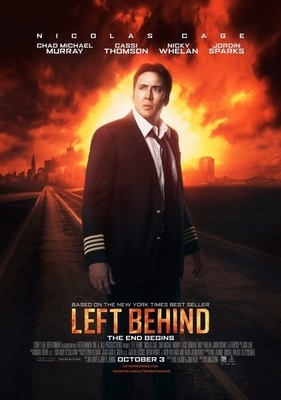
A few months later, Tim LaHaye and Jerry Jenkins published the first “Left Behind” novel. Like many other evangelicals, I devoured it. I also read other books that promised to unlock the code of Revelation, listened to church leaders theorize about the Antichrist’s identity — often the Democratic presidential candidate — and sometimes jumped if I heard something that sounded a little too much like a trumpet.
This wasn’t a new fad. Hal Lindsey ignited Christian culture’s end times obsession with his 1970 book “The Late, Great Planet Earth,” which theorized that the Rapture and Tribulation could play out in the ’70s and ’80s (spoiler alert: they didn’t). Russell S. Doughton’s “A Thief in the Night” and its three sequels depicted the Rapture and Tribulation for Christian filmgoers several decades before Kirk Cameron and Nicolas Cage were left behind. And any time a new war or global conflict occurred, writers found a new way to link those events to the Biblical warnings of trumpets, seals and horsemen — all for a price. Rapture culture is so pervasive that even Homer Simpson got in on it.
It’s easy to understand the evangelical obsession with the end times. We love doomsday stories, and Earth under the Tribulation is the ultimate dystopia. It’s the perfect plot for a movie, complete with apocalyptic weather, a world war and supernatural beasts; it’s no wonder Christian bookstores are filled with Rapture films and books. Plus, there’s a smug satisfaction evangelicals get from Rapture narratives. Not only do the bad guys get judged, but we don’t have to suffer; we get to sit on a cloud in Heaven watching the show.
Two decades after that concert, I’m a bit chagrined about how into all of this I was. Many Christians, including myself, actually believe “Left Behind” is way off base. The word “Rapture” doesn’t appear in the Bible at all. The idea of Christ coming to rescue believers before the Tribulation was popularized by an Irish priest in the 1800s. While Christians do believe Christ will return, judge the living and the dead, and bring Heaven down to Earth, we’re a bit muddy on how that all works. Some still believe in a pre-tribulation Rapture; others believe it might happen afterward or halfway through. Still others believe that Revelation is symbolic of events that have already happened, or is both a warning to the early church and a political allegory. The ominous number 666 conjures pictures of tattoo’d barcodes in some believers’ heads, while others believe it’s actually a reference to Caesar Nero, who was persecuting Christians around the time Revelation was written.
The truth is, I don’t know how the world is going to end. I also don’t know
when
it’s going to end, or if I’m going to be around to see it. I’ve stopped worrying or trying to figure it out. As a Christian, I rest in Jesus Christ and His finished work. If He chooses to take me away before things get bad, through death or Rapture, I’ll welcome it. But if it’s His plan for me to endure the Earth’s final days, I believe that He’ll give me the strength to do that as well. My job is not to try to predict events or look for hidden Bible codes. My job is not to fear the end times or pray for judgement. My job is to trust.
And to hope, which is something that goes missing in all the Rapture obsession.
In a culture that peddles fear and tension, end times theology has taken on a grim tone. Yes, the Bible says that things will get dark before Christ’s return. And looking around our world, it’s easy to see violence and disaster everywhere and wonder just how much worse it’s going to get. Admittedly, sometimes it feels like I’m just waiting for God to step in and say, “Time’s up.”
But what gets lost in the Rapture hysteria is that the promise of Christ’s return is not one of destruction, but of renewal. It’s a reminder that no matter how dark this world gets, there’s coming a day when Christ will make it right. This world might be destroyed by war, but it will be renewed by love. Oppressive regimes will be wiped away, replaced by a good king who’s died for his subjects. Sickness and death will be replaced by a life more vivid and vibrant than anything we can imagine. Revelation ends not with a war but with a feast. Not with enemies, but a family. Not with screaming, but with singing.
Contrary to media portrayals — and, very often, our own words — Christianity is not about licking our lips and waiting for our enemies’ annihilation. It’s about believing a truth so beautiful that we want the entire world to believe it: God has made a way for us to know Him. Many times when I was younger, I wondered why Jesus didn’t just take the disciples with Him to Heaven and end the story there. Why wait several millennia to return? It’s only been in recent years that I’ve discovered two reasons. One is that we know this world is a mess, and Christ’s followers are tasked with making it less messy. We have the job of preparing for the king’s arrival by pushing back the effects of sin. We’re called to love and serve others, live peacefully, take care of the planet, and pursue justice. And the other reason? Christians believe in “the more, the merrier.” We believe that the reason Christ hasn’t returned isn’t because He’s lazy or slow, but because He’s patient and has given us time to reach the world with His message. Those two things drive missionaries in every corner of the world and should be the beating hearts of our churches. That — not politics, morality or nationalism — is the heart of evangelicalism.
One thing that Morgan Freeman mentions at the end of the episode is that the word “apocalypse” doesn’t mean annihilation or ending. It’s actually a Greek word that means “unveiling.” And these days, when I look out at our world and think of what my faith tells me comes next, I’m no longer filled with fear, but with hope and expectation. For the Christian, the apocalypse isn’t the war to end all wars. It’s the wedding to end all weddings, and the start of the true story we’ve been preparing for all of our lives.It’s not an end; it’s the beginning of forever.
Any time any person (usually a christian) says “Changing this will lead to that,” they are scorned for espousing the slippery slope theory. Sadly, human nature being what it is, the slopes are often slipped.
We see this already in Australia. Just one year after the Same Sex Marriage plebiscite, which we were told would not affect anybody, we find that attacks are being made on the rights of religious schools to teach their beliefs about human sexuality. They said, “If you don’t like same sex marriage you don’t have to have one,” but already the pressure is building for schools and, soon, churches to buckle under and negate their own faith.
People around the world have been shocked by the decision in New York State to allow abortions right up until birth. A baby now has not even the right to live right until it is safely born. The city was lit up in pink in an obscene celebration of this event.
But it gets worse. In the state of Virginia similar legislation is being introduced. The Governor of that state has been reported to have coldly described a scenario in which labour starts before an abortion is completed. The baby is born naturally and then made comfortable while the doctor and the mother decide whether to kill the baby or allow her to live. In normal societies this is called infanticide and fills people with revulsion.
Whenever people decide to live their lives separate from God, it always results in a death culture. Whether it is the traditional pagan human sacrifice or its modern versions of abortion and euthanasia, humans will be sacrificed.
Fifty years ago this would have prompted outrage but now we are not surprised as the slopes continue to be slipped.
A number of times in the scriptures people are given choices and exhorted to “choose life.” Have you ever wondered why they had to be told to “Choose life”? Isn’t that a normal desire?
No. Sin, our built in rebellion against God always drives us towards death. A culture that ignores God will always, in the end, choose death- even the deaths of newborn babies.
CIMMERIA—Speaking in a message sent from the Hyborian Age, famed sword and sorcery hero Conan the Barbarian apologized to all women everywhere for his harsh treatment and objectification of women, as well as his harmful comments about hearing women’s lamentations.
The catalyst for Conan’s change of heart was reportedly a brief Gillette ad, which he viewed through a dark sorcerer’s portal before cutting the foul wizard’s head off.
“Many times I would grab women by the hair, tell them to shut up, and rescue them from pirates or enchanters without so much as asking their consent,” he said in a statement. “Now, thanks to Gillette, I see that my past behavior is not the best a man can be. It’s not the best a Cimmerian can be.”
“I vow to do better,” he said.
Once a fearsome barbarian who roamed the land in search of fame, fortune, and glory, Conan now hangs out at local taverns, where he lectures men who get too saucy with the waitstaff. “Actually, Ulrich, this serving wench is worthy of our respect and doesn’t deserve to hear your disparaging comments,” he said to a friend at a recent encounter before cutting his head off.
Conan also vowed to strive for better gender representation in his quests. Instead of venturing into sorcerer’s towers and dank dungeons by himself or with a companion who inevitably gets killed in the first room, the barbarian conquerer promised to raid dungeons with a party of at least 50% women.
Gillette spokesperson Howie Robert said the company was very pleased with Conan’s progress. “This is exactly what we knew would happen: men with the worst masculine instincts would check out a razor commercial and immediately change their ways. We totally didn’t do it for publicity or anything.” Conan quickly cut off Robert’s head.
Based on his new change of heart, Conan the Barbarian will be adapted into a new film, Conan the Sensitive, featuring Emily Blunt in the leading role instead of Jason Momoa.