The Point of No Return (Again and Again)

Have you noticed something missing this year? No? Each time just before these conferences happen the World Meteorological Organisation normally pronounces that the current year will be the hottest or second hottest on record, often weeks before the end of the year. Then when the figures are actually collated and published well after the climate scare conference, a quiet retraction is published that says “We didn’t quite lie, but it wasn’t exactly true.” Maybe it’s because nobody’s listening any more, except the ABC.

Tim Blair on the religion of “Point of No Return”

It’s that time of year again when we join with friends and family to celebrate the annual Point of No Return religious festival.

On Sunday morning hundreds of politicians, government officials and scientists will gather in the grandeur of the International Congress Centre in Katowice, Poland.

It will be a familiar experience for many. For 24 years the annual UN climate conference has served up a reliable diet of rhetoric, backroom talks and dramatic last-minute deals aimed at halting global warming.

But this year’s will be a grimmer affair – by far. As recent reports have made clear, the world may no longer be hovering at the edge of destruction but has probably staggered beyond a crucial point of no return.

Hooray! This fine tradition truly unites all people and cultures in a spirit of holy panic and demands for cash prizes. Let’s take a look at how the world marked the Point of No Return in years past:

2017:

We’re Now Even Closer to the Point of No Return

2016:

Climate change escalating so fast it is ‘beyond point of no return’

2015:

Climate Change Goes Past Point Of No Return

2014:

Passing the “Point of No Return” on Climate Change

2013:

The Fast-Approaching ‘Point of No Return’ for Climate Change

2012:

Warming nears point of no return, scientists say

2011:

When do we hit the point of no return for climate change?

 Embedded video

BBC News (World)

✔

@BBCWorld

 “We’re facing a man-made disaster of global scale… time is running out” – Sir David Attenborough issues warning at UN Climate Conference #COP24 in Poland http://bbc.in/2Pd3yfP 

We are passing the point of no return on climate change

2009:

Climate Change: The Point of No Return

2008:

ARCTIC: POINT OF NO RETURN?

2007:

Beyond the Point of No Return: It’s too late to stop climate change – so what do we do now?

2006:

Environment in crisis: ‘We are past the point of no return’

2005:

Climate’s Point of No Return

2004:

Is Greenland Ice Sheet passing “Point of No Return”?

2003:

Beyond these temperature thresholds, evidence suggests a ‘point of no return’,

It’s quite mild here in Sydney today, by the way. How’s the end of the world going in your neighbourhood?

Read the full article here

Kyuboem Lee: Jesus and Leadership

Formation

The Dominant Approach to Leadership in the Church and Why Jesus Means to Upend It

Print Friendly, PDF & Email

A couple of months ago, I was with my friend JR Woodward and the V3 Movement as they had their conference in Philly, and the theme was Reimagining Leadership. JR’s colleague, Dan White, Jr., opened the time by saying, “We’re thinking about leadership a lot these days,” to knowing, albeit weary, laughter.

Indeed. We just endured a midterm election. The Catholic Church is in a deep crisis over the abuse victims coming forward after spiritual leaders used their powers to engage in a decades-long cover up. As a result, the Catholic community has been getting rent asunder. Evangelicals (or at least the ones who tend to be older, white, rural to suburban) have come to be known in this country as the demographic that will most reliably side with the power that promises to look out for their interests—no matter how that leadership exercises its power, its personal moral conduct, or its policies towards orphans, widows, strangers. “We need a strong leader in times like this,” I hear many say. But was Jesus a “strong leader”?

Working on an initiative at my seminary for mentoring pastors in transition, I’ve been thinking a lot about pastors and what they’re facing today. Many are discouraged, isolated, and on the verge of dropping out. I have come to believe that so much of it has to do with the theology of leadership and power that we had passed down from Christendom. What I’m finding is even if we subscribe to the missional theology brand, we might not have been able to do away with Christendom habits that continue to live within our bodies and the Christendom structures that continue to shape our churches, denominations, and institutions.

Christendom is a hard habit to break.

A Different Way of Leading for a New Kingdom

There’s a reason many pastors feel used and abused—they’ve been living as cogs in the wheels of the Church Industrial Complex (as my friends JR and Dan White say in their book, Church as Movement).

What is the remedy?

It’s certainly not trying harder to keep the machine going. Jesus said there is a different kingdom—and a different way of governing, or leading. A different theology of power for a different kingdom. And out of it, a different way of structuring ourselves as society or organization or community. The greatest in this society will be the servant of all.

Henri Nouwen has a beautiful little book called In the Name of Jesus: Reflections on Christian Leadership, and Nouwen’s life itself is a lesson on that subject. He was a highly respected professor in an Ivy League school, but when he left all that prestige and entered into a community where he lived among people with disabilities and handicaps, he experienced intimacy with Christ.

In this book, Nouwen looked at Christian leadership through the temptations of Christ. He says we are tempted in the same way Jesus was:

  1. to be relevant (turn the stones to bread),
  2. to be spectacular (celebrity preachers who draw big crowds),
  3. to be powerful (control the outcome, bring about your desired end).

In the end, it’s all about power. And the way of power avoids the way of the cross. Nouwen says:

Power offers an easy substitute for the hard task of love … It seems easier to be God than to love God, easier to control people than to love people, easier to own life than to love life.

This is the way of Christendom, but it’s not the kingdom. My Anabaptist friends are very helpful in pointing this out: Christendom has conflated the cross and the power of this world for a long time; Christendom is Babylon with a cross.

Christendom has conflated the cross and the power of this world for a long time; Christendom is Babylon with a cross.CLICK TO TWEET

The Church’s Thirst for “Strong Leaders”

In The Lord of the Rings trilogy, we meet Saruman. He is someone who, unlike Gandalf, went down that road of seeking power in the name of achieving good ends, like: build the church, feed the hungry, bring about a prosperous, peaceful, moral society. But along the way, power went from a means to an end, to the end itself, the ultimate good, and this happens oh so subtly. Although Saruman began as a wise man, his compromises with power ended up transforming him into a monster. A cautionary figure indeed.

We know that institutions and churches have become machines that crush underfoot the very people it was meant to bring the good news to when those in positions of power receive protection from the structures set in place by those systems in instances when abuse of power comes to light, and victims are instead silenced, shamed, blamed, and marginalized. Diane Langberg is a psychotherapist who has been dealing with systemic issues around power and abuse in churches. We need to give ear to prophetic voices like hers to help us grow in learning how to identify and fend off toxic power from infecting and disfiguring our leadership and institutions. Here’s a sample of how the machine works:

Diane Langberg, PhD@DianeLangberg


We are to have nothing to do with the deeds of darkness but rather expose them. It has often been my experience that when abuse in a marriage has been exposed the church speaks out in horror not against the abuse but rather against the exposure.


42 people are talking about this


A system produces exactly what it was designed to produce, and we need to own up to our systems that have protected abuses of power, perhaps even encouraged it with our desire for “strong leaders;” systems that produce Caesars rather than likenesses of the crucified messiah. Notice what I am saying here: the problem isn’t individual bad apples; the problem is systemic.

The Church must own that we have not only protected but encouraged abuse of power in our thirst for ‘strong leaders.’ We have produced more Caesars than likenesses of the crucified Messiah.CLICK TO TWEET

Not the Way of Caesar, but the Way of the Crucified Messiah

But we, as followers of Christ, are called to resist the temptation to be powerful and follow Christ in the way of the cross. When the disciples argued about who would sit at his right and left, Jesus said:

Deny yourself, pick up your cross, and follow me.

The mission of God would be much better served if the church were to find a new way than the old Christendom ways.

The theology of power that the church develops needs to better witness to the kingdom of God, not merely mimic Babylon.

We need leadership development systems that will encourage leadership fashioned in the image of Christ, not of Caesar.

Listen to what Dietrich Bonhoeffer says about our mission (HT to David Fitch for the quote) in his sermon on 2 Corinthians 12:9:

Christianity stands or falls with its revolutionary protest against violence, arbitrariness and pride of power and with its plea for the weak. Christians are doing too little to make these points clear rather than too much. Christendom adjusts itself far too easily to the worship of power. Christians should give more offense, shock the world far more, than they are doing now. Christians should take a stronger stand in favor of the weak rather than considering first the possible right of the strong.

We are following Jesus into the world—not in triumph and success and power, but rather in weakness. We are witnesses of the crucified King.

Post-Christendom Theological Education

As a theological educator, I am haunted by these questions: Are we doing an adequate job in helping our students to leave Christendom and enter into the kingdom of God? Or have we been helping to feed the machine? Are we teaching them and modeling for them and equipping them with the skills to build the beloved community (which is built on confession and forgiveness, and not built on productivity and usefulness, as a machine is), the character of servant leadership (not a star or CEO), and the theology of kingdom power that is found in weakness?

Out of earshot of students, seminary administrators and professors wonder about the adequacy of the theological seminary, a product of Christendom, for the work of mission in a post-Christendom world. Do we need new wine-skins fit for the new wine of theological education and leadership development in the rapidly changing landscape? Are there ways that the old form can be retrofitted and modified to better serve the function it was created to serve? What are they?

So many questions to keep us seeking the Lord and depend on him. May the Lord give us grace and faith to sustain us.


From missioalliance.org

Babylon Bee: Carol Changes Cause Riots

Congregation Erupts Into Violent Protests As Worship Band Shamelessly Tampers With Yet Another Timeless Christmas Carol

PERRY, MA—Violence broke out at Everlasting Savior Community Church in Perry last Sunday after, in an audacious show of nerve, the worship band messed with another classic Christmas song. Congregants were whipped into a frenzy during “O Come, O Come Emmanuel” when a new bridge was added to the already satisfactory song. 

“Rejoice with tidal waves of grace, oh Savior of the broken, pouring over me everlasting in a rushing mighty wave of love…” the new lyrics began. It was at that point that a hymnal was lobbed into one of the speakers causing an explosion of sparks. The congregation rushed the stage and attacked the worship band, knocking over microphone stands, throwing drums, and lighting amplifiers on fire.

With the church ablaze, the angry mob took to the streets overturning cars and breaking windows. Local police arrived on the scene and were forced to use tear gas and pepper spray to control the protestors.

Earlier in the service, songs such as “O Come All Ye Faithful” and “Hark the Herald Angels Sing” had also been tampered with, creating a palpable frustration among the elder members of the church. By the third song, they had had enough.

A number of church members had locked themselves inside of the building and were holding hostage worship leader, 19-year-old Gavin Blaine, demanding that all Christmas songs from this point forward be played the normal way they have always been played. Officers at the scene held the worship band at gunpoint and instructed the musicians to comply with the sensible demands. “There’s no reason for this kind of brazen disregard for these beloved songs,” shouted the police chief at the worship leader. “Change the songs back or lethal force may be used.”

At press time, Blaine had refused to comply with the orders and was placed in police custody.

From The Babylon Bee

Reflection on Malachi 3:1-5


Scripture

“Then suddenly the Lord you are seeking will come to his temple, the messenger of the covenant, whom you desire, will come,” says the Lord Almighty.

Observation

The Lord will send His messenger to prepare the way. Then the Lord will come suddenly and appear in the Temple.

The Lord is coming like a refiner’s fire. He will purify the silver, the Levites, so that He will have men who bring Him offerings in righteousness. Then the offerings of Judah will be acceptable.

Then the Lord will come against the sinners and the oppressors of the weak and vulnerable because they refuse to fear the Lord.

Application

The Lord has a different idea of time to us. Malachi, writing about 400 BC says the Lord will appear suddenly in His Temple. It took 400 years, but then it did seem suddenly when Jesus came.

The Lord is good in all things, even in His timing and in His “suddenlies”.

Jesus refined the people. He brought judgement, but not in the way that people expected.

Those who are looking for salvation in Christ and who turn to Him in repentance will find forgiveness and new life. They will be free of sin.

Those who refuse to follow Jesus will be judged because they refuse to fear God and turn away from the sins.

In John 3:16-21 we read that Jesus did not come to condemn the world, but His coming set a clear dividing line between the righteous and the evil. It is like a catalyst that is dropped into a test tube, and everything changes even though the catalyst remains untouched.

At Christmas we celebrate the birth of a saviour who came so that everyone who trusts in Him will live for ever.

Prayer

Thank you Father for the message of Christmas. Thank you for sending Jesus into the world “suddenly” for my salvation. Amen.

Mario Murillo: A Weapon Called Christmas

A WEAPON CALLED CHRISTMAS

The leading newspaper in the nation has not mentioned Christmas in 10 years. Christmas is attacked by both God haters and religionists. It has fallen into great disfavor—accused of everything from paganism to materialism. It is socially unacceptable to celebrate Christmas.  It is 1843 England. Also known as the hungry 40’s.
A young and gifted writer is deeply restless and can’t sleep. He asks an assistant to meet him in the middle of the night, “take me to see the worst of London. Do not spare me anything.”
What he saw horrified him and left a mark in his soul that would haunt his novels for the rest of his life. Children, living like stray dogs scavenged through garbage in sub-zero temperatures.
Charles Dickens had to do something. So, he mustered his considerable weapon: he marshalled the English language and sent it into war against child abuse. Vast corruption must be exposed! This nation-destroying curse must be lifted!
He set ink to paper with the force of a volcanic eruption and the skillful cuts of a surgeon. The result was a pamphlet entitled An Appeal on Behalf of the Poor Man’s Child.Then something happened:
He never released the pamphlet. Historians are divided about why. Usually, it does not fall upon facts but on anti-Christian bias. Here is what really happened: He heard the voice of God. “If you release this pamphlet it will bring good for a season, but if you write the story, I am about to give you, it will bring good for all time.”
It would be a story where the main character is the most uncompelling, and unsympathetic character to any audience: an old man—a wealthy miser! Even his name is off-putting: Ebeneezer Scrooge.
With only weeks left before Christmas how could he finish it and get it published? Astonishingly it was published on December 19, 1843. Not only that, it was made into a script and opened in 2 theaters that Christmas day.
 
This story is not only credited with saving Christmas, it has been synonymous with Christmas ever since.  Outside the Bible, no written word about Christmas has been more influential and widespread in its power to evoke love for children and the poor.
Christmas has inspired the best music. Musical artist regardless of their fame are compelled to release a Christmas album. It has a power that no one can explain or predict. Opposing armies have stopped combat, met on neutral ground in the middle of a war to celebrate Christmas.
Here is Nephew Fred from A Christmas Carol: “I have always thought of Christmastime… as a good time: a kind forgiving, charitable, pleasant time: the only time I know of, in the long calendar year, when men and women seem by one consent to open their shut-up hearts freely, and to think of people below them as if they really were fellow-passengers to the grave, and not another race of creatures bound on other journeys.”
The supernatural power of Christmas is also seen in the creation of Silent Night. It was written because the organ broke and a song for a guitar was necessary.  Christmas again showed its power with Handel’s Messiah. Handel wrote it in 24 days. When he finished the Hallelujah Chorus, he said it was as if the roof came off his room and he saw the great God Himself.
Christmas is a weapon! It brings proof of the Deity of Christ by its inexplicable effect on the world. Even when it offends it is doing God’s work. Even Scrooge screamed, “then let me leave it alone!” But Christmas won’t let us leave it alone.
But the message about Scrooge transcends even Christmas. It is about God’s power to create a weapon to combat evil through anointed artforms.
It is because of Scrooge, that I find much of today’s formulaic Christian music unimaginative, predictable, and even snowflake like. Bono from U-2 called it “dishonest.” How dare I make such a criticism? Because we didn’t use to scare so easily. We wrote songs of sacrifice and commitment; towering themes filled majestic hymns.
Somewhere in the mid to late 20th Century the church developed an insecurity complex and began to “do things almost as good as the world does.” Not just in music, but in all art forms. We even have green rooms which is a nod to Hollywood.
A great exception is Black Gospel Music. It was so original the world had to copy it for Motown and R and B. Black Gospel was so powerful the world kept trying to steal talent out of the church. Aretha Franklin, Whitney Houston, and many others began in church.
The spark of divine creativity does not rest on those who surmise what might sell or what won’t offend. It comes on those who would sacrifice all to obey God.
However, there is another reason creativity is in short supply: We don’t recognize the multiple opportunities of service outside the pulpit. Not everyone is a preacher—nor should they be! The gifts of God fit in business, art, media, healthcare, education and yes, politics.
Because God came upon a famous novelist like Charles Dickens, the devil was blindsided. What if you are supposed to create something no one has seen before?
Finally, the idea that we need to tone anything down to win souls is hogwash. Johnny Cash comes to mind. It is truly amazing the influence he carried. Bob Dylan, Elvis, the Beatles, and the Rolling Stones revered him. Yet, he never muted his faith or his witness. God gave him a sound the world couldn’t resist.
A heart filled with love for God and hatred for evil, who is willing to be completely open to do something new is our greatest need today. God is searching to drop original miracles on someone like you.

Reflection on Luke 21:25-36


Scripture

“Keep a constant watch over your soul, and pray for the courage andgrace to prevail over these things that are destined to occur, andthat you will stand before the presence of the Son of Man with aclear conscience.”

Observation

When the Son of Man returns, there will be perplexing signs in the heavens, raging of the seas, and earthquakes. Then the Day ill come when Jesus returns in clouds and with power and miracles.

The trees show the changing of the seasons and, similarly, when we see these prophetic signs cme to pass, we will know that the earth is yielding to God’s kingdom.

The Day will come suddenly, and we are to make sure we keep our hearts and souls pure.

Application

The doctrine of Christ’s return is not about looking for the signs of the end times so much as making sure that we are ready.

Jesus here tells us to “keep a constant” watch over our souls.” In other words, I must constantly be aware of the state of my soul. That means watching out for sinful attitudes, treating people in a way that confirms Jesus’s love for them, being in touch with God through prayer, Scriptures and corporate worship.

Jesus wants us to have the grace and courage to overcome the adversities and temptations in our lives. This is not about the Great Tribulation and the Antichrist, but our daily life in the world. Am I allowing bitterness or vengeance or secret sins to take hold?

The aim of this is simple. Jesus wants us to be able to stand before Him with a clear conscience. How can we enter spiritual worship if our sins condemn us, much less enter the divine throne room?

All of us sin, even after we start to walk with the Lord. We must confess our sins to Him and receive His forgiveness so stand guiltless in His glory.

Prayer

Thank you Father that through the Blood of Christ I am free from sin. Help me to stay clean in you. Amen.

“Drag Queens” and Grooming

As a community we are sleep-walking into the most dangerous, demented, suicidal period in our history.

There is a culture war under way for the souls of our children, and most adults, even christians are utterly clueless.

From lifesitenews.com

Drag queen admits he’s ‘grooming’ children at story hour events

LAFAYETTE, Louisiana, November 27, 2018 (LifeSiteNews) – Drag queens are deliberately “grooming” the next generation to accept LGBT ideology when they read to children in public libraries at drag queen “story hour” events, a U.S. drag queen admitted. 

Dylan Pontiff, a drag queen who helped organize one of these story hour events for children as young as three at the Lafayette Public Library in early October, is shown in a video making that shocking admission to the Lafayette City-Parish Council in Louisiana during a Sept. 17 meeting.

“This is going to be the grooming of the next generation. We are trying to groom the next generation,” said Pontiff, who when dressed in drag goes by the name Santana Pilar Andrews. 

Pontiff said that as a drag queen he has performed in shows for adults that he compared to an R-rated film. He argued that he should be able to have access to children because, as an adult, he knows how to “filter” himself and make his content PG-rated. 

“I can go in and entertain adults in a club and also entertain a group of students and young children. I’m able to do that because I’m an adult and able to filter myself,” he said.

Citizens of that community in Louisiana shook their heads in bewilderment behind Pontiff as he made these comment. 

“Unfortunately, the Drag Queen Story Hour program is turning public libraries into platforms to advance the transgender revolution, places where pro-homosexual activists are given access to children as young as three,” said John Ritchie, director of TFP Student Action, in an interview. 

“Instead of protecting the precious innocence of our children with wholesome stories, libraries are misusing our tax-dollars to harm their innocence,” he said. “To attempt to dismantle and destroy the distinction between male and female is not only biologically ridiculous, but also a direct attack against God’s plan for us and for the family.  Everyone who loves the family should wake up, pray and push back.”

The public meeting by the Lafayette City-Parish Council in September was to consider a motion to denounce the drag queen story hour proposed for the local library on October 6 as not being age-appropriate.

The motion, derided as “hateful” and “discriminatory” by its opponents, would not have been binding on the public library. But it never got that far. The majority of the Lafayette City-Parish Council declined to vote on it, effectively scuttling the motion.  

Leslie Alexander, a member of the community, said that the library should not have approved the drag queen story hour event without consulting the public.

“This is not about tolerance or anti-bullying,” she told the Lafayette Daily Advertiser. “It is a direct and intentional effort to create gender confusion and doubt among very young children at the very time they need solid guidance and understanding. The intent is to plant a seed to make children more likely to question their sexuality or gender at a later age.”

According to Ritchie, the seeds of this indoctrination of young children in public libraries was sown when marriage was legally re-defined.

“When homosexual ‘marriage’ was legalized back in 2015, the naive told us not to worry because the decision would never affect us,” said Ritchie. “Marriage is just a word, they said. But for those who understand history, the redefinition of true marriage by the U.S. Supreme Court contained a string of ugly consequences.” 

“What was unthinkable yesterday is tolerated today: Transgender drag performers are allowed to explicitly target children in public buildings,” he said. 

A number of LGBT activists have highlighted in recent years that the movement’s goal is to “indoctrinate” children into accepting the normalcy of the LGBT agenda.

“I am here to tell you: All that time I said I wasn’t indoctrinating anyone with my beliefs about gay and lesbian and bi and trans and queer people? That was a lie,” wrote Canadian gay activist Sason Bear Bergman, a woman who identifies as a transgender man, in a March 2015 piece titled “I Have Come to Indoctrinate Your Children Into My LGBTQ Agenda (And I’m Not a Bit Sorry).” Bergman holds nothing back, stating she wants to make children “like us” even if that “goes against the way you have interpreted the teachings of your religion.”

In 2011 U.S. gay activist Daniel Villarreal penned a column for Queerty.com stating that the time had come for the homosexual lobby to admit to “indoctrinating” schoolchildren to accept homosexuality.

“Why would we push anti-bullying programs or social studies classes that teach kids about the historical contributions of famous queers unless we wanted to deliberately educate children to accept queer sexuality as normal?”

“We want educators to teach future generations of children to accept queer sexuality. In fact, our very future depends on it. Recruiting children? You bet we are,” he added.

Homosexual activist Michael Swift wrote in 1987 in the Gay Community News that school children would become explicit targets for homosexual indoctrination. “We shall seduce them in your schools…They will be recast in our image. They will come to crave and adore us,” he wrote at the time. 

RELATED STORIES: 

After pro-family campaign, library drops drag queen storytime for kids

American Library Association doubles down on drag queens reading to kids

The latest LGBT lunacy: ‘Transgender’ puppet to teach kids about ‘gender issues’

So What Was The Perfect Pre-Industrial Global Temperature?

According to the Climate Change Alarmism crowd the earth was once perfect in every way, then we started to use fossil fuels. We don’t have enough actual temperature measurements from back then so to find out what it was like in 1850 you can use the climate models to “hindcast” the temperatures. Yes, those same models that failed to forecast the 20 year pause.

And here we are spending trillions of dollars to fight a problem we can’t actually measure or define.

From “Watts Up With That”

What Was Earth’s Preindustrial Global Mean Surface Temperature, In Absolute Terms Not Anomalies, Supposed to Be?

And What Have the Average Temperatures of Earth’s Surfaces Been Recently in Absolute Terms, Not Anomalies?

The answers may surprise you.

THIS POST HAS BEEN UPDATED. The update is near the end of the post.

Recently, the Intergovernmental Panel on Climate Change (IPCC) and the U.S. Global Change Research Program (USGCRP) have cranked up their alarmist propaganda, with the IPCC now pushing the goal of limiting global warming to 1.5 deg C above preindustrial global surface temperatures.

That, of course, initiates the title question, What Was Earth’s Preindustrial Global Mean Surface Temperature, In Absolute Terms Not Anomalies, Supposed to Be?

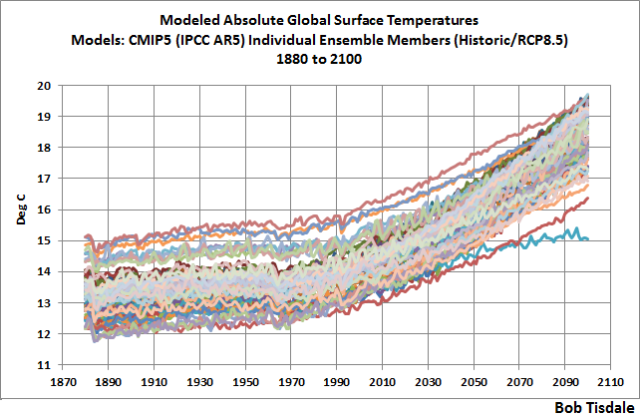
Four years ago, in the post On the Elusive Absolute Global Mean Surface Temperature – A Model-Data Comparison (WattsUpWithThat cross post is here), we illustrated and discussed the wide (3-deg C) span in the climate model simulations of global surface temperatures on an absolute, not anomaly, basis. Figure 1 below is Figure 5 from that post. In that post, we started the graphs in the year 1880 because the GISS Land-Ocean Temperature Index (LOTI) and NOAA NCDC (now NOAA NCEI) data started that year.

Figure 1

However, the spreadsheets I prepared for that post had the climate model hindcast outputs as far back as their common start year of 1861. (I say common start year of 1861 because the outputs of some models stored in the CMIP5 archive start in 1850 while others begin in 1861.) So I couldn’t use the climate model outputs stored on that spreadsheet for this post.

Note: The IPCC’s new definition of preindustrial, as stated in their Changes to the Underlying Scientific-Technical Assessment to ensure consistency with the approved Summary for Policymakers:

The reference period 1850-1900 is used to approximate pre-industrial global mean surface temperature (GMST).

It’s odd that the IPCC selected those years when not all the climate models used in their 5th assessment report (those stored in the CMIP5 archive) for simulations of past and future climates extend back to 1850. Some only extended back to 1861. Then again, no one expects the IPCC to be logical because they’re a political, not scientific, entity.

Luckily, the ensemble members that meet the criteria of this post do extend back to 1850. So we’ll use the ensemble member outputs for the full IPCC-defined preindustrial period of 1850 to 1900 for this post.

ACCORDING TO THE CMIP5-ARCHIVED CLIMATE MODELS THERE’S A WIDE RANGE OF SIMULATED PREINDUSTRIAL GLOBAL MEAN SURFACE TEMPERATURES

The source of the outputs of the climate model simulations of global mean surface temperature used in this post is the KNMI Climate Explorer. Specifically, as a pre-qualifier, I used the outputs of the simulations of Surface Air Temperatures (TAS) from 90S-90N from the 81 individual ensemble members. From those, I identified the ensemble member with the warmest global mean surface temperature for the preindustrial period and the ensemble member with the coolest global mean surface temperature for the same period. For those who wish to confirm my results, the coolest (lowest average absolute GMST for the period of 1850-1900) is identified as IPSL-CM5A-LR EM-3 at the KNMI Climate Explorer, and the warmest (highest average absolute GMST for the period of 1850-1900) is identified there as GISS-E2-H p3. The average global mean surface temperatures for the other 79 ensemble members during preindustrial times rest between the averages of the two ensemble members.

The outputs of the simulations of global mean surface temperature from those two (the warmest and coolest absolute temperatures) ensemble members for the preindustrial period of 1850-1900 are illustrated in Figure 2, along with their respective period-average global mean surface temperatures for the IPCC-defined preindustrial period of 1850 to 1900 (dashed lines).

Figure 2

As noted at the bottom of the illustration, The Scientists Behind the CMIP5-Archived Models (Used By the IPCC for AR5) Obviously Believe Earth’s Preindustrial Average Surface Temperature Should Be Somewhere Between 12.0 Deg C and 15.0 Deg C. The modelers at the Goddard Institute for Space Studies (GISS) and at the Institut Pierre-Simon Laplace (IPSL) would NOT have archived those models if they hadn’t believed they were of value.

Read the rest of the article here