Jo Nova: Dept of Climate Change gives $1.6m in trips to Brazil as reward for prophets, activists, sycophants

From joannenova.com.au

Cynics are wondering what, exactly Australia got for spending $1.6 million sending 75 people on a two week junket in Brazil last year?

Australia, of course, got nothing, but this is the bread and butter currency for The Blob. How else can you convince bored bureaucrats to pretend warming causes cooling, and maintain the righteous indignation!

Getting a free trip to Brazil surely ranks pretty high on bragging lists at Saturday night dinners. That shine helps make up for the mental effort of selling your soul and pretending that Sunday night’s pot roast causes floods in Dhaka.

It also provides the inspiration to keep the next generation of Blobocrats focused. The underlings learn that people who shed tears about climate change get rewarded, while the critics don’t. Just one ill advised remark, one careless joke, could compromise the plane tickets.

Responses to Senate estimates questions on notice have revealed Department of Climate Change and Energy sent 32 officials, the Department of Foreign Affairs and Trade sent nine officials, and the Department of Agriculture sent one official to Belém, Brazil in November last year for the UN Conference of the Parties summit.

And the Department of Climate Change budgeted $1.6m for their 32 officials to fly to Brazil, it said.

And this $395,000 — it’s just an investment for the future. One day a Youth Climate Coalition leader will end up in a heavily edited documentary promoting your Department. Think of this as advertising money and it all makes sense….

The department also revealed it disbursed a $395,000 grant program for other organisations to attend the COP30 summit. This included groups like the Aboriginal Carbon Fund, Australian Youth Climate Coalition, United Nations Youth Australia, and Women’s Environmental Leadership Australia.

Remember, even as the Departments of Fisheries, Forestry and Agriculture enjoy their tours of the Amazon, that some fishermen, farmers and foresters have lost their jobs in Australia due to whimsical policy changes. Labor has recklessly damaged these industries, while the Departmental Chosen Ones use their tax dollars to party in Latin America.

Christian Community

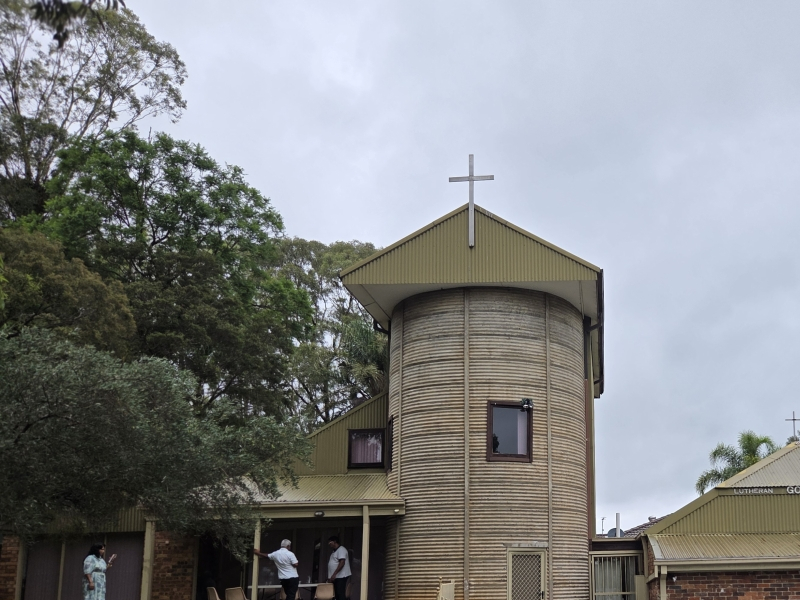
Last week I had the joyful experience of meeting up with a group of christian migrants mainly from Pakistan who now live in the western suburbs of Sydney, around Liverpool. I was asked to preach at their Sunday service as well as lead a Bible study and do some other things.

The congregation there ranges from fairly recent arrivals who have little knowledge of English to the children and grandchildren who have spent most or all of their life in Australia and are more Australian than Pakistani. The cultural generation gap becomes visceral when the national cricket teams play each other.

The people in this community mainly speak Urdu amongst themselves, and the services are conducted in Urdu. I spent much of the weekend not having any idea about what people were saying. That would be the situation of course faced by many of these people when they first came to the country.

The younger people speak English, and Urdu is a secondary language. Over time this congregation will become more English based but always keeping its unique cultural background.

What impressed me in all of this is how similar these people are to the people of my own church. Both groups love God and they care for each other. You can see this in the depth of relationships they enjoy with one another.

There is something very special, even unique, about christian communities. Whether we are true blue Aussies in a small town, or immigrants in a big city, the love of Christ binds us together. The apostle Paul used the analogy of a body to make the point that although we look different and have different gifts, we all belong together.

As our society becomes increasingly fragmented, christians will stand out as people who care for one another.

Happy Australia Day

My Country

The love of field and coppice,
Of green and shaded lanes.
Of ordered woods and gardens
Is running in your veins,
Strong love of grey-blue distance
Brown streams and soft dim skies
I know but cannot share it,
My love is otherwise.

I love a sunburnt country,
A land of sweeping plains,
Of ragged mountain ranges,
Of droughts and flooding rains.
I love her far horizons,
I love her jewel-sea,
Her beauty and her terror –
The wide brown land for me!

A stark white ring-barked forest
All tragic to the moon,
The sapphire-misted mountains,
The hot gold hush of noon.
Green tangle of the brushes,
Where lithe lianas coil,
And orchids deck the tree-tops
And ferns the warm dark soil.

Core of my heart, my country!
Her pitiless blue sky,
When sick at heart, around us,
We see the cattle die –
But then the grey clouds gather,
And we can bless again
The drumming of an army,
The steady, soaking rain.

Core of my heart, my country!
Land of the Rainbow Gold,
For flood and fire and famine,
She pays us back threefold –
Over the thirsty paddocks,
Watch, after many days,
The filmy veil of greenness
That thickens as we gaze.

An opal-hearted country,
A wilful, lavish land –
All you who have not loved her,
You will not understand –
Though earth holds many splendours,
Wherever I may die,
I know to what brown country
My homing thoughts will fly.

— Dorothea Mackellar

Stephen McAlpine: Australia Is Coming Apart: The Church Can Point a Way Forward.

Stephen McAlpine writes:

Australia Is Coming Apart: The Church Can Point a Way Forward.

This past Sunday at church I watched as an elderly man – a long time member – walked into church and went to the front row. I won’t name him, but it would be fair to say that life has not been easy for him. He’s had his fair share of struggles. He’s generally not someone who is going to be in the photographs on the front page of your church’s website. Okay, switch out the word “generally” in that last sentence and that’s probably more accurate.

Afterwards over coffee we all had the usual chatting and talking and encouraging, and he too was in that mix. Eventually everyone packs up and we all leave (Jill and I always seem to be there until they turn out the lights – one of us is a chatterbox, but who can tell which one!)

But as this bloke said hello to a few people, raised a hand in greeting, and as a couple of people responded before he sat down just before having to stand up again as we began to sing, it struck me once again what a magnificent thing the church is.  Where else?

Where else is there such a levelling of people. Or indeed such a raising up? I have not seen it anywhere else.  It does not exist anywhere else. Indeed our rector over coffee a day or so later was observing that in the other communities to which he belongs – those outside the people of faith – there is much talk about togetherness and community. Many ideas about fairness and equality. But talk and ideas are not the same as tangible proof.

Where else? It simply does not exist. Not in the long term.  And I’ve seen this over and over again. I recall one complex character, loveable, smart, loud and pretty broken, and who could use up a lot of your time (and did when life got bad). A parishioner said to me

I am going to treat him in such a way that in the New Creation I won’t look back in shame or embarrassment at how I acted towards him.

Naturally we baulk at that because we think that we are more noble than that. We think that we are more innately good than that. We think that others might behave poorly towards such a person, but not I. Not magnanimous I!

Piffle. You are not magnanimous. You just are not.

Humans are tribal, self-selecting in their relationships, mistrustful of anyone not like them enough, and determined to be the birds who stick together with those whose feathers they recognise as their own.

It is only the gospel of Jesus, nay, Jesus himself who both compels and empowers us to be any different.  When James writes to Christ followers – mostly Jewish converts – he leans into our inability in our own flesh to be welcoming to the stranger. And by stranger I don’t mean someone we don’t know, I mean someone we don’t want to know. Someone who might be a risk to our time and attention and energy.

You see, people who are like us, share our values, our social status, our educational standards etc, they are not strangers to us, even if they come into church new. Yes of course we don’t know them, but we’re pretty quick to change that. We lean into them.

Other types? Not so much. We lean away.

That’s why James has to say this:

My brothers, show no partiality as you hold the faith in our Lord Jesus Christ, the Lord of glory. For if a man wearing a gold ring and fine clothing comes into your assembly, and a poor man in shabby clothing also comes in,and if you pay attention to the one who wears the fine clothing and say, “You sit here in a good place,” while you say to the poor man, “You stand over there,” or, “Sit down at my feet,” have you not then made distinctions among yourselves and become judges with evil thoughts?

We recognise that in ourselves don’t we? But notice that James’ first call is not to lean into the humility of Jesus as a reason to show no partiality, but rather the glory. And the fact that he has to state this so clearly in the very first generation of the church, demonstrates that it is counter intuitive.

James then goes on to say that the strangeness of God – certainly strangeness in terms of the gods of the Roman Empire of their day – is that he chooses the very things that the culture despises. And that the culture assumes that the gods would despise:

Listen, my beloved brothers, has not God chosen those who are poor in the world to be rich in faith and heirs of the kingdom, which he has promised to those who love him?

In this one verse James flips the script and shows that God is the role reverser.  And that has always been the case when salvation is on the table.  It was the case for Hannah prior to the birth of Samuel when she prays:

The Lord makes poor and makes rich;
    he brings low and he exalts.
He raises up the poor from the dust;
    he lifts the needy from the ash heap
to make them sit with princes
    and inherit a seat of honor.
For the pillars of the earth are the Lord‘s,
    and on them he has set the world.

Words that are echoed in the Magnificat centuries later by Mary.  And note that last verse, it is because God is in control that such reversals occur. This is not saying that God cares for the weak because he is weak, but precisely because he is strong. He rescues the poor because he is rich. The one who has no need lifts up the needy.

You can imagine receiving James’ letter. You can imagine being a small, insignificant group of people, on the fringes of the culture, both as Jewish people and as Jewish people who have decided that Jesus is Messiah. Yet you cannot imagine that that role reversal, that script flipping, would become the very power that swept away the Roman idea of power (or at least put a hand up to stay it over the centuries).

Four months ago I wrote a blog post called Australia Is Coming Apart. In it I said this:

if Australia – and indeed the West – is to avoid the devastation of coming apart, we will need some priests of history, as Associate Professor at Australian Catholic University, Sarah Irving Stonebraker, puts it. If anyone has a remit to hand on the baton of the truth, to rightly divide the word of truth, and to speak truth to a fractured and fractious world in which competing visions of reality are tearing us apart, then the church certainly has that remit.

I was promptly poo-pooed by another Christian leader online about the idea that we are coming apart as a nation, who said it’s still great place to live. Sure, by certain indices in certain places it is. Ironically, the offline conversation that ensued led to a social media unfriending. We came apart.

Even more ironically the next day Charlie Kirk was murdered, which exposed huge faultiness in belief and values not just across Australians, but within the church.. And not three months later the Bondi massacre. The division, unrest and indeed the hatred is only going to increase.

There was a short show of unity before it all came crumbling down again. We are not going to “Kumbaya ourselves out of this one, don’t kid yourself that we are.

And we’ve all got something to say. We are all cultural and geo-political experts suddenly. We all have a view of Venezuela even though we don’t know any Venezuelans and couldn’t point it out on a map, and have no clue why their oil is different to the oil that the Saudis have. Yet we all have something to say.

I don’t want us all to turn inwards. There is work to be done socially and politically. I don’t want evangelicals to retreat to quietism, much less only focus on church.

I don’t think we’ve been given a mandate to do that. I think we’ve been given a mandate to both preach the gospel AND to shape the world for good in the public square through our gifts, talents and experiences even in the culture’s fallen state. I also think my own tribe in Australia the past thirty years hasn’t been at the forefront of that public task and is playing catch up.

Yet at the same time, I return to that scene I saw on Sunday morning at church and I think “Wow! Where else?” Yet at the same time I lament as I experience – and listen to – a disturbing number of relational schisms, outright ungodly behaviour and frantic attempts to cover it us, among our self-declared theological finest.

If the events of the past three to four months have disturbed us, then you can imagine how disturbing they are to those without hope and without God in the world. The cultural, political and social spasms of the past couple of years is exactly why we are seeing the Quiet Revival. It’s exactly why we are seeing “full fat faith” among previously secular young people.

How should we prepare for such eventualities? Tidy up our church grounds? Get our “Ms” in place? Ensure we have our staff teams and vision sorted? Sure, why not. But perhaps a cursory read of the Book of James might be a place to start. And then to ask ourselves, how are we going to flip the increasing crazy and disturbing cultural, political and social script we are witnessing today?

How are we bringing people together at the very time that society is pushing them apart.
Dry heat.

At 4.30 pm this afternoon the temperature was a little shy of 35 degrees which is not unusual in Narrabri in summer. The humidity is another story, just 1% That means you can go outside, work up a bit of a sweat and it will cool you off real fast. The dew point, that is the temperature at which water will condense out of the air is -29. Feel free to leave your stuff outside – it won’t get damp tonight.

Fred Pawle: Boomer Liberalism Died at Bondi

Prime Minister Anthony Albanese didn’t need to use ChatGPT — but probably did anyway — to script his statements yesterday morning about the terror attack at Bondi on Sunday.

“We are stronger than the cowards who did this,” he said with practised gravitas. “We refuse to let them divide us. Australia will never submit to division, violence or hatred — and we will come through this together.”

This schmaltzy liberal routine is older and even more grating than The Seekers’ I’d Like to Teach the World to Sing (In Perfect Harmony). Simpletons like Albo and the rest of the ruling elite who have been peddling it all their lives are the only ones unable to see what is now blindingly obvious to the rest of us.

On the contrary, Albo, many of us want to be divided. We don’t want to “come through this together” any more. We are tired of all your enforced togetherness. Instead, we want to “come through this” in a country where we feel at home, surrounded by people we can love, respect or at least have a beer with. Everyone else can — pardon me while I resist the urge to use expletives here — kindly find somewhere else to live.

Your entire schtick is based on the postwar consensus that the best way to avoid repeating the horrors of World Wars I and II is to open our borders and “tolerate” people who are different to us. The veracity of this idea was never tested. Neither were we asked if we wanted it. It was simply packaged under the cute but oxymoronic term “multiculturalism” and pushed on us in increasingly intrusive ways.

We were told that the migration of people from undeveloped countries into prosperous liberal democracies was essential and good; so good in fact that the Labor government had to pass section 18C of the Racial Discrimination Act in 1995 to enforce compliance with it.

This has since spawned “hate speech” laws, which have had the intended psychological effect. Over the years, mass immigration has become unquestioningly virtuous, to the point where your government could import millions of unskilled parasites, and anybody who objected was automatically labelled a racist. By promising, through state-funded translators, to give these new arrivals loads of free things, you secured huge blocks of votes at every election.

You couldn’t care less whether these new Australians want to live among the rest of us. Turns out many of them don’t. Worse, some of them want us dead, and our culture erased. Immigrants who don’t assimilate are not immigrants, they are invaders. And eventually they act like them.

Every time the predictably “unthinkable” happens, as it did again Sunday, your instinctive response is to deny your own culpability and instead cling to the same tropes that caused the problem in the first place. That is, when you’re not throwing red herrings like gun laws out as a distraction.

Essentially, you are asking young and future Australians to reject the homogenous culture and high-trust society that allowed your generation the freedom and opportunity to become comfortably rich, and in its place put up with fragmentation, tediously shit jobs and a reduced sense of belonging in their own country.

And that’s not the only fundamentally flawed liberal idea you and the ruling elite are pushing through. You’ve told young women that motherhood is not as important as having a career, young men that their masculinity is toxic, and infant children that government childcare centres are even better than being at home, the odd serial pedophile notwithstanding.

There are alternatives to these suicidal ideas. Poland and Hungary, for example, both use taxation to encourage young people to start families, and are defiantly independent and resolute about the people they allow to settle there. It’s no coincidence that both these countries endured some of the worst atrocities in living memory. They are determined to rebuild themselves on their own terms because they know that the alternative to a strong, homogenous culture is unavoidably horrific subjugation by someone else.

Young Australians don’t have much time before your plan to replace them becomes irreversible. The attack on Sunday might be the catalyst for them to finally en masse call for an end to your suicidal empathy for foreigners, and maybe call bullshit on the rest of your anti-family, civilisation-killing novelties as well.

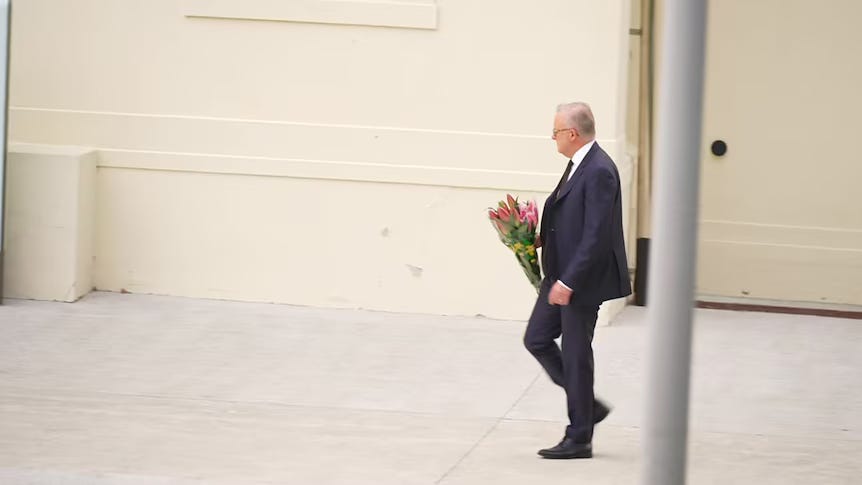
There are people amongst us who wish us harm. Instead of organising a wreath-laying photo opportunity at the scene of the latest crime, a proper national leader would be mobilising police and military to root out the remaining potential provocateurs and send them packing.

We’ve reached a fork in the road. Either we continue to embrace liberalism (in which case the next Bondi attack is just around the corner) or we reclaim the civilisation we were so lucky to inherit.

Bondi Terror Attack

My heart is heavy this morning having watched the news reports last night of the awful shooting at Bondi. In a clearly anti-Semitic attack on a Hanukkah celebration in a park adjacent to the bridge, two gunmen killed at least 16 people and injured 40 others. Police have also found explosives in their vehicle.

The only upside of this horrible event is the hero who walked up to one of the attackers and wrestled the rifle away from him. The thing I have noticed in these events over the years is that there is always just one or two men who will put their lives at risk to tackle an armed terrorist. This man’s name apparently was Ahmed Ahmed, so obviously an immigration success story and potential nominee for Australian of the Year.

Blind Freddie could have seen this coming two years ago, following the Hamas atrocity in Israel. On October 8th 2023, thousands of people marched on the Opera House, which has been lit up in the colours of the Israeli flag. They clearly chanted “Gas the Jews!” Every single one of them should have been charged under racial vilification laws, but the NSW Government chose the path of appeasement. They got “experts” to prove that the chants were “Where’s the Jews?” as if that was somehow less threatening.

Since then we have had weekly pro-Palestine marches in various cities. We have had synagogues, Jewish schools and Jewish-owned restaurants burnt and homes vandalised. We even had two nurses from Bankstown Hospital boasting online about how they had killed Jewish patients.

The response from politicians has been “There is no place for antisemitism in Australia.” Well, clearly there is place for antisemitism in Australia because the very same politicians have encouraged it. They have pandered to the Muslim community, they have made a moral equivalence of antisemitism and the made up disease of Islamophobia, they have brought in untold numbers of migrants and refugees with minimal background checking, they have refused to confront the hate preachers who every Friday call for the killing of the Jews, and all in the hope of winning their votes.

It is time to restore peace and hope to this nation.

It is time to reverse course before we end up in the same place as UK and much of Europe.

It is time to end mass migration into this country, and to ensure that only peaceful people who intend to assimilate into our culture come in.

It is time to round up every hate preacher who does not have Australian citizenship and send them out.

It is time to enforce laws against racial hatred.

Above all we need to pray for this nation of Australia. This attack is a wound to our national spirit. We need God’s grace to heal us.

Christmas Traditions

It’s that time of the year again when we hear a lot of complaints about disappearing Christmas traditions.

This year, the Martin Place Christmas Tree is bedecked with the words “Happy Holidays” rather than “Merry Christmas.” I love it when we try to pretend that the day being celebrated has nothing to do with Christ, but a more generic “holiday.”

David Jones copped criticism because they have abandoned the traditional Christmas window displays, which many people have for generations travelled into the city with children or grandchildren in tow to view each year.

The biggest outcry was reserved for rumours that Fire and Rescue NSW are abandoning the traditional lolly run due to health and safety concerns. Rather than throwing lollies at children while on the move, fire engines will have to stop to hand out the treats. This is out of concern for children running onto roads than any fear of hitting them in the eye with a hard lolly.

It is interesting just how much people value these traditions, even people who never set foot in church to celebrate the birth of Jesus. It is like the generational memory of faith in Jesus, attending church services and celebrating real Christmas and Easter festivals continues to anchor people despite our rapidly changing culture.

Christmas is a time of incredibly good news, in a time when there is such a shortage of good news. It’s more than a long weekend, a time to get together with the family, or even a special time for the kids.

Christmas is about a God who cares about people so much that He came down to earth to live with us. The baby in the shed with the animals turned out to be the creator of everything in a human form. The story reaches its climax at Easter when we recall that Jesus Christ died to cover the wrongs of every single person.

If you haven’t been to church for a while, why not start a new tradition this Christmas?

Sowing And Reaping

The number of trucks going past my house reminds me that we are in the middle of harvest time. Farmers, contractors, silos, truck drivers and mechanics are all working long hours to get the harvest into storage before storms, birds, insects or other disasters can do serious damage.

The Bible is full of references to farming and, in particular, to harvesting.

The phrase “you reap what you sow” is one of those references, and I imagine it would have been a fairly common saying back in the day. We can’t imagine a farmer planting barley and hoping for wheat. That would go against all the laws of nature.

Strangely, though, many people fail to apply this to their own lives. If you sow kindness and generosity, people will respond by being kind back to you. If you live by violence and bullying, then you cannot expect others to treat you with love and respect.

One of the Old Testament prophets coined this phrase, “They sow the wind and reap the whirlwind.” This referred to the then rulers of the state of Israel who ignored their God and instead chose to encourage the worship of the fake gods of other nations. The result, Hosea said, was that they would be overrun by the Assyrians, one of the nastiest empires of the time, and of course full of idols. The Israelites had played at worshipping idols, now they would be destroyed by expert idol worshippers.

In modern times, we might think of people who play fast and loose with the rules, seemingly untouchable until the Police or the Tax Office catch up with them. They sowed a wind but reaped a whirlwind of trouble.

Many people spend their whole lives without any reference to God. They might be good people but just have no time for religion. They are good enough for God, they reason, and He will take care of them in the after life.

But if you have a life in which you sow arrogance towards God, then you will reap a whirlwind of wrath. On the other hand, a life of humble service to the Lord will reap a very different harvest.

What are you sowing?