Tasmania Day 2

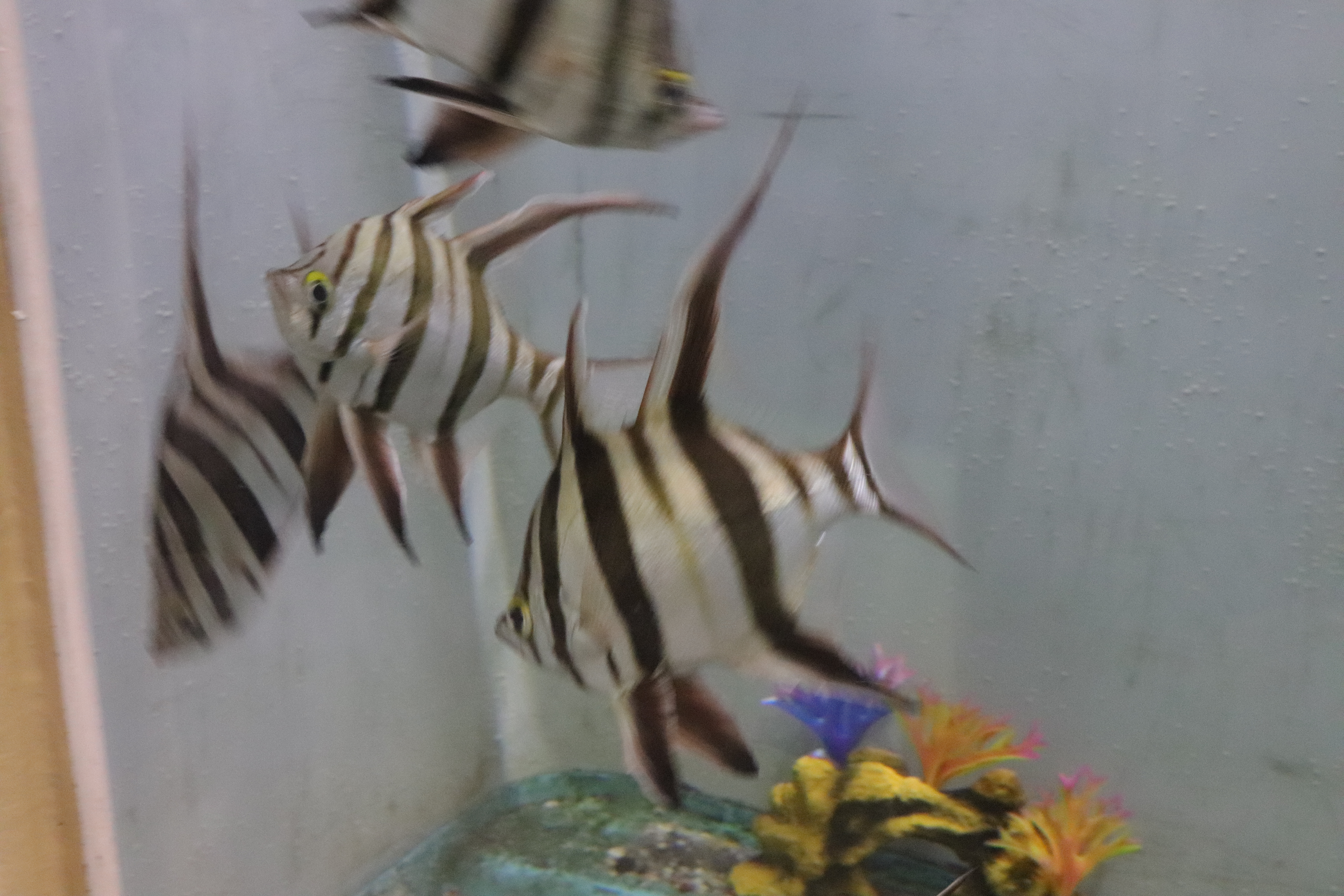
Today was all about driving. Hobart to Strahan is about 300 km by road, but it actually takes well over 3 hours. The speed limit is 100 km/hr, but much of it is winding mountain roads so you are travelling at less than 60 km/hr around the curves.

After a very nice buffet breakfast at the hotel’s restaurant (it would want to be nice at $25 each!), we hit the road for our first tourist attraction.

We stopped at Woolies to buy the groceries for the days where our meals aren’t covered.

After this stop, the road took us to the very rugged and isolated West Coast of Tasmania. The extensive Hydro Electric scheme has facilities and power stations at many places through the highlands and along the West Coast.

We stopped for a quick bite at Nives River, where a friendly raven entertains passing humans by eating food scraps they throw him.

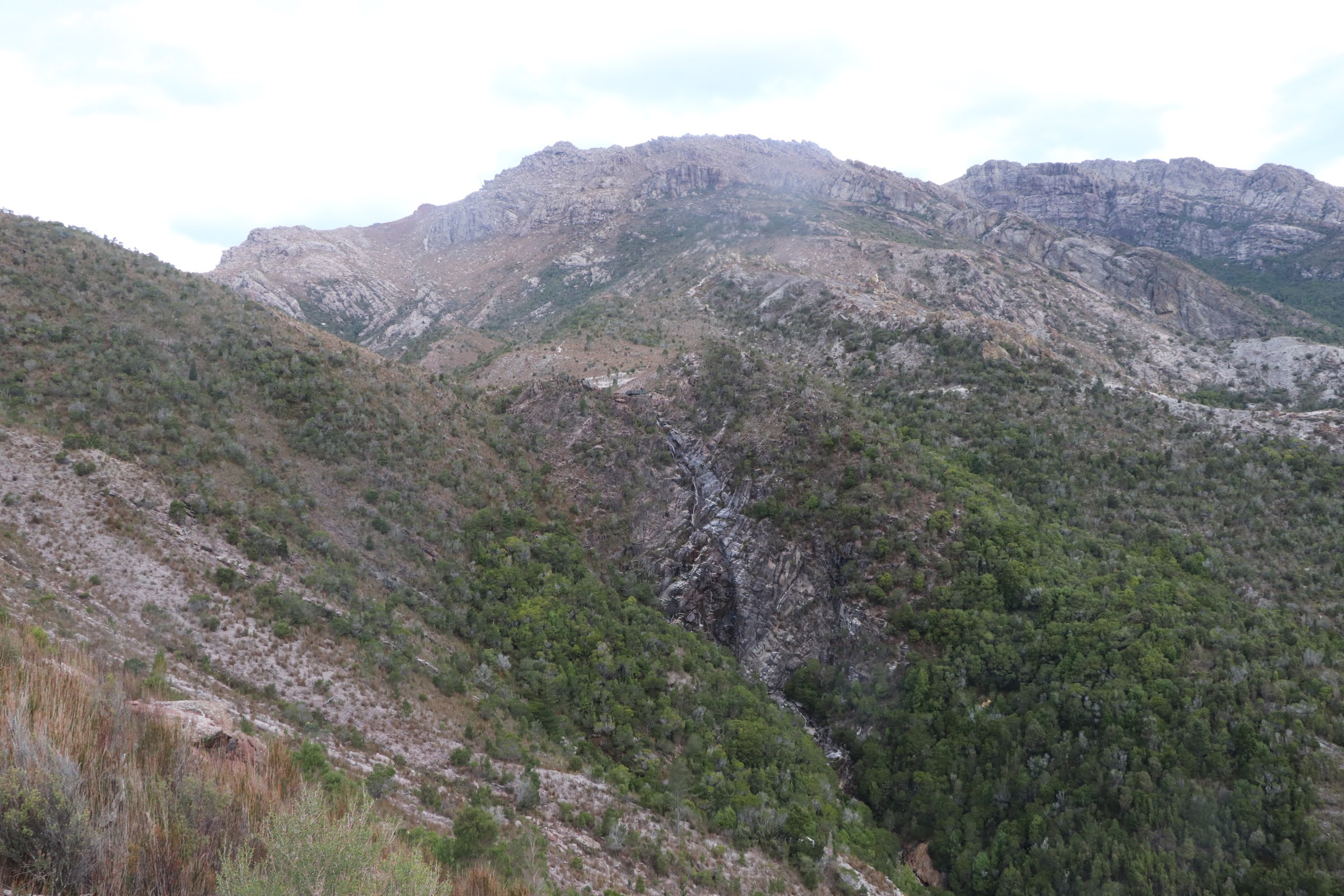
Further north the mountains become very bare due to the top soil having washed away, leaving bare rock where plants can’t gain a foothold. I was surprised when we got out at Horsetail Falls that there was no sound of life at all- no bird calls even. The falls themselves don’t look that spectacular as the water just flows along a channel worn into the rock. But the roar of the water tells you that there is a hufe quantity falling over the rock and into the valley below.

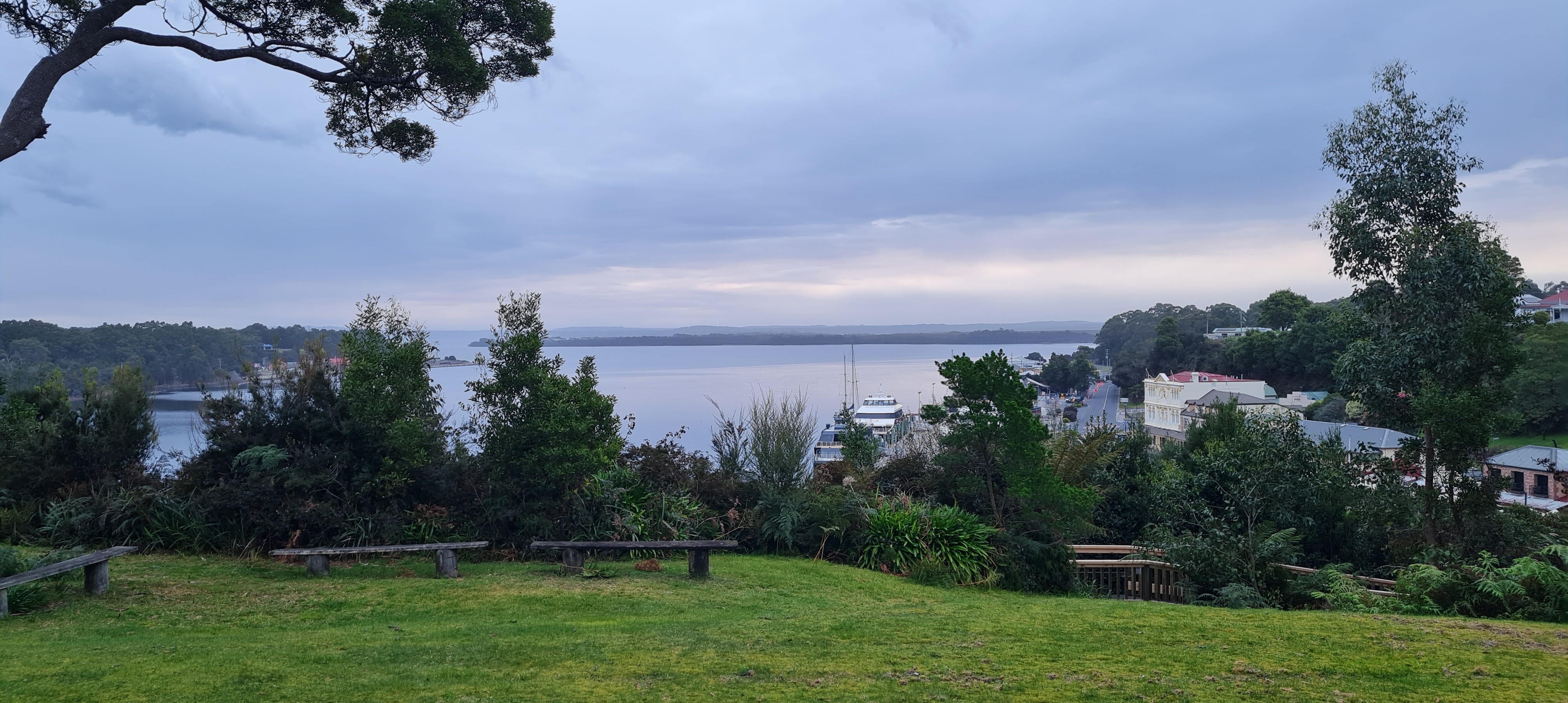
We arrived at Strahan late in the afternoon. We are booked into a facility known simply as Strahan Village. It seems to be owned by NRMA, which you normally associate with NSW, but they must operate in Tasmania as well. The village contains several building on the one site, with varying levels of accommodation. We have a good sized unit at the top of the hill. Here is the view from the back door.

Our room comes with $75 of meal credits at the local Bistro and Pub. We chose the Pub, where we ordered a $26 burger each and orange juice. We came close to using the full $75 in one go. If we had gone to the Bistro we would have been over the allowance. It was good tucker.

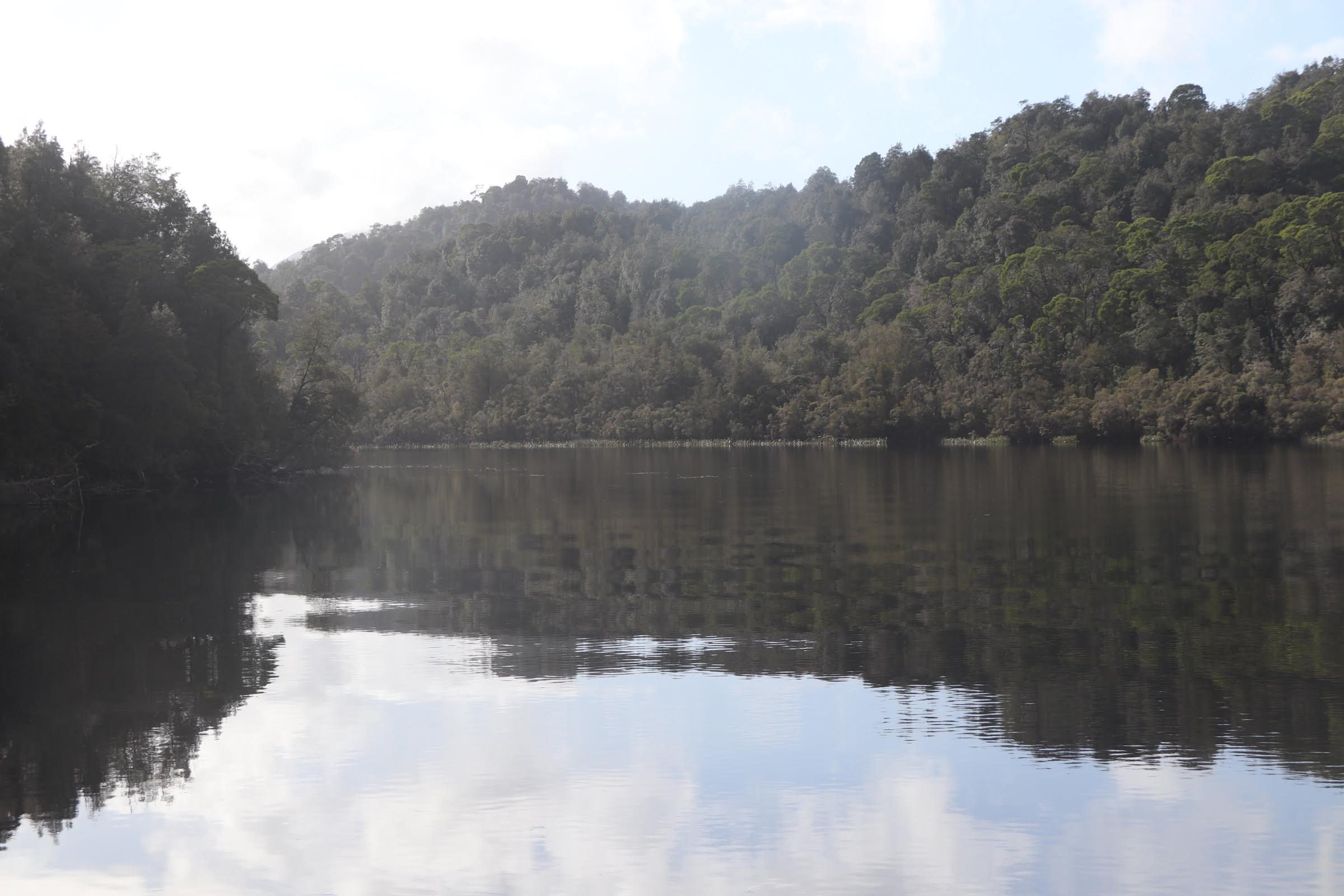
Tomorrow we will spend the day cruising the Gordon River

Tasmania Day 1

Day 1 of our holiday was dominated by travel. It’s a long way from Narrabri to Hobart! (1400 km as the crow flies). We set out at 6.30 am to drive to Tamworth Airport. From there we flew to Sydney with a 2 hour stop over before flying to Hobart.

Weather at home was damp, and we were worried about not being able to make it to Tamworth due to flooding. But God is good, and the flood peaks at Carroll (between Gunnedah and Tamworth) were not expected until tonight. From the air, we could see that there is a lot of water on the ground around Tamworth, so there is a flood of some size heading down to Narrabri over the next week or so.

After rain at home and rain in Sydney, it was funny to get to Hobart where it was warmer and sunny, contrary to all expectations.

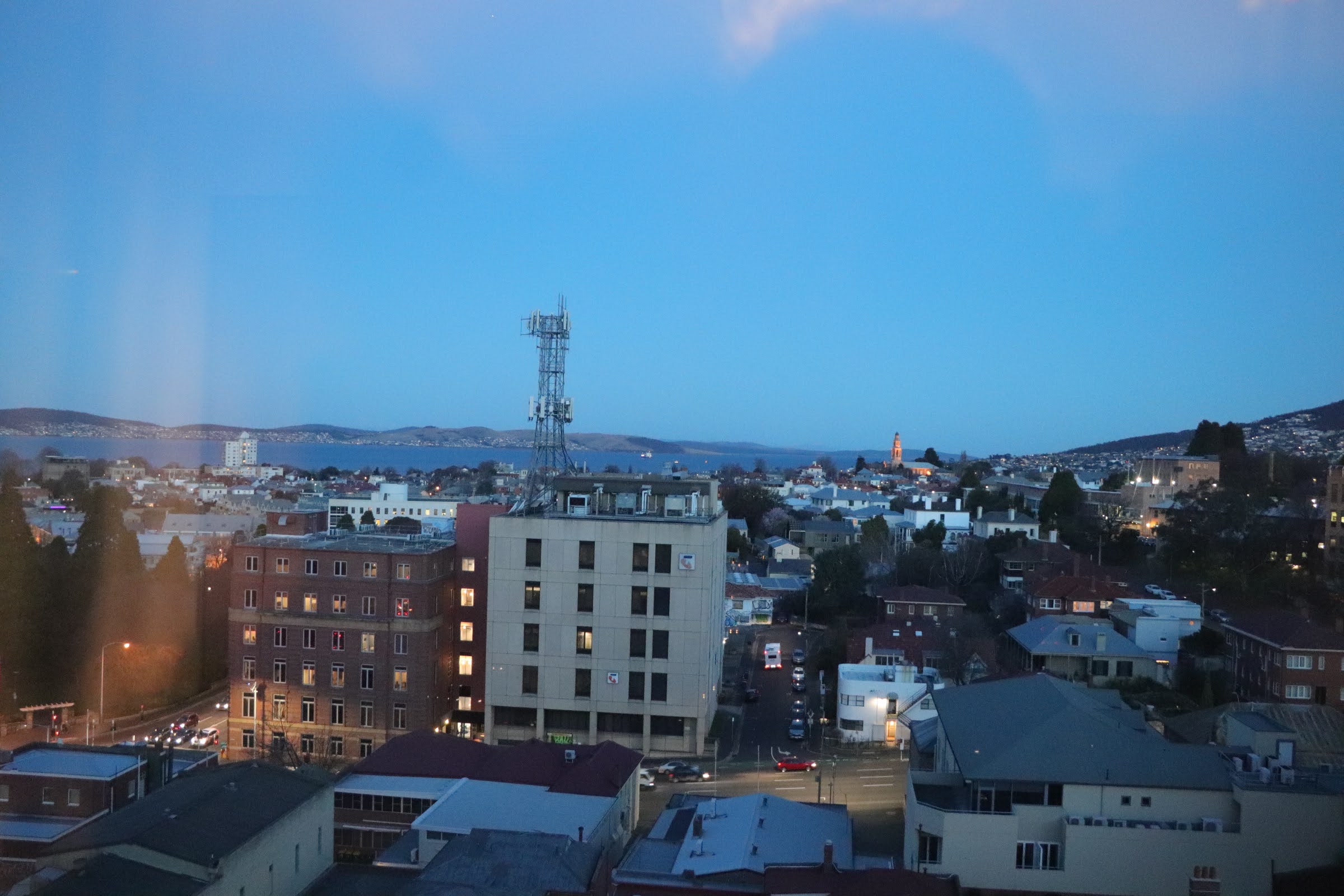
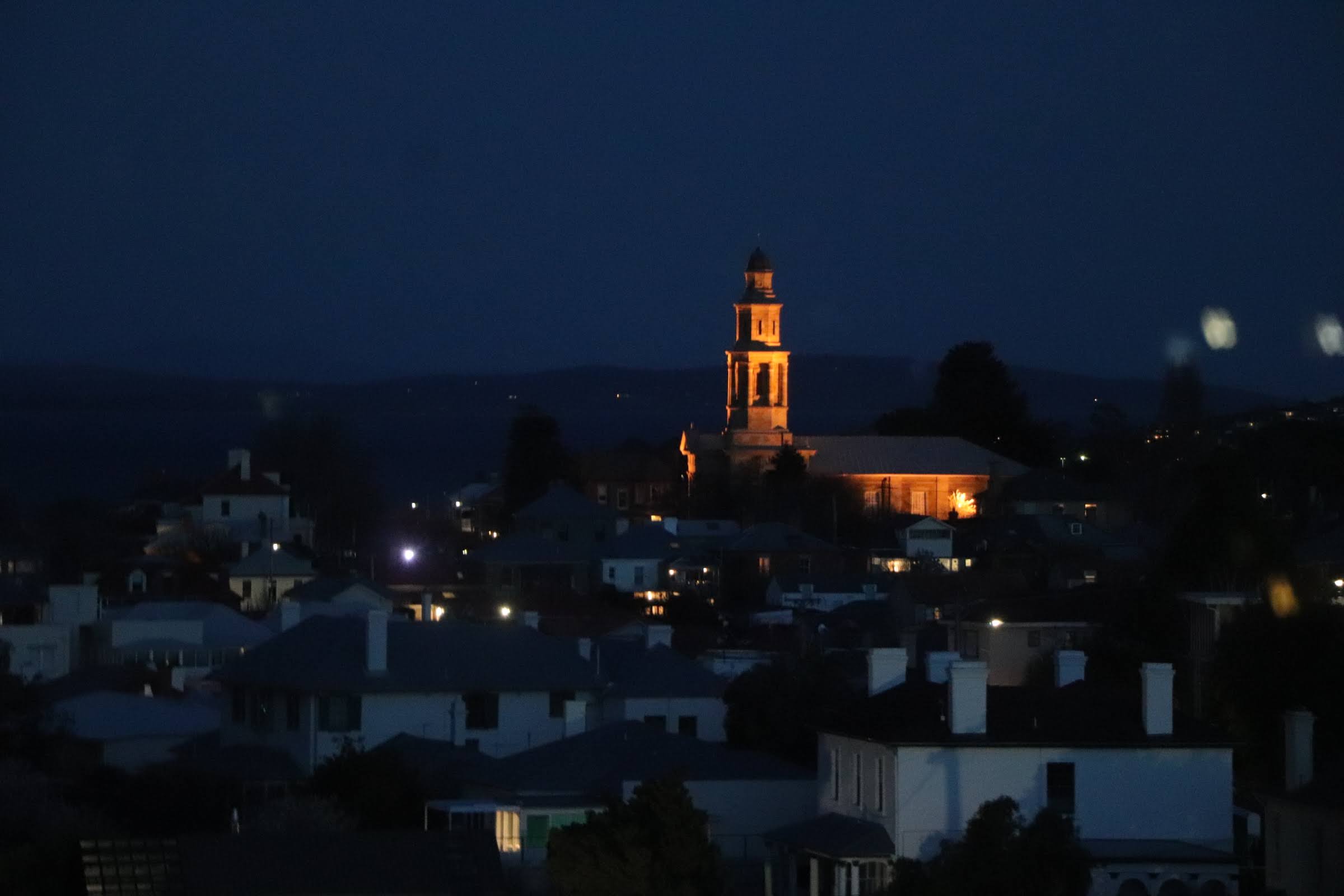
Now we are at the Ibis Styles Hotel in the centre of Hobart. We have great views from the room, which by itself is tiny.

The Mr Good Guys Asian Restaurant, located in the hotel, is quite nice. We shared Malaysian Satay Chicken Skewers (described as a small plate, but it was enough for two of us) with a side of jasmine rice. It was really nice after a long day.

Tomorrow we head up to Strachan, about 200 km away, but a 5 hour drive. It describes itself as a village, so it will be nice to get away from the “big city” (Hobart’s population is 191,000) and into the country.

Peter Ridd: The Great Barrier Reef Is Doing Fine

My article from The Australian this morning below. But first, AIMS are agreeing that the reef is coming off record highs so the small drop should be viewed in that context. However, much of the media is still reporting the drop as a disaster.

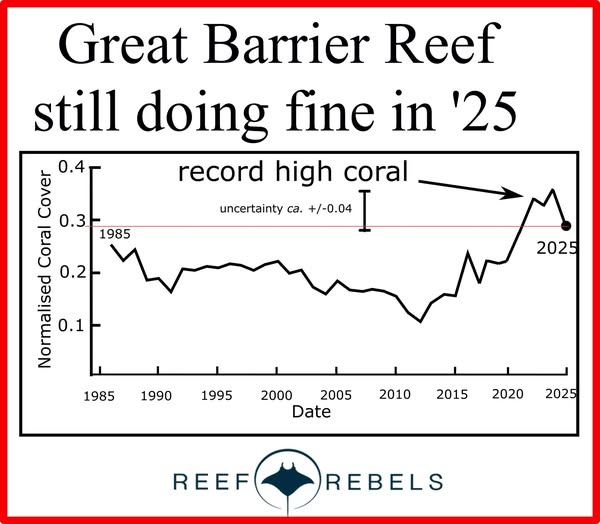
The latest 2025 statistics on the amount of coral on the Great Barrier Reef (GBR) show the reef is still doing fine despite having six allegedly cataclysmic coral bleaching events in the last decade. There should be no coral at all if those reports were true.

The normalised coral cover dropped from a record high number of 0.36 down to 0.29, but there is still twice as much coral as in 2012. The raw coral cover number for all the last five years has been higher than any of the previous years since records began in 1985. However, when one considers the uncertainty margin, the present figures are not significantly different from many of the previous years.

The Australian Institute of Marine Science collects coral data on around 100 of the 3000 individual coral reefs of the GBR. Analysis of the data at smaller scales shows the GBR is doing what it always does – change. There is a constant dynamic as cyclones, starfish plagues and bleaching events dramatically kill lots of coral in small areas, while it quietly regrows elsewhere.

Guess whether the ‘science’ institutions emphasise the death or regrowth.

The institutions often justify this embarrassingly high coral cover as just “weed coral”. But the type of coral that has exploded over the last few years is acropora, which is the most susceptible to hot-water bleaching. How can we have record amounts of the type of coral that should have been killed, again and again, from bleaching? The acropora takes five to ten years to regrow if it is killed.

There are two conclusions that must be drawn. First, not much coral has been killed by climate change bleaching – at least not compared to the capacity of coral to regrow. Second, the science institutions are not entirely trustworthy, and are in need of major reform.

And not just with regard to GBR or climate science. It is well recognised that most areas of scientific study are suffering a problem of reliability, which is damaging the reputation of science itself. It is well accepted that around half of the recent peer-reviewed science literature is flawed. Is there any other profession with such a high failure rate?

This last point has been noted in the United States, where American science is going through a process of genuine revolution. Scientists who were once victimised and ostracised have been appointed to lead science and medical research institutions. Among the more notable and encouraging appointments have been Professor Jay Bhattacharya who famously opposed the groupthink on Covid lockdowns, especially for children. He is now head of the National Institutes of Health and is proposing radical changes in the funding methodology to break the cycle of groupthink. He is also changing funding rules to encourage bright young scientists with new ideas rather than the present system which rewards older scientists who are wedded to conventional wisdom, and often enforce groupthink. In short, Bhattacharya is encouraging dissenters.

The US Department of Energy recently released a report on whether the conventional wisdom on climate change is entirely defensible. It is written by five eminent scientists, all with spectacular careers, who have consistently challenged the view that climate change is an existential threat. Their report includes data about GBR that shows there is little to worry about. Significantly, it systematically addresses many other aspects of Climate-Catastrophe Theory, such as wildfires and deaths from extreme weather events. And it points out the oft-ignored fact that carbon dioxide is a wonderful plant fertilizer which has already increased crop yields and plant growth.

Most importantly, rather than shutting down critics, the report’s writers are actively encouraging criticism, which they will respond to.

Science progresses through argument, logic, and quality assurance systems that make sure debate always takes place. Groupthink kills science, and groupthink is being challenged like never before in the US.

This revolution seems a long way off for Australia. But it will come, simply because US science, and science funding, dominates all other countries.

Imagine if Professor Ian Plimer, Australia’s most famous climate sceptic, was in charge of our climate science funding. Or if I were in charge of the Great Barrier Reef Marine Park Authority. Sounds crazy. But that is what has effectively happened in the US.

Australia’s science agencies would do well to contemplate whether they need to change their ways before the revolution comes to these shores. Better to adapt before the scientific guillotine falls.

Peter Ridd is an Adjunct Fellow at the Institute of Public Affairs.
Blue bottles and other stingers

Now one of the longest-held beliefs about bluebottles has been debunked

 
Thousands of them wash up on Australian beaches every summer but scientists have only just discovered that there’s more than one species of bluebottle on the planet.
Until recently the bluebottle or Portuguese man o’ war was believed to be a single species known by the scientific name Physalia physalis.
For decades, scientists operated under the impression that these jellyfish known for their painful sting drifted across oceans all over the world.
 
Bluebottles invasion on Newport Beach after days of north east winds Photo nick Moir 18 jan 2019
Scientists have only just discovered that there’s more than one species of bluebottle on the planet. (Nick Moir)
Now those beliefs have been utterly debunked.
New research from Yale University has proven the existence of at least four distinct species of bluebottle with their own unique appearance, genetics and distribution.
A number of Australian researchers at Griffith University and the University of New South Wales (UNSW) also contributed to the study, including Griffith’s Professor Kylie Pitt, who was shocked by what it uncovered.
 
“One in six Australians have been stung by a jellyfish and most of those stings are due to bluebottles, and we didn’t even know that we had different species,” she said.
“Here’s a species that causes so many problems along the Australian coast, and we still know so little about it.”
As well as the Physalia physalis, the study proved the existence of the previously proposed Physalia utriculus and Physalia megalista.
It also identified a whole new species called Physalia minuta, which is found in the waters near New Zealand and Australia.
The study proved the existence of at least four distinct bluebottle species.
The study proved the existence of at least four distinct bluebottle species. (Supplied)
Thankfully, the discovery of additional bluebottle species does not mean there will suddenly be more jellyfish washing up on Australian beaches.
“Your experience at the beach won’t change,” Pitt promised.
Associate Research Scientist at Yale University Samuel Church led the study, enlisting scientists from around the globe to collect bluebottle samples from their local beaches.
Samples from more than 150 animals were sent to Yale, where researchers analysed their genetics.
Everyday Australians also played a part in the project, though they may not have known it.
As well as studying information and samples collected by scientists like Pitt, the Yale research team analysed thousands of citizen-science photos.
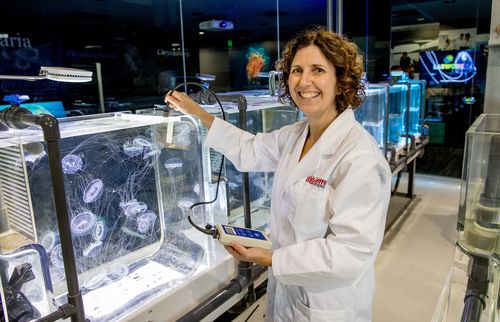
Kylie Pitt was among the Australian researchers who contributed to the game-changing study.
Griffith’s Professor Kylie Pitt was among the Australian researchers who contributed to the game-changing study. (Supplied)
The images were taken from iNaturalist.org, an online social network for nature-lovers where they can upload photos of flora and fauna they’ve seen in the wild.
The website also serves as a “crowdsourced species identification system and organism occurrence recording tool” and was an invaluable resource for the bluebottle study.
There are currently more than 20,000 images of bluebottles on the site, including more than 3000 listed as having been taken in Australia.
“There are hundreds and hundreds of photographs and records of bluebottles from all around the world,” Pitt said.
“So as part of this project, we extracted all the photos and we tried to allocate them to the different species that we identified, based on the way that they look.”

Apostolic Summit Afternoon Off

John likes to say “We are a civilised people, and we believe in having a siesta.” So afternoons are generally free at the Summits.

Since we have the joy of being accompanied by a young child, we decided to visit the splendid Rockhampton Zoo.

No zoo is complete without a meerkat or 10.

Of course there are always the monkeys to delight the humans – or is it the other way around?

There is a sign that says humans share 99% of their DNA with chimps. This is out of date information that bolsters the evolution narrative. A recent study which compared the full human genome with that of chimpanzees put the figure at a much lower 85%

The zoo features a number of native Australian animals including koalas, kangaroos and emus.

To remind visitors that everything in Australia is out to kill you, there is a not so friendly saltwater crocodile, a native to this tropical region.

I highly recommend the Rockhampton Zoo as a place for a leisurely wander.

Fred Pawle: Why Conservatives Should Rejoice

Australia just had a disastrous Federal election. The conservative Liberal Party ran a terrible campaign, allowing an incompetent and deceitful Government to be re-elected.

Why Conservatives Should Rejoice

Australia has dodged the bullet of fake conservatism. It is now incumbent on those who can survive Labor’s treacherous incompetence to ensure a decent alternative is offered in 2028.`

Phew. That was close! Had Peter Dutton’s Coalition won this election, we would be staring at three years of fake conservatives appeasing the environmental lobby, imposing new censorship laws, introducing a digital ID and central bank digital currency, ignoring the toxic National School Curriculum and locking us all up every time Anthony Fauci catches a cold.

The Coalition would have combined that with just enough sensible reform to keep both its base and its leftist focus groups onside come the next election. In other words, long-term, robust conservative policies would have been as likely as Albo’s newfound Catholicism preventing him from marching in the next Mardi Gras.

Thank goodness that instead we are staring down three years of unmitigated catastrophe at the hands of the most incompetent, nastiest bunch of politicians Australia has seen. Our contempt for them need not be moderated. Nor will we need to stifle our amusement as they impose arguably the worst agenda of any Australian government in history.

Conservatives who are lamenting that Labor’s divisive, illogical, unpatriotic and economy-destroying performance has been rewarded with another term are forgetting how much fun it is to be in opposition. We are the pirates, the rebels, the discerning minority who warned during this campaign that Labor would destroy the country. And now they will. It’s time to break out the popcorn and await vindication.

I say this with enormous sympathy for those who cannot avoid being victimised by this government. I’ve met farmers, for example, whose properties, which have been in the family for six generations and have provided Australia with both food and exports for more than a century, who will be driven to despair and in some cases bankruptcy and suicide, when Energy Minister Chris Bowen’s high-voltage wires are forcibly suspended above their crops. I won’t bore you with the details, but these wires, delivering electricity from remote windmills and solar operations to the cities, will make the farms unviable and impossible to sell, which is stage one of Bowen’s long-term plan. Stage two is to pick up the land for a song and carpet them with solar panels. Farming is so last century, don’t you know.

Similarly, small business operators who survive on narrow margins, and people with large mortgages and small children will, if they are smart enough to have seen through Labor’s counterproductive, inflation-driving promises of “free” handouts, will be trembling tonight. I feel for them.

Back in January, I compared Donald Trump, who was about to be inaugurated on a mandate of action and optimism, with Albo, who was preparing to embark on a campaign to be re-elected knowing that “most of his supporters hate the place, and think its history consists of nothing but theft and genocide. He knows his only chance in the forthcoming election is if enough voters share his dreary vision of multicultural dystopia, Net Zero deindustrialization, Soviet-style censorship and bloated bureaucracy.”

Nothing that happened during the campaign disabused me of this succinct observation. Albo knew his only chance was not to appeal to patriotism or a sense of mutual responsibility between state and citizen; rather, it was to give away as much money as he could in the key electorates and demographics. Great democratic victories are based on a broad vision that brings people together; Albo won it by promising to pay our doctors’ fees.

Some of Labor’s key demographics make astroturf look like the croquet garden at Windsor Castle. Labor has for decades been flooding the nation with low-skill workers who are dumb and nihilistic enough to vote for the party that obsequiously buys their affection, and Albo’s government has put the strategy on steroids.

The flip side of this arrangement for the MPs is that they need to wear strange costumes every time Ramadan, Diwali, Chinese New Year and the ancient Feast of the Non-Binary Mountain Goat rolls around. Let them. They know they look ridiculous.

We will retain our own culture, thanks very much, in which the only early-morning call to prayer is for the Dawn Service on April 25, and the only traditional greeting is a heartfelt “g’day” followed by “have a good one”.

Either deliberately or through its monumental incompetence, Labor is going to impose enormous suffering on Australians. Conservative commentators won’t be exempt. We’ve already seen in Britain and Germany what happens to people who upset the leftist agenda. Tommy Robinson and Lucy Connolly are the most famous, but in fact Pommy plods are arresting 30 people a day for wrongspeak. It will happen here too when the government reintroduces the Misinformation and Disinformation Bill, which empowers apparatchiks to define the truth. Albo and his colleagues are authoritarian losers who know they can’t win an argument, so must resort to blunter methods to retain power.

Nigel Farrage has just proved that even this isn’t foolproof. His Reform Party, which evolved from the Brexit Party in 2021, is now the most popular party in Britain. In a by-election last week it destroyed the incumbent Labor while also taking out 10 local councils. Farrage has called it the death of two-party politics. British Labour backbenchers are already sharpening the knives for their evil leader, Keir Starmer.

Albo is taking us down the same road travelled by his hero Starmer, unaware that a humiliating Farrage-like backlash will ensue.

This term of federal government will inspire patriotic Australians in ways Peter Dutton, let alone Labor, never thought possible.

Wet wet wet

How wet was it in Narrabri? Here in the West, we had exactly 100 mm for the 24 hours to 5 pm, a total of 125 for the last couple of days. Our average for the whole of March is 56 mm, so a bit damp.

There are lots of roads closed due to flash flooding and some houses have been inundated.

After clearing for a while this afternoon, the clouds are coming back over so we might yet get some more.

Cats And Dogs

After relatively dry and warm weather in Narrabri the last two months, we are well and truly over our average rain for the month of March. Since 11 am yesterday morning we have received 74 mm as at 9.00. Our average for the month of March is 56 mm!

Time

While I mostly like Daylight Saving Time, I think it goes a bit too long. It seems odd to me that we have the sun rising after 7 am and so many people are getting up in the dark while we are so far from winter. If you look at the start and finish dates of Summer Time, we end it about a month later than we should.

In times gone by, each town or village ran to their own time zone. There might be only one clock in a locality, probably on the church. The local time was 12 noon when the sun was at its highest point. The advent of trains and timetables meant that a standard time in a county or region had to be adopted, otherwise timetables could not be worked out.

The internet age accelerated things further so that we now synchronise time to millionths of a second to make possible these instantaneous transactions of data. When the natural world drifts too far from internet time, a “leap second” has to be inserted into the atomic clocks that govern it all.

As opposed to this chronological idea of time, the ancients has a concept of “appointed time.” This was the right time. We have all had those experiences when everything just came together at the right time; what was impossible a month ago suddenly comes to pass. In farming, sowing and harvest are appointed times, determined by seasons and weather. A baby’s birth is an appointed time that nobody can control.

The Bible tells us that “it is appointed for man to die once, and after that comes judgement.” You and I don’t know when we will die, when that “appointed time” is. Wisdom suggests that we should prepare for death well in advance.

One thing that every person should do is to make sure that they are ready to stand before God. The Bible tells us that we are all sinners, but also that “in Christ God was reconciling the world to Himself.” Those who are followers of Jesus have nothing to fear from death or from judgement, because He has paid the price.

It is one thing to gt the clocks right. Let’s make sure our relationship with God is also right.