Australia
Mark Latham Is Right- He Would Make a Better PM Than Almost Anyone
From Caldron Pool
Mark Latham says, if parliament can social distance safely, then so could churches: They would be ‘a place of solace and inspiration’ in difficult times
-
30.5KSHARES
Mark Latham has said it makes no sense closing down churches while TAFE colleges, schools, and some universities remain open.
Speaking with Alan Jones on 2GB/4BC, the NSW One Nation leader described the inconsistencies in the Prime Minister’s partial shutdown as “just horrific”, saying safely done, churches would be a place of “solace and inspiration” for people in these difficult times.
“I’ve spoken to church leaders,” Mr Latham said, “there is a challenge in social distancing, in the congregation that they’ve got at their worship… but they thought they were mastering that.
“I can tell you, the state parliament sat yesterday. We did the one and a half metre social distancing. I got to say, with the hand washing and so forth, it all felt safe and protected compared to the normal brushing up against each other.
Mr Latham went on to say, “So, if parliament can social distance safely, then you would have thought a church could. A metre and a half on the pews, and if there’s an overflow, they could put up a video screen on the outside with modern technology.
“So, you’re right. Churches would be a place of solace and inspiration for people in these difficult times. So, to close them down while lots of other places are open just doesn’t seem to make sense.”
The Corona Recession
Steve Kates is one of the few economists who actually understands economics. He says that Covid is bringing a major restructuring of the economy, and the job of Governments is not to “stimulate” the economy by boosting retail spending, but to help businesses survive the transition. Well worth a read.
From Catallaxyfiles.com
Classical economic policy and the present recession

Whatever anyone might believe about the dangers of the Corona Virus, there is no doubt that the American economy, in fact every economy, is heading into recession. There will be a large fall in output and a rise in the rate of unemployment. All this is inevitable. But what must be understood if policy is to achieve a positive outcome is that the downturn cannot be understood as due to a fall in demand as modern economic theory would have it, but will be due to a massive structural shift in our economies. It is not that we will be buying less because we are saving more, but we will be buying not just less, because we will be producing less, but we will not be buying many goods and services we had been buying until concerns about the virus became so general. Lots of forms of production, such as air travel and restaurant meals, will experience a major contraction in demand because of the fears that certain activities are now forbidden or many people have self-isolated.
As every pre-Keynesian economist once knew, recessions do occur but NEVER because a deficiency of demand. When they occur, they are the result of a structural shift in the underlying economy. We are now in the midst of one of the most profound shifts in the international economy ever seen. Just the restaurant trade is facing a major fall in demand, along with airline travel, tourism and lots of other parts of the economy. The structure of the economy is under immense stress. The downturn which is inevitable is due to a structural shift, not a fall in demand. Everyone once understood that. Since 1936, since the publication of Keynes’s General Theory, this then-universal understanding of why recessions occur has disappeared utterly from economic discourse. I used to think the pre-Keynesian conception was obvious, but have discovered to my amazement that virtually no one any longer understands it. We are all Keynesians now, except for a handful of others who have retained this older, now abandoned, approach. But what has amazed me now even more is that the approach taken by Donald Trump in trying to deal with the coming downturn clearly takes a classical approach to softening the economic fall-out that is now inevitable.
Nothing will prevent a downturn now, but what must be done is:
(1) ensure those who are now being temporarily displaced from their paid employment are receiving cash in hand so that they can buy what they need,
(2) businesses, whose revenues will be falling and in many instances be reduced to zero, must have an immediate fall in production costs through perhaps cuts to various forms of taxation, along with receiving cash injections so that businesses which will return to profitability after this disruption are able to maintain at least part of their cash flow and pay their bills, not just so that they can stay in business but that so too can their suppliers
It is the structure of demand that needs to be preserved, not the level. The level of demand will fall, but the crucial issue is that the structure of demand will also be badly affected. The aim of policy must be to ensure that the underlying structure of supply is maintained. This is what is meant by supply-side economics. It is to maintain the structure of the economy that matters. Maintaining the structure is crucial, not the totality. Demand is constituted by supply, and supply will be falling all over the place and therefore so to will demand.
See the airline industry as a clear example. People will one day wish to fly as they have always done, but the airlines must be preserved in the meantime. Virtually every industry is in exactly the same position. No revenue or drastically reduced revenues at the moment to meet their costs, but also with a certain expectation that demand will return in the near future. The aim must now be to preserve as much as possible.
The photo above was taken while watching Fox with the proposed government approach stated as follows:
RPT:PROPOSED GOVT STIMULUS PKG WILL INCLUDE $1200 FOR SINGLE AMERICANS AND $2400 FOR COUPLES
As we think of things today, it has to be presented as a “stimulus” as if the aim is to raise the level of demand. It is, nevertheless, an approach to dealing with a structural shift in the economy, and the aim is to preserve as much of the economy as can be preserved for when things return to normal. The policy proposal is discussed here: GOP coronavirus stimulus bill unveils $1,200 checks for public.
“Recovery checks of up to $1,200 will be put into the hands of most taxpayers, providing cash immediately to individuals and families,” the Senate Finance Committee said in a statement.
President Trump requested that the legislation include the direct payments to boost consumer purchasing. The White House requested two $1,000 waves of checks to all taxpayers.
On the business side, there is also this:
The package also includes $300 billion in small business loans, which would be forgiven if the firms don’t lay off workers.
Another $58 billion in loans would go to airlines suffering a demand plunge worse than after 9/11, with another $150 billion of loans and loan guarantees to other businesses.
This is obviously also intended as a means to maintain the structure of the economy, not as a “stimulus” to lift demand. Among the good luck of the moment is that the President is a former businessman who understands the problems facing business and what needs to be done immediately to minimise the long-term harm to the economy. I can only hope the same approach is taken across the world.
Having just finished the first round of editing of my next book, Classical Economics and the Modern Economy, let me recommend it to one and all once it is finally published in June. It is even possible that classical economic theory may once again come back into fashion. The benefit to our economies and future standard of living would be massive.
Corona Will Steal Your Freedom
In Italy, a priest who was celebrating Mass in an empty church, streamed to people keeping a safe distance outside, was raided by local police and told he had to stop- despite following the regulations. He finished the Mass.
I’m not going to promote any conspiracy theories, but we do need to be wary of Governments seizing this opportunity to further restrict our rights, and to keep those restrictions long after the threat is over. These are gifts not just freedom of religious observance, but freedom of association, freedom of speech, freedom to move.
Because that is what Governments do. They “protect” us by restricting us, using fear to get us to acquiesce to things we normally would never accept.
Don’t believe me? How many people thought church services would be shut down in Australia two weeks ago?
How long will these restrictions be here for? Well we’ve gone from “a few weeks” to “up to six months.”
We must keep pushing back against these restrictions, demanding that normal freedoms be returned to us as soon as the crisis is over.
Civilisation Is In The Small Towns
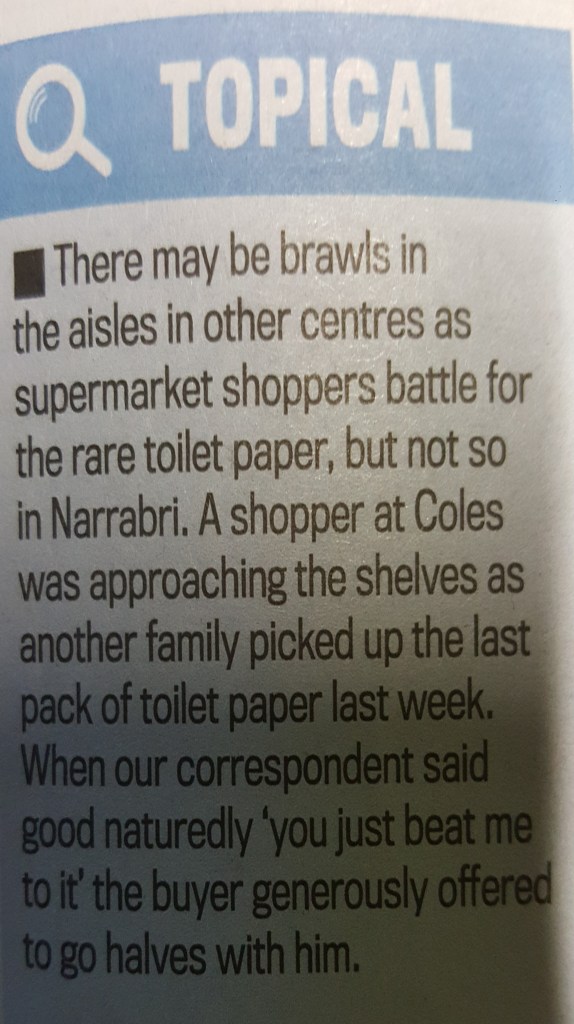
So in large cities it is “fight to the death” for toilet paper. In more civilised places, where people still recognise each other’s humanity, we share. That is why for most of my adult life I have chosen to live in small towns.
From Narrabri’s paper, The Courier
A Cautionary Tale?
From Greg Chapman at Quadrant Online

The Emperor was rightly proud of his achievements. His legions had conquered his neighbours and tributes were being collected to pay for his armies, his court, his administrators. There was even enough left over for the entertainment of the masses. Bread and circuses. In spite of all his victories, there was still disquiet in the land from ungrateful plebeians.
With three seasons of drought, the harvests had been poor and it had been difficult to collect taxes to pay for the upkeep of his empire, no matter how hard he squeezed the peasants. Even the patricians in their gilded villas had become agitated about the sustainability of their protected positions, and they recommended he consult the oracles to see what the future held. Thus the Emperor summoned the High Priest to his palace.
Dressed in magnificent robes with borders embroidered in gold thread and wearing a mitre that made him tower over everyone else in the court, the High Priest entered with due ceremony. He acknowledged no one but the Emperor, to whom he made a slight bow when he reached the podium upon which sat his throne. The Emperor gestured to the High Priest to approach him. “Ave, High Priest. I have a question for you: why are the gods punishing us with these droughts? Everyone in my Imperium suffers. Why at the feast last week, even I as Emperor was unable to acquire sufficient pheasant to satisfy my guests and the wine this season has been inferior to any other in living memory. This cannot continue.”
The High Priest considered his Emperor’s challenge. “I’m most sorry that you have suffered so, but it’s difficult for us mortals to comprehend the ways of the gods Your Highness. However, I and my fellow priests have a way to predict them with some certainty. Would Your Highness be interested in knowing how?”
“Of course” said the Emperor. “To see the future is to control it. How would I do that?”
“Well,” the high priest continued, “Your Highness would be aware that the priesthood has for many decades been sacrificing chickens and examining their entrails. What Your Highness may be unaware of is that after each sacrifice, we record an analysis of the entrails.”
“I did not know that,” the Emperor nodded. “You may continue.”
“As Your Highness would also know, we have a record of all harvests over the same period from your tax collectors, so it should be straight forward to compare the two so we can use these sacrifices to forecast future harvests.”
The Emperor appeared rather dubious about this proposition and motioned to his head counsellor. “What do you think of this?” he demanded.
The counsellor, well known for his forthrightness, which the Emperor valued when he agreed with his own opinion, not so much when he didn’t, stroked his prominent chin and after some consideration addressed both the Emperor and the High Priest firmly. “I can’t believe that there is any connection between the size of the harvest and the condition of the entrails from slaughtered chickens. This is just superstitious nonsense and a waste of the Emperor’s wealth.”
The High Priest glared at the counsellor. “How dare you question the authority of the High Priest and the consensus of the IPCC.”
“What’s the IPCC?” interjected the Emperor.
“Why Your Highness, the Infallible Priesthood Chicken-entrail Convocation. The highest authority on these matters in the Empire.” Turning to the counsellor the High Priest demanded, “By what authority do you challenge this sacred knowledge. Have you ever been a part of the priesthood?”
Suitably admonished, the counsellor withdrew. “Very well,” said the Emperor, regaining control of the audience. “What do you need?”
Read the rest of the article at Quadrant
Who does Fireman Paul Really Love?
Fireman Paul Parker was adored by the media left for telling the Prime Minister to F*** off. Then he claimed to have been “sacked” from the RFS for doing this in uniform. (He should have been, but wasn’t)
It turns out that the politician that he really admires is not anybody remotely interested in controlling the climate.
The miracle crop that saved our farm
From “Eternity” comes this good news story about God’s provision in the drought.
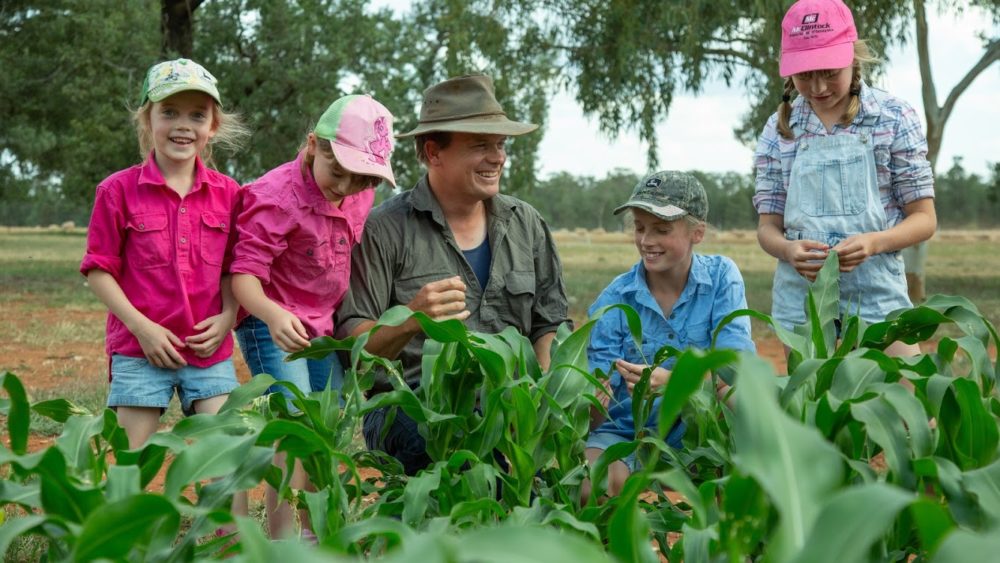 Jarrod Amery with four of his six kidsImage supplied
The miracle crop that saved our farm
How this faithful farmer survived the drought
It’s nine months since Eternity caught up with 37-year-old farmer from Central West NSW, Jarrod Amery. At the time, Amery was simply blown away by the “miraculous” canola crop he had planted just weeks before – after a dream that he believed to be from God.
It was a big leap of faith. In the dream, Amery was standing in the midst of lush, green canola in a paddock on his 6500-hectare farm outside Forbes. Many drought-stricken locals would simply have written off the dream as wishful thinking; canola crops were few and far between, and those that did exist were struggling. Yet Amery, convicted by his desire to be a “supernatural farmer”, went and purchased $36,000 of canola seed. Then he and his wife Emma sowed it into the dry, thirsty earth and waited on God.
“I remember praying about the crop and saying, ‘God, we’ve done all we can do, and we’re trusting you.” – Jarrod Amery
It was a leap of faith that paid off. “The crop grew and grew and it flourished better than any other crops we planted,” says Amery. “It was the best crop in the area by a mile …
“Every Sunday after church, Emma and I and our six children would intentionally drive past that crop, even though it took longer to get home, and we’d thank God for the crop. I remember one Sunday in early June, we got out of the car and I said to Emma ‘this crop has grown to a stage where it’s exactly like I saw in my dream’, and I was like, this is amazing! This is a dream in reality.”
But when this “supernatural” crop was looking its best, the rain dried up during the middle of 2019.
“Pretty much from the first of July onwards, the rain stopped,” says Amery about a common problem across drought-affected areas of Australia.
“From July 1 to the end of January 2020, we had 46 millilitres, which is virtually nothing. Last year was the driest year we’ve ever recorded.
“As the crop went on, it got thirstier and thirstier. It still looked like one of the best crops in the area, but over time it started to wilt.”
Amery began to question God, saying: “God, I thought that this dream was going to have a happy ending.”
“I remember praying about the crop and saying, ‘God, we’ve done all we can do, and we’re trusting you that whatever happens, happens because you’ve got a good plan going on.”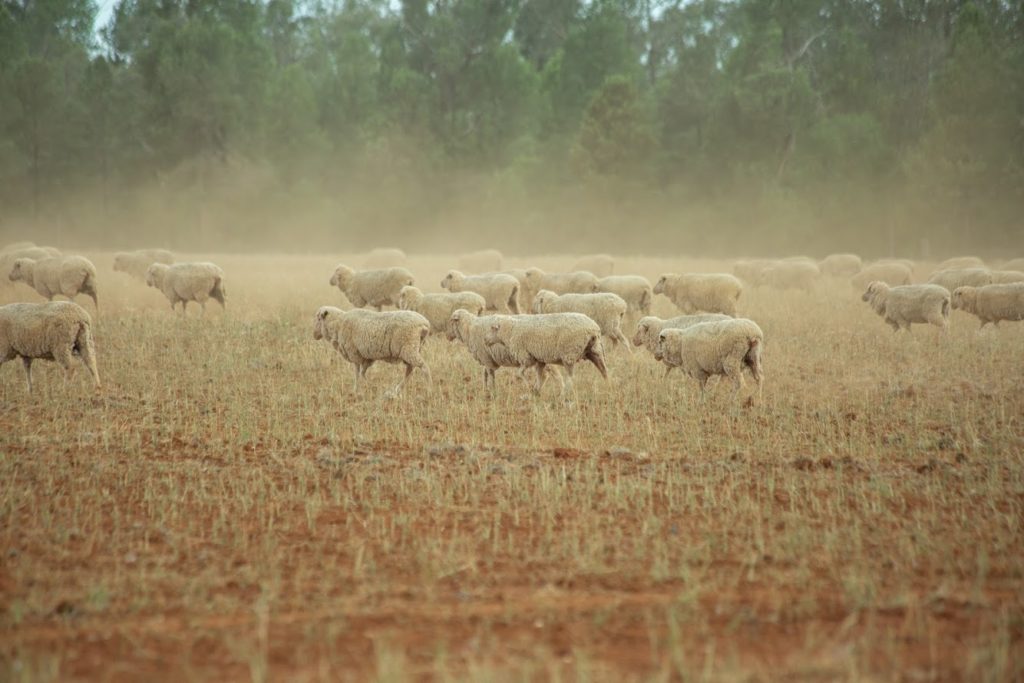
The Amerys’ propertyImage supplied
While other canola crops on the Amery farm withered up and died, the miracle crop continued to grow, although “not at a great rate”.
“We made a decision that we’re going to put faith in God and that the dream was from God,” Amery reflects.
“We made a choice near the end of March [2019] that we were going to sow [canola seed]. So we just started sowing 24 hours a day. We got 80 per cent of the paddock sown, but the other 20 per cent we didn’t quite get sown because it started to rain.
“We came back and sowed that last 20 per cent seven days later when the paddock dried out. That part of the paddock, that we sowed after the rain, withered up and died – it was un-harvestable.
“If we hadn’t have taken a step of faith … then we wouldn’t have had any crop at all.” – Jarrod Amery
“So if we hadn’t have taken a step of faith and started to sow the crop when God gave us the dream to sow it into dry soil, then we wouldn’t have had any crop at all.”
“That was a miracle in itself!” laughs Amery incredulously.
When the Amery family eventually cut the canola crop and sold it for hay (to be used as animal feed), they “got heaps and heaps and heaps of hay bales. More than anyone else in the district.”
“These hay bales were in great demand. Our hay was being sold from Tamworth to Guyra to Condobolin and even up near the Queensland border. It was going all over the place.
“That canola was approximately 10 per cent of our land mass, but provided us with around 80 per cent of our income in 2019.”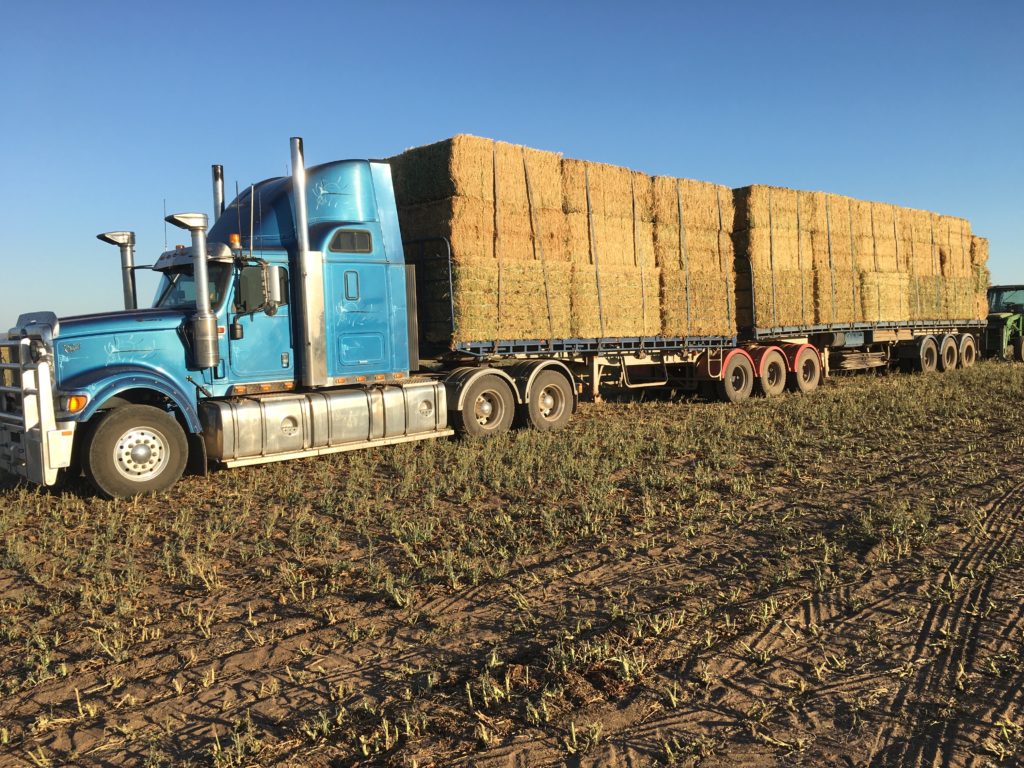
“We had heaps and heaps and heaps of hay bales. More than anyone else in the district,” says Jarrod Amery.Image supplied
While the farm is still running at a loss, Amery says: “If we hadn’t done what God had shown us in the dream, we wouldn’t have had any income whatsoever from that paddock. That would have probably resulted in Emma and I not being able to carry on with our agricultural business.”
“That small thing we did by just sowing in faith has enabled Emma and I to continue on during this drought, which has been ever so hard, and to come out the other side and continue to live the dream of being farmers.”
The next leap of faith
“We’re off to a far, far better start this year than last year,” says the ever-positive Amery. During the past week, they’ve received 115 millilitres of rain – that’s 80 per cent of the entire rainfall at the property last year.
“That water will stay in the ground until we want to plant our crops. So it’s money in the bank pretty much.”
Amery believes that the drought is starting to break, although he qualifies: “but I don’t shout it from the hilltops because some of the farmers haven’t got that rain yet.”
For farmers in his local area, the recent rain has been a “massive morale booster” and “a game changer”.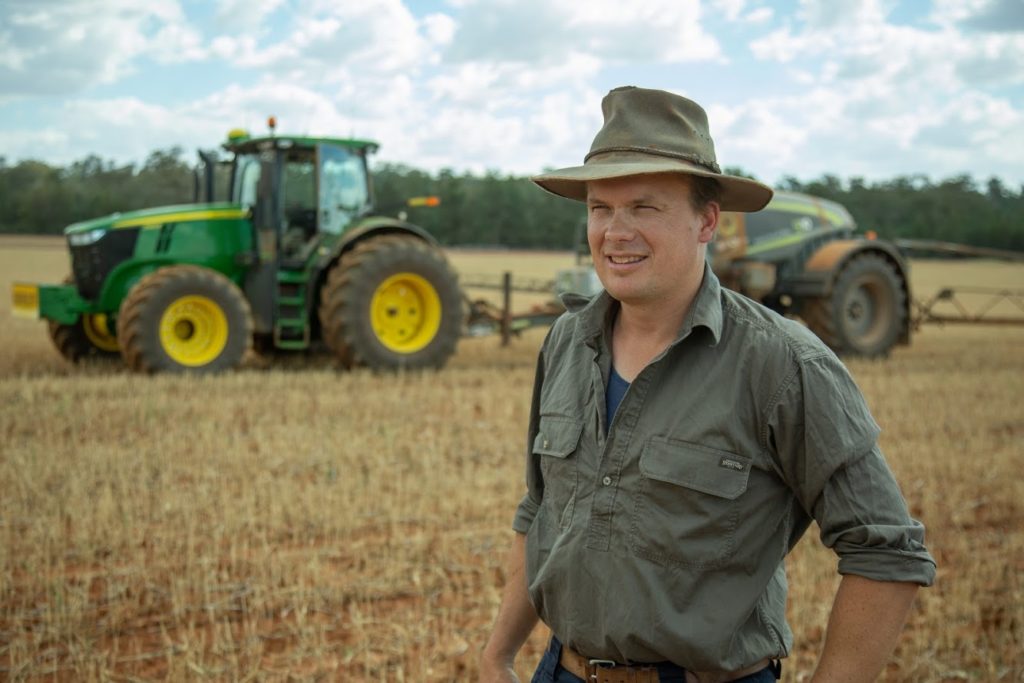
Jarrod AmeryImage supplied
Reflecting on the lessons he’s learned during this drought, Amery says: “It has been really hard at times and very challenging, but I know that God is so faithful and he’s so good. And I also know that I’ve learnt the most important lessons in life when life’s been most challenging.
“I have not wanted to waste such a difficult time by sitting around twiddling my thumbs, waiting for my environment to improve. I’ve been really consciously seeking out what can I do better on my farm; God, what do you want to show me about my heart, what skills do you what to teach me, what do you want to show me to help me to be a better farmer, a better business person, a better family man, a better community man at this particular time?”
While he doesn’t want to minimise the impact of the drought, Amery goes as far as to say that the drought is actually one of the best things that’s happened to him as a farmer.
“I reckon that this drought could be one of the greatest opportunities that I’ll have in my career.” – Jarrod Amery
“I’ve been thinking about this. The drought for some people seems like a waste of time, a waste of effort and a waste of money. But I reckon that this drought could be one of the greatest opportunities that I’ll have in my career.
“The number of things that I’ve learnt – that people have taught me, I’ve taught myself or God’s shown me – turns you into a bigger, better and wiser person.”
Amery says he’s “only on the start of this journey” of faithful living. He is currently waiting on God to direct his decisions about stock purchasing and crop planting in the next month or so.
“I’m determined not to do what I’ve always done because if I do that, I’ll get what I’ve always gotten,” he explains.
In summing up, Amery adds: “The crux of it is if you believe that God’s speaking to you, you’re better off giving it a go rather than waiting and waiting to see if it was from God.”
“Don’t just sit around, step out in faith and ask God ‘Was this really from you?’”
Lake Fills In A Couple of Days
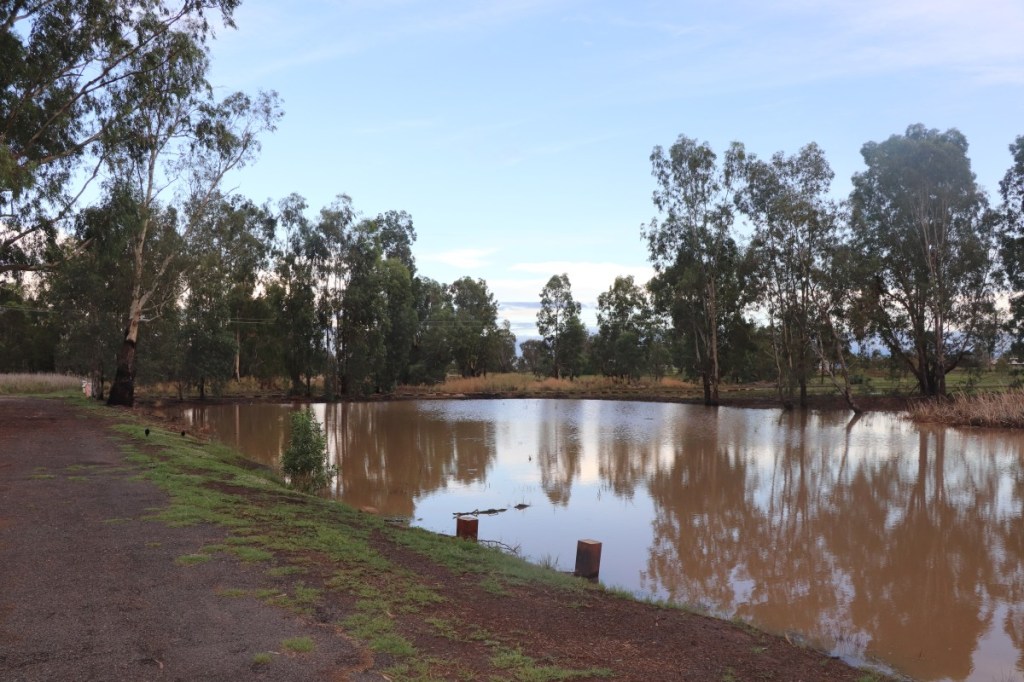
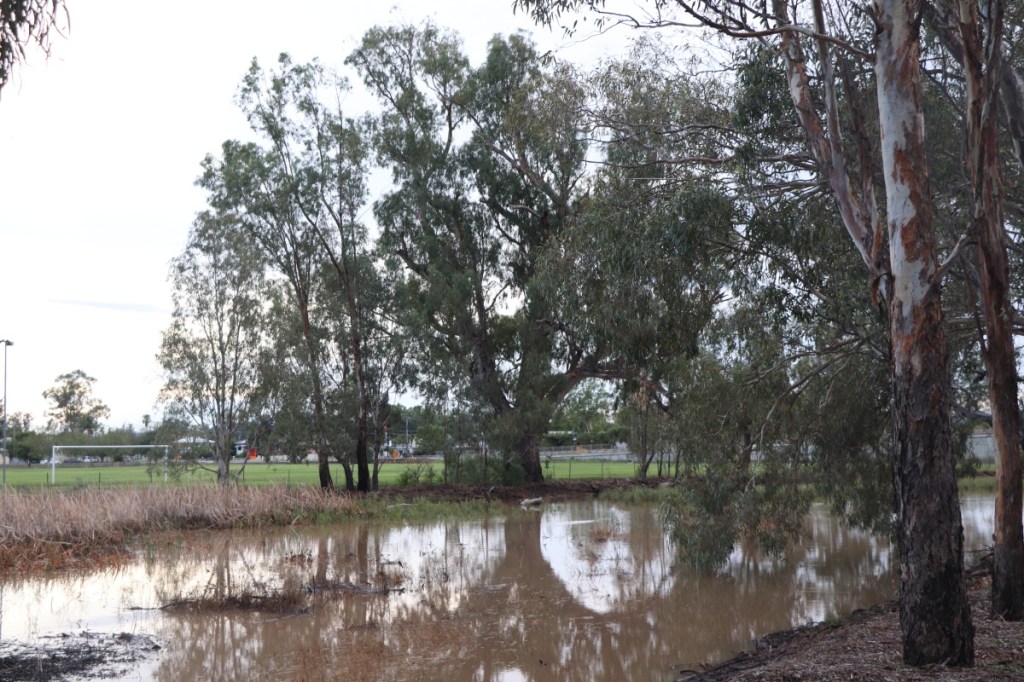
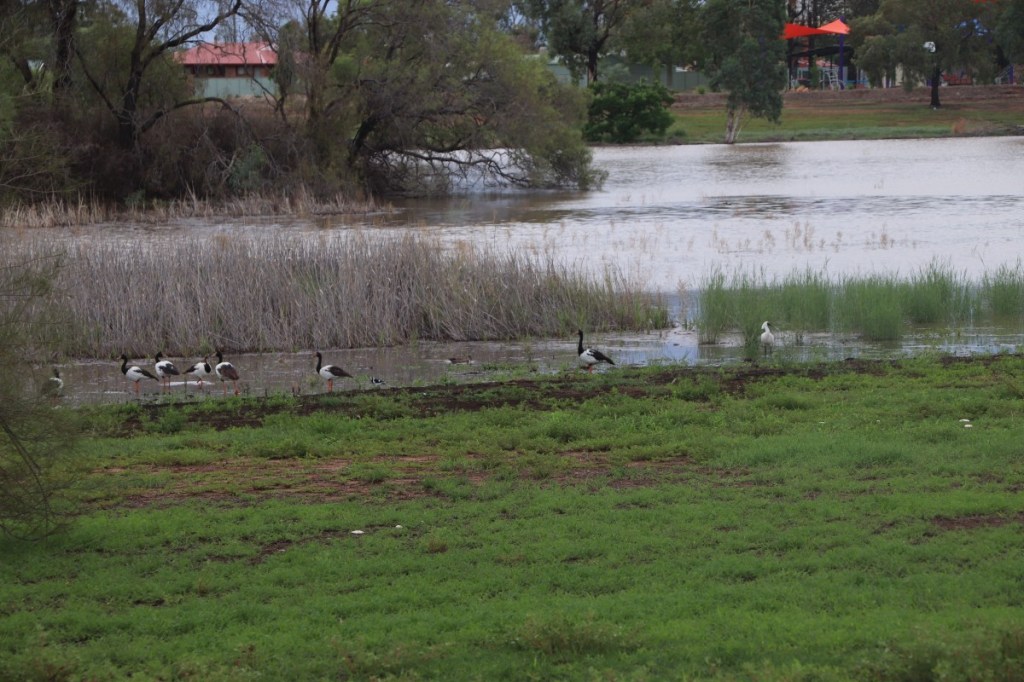
After months of complete desiccation, the Narrabri Lake is just centimetres from overflowing. When I last looked a couple of days ago, there was just a shallow layer covering about half the total area. Since then, hundreds of megalitres have flowed in to fill the lake. And the birds have come flocking in.


A Land of Droughts and Flooding Rains
Narrabri, like much of eastern Australia, has been in the grip of drought for several years. The creek at the back of our house has been pretty much dry for months.
Yesterday, we received 45 mm of rain which is 3/4 of our average rainfall for the whole of February. Heavy rain on the Nandewar Ranges, east of Narrabri resulted in minor flooding in the eastern side of the town.
This morning our creek is full of water, and there is a cacophony of frogs that is almost deafening.