The Solar Power Plant That Runs on Natural Gas

So, get this, environmentalists worked everyone up into a lather about global warming- now on pause for over 18 years- and the need to use renewables- which are green, safe and just dandy (don’t mind that the “free” energy costs three times as much as the “dirty” stuff”).

So in California they built a you-beaut solar thermal plant which fries birds by the thousand and which actually needs natural gas to keep it running smoothly- for up to 4 hours a day they burn those awful fossil fuels to keep the turbine spinning.

That my friends, is why no rational person should ever vote Greens or pay any attention to an “expert” with the word sustainable in his/her job description.

From WUWT:

Solar Fossil Fueled Fantasies


Guest Post by Willis Eschenbach.

Sometimes when I’m reading about renewable technologies, I just break out laughing at the madness that the war on carbon has wrought. Consider the Ivanpah solar tower electric power plant. It covers five square miles in Southern California with mirrors which are all focusing the sun on a central tower. The concentrated sunlight boils water that is used to run a steam turbine to generate electricity.


ivanpah solar power plant


Sounds like at a minimum it would be ecologically neutral … but unfortunately, the Law of Unintended Consequences never sleeps, and the Ivanpah tower has turned out to be a death trap for birds, killing hundreds and hundreds every year:

“After several studies, the conclusion for why birds are drawn to the searing beams of the solar field goes like this: Insects are attracted to the bright light of the reflecting mirrors, much as moths are lured to a porch light. Small birds — insect eaters such as finches, swallows and warblers — go after the bugs. In turn, predators such as hawks and falcons pursue the smaller birds.

But once the birds enter the focal field of the mirrors, called the “solar flux,” injury or death can occur in a few seconds. The reflected light from the mirrors is 800 to 1,000 degrees Fahrenheit. Either the birds are incinerated in flight; their feathers are singed, causing them to fall to their deaths; or they are too injured to fly and are killed on the ground by predators, according to a report by the National Fish and Wildlife Forensics Laboratory.”

– David Danelski, Solar: Ivanpah Solar Described as Deadly Trap for Wildlife,” Riverside-Press Enterprise, April 8, 2014.

But of course, that’s not what made me laugh. That’s a tragedy which unfortunately will be mostly ignored by those good-hearted environmentally conscious folks suffering from chronic carbophobia.

The next oddity about Ivanpah is that despite being powered by light, it is light-years away from being economically viable. Like the old sailors say, “The wind is free … but everything else costs money”.

But being totally uneconomical doesn’t matter, because despite costing $2.2 billion to build, Google is a major shareholder, so at least they could afford to foot the bills for their high-priced bird-burner …

Read the rest here


Tony Abbott Wants Fewer Wind Farms

If renewable energy really was cheaper we would not need a RET or subsidies or a plethora of rent-seeking organisations demanding quotas and subsidies. If it was free as the advocates like to tell us, the big energy companies would abandon coal technology tomorrow. If Australians really wanted more renewable energy as the Greens and Labor want to believe, we would all be ticking that little box that says “Please charge me more to use green power.”

Facts:

  • Windfarms are ugly
  • They produce lots less energy than it says on the box
  • Their output is irregular and difficult to engineer for
  • They cost more than conventional power
  • They kill birds, including endangered species.


From the ABC:

Tony Abbott wants fewer ‘visually awful’ wind farms, wishes Howard government never implemented Renewable Energy Target

Updated 34 minutes ago

Prime Minister Tony Abbott has described wind farms as “visually awful” saying he wishes the Howard government, of which he was a member, had never implemented the Renewable Energy Target (RET) policy.

“When I’ve been up close to these things, not only are they visually awful, but they make a lot of noise,” Mr Abbott told Sydney broadcaster Alan Jones this morning.

His comments echoed those of Treasurer Joe Hockey, who last year described wind turbines as “utterly offensive”.

Mr Abbott said changes before the Federal Parliament to reduce the RET were designed to prevent wind farms from further spreading across the Australian landscape.

“I would frankly have liked to reduce the number a lot more but we got the best deal we could out of the Senate,” he said.

“And if we hadn’t had a deal, Alan, we would have been stuck with even more of these things.”

The target was initially created in 2001 by John Howard and subsequently strengthened by Labor to “at least 20 per cent by 2020”, calculated at the time as being 41,000 gigawatt hours of electricity.

But energy efficiency gains since then mean that 41,000GWh would have represented a figure closer to 27 per cent of 2020 electricity needs.

Knowing what we know now, I don’t think we would have gone down this path in this way, but at the time we thought [introducing the RET] was the right way forward.

Prime Minister Tony Abbott

The Federal Government has sought to cut the target, saying it wanted one more in line with original 20 per cent target.

Changes to the RET legislating a 33,000GWh target have passed the Lower House but not the Senate — a point on which Mr Abbott appeared to be unclear.

“What we did recently in the Senate was reduce, Alan, reduce, capital R-E-D-U-C-E, we reduced the number of these thing that we’re going to get in the future,” he said.

Mr Abbott also said he would have preferred the Howard government had never created the RET in the first place.

“Knowing what we know now I don’t think we would have gone down this path in this way, but at the time we thought it was the right way forward,” he told Jones.

Opposition spokesman for the environment Mark Butler said he was “stunned” by Mr Abbott’s comments.

“Renewable energy is enormously popular in Australia,” Mr Butler said.

“People want more renewable energy, not less, because of the obvious economic and environmental benefits of creating clean energy from free resources like wind, solar and waves.”

Greens deputy leader Larissa Waters said Mr Abbott’s comments could harm the industry.

“This is the guy that’s held out — he’s trying to cut to give certainty. In fact, he’s made it clear that he doesn’t want the industry to exist at all,” Senator Waters said.

Abbott set out to destroy viable industry: Australian Wind Alliance

Australian Wind Alliance national coordinator Andrew Bray said the comments exposed the Government’s true intentions on the RET.

“These comments are extraordinary. Our Prime Minister has just admitted to setting out deliberately to destroy a viable industry in Australia, one that could provide jobs to many Australians, investment to regional communities and new income to farmers,” Mr Bray said.

“Not only that but he regrets that he wasn’t able to gut the industry even further.

“The Government has always maintained that it was cutting the RET due to an oversupply of electricity.

“But it’s obvious that rationale was just smoke and mirrors to cover up their real intent: to destroy wind energy in Australia.”

A Senate committee initiated by several independent senators is currently underway into whether wind turbines cause illness.


Medical reviews, including one by Australia’s premier medical research body, the National Health and Medical Research Council, have found no clear link between wind turbines and reported symptoms.

So You Want To Be Coal Free by 2100?

Earlier this week, the G7 countries proudly announced a target to be free of fossil fuels by the end of the century. What a joke, setting a target for something when the date is long after they are all no longer on the planet.

But if such a thing is possible and even desirable, why are the same countries actually increasing their usage of coal?

The brave new religion of global warming where lip service is far more important that actual deeds. The exact opposite of true faith.

From Jo Nova:

Forget momentum for renewables. Five of the G7 nations increased their coal use

Spot the contradictions. Oxfam want us to believe we can be “coal free” in France, the UK and Italy by 2023. Then they tell us that most of these richest of rich nations are already trying and failing to do that. They are using more coal.

Then there is a nifty graph below, which seems to suggest that in these same nations solar is cheaper than coal. If solar is so cheap then, we don’t need any schemes, markets or subsidies. Right?

Welcome to reality — even the richest greenest nations need more coal:

Five of the world’s seven richest countries have increased their coal use in the last five years despite demanding that poor countries slash their carbon emissions to avoid catastrophic climate change, new research shows.

Britain, Germany, Italy, Japan and France together burned 16% more coal in 2013 than 2009 and are planning to further increase construction of coal-fired power stations. Only the US and Canada of the G7 countries meeting on Monday in Berlin have reduced coal consumption since the Copenhagen climate summit in 2009.

The US has reduced its coal consumption by 8% largely because of fracking for shale gas. Overall, the G7 countries reduced coal consumption by less than 1% between 2009-2013, the Oxfam research shows.

A tad ambitious?

The UK could feasibly stop burning coal for its energy supply by 2023, according to Oxfam’s report.

….  and in the US and Canada by 2030

There is a reason Africa is poor and Africans want to come to the West.

The briefing paper comes as nearly 200 countries meet in Bonn ahead of crunch climate talks in Paris later this year, and shows that G7 coal plants emit twice as much CO2 as the entire African continent annually, and 10 times as much as the 48 least developed countries put together.

Read the full article here. If you have trouble understanding the map, consider this. Some parts of Australia that are too remote to be connected to the mainly coal-fired national electricity grid have discovered that solar power is cheaper than using diesel generators to power the town. Therefore the whole of Australia is coloured as solar is cheaper than “conventional.”

Another Dud Climate Prediction Now Falsified

I don’t know how this guy (that’s Flannery not Blair!) and his mates sleep at night.

From Tim Blair:

Tuesday, June 09, 2015 (1:06pm)

Just imagine:

image

Flannery’s solution, proposed immediately following his no-ice prediction:

Sometimes we actually cut off a leg to save the patient, and in this case, we may need to inject sulphur into the stratosphere to cool our planet. It’s going to change the colour of our sky, it’s going to change the amount of sunlight we get; but we may need to do it to buy ourselves a bit of time. Unfortunately we have foot-dragged for so long that we are now in a position where those very unpalatable remedies may have to be resorted to, even if they are dangerous.

People actually took this seriously, back in the day.

More Greenpeace lies

Amongst all the spin and lies amongst the environmental movement at the moment, there are none so shameless as Greenpeace and WWF.

Here is the latest Greenpeace con job.

From Andrew Bolt:

Andrew Bolt

MAY212015(7:41pm)


The Greenpeace ad, claiming our Great Barrier Reef is being destroyed:

image

But wait. That picture of dead coral is actually of coral in the Philippines, and was lifted from another Greenpeace publication:

image

Even more amazing, Greenpeace had actually used that picture to demonstrate how coral killed by a cyclone could actually grow back. Don’t panic!

Apo Island’s community-managed marine sanctuary is considered one of the best of its kind in the world. Established in the mid1980s, the sanctuary became a beacon of hope that damaged reefs can, with proper protection, management, and community buy-in, be restored back to health. ..

Strong storm surges decimated the corals and washed them ashore. The sanctuary, once known to be teeming with marine life was left devastated and now resembles a coral graveyard. Fortunately the reefs on the other sides of the island were spared. But while the damage to the sanctuary was significant not all was lost because marine life around the island was already healthy…

Apo Island’s success story has always been a model of hope for the Philippine seas. 

What a con. Here’s Greenpeace using a dodgy picture to push a dodgy scare about a dodgy warming theory – with the result that it’s likely to drive away tourists.

It’s also pretending nothing is being doing to “save” the Reef, when in fact more than $2 billion of taxpayers’ money is being spent over the next decade to protect it.

Has Greenpeace no shame?


35 Years of Satellite Temperature Measurement

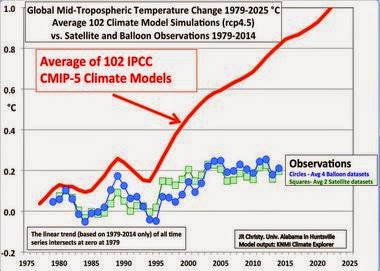
It’s interesting to see how satellite measurement of earth temperatures over the last 35 years compares with IPCC predictions. The satellite measurements are important because they are entirely free of human interference in “adjustments”, “homogenisation” and other statistical manipulation that so-called climatologists engage in to support the carbon monster myth.

To summarise the graph, actual warming since 1980 is just 0.2 degrees while the climate models wrongly predicted an average temperature rise of  1 degree.

And we still spend billlions of dollars a year on this nonsense!

Jo Nova- Welcome to the CO2 Disaster

Jo Nova slices a UNSW press release pointing out despite ongoing deforestation in the tropics and “climate change” the amount of vegetation globally is increasing. They ascribe this to the scientific principle of “good luck” (that would have had you laughed out of a 1st Year physics class 30 years ago), although they do give grudging acknowledgement of the effects of increased CO2 and warmer temperatures.

Welcome to the CO2 disaster — 4 billion tons more plants, more greenery

During the recent warmest decades on record, Earth suffered under the highest CO2 levels of the last 800,000 years. Life responded to this devastating situation by — flourishing. There are now some 4 billion tons more living matter on the planet than there was in 1993. What a calamity. (And what a lot of carbon credits.)

It has, naturally, got nothing to do with warmth andaerial fertilizer. The researchers tell us it due to that force of nature known as “good luck”. Remember, human CO2 emissions were pollution that was going to afflict life on Earth. After twenty years of predicting the loss of forests and species, it turned out that biology bloomed instead. Notch up another model “success”. The press release headline:Good luck reverses global forest loss.(What else would we expect from UNSW?)

To those who know basic biology — and that almost half the dry weight of plants is carbon, sucked straight out of the air — this is not so much good luck as one entirely foreseeable and foreseenconsequence of rising CO2. Acquiring carbon is often a plant’s hardest task. When the sun comes up, a cornfield begins sucking, andby lunch timeits already got all it can get, so growth slows til night returns to pump up the CO2 levels again. Pulling out all that plant fertilizer from under Middle Eastern deserts and spreading it around where the plants could get it has a predictable effect on plant life (though it’s fair to ask if our emissionsactually contributeverymuch).

Remember in post-modern climate science, your air-conditionercauses snowstorms,but if CO2 rises and plants grow — that’s “luck”.

Read the rest here

Major Problems With Climate Models


Do you ever wonder why there is such a big gap between the predictions of climate models and reality? Part of the reason is that they are fundamentally flawed, like disobeying the laws of thermodynamics and underestimating the incoming solar radiation for starters.

From WUWT

Whoops! Study shows huge basic errors found in CMIP5 climate models

Earth’s_Energy_Budget_Incoming_Solar_Radiation_NASA

Incoming solar radiation at the Top of the Atmosphere (TOA)

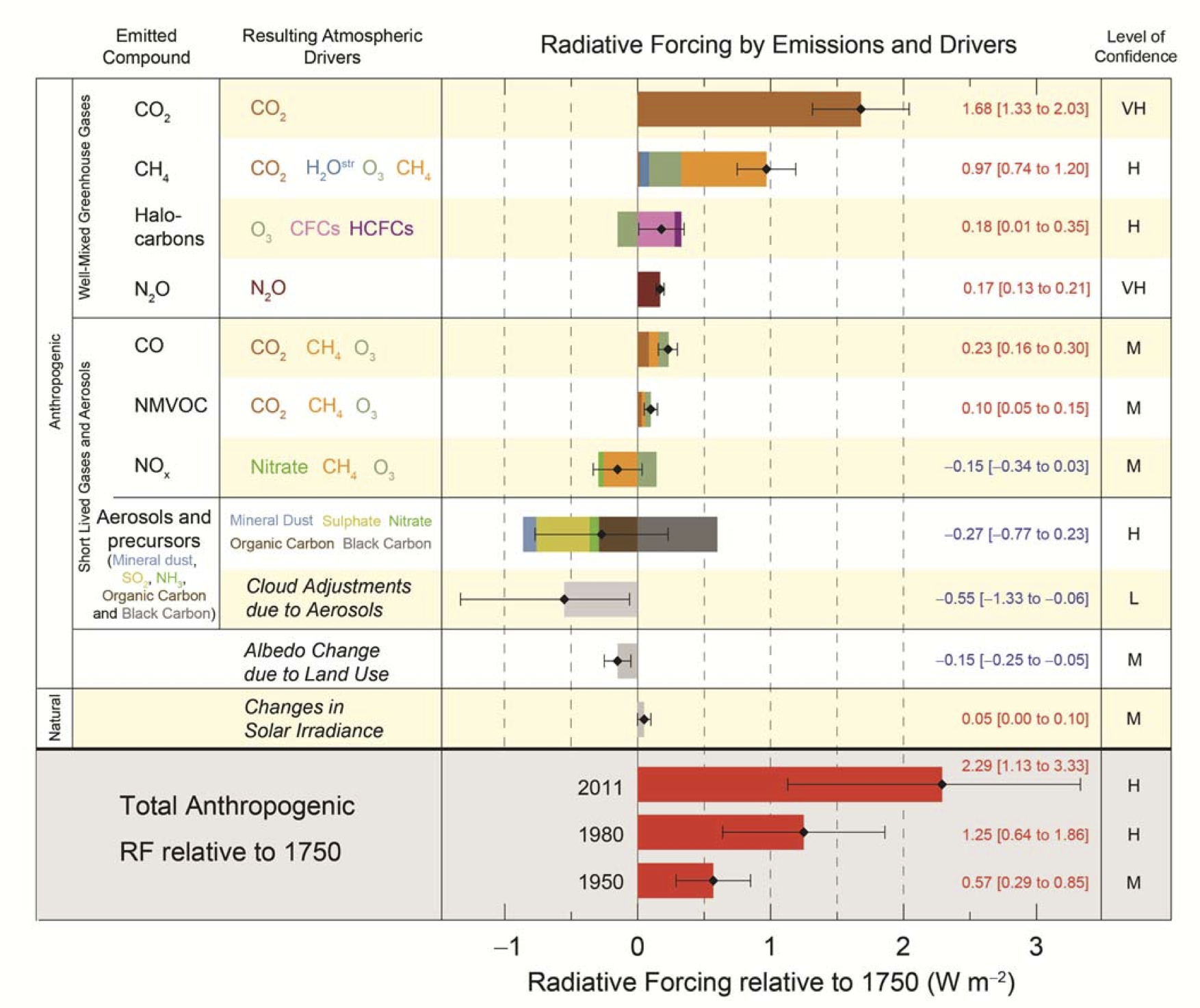
It was just yesterday that we highlighted this unrealistic claim from CMIP5 models: Laughable modeling study claims: in the middle of ‘the pause’, ‘climate is starting to change faster’Now it seems that there is a major flaw in how the CMIP5 models treat incoming solar radiation, causing up to 30 Watts per square meter of spurious variations. To give you an idea of just how much of an error that is, the radiative forcing claimed to exist from carbon dioxide increases is said to be about 1.68 watts per square meter, a value about 18 times smaller than the error in the CMIP5 models!

The HockeySchtick writes:

New paper finds large calculation errors of solar radiation at the top of the atmosphere in climate models

A new paper published in Geophysical Research Letters finds astonishingly large errors in the most widely used ‘state of the art’ climate models due to incorrect calculation of solar radiation and the solar zenith angle at the top of the atmosphere.

According to the authors,

Annual incident solar radiation at the top of atmosphere (TOA) should be independent of longitudes. However, in many Coupled Model Intercomparison Project phase 5 (CMIP5) models, we find that the incident radiation exhibited zonal oscillations, with up to 30 W/m2 of spurious variations. This feature can affect the interpretation of regional climate and diurnal variation of CMIP5 results.

The alleged radiative forcing from all man-made CO2 generated since 1750 is claimed by the IPCC to be 1.68 W/m2. By way of comparison, the up to 30 W/m2 of “spurious variations” from incorrect calculation of solar zenith angle discovered by the authors is up to 18 times larger than the total alleged CO2 forcing since 1750.

radiative-forcing-components

Why wasn’t this astonishing, large error of basic astrophysical calculations caught billions of dollars ago, and how much has this error affected the results of all modeling studies in the past?

The paper adds to hundreds of others demonstrating major errors of basic physics inherent in the so-called ‘state of the art’ climate models, including violations of the second law of thermodynamics. In addition, even if the “parameterizations” (a fancy word for fudge factors) in the models were correct (and they are not), the grid size resolution of the models would have to be 1mm or less to properly simulate turbulent interactions and climate (the IPCC uses grid sizes of 50-100 kilometers, 6 orders of magnitude larger). As Dr. Chris Essex points out, a supercomputer would require longer than the age of the universe to run a single 10 year climate simulation at the required 1mm grid scale necessary to properly model the physics of climate.

The paper: On the Incident Solar Radiation in CMIP5 Models

Linjiong Zhou, Minghua Zhang, Qing Bao, and Yimin Liu1

Annual incident solar radiation at the top of atmosphere (TOA) should be independent of longitudes.However, in many Coupled Model Intercomparison Project phase 5 (CMIP5) models, we find that the incident radiation exhibited zonal oscillations, with up to 30 W/m2 of spurious variations. This feature can affect the interpretation of regional climate and diurnal variation of CMIP5 results. This oscillation is also found in the Community Earth System Model (CESM). We show that this feature is caused by temporal sampling errors in the calculation of the solar zenith angle. The sampling error can cause zonal oscillations of surface clear-sky net shortwave radiation of about 3 W/m2 when an hourly radiation time step is used, and 24 W/m2 when a 3-hour radiation time step is used.

Half of Australia’s Warming Due to “Adjustments”

The duplicity of the BOM in its historic temperature adjustments is documented in this article from Jo Nova:

Historic documents show half of Australia’s warming trend is due to “adjustments”

Adjustments that cool historic temperatures have almost doubled Australia’s rate of warming.

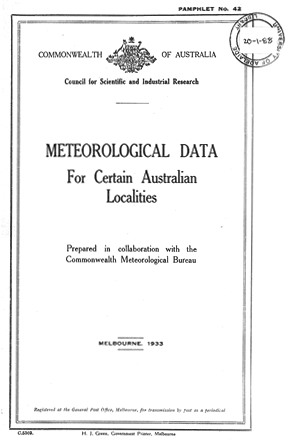
CSIR published “Meteorological Data” 1855 – 1931

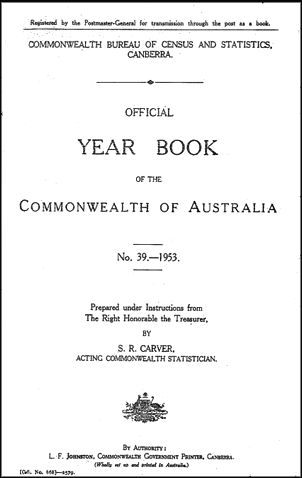
There was a time back in 1933 when the CSIRO was called CSIR and meteorologists figured that with 74 years of weather data on Australia, they really ought to publish a serious document collating all the monthly averages at hundreds of weather stations around Australia. Little did they know that years later, despite their best efforts, much of the same data would be forgotten and unused or would be adjusted, decades after the fact, and sometimes by as much as one or two degrees. Twenty years later The Commonwealth Bureau of Census and Statistics would publish an Official Year Book of Australia which included the mean temperature readings from 1911 to 1940 at 44 locations.

Chris Gillham has spent months poring over both these historic datasets, as well as the BoM’s Climate Data Online (CDO) which has the recent temperatures at these old stations. He also compares these old records to the new versions in the BOM’s all new, all marvelous, best quality ACORN dataset. He has published all the results and tables comparing CDO, CSIR and Year Book versions.

He analyzes them in many ways – sometimes by looking at small subsets or large groups of the 226 CSIR stations. But it doesn’t much matter which way the data is grouped, the results always show that the historic records had warmer average temperatures before they were adjusted and put into the modern ACORN dataset. The adjustments cool historic averages by around 0.4 degrees, which sounds small, but the entire extent of a century of warming is only 0.9 degrees C. So the adjustments themselves are the source of almost half of the warming trend.

The big question then is whether the adjustments are necessary. If the old measurements were accurate as is, Australia has only warmed by half a degree. In the 44 stations listed in the Year Book from 1911-1940, the maxima at the same sites is now about half a degree warmer in the new millenia. The minima are about the same.

Remember that these sites from 1911-1940 were all recorded with modern Stevenson Screen equipment.  Furthermore, since that era the biggest change in those sites has been from the Urban Heat Island (UHI) effect as the towns and cities grew up around the sites. In some places this effect may already have been warming those thermometers in the first half of the last century, but in others UHI can make 5 to 7 degrees difference.

If Australian thermometers are recording half a degree higher than they were 70 – 100 years ago, we have to ask how much of that warming is the UHI effect? Common sense would suggest that if these older stations need any correction, it should be upward rather than downward to compensate for the modern increase in concrete, buildings and roads. Alternatively, to compare old readings in unpopulated areas with modern ones, we would think the modern temperatures should be adjusted down, rather than the older ones.

The Official Year Book 1953

Chris Gillham discusses the potential size of the UHI changes:

“In 2012 and 2013 it was anticipated that UHI warming in south-eastern Australia will continue to intensify by approximately 1C per decade over and above that caused by global warming (Voogt 2002), with tests in 1992 showing a UHI influence up to 7.2C between the Melbourne CBD and rural areas. [PDF]

Smaller but significant UHI influences were found in regional towns, with a 1994 test observing a UHI intensity up to 5.4C between the centre of a Victorian town and its rural outskirts.”  [PDF]


Full article here