Every year we get the same nonsense arguments about Easter being pagan.
Following Jesus
Study: Revival in the UK

Study: Revival in the UK: Church Attendance Up 50%—Gen Z Leading the Way · Caldron Pool
“The report reveals that over two million more people are now attending church than six years ago—a 50% increase in attendance that challenges longstanding narratives of Christian decline.”
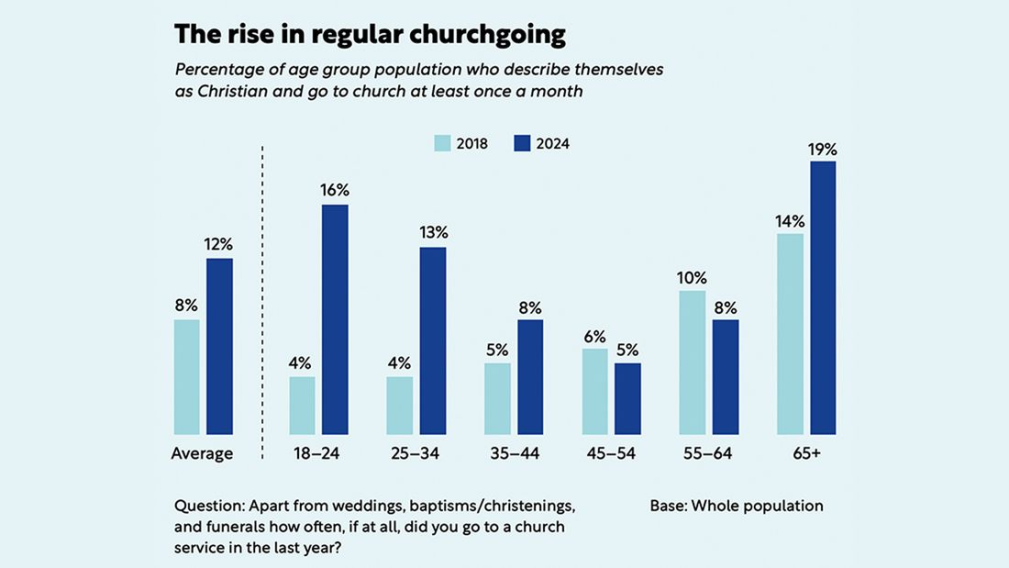
Church attendance in the United Kingdom is seeing a dramatic resurgence, particularly among young adults, according to new findings published by Bible Society UK. The report, The Quiet Revival, reveals that over two million more people are now attending church than six years ago—a 50% increase in attendance that challenges longstanding narratives of Christian decline.
The research, conducted by Bible Society and YouGov, highlights the most significant growth among 18–24-year-olds. In 2018, only 4% of this age group reported attending church at least monthly. That figure has since quadrupled to 16%. Among young men, attendance jumped from 4% to 21%, while young women saw an increase from 3% to 12%.
The also study found the Church is becoming more ethnically diverse, especially among younger groups. Around one-third (32%) of churchgoers under 55 are from non-White backgrounds, compared to just 6% among those over 55. This younger demographic is more ethnically diverse than the general population, where 18% identified as non-White in the 2021 census. Notably, nearly half (47%) of young Black people aged 18–34 attend church monthly, and one-third (33%) of 18–34-year-olds from mixed ethnic backgrounds are also regular churchgoers.
The rise in church attendance is not only due to increased participation from minority ethnic groups; White attendance is also on the rise. For example, 18% of 18–34-year-old White men now attend church monthly, a figure that has quadrupled from just 3% in 2018. A similar, though less pronounced, trend is observed among young White women. This demonstrates an overall increase in churchgoing among young adults, with notable growth from the White population.
“These are striking findings that completely reverse the widely held assumption that the Church in England and Wales is in terminal decline,” said Dr. Rhiannon McAleer, co-author of the report.
Young adults today are not just attending church—they are becoming the most religiously engaged generation alive. The data shows a rise in Bible reading and belief in God among 18–24-year-olds, marking a shift from passive identification to active faith.
Beyond attendance figures, the report notes broader social benefits tied to church involvement. More than 60% of churchgoing Christians say they feel a strong sense of belonging in their local community—compared to just 25% of non-churchgoers.
Church involvement is strongly correlated with improved mental and emotional well-being—particularly among young adults. At a time when this generation faces a growing mental health crisis, active faith participation appears to offer significant support and stability.
Researchers suggest the real decline is not in Christianity itself, but in nominal Christianity—where people identify as Christians culturally, but do not actively participate in church life or mission.
These findings are based on a nationally representative longitudinal study tracking religious attitudes and behaviour across England and Wales since 2018. The data, commissioned by Bible Society and conducted by YouGov, offers the most comprehensive look at the Church’s trajectory in years.
Speaking with Caldron Pool, Reverend Brett Murphy of Emmanuel Church, in Morecambe Lancashire, described the United Kingdom’s recent past as a “spiritual wasteland” marked by decades of decline in Christian attendance and a corresponding rise in radical secularism.
“Radical secular leftism has weakened the Christian foundations of our culture to the extent that aspects of British culture many Britons take for granted are dissolving before their very eyes,” Rev. Murphy said, adding that for over forty years, much of the church—particularly the Protestant denominations—has “capitulated to the prevailing leftist cultural zeitgeist.”
Rev. Murphy cited widespread biblical revisionism and theological compromise as contributing factors in the collapse of church attendance across the country. According to recent reports, over 3,000 churches have either closed or are now rarely used within the past decade.
On top of this, Rev, Murphy noted that Britain has simultaneously seen “almost uncontrolled levels of Islamic migration.” Despite the bleak outlook, he pointed to the findings as signs of hope: “In the midst of this darkness, there is a glimmer of light, a reminder that Almighty God has preserved a remnant and is building His church.”
“Young men, and to a lesser extent young women, are attending predominantly traditionalist churches, avoiding the woke denominations almost entirely,” Rev. Murphy said. “This confirms a hunch I’ve had for a few years. The younger generations are fed up with the shallow vapid lies of wokeism and are yearning for a belief system of substance.”
According to Murphy, many young people are disillusioned with the country’s trajectory and are turning back to historic Christianity as a source of cultural and spiritual strength. “We have attracted people from all walks of life,” he said of his own independent, traditionalist Anglican congregation. “A large percentage are young men searching for a community of Christians who stand firm on God’s word.
“Let’s hope and pray that the survey results from Bible Society and YouGov are good signs of a revival beginning to break out in the Green and Pleasant Land,” he said.
Source https://caldronpool.com/study-revival-in-the-uk-church-attendance-up-50-gen-z-leading-the-way/
What Is Easter About?

Easter is more than a 4 day long weekend and an opportunity for a short holiday, special as that is.
It is more than chocolate eggs and bunnies, and I enjoy chocolate as much as anybody.
Easter is about the ultimate revelation of what life is about. So of course our culture reacts to that by focusing on the chocolate.
To understand why this is important, we need to travel back in time to a couple of thousand years ago and to the city of Jerusalem. On the eve of the annual Passover festival, a religious teacher called Jesus was put to death on a cross. Three years of public teaching about God had got him into trouble with the authorities, so they did what dictators always do, they had him killed. Problem solved.
That was the Friday, but by Sunday an incredible thing had happened. Jesus’s followers were claiming that Jesus was alive. Even back then, people understood that dead people do not normally come back to life.
Looking back at the reports of the events of that weekend, there are 4 alternatives;
1. Jesus was not really dead. Some people think that in the cool of the cave Jesus somehow revived. The Roman army was the most ruthless and efficient killing organisation of its time. When they killed you, you stayed dead. They did not make mistakes.
2. The disciples stole the body and perpetrated a huge hoax on humanity. The Twelve apostles, (minus Judas who suicided) suffered horrendous torture and death. Would you die for a lie?
3. The authorities stole the body. They had no interest in promoting christianity and could have squashed the movement by simply producing the body.
4. Jesus really is alive. This fits what we know about the early church. Hundreds of followers of Jesus were galvanised by their own meetings with the risen Christ or by reports of people they knew. Their lives were changed for the better, their communities were changed, and in a couple of generations, the whole Roman Empire was changed.
Jesus promised that those who believe in Him, who give Him their loyalty and obedience, they will not die but live for ever. We don’t know exactly what that looks like, but we do know that for followers of Jesus, the next life will be even better than this life. There will be no sadness, fighting, disease or death.
Easter is a time of celebration and joy for christians around the world. Give is a go. Every church in town will be pleased to welcome you.
Joseph Mattera: Character Traits of Those Who Make God Their Dwelling Place (Part 1)

Character Traits of Those Who Make God Their Dwelling Place (Part 1)
Joseph Mattera writes:
The kingdom of God is more than an attempt to change a lost world; it is about reclaiming and functioning within what God has always sovereignly owned and managed. Psalm 24:1 declares, “The earth is the Lord’s, and everything in it, the world, and all who live in it.” God framed creation and entrusted it to humanity for stewardship (Genesis 1:26-28). To make God our dwelling place is to understand His sovereignty, His presence, and our role in the cosmos He created. Moses even said, “Lord, you have been our dwelling place in all generations” (Psalm 90:1).
This perspective reframes reality. Time and space, as Hebrews 11:3 reminds us, exist within God’s creative matrix. Acts 17:28 declares, “In him we live and move and have our being.” Coming into this revelation transforms our understanding of worship, life, and purpose. It shifts us from “going to church” to seeing the cosmos as God’s sacred dwelling place. Hence, Christ is not only “in” believers—but we are truly “in Him” and exist within His reality!
Furthermore, as His family, the church represents His Lordship on earth as it is in heaven.
Here are ten traits of those who make God their dwelling place.
- Gratitude for Everything
Profound gratitude is the first mark of someone who makes God their dwelling place. James 1:17 reminds us, “Every good and perfect gift is from above, coming down from the Father of the heavenly lights.” Recognising that every blessing, resource, and opportunity comes from God fosters a heart of thankfulness.
When we acknowledge that the earth and everything belong to God, we shift from entitlement to appreciation. Gratitude becomes a daily act of worship, recognising God’s provision in all areas of life.
- A Life Centred on Worship
Those who dwell in God find worship woven into every aspect of their existence—prayer, work, family, rest. Worship is not limited to Sunday services but permeates every moment, reflecting the rhythm of creation (1 Corinthians 10:31).
In Genesis, the six days of creation culminated in the seventh Day, a Sabbath of rest and worship, demonstrating that all activity ultimately leads back to glorifying God. Even the natural world testifies to His greatness: “The trees of the field clap their hands, and the rocks cry out in praise” (Isaiah 55:12; Luke 19:40).
For such individuals, worship becomes not an event but a lifestyle.
- Submission to Christ’s Lordship
To make God your dwelling place is to recognise His absolute Lordship. Psalm 90:1 and 91:9 speak of God as the eternal refuge. This means submitting to His authority in every area of life.
Every decision, action, and goal becomes an opportunity to honour Him. Those who dwell in God’s presence are constantly aware that Christ is not just Savior but Lord. His will becomes the standard for all they do, and obedience is their ultimate act of love (John 14:15).
- No Separation Between Secular and Sacred
People who make God their dwelling place understand that all life is sacred. There is no division between what is “secular” and what is “spiritual” because “The earth is the Lord’s” (Psalm 24:1).
Work, family life, recreation, and even mundane tasks are opportunities to glorify God. This understanding dissolves artificial boundaries, allowing them to see every moment as a chance to reflect God’s kingdom.
- Integration of Church and Workplace
In the same way that they do not separate the secular from the sacred, these individuals refuse to divide the “church place” from the “workplace.” They see their work, whether in an office, a field, or a factory, as a ministry and an extension of God’s mission.
Colossians 3:23-24 encourages, “Whatever you do, work at it with all your heart, as working for the Lord.” The workplace becomes a platform for reflecting Christ’s values and principles.
- Stewardship of Creation
Making God your dwelling place instils a deep sense of responsibility for creation. Genesis 1:26-28 calls humanity to steward the earth as caretakers under God. This involves honouring and studying the natural world, using resources wisely, and protecting the environment as an act of worship (Psalm 111:2).
In recognising creation as God’s possession, these individuals see stewardship as optional and a divine mandate.
- A Call to Restore the Breach
Isaiah 61:3-4 speaks of those who will “rebuild the ancient ruins” and “restore the places long devastated.” Those who dwell in God feel compelled to be restorers—healing broken relationships, rebuilding communities, and bringing God’s justice to areas of destruction.
This trait reflects God’s heart for communities, cities, and nations. He has called His people to stand in the gap and see every “pain point” in their community as an opportunity to manifest God’s creative solutions that elevate the quality of life for all as a witness of the gospel.
- Using Finances to Advance God’s Kingdom
Those who see God as their dwelling place view their finances as a tool for kingdom work. They understand that their wealth is not their own but entrusted to them by God for His purposes (Deuteronomy 8:18).
This perspective drives them to give generously to support the gospel, help the needy, and invest in causes that reflect God’s heart. They live with the mindset that “where your treasure is, there your heart will be also” (Matthew 6:21).
- Appreciation of Nature as a Reflection of God’s Glory
Creation is seen as a useful resource and a reflection of God’s glory and creativity. Psalm 19:1 declares, “The heavens declare the glory of God; the skies proclaim the work of his hands.”
Those who dwell in God cultivate an acute appreciation for nature, seeing it as a testimony to His power and wisdom. Whether marvelling at a sunrise or tending a garden, they are reminded of God’s beauty and majesty.
- An Acute Sense of God’s Nearness
Finally, those who make God their dwelling place experience an unparalleled awareness of His presence. Acts 17:28 declares, “In him we live and move and have our being.” This sense of nearness transforms their view of reality, enabling them to see God’s hand every moment.
Psalm 91:9 promises, “If you say, ‘The Lord is my refuge,’ and you make the Most High your dwelling, no harm will overtake you.” This intimate relationship with God provides peace, security, and confidence, even in trials.
Making God your dwelling place transforms every aspect of life. It shifts your perspective from merely “attending church” to living as part of God’s sacred cosmos. Those who embody these 10 traits demonstrate what it means to reclaim their role as stewards of creation, ambassadors of the kingdom, and worshippers of the Most High.
Understanding that the earth is the Lord’s and living in the light of this revelation calls us to gratitude, worship, submission, and stewardship. It reminds us that in every moment and every place, God is near—inviting us to dwell in Him and reflect His glory to the world
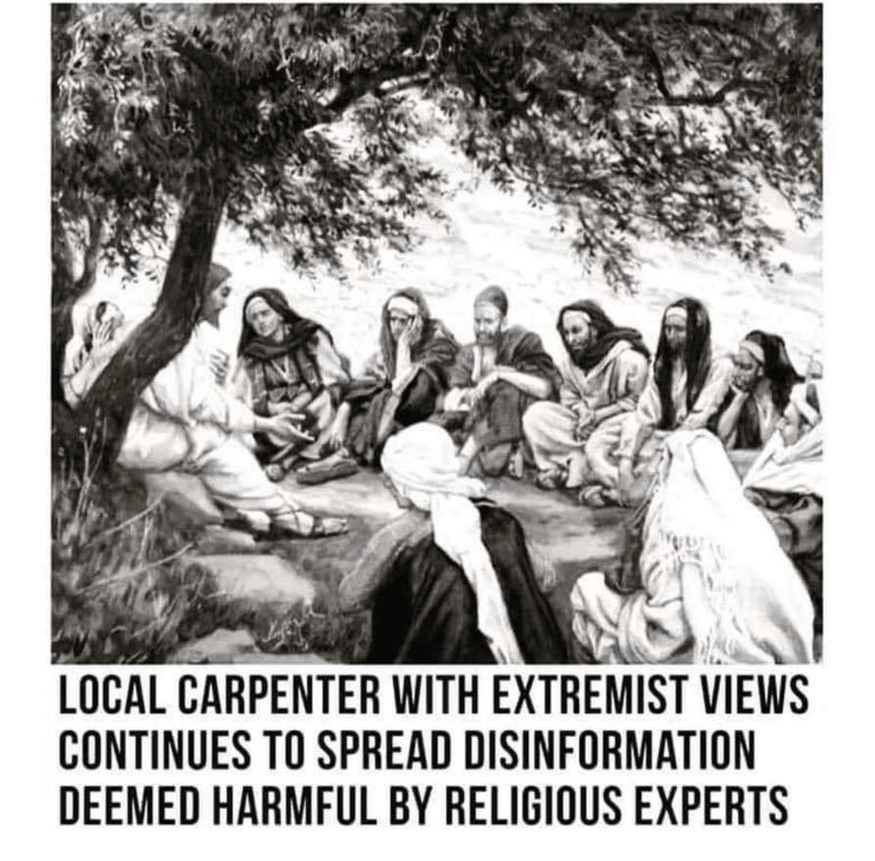
Disinformation
Christian Lifestyle Part 5- Pornography
Christian Lifestyle Part 5
Pornography
Pornography is probably one of the most pervasive influences in the western world today.
Consider the following statistics:
- A 2020 report by the website Pornhub, one of the largest adult content platforms, claimed that it received over 42 billion visits in 2019, with an average of 1.3 billion visits per month.
- A 2019 survey conducted by the Australian Institute of Family Studies found that approximately 1 in 5 Australians (21.5%) reported watching pornography at least weekly.
- A 2018 study published in the Journal of Sex Research estimated that around 30% of internet users in the United States (approximately 90 million people) visited adult websites in a given month.
Various studies have revealed that porn use amongst teens is also widespread. This is very concerning as they are gaining an understanding of sexuality that is unrealistic and is deliberately isolated from the context of relationships.
A 2020 Australian study published in the Journal of Adolescence found that:
- 69% of males and 23% of females aged 15-16 reported watching pornography in the past year.
- 45% of males and 13% of females reported watching pornography at least weekly.
The purpose of pornography is to stimulate sexual desire through the use of imagery. There are complex chemical reactions that take place in the brain when exposed to pornography, but the general result of regular pornography use is that we become more fixated on the images that on real people, we seek ever greater levels of stimulation, and some get caught in a spiral that may lead to child sexual abuse material.
People often think that porn is harmless because nobody gets hurt- it is a lesser sin than sexual assault, domestic violence and child abuse.
The fact is that people are hurt badly by pornography. According to anti-pornography campaigners fightthenewdrug.org, there is no guarantee that actors are consenting to what is happening. There is often a high level of violence being portrayed. There is also evidence of links between pornography and human trafficking.
Right through the Bible there is a strong condemnation of sexual practices that are outside of life-long marriage. Prostitution, adultery, fornication, homosexuality, and much more are described as sinful and even an abomination to the Lord.
Watching pornography, though, is not condemned in the Bible, because that was not an issue in those days. Jesus did say this: “But I tell you that anyone who looks at a woman lustfully has already committed adultery with her in his heart. “ (Matthew 5:28)
Pornography essentially strips away the personhood of the actors. These people were created in the image of God, but are partaking in something that is not honouring to God’s ways. To become a channel of merely stirring desire with no essence of relationship is a violation of the humanity of the people.
For these reasons, christians should not view pornography. It debases watcher, actor and producer. Rather than stir up the works of the flesh, christians should be producing the fruit of the Holy Spirit (see Galatians 5:19-25)
New evidence has experts believing this is Noah’s Ark
From news.com.au
New evidence suggests this is Noah’s Ark
Adriana Diaz – New York Post — 2 minutes
A recent discovery has led some experts to believe they’ve found the fossil of Noah’s Ark.
Researchers have found that a boat-shaped mound — long believed by the faithful to be Noah’s Ark — was most likely submerged under water during a devastating flood some 5000 years ago, The Jerusalem Post reported.
The international team of experts has been working together since 2021 to study the Durupinar Formation, which they believe could be the site of a massive preserved vessel.
The 164m geological structure, composed of limonite — an ore of iron — is located approximately 35km south of Mount Ararat’s summit, in Turkey near the Iranian border in the Dogubayazit district of Agri.
This formation has interested experts for decades due to its ship-like shape and dimensions, similar to the biblical description of Noah’s Ark and Mount Ararat’s mention in religious texts.

According to the Bible, the dimensions of the vessel were “a length of three hundred cubits, its width fifty cubits, and its height thirty cubits,” mirroring those of the Durupinar formation, “and the ark rested … upon the mountains of Ararat”.
New findings have also shown that the formation was once submerged under water as soil samples containing traces of claylike materials, marine deposits and seafood remnants were dated back to a time when the biblical floods are said to have occurred, between 3500 and 5000 years ago.
“According to the initial results, it’s believed there were human activities in this region since the Chalcolithic period,” professor Faruk Kaya, a lead researcher on the subject, told The Jerusalem Post.

The marine deposits and seafood remnants have pushed researchers to believe the area was once filled with water.
“Our studies show that this region harboured life in that period and that, at some point, it was covered by water, which reinforces the possibility that a catastrophic event of great magnitude occurred,” the researchers stated.
Previous research concluded that humans had likely been in the area, but the additional evidence of past floods in the region has encouraged those who believe this to be Noah’s Ark.
Various religious texts, including those touted by Christianity, Judaism and Islam, all reference Noah and the ark, but scientists have yet to determine the authenticity of the stories.
Since its discovery in 1948, many have theorised that the Durupinar formation is the fossilised wood of Noah’s ark.
More Coverage
The reality of these occurrences has continued to be a topic of debate between scientists and scholars for centuries. However, recent research has pushed more experts to believe the legend may be true.
Researchers involved in the project noted, “The evidence suggests that the story might have a basis in reality”.
Let Jesus Calm Your Storm

As I write this, Tropical Cyclone Alfred is heading for Brisbane and is expected to wreak havoc though the Sunshine Coast and Gold Coast areas as well as into the North Coast of New South Wales.
Tropical cyclones, called hurricanes or typhoons in other parts of the world, are very intense low pressure systems that generate huge winds and heavy rainfall, sometimes over very big areas. They can cause destruction and flooding and people rightly get nervous when a cyclone approaches. Readers of a certain age will recall Cyclone Tracey which on Christmas Eve 1974 flattened most of Darwin and killed 66 people.
Cyclones are very important in regulating the earth’s temperature. They are like conveyor belts for energy taking heat energy from the tropics and transporting it to more temperate regions. That is great for the planet, but not so good when people get in the way.
We often speak of storms as descriptions for what is happening in our lives. Relationships can be stormy. Angry individuals act like cyclones, destroying everyone they encounter. Sometimes we might go through a “perfect storm” where everything seems to be coming against us and it all threatens to overwhelm us.
On one occasion some followers of Jesus were caught out on the sea at night time in a tiny boat when a huge storm blew up. The waves threatened to sink the boat. They were already terrified when a ghostly figure approached them, walking on the water. One of them, Peter, called out, “Lord if it’s really you command me to walk on the water.” With that, Peter stepped out of the boat and strode across the waves that had a short time before scared him. (See Matthew 14:22-33)
You might be going through a “perfect storm” right now. Cyclone Alfred is nothing compared to the personal devastation you are fearing or feeling. Hand over all your cares to the Lord and put your trust in Him. He still calms the storms and gives us the grace to stride across them confidently.
Speaking in Tongues
Christian Lifestyle Part 3
Sexuality
Many years ago, it used to be complained about the churches that they are obsessed with sex. Since then, the situation has reversed and while the church remains quiet (or at least unreported) on sexuality, our society has become obsessed with it.
Sex, in almost any form you might like to imagine it, has become the obsession of our culture. Sexual activity in any form is considered a goal in itself, rather than as a part of an ongoing intimate relationship.
In the last two articles, I raised the principles that we are created by God and in that sense owned bu Him. If God “knitted me together in my mother’s womb” (Psalm 139:13), then He has the right to direct my life and to give me wisdom about how my life works best.
In the last few years, there has been a huge amount of attention given to transgenderism and the demands of such people to be not just recognised but celebrated. This movement followed a similar trajectory to the demands of homosexuals to be recognised, legalised and celebrated.
As christians our morality should be shaped by the Bible and not by our own ideas. Our sexuality should be determined by God’s word and not by societal norms.
In Genesis 2 we have the story of how the first man and woman were created. The chapter culminates with this
Then the LORD God made a woman from the rib, and he brought her to the man.
“At last!” the man exclaimed. “This one is bone from my bone, and flesh from my flesh! She will be called ‘woman,’ because she was taken from ‘man.’”
This explains why a man leaves his father and mother and is joined to his wife, and the two are united into one.
Now the man and his wife were both naked, but they felt no shame.Genesis 2:23-25, NLT
Contrary to the transgender issue, these verses show that God makes us male and female. There are only two genders, not the near infinite number proposed by advocates. Not only that, but our biological sex is written in the DNA in every cell of our bodies. Just taking hormones and having very nasty surgery will not change the reality of any person’s gender. Our gender is not assigned at birth as the activists like to say, it is determined at conception.
The Bible also shows that union of male and female is the norm of sexual relationships. In fact, at several places homosexuality is described as an “abomination” to God. In Romans 1, Paul talks about how God’s righteousness can be seen in nature, but people, instead of worshipping the Creator, started to worship creation. As a result, he says, God handed them over to their own desires:
That is why God abandoned them to their shameful desires. Even the women turned against the natural way to have sex and instead indulged in sex with each other. And the men, instead of having normal sexual relations with women, burned with lust for each other. Men did shameful things with other men, and as a result of this sin, they suffered within themselves the penalty they deserved. Since they thought it foolish to acknowledge God, he abandoned them to their foolish thinking and let them do things that should never be done.
Romans 1:26-28
Homosexuality, Paul says, is not a thing to be celebrated or equated with normal heterosexual relations. It is, in fact, God’s judgement on people for idolatry and materialism.
The passage from Genesis 2 says that a man and woman are joined in marriage and become one flesh. The idea here is that sexual relations outside of marriage (being one man and one woman committed for life) are not allowed for christians. The Bible condemns fornication (an unmarried person engaging in sex) and adultery (a married person who has sexual intercourse with a person other than their spouse).
Jesus says that divorce is not permitted unless a partner commits adultery (Matthew 19:1-12). Marriage is for life, so we enter into it carefully and leave it only if the marriage bond is violated. God blesses marriage, and enters into the covenant with the husband and wife. It is God who binds them together and makes them one flesh, so no human should allow that bond to be broken (Matthew 19:6)
We could go on to talk about casual sex- “friends with benefits” and hookup culture. These are abhorrent to God for the same reason.
God made us male and female. He made us sexual creatures. He determined that we flourish best when we value sex so highly that it is reserved for the most intimate and permanent of relationships, i.e. marriage.
This is not about killing fun or being Victorian era fuddy duddies. It is about being faithful to the God who made us and the God who owns us.
 New Life Narrabri