Apostolic Summit Session 2

At Peace Church, pushing babies is always a popular past time.

In Session 2, David Alley expounded on the so-called Passover Problem. This relates to whether Jesus was crucified on the date of Passover (14 Nisan) or the following day (15 Nisan).

The Passover Problem

God can be confusing but that is what you expect from a God who is far greater than we are. He is bigger, grander and more wonderful than we can imagine.

Some people like to find so-called contradictions in the Bible. But there is usually a solution that can be found.

Luke 20:14-16. Jesus is having Passover with disciples

John 20:28 Passover has not happened yet, on day Jesus is executed.

Passover starts 14 Nisan night. Luke says Jesus died 15th, John says 14th.

Last Supper and crucifixion are actually the same day in the Jewish calendar.

Some scholars think the discrepancy is real. Typically they say John is right and others are wrong.

But if we believe the Bible is the Word of God then there must be a solution that honours both.

There are many speculative theories to harmonise the accounts.

Leviticus 23:5-8.

Passover begins 14th

In Australia, Christmas is 25th but all December is called Christmas

In Leviticus Passover starts 14th, but 15th is start of Feast of Unleavened Bread. The 15th is a Sabbath, or Day of Assembly.

In synoptics, Jesus has a Last Supper on the 14th, and calls it the Passover.

He dies on the 14th which is not a Sabbath, but the Day of Preparation.

Jesus likely died on the Friday and the next day was both the normal Sabbath and the Passover Sabbath

But why did Jesus celebrate the Passover a day early? This is a theological not a chronological problem.

At the Last Supper there is no Passover lamb. Jesus Himself is the Lamb who takes away the sins of the world. He redefines the Passover in a new covenant.

Jesus died at 3 pm, the time when Passover Lambs were sacrificed.

Jesus manages to fulfil both sides of the Passover… the lamb at the meal and the sacrificial lamb on the cross.

Apostolic Summit 2025- Session 1

The trip from Narrabri to Rockhampton is long; it is a full day. We leave at 7 am and arrive usually by about 6 pm. The rain slowed us down, and we didn’t arrive until 6.30 pm. It was a rush to get into the apartment, get some dinner and then to the church by 7.30 pm.

As usual, we had lunch at Condamine. This used to be a sleepy little place where nothing happened, apart from occasional gigantic floods. It seems to be going ahead, and these days a coffee and donut van comes every Thursday. The freshly cooked donuts are delicious.

At the church, we sat not far from the Coopers. Both Danielle and Evelyn enjoyed dancing to the upbeat music.

We quickly caught up with old friends, including Suresh and Jonthi from Hyderabad. I think the highlight of the Summit each year is renewing friendships with people from all over the country and around the world.

Here are my notes from Session 1, much of which consisted of video interviews between John and David Alley.

Video interview between John and David Alley

John talked about the origins of the Apostolic Summit. John originally thought it would be a gathering of apostles but it hasn’t always worked out.

It’s a place for teaching of revelations from Scripture e.g. it was thought that there were no modern apostles but we now know Scripture does not teach this.

Arthur Schopenhauer

Truth passes 3 stages

1. It is ridiculed

2. It is violently opposed

3. It is accepted as self-evidently true.

Apostolic movement is about bringing church to maturity.

People assumed it was about gifted leaders, but apostleship is an anointing not just leadership.

In Revelation the church of Ephesus was commended for testing so-called apistles and finding them false. So how do we test apostles? The various tests we can use are described in the book, “The Testing of Apostles.”

Two kinds of tests:

1. Those Christ puts them through in order to bring out the qualities necessary for the ministry.

2. Tests the church must apply to weigh up whether a person is a genuine apostle.

Another slaughter of christians in Nigeria

Herdsmen Slaughter 42 Christians in Taraba State, Nigeria

Taraba state Gov. Agbu Kefas. (Agbu Kefas Media)

Taraba state Gov. Agbu Kefas. (Agbu Kefas Media)

ABUJANigeria (Christian Daily InternationalMorning Star News) – Fulani herdsmen in the early hours of Saturday (May 24) killed 42 people in three predominantly Christian communities in Taraba state, northeast Nigeria, sources said.

In Karim Lamido County, the assailants invaded Munga Dosso, Munga Lelau and Bandawa villages, destroying homes as well as slaughtering residents, according to officials and residents.

“My people in Karim Lamido Local Government Area, who are mostly Christians, have been attacked by Fulani herdsmen. Our houses have been burnt, and more than 42 Christians killed,” Miriam Silas told Christian Daily International-Morning Star News in a text message.

Taraba Gov. Kefas Agbu described the attacks as a “direct assault on the peace- loving people of the area” and “horrendous and unacceptable.”

The governor said he would ensure the assailants would be found, arrested and prosecuted.

“Our citizens’ safety is my top priority. We have activated all necessary security measures to prevent further violence and bring those responsible to book,” Agbu said through a statement by spokesman Emmanuel Bello.

Area residents sent distressed messages on Saturday (May 24).

“A devastating attack by herdsmen on three communities has claimed the lives of 42 Christians and forced hundreds of others to flee their homes the early morning of Saturday,” Obadiah Abbawa said in a text message. “The attack led to the destruction of houses and left the communities in complete ruins.”

Another area resident, Zion Chaffi, said, “Karim Lamido area is being attacked by Fulani herdsmen. Pray for God’s intervention for us.”

Dr. Tijo Kenneth Mingeh, a prominent Christian resident of the area, described the attacks as tragic.

“This tragic attack has brought untold pain and disruption to lives, homes and livelihoods,” Mingeh said. “These communities have been torn apart by this unfortunate incident.”

James Leshen, spokesman for the Taraba State Command, said police were deployed to the areas.

Numbering in the millions across Nigeria and the Sahel, predominantly Muslim Fulani comprise hundreds of clans of many different lineages who do not hold extremist views, but some Fulani do adhere to radical Islamist ideology, the United Kingdom’s All-Party Parliamentary Group for International Freedom or Belief (APPG) noted in a 2020 report.

“They adopt a comparable strategy to Boko Haram and ISWAP and demonstrate a clear intent to target Christians and potent symbols of Christian identity,” the APPG report states.

Christian leaders in Nigeria have said they believe herdsmen attacks on Christian communities in Nigeria’s Middle Belt are inspired by their desire to forcefully take over Christians’ lands and impose Islam as desertification has made it difficult for them to sustain their herds.

Nigeria remained among the most dangerous places on earth for Christians, according to Open Doors’ 2025 World Watch List of the countries where it is most difficult to be a Christian. Of the 4,476 Christians killed for their faith worldwide during the reporting period, 3,100 (69 percent) were in Nigeria, according to the WWL.

“The measure of anti-Christian violence in the country is already at the maximum possible under World Watch List methodology,” the report stated.

In the country’s North-Central zone, where Christians are more common than they are in the North-East and North-West, Islamic extremist Fulani militia attack farming communities, killing many hundreds, Christians above all, according to the report. Jihadist groups such as Boko Haram and the splinter group Islamic State in West Africa Province (ISWAP), among others, are also active in the country’s northern states, where federal government control is scant and Christians and their communities continue to be the targets of raids, sexual violence, and roadblock killings, according to the report. Abductions for ransom have increased considerably in recent years.

The violence has spread to southern states, and a new jihadist terror group, Lakurawa, has emerged in the northwest, armed with advanced weaponry and a radical Islamist agenda, the WWL noted. Lakurawa is affiliated with the expansionist Al-Qaeda insurgency Jama’a Nusrat ul-Islam wa al-Muslimin, or JNIM, originating in Mali.

Nigeria ranked seventh on the 2025 WWL list of the 50 worst countries for Christians. 

If you would like to help persecuted Christians, visit https://morningstarnews.org/resources/aid-agencies/ for a list of organizations that can orient you on how to get involved.  

If you or your organization would like to help enable Morning Star News to continue raising awareness of persecuted Christians worldwide with original-content reporting, please consider collaborating at https://morningstarnews.org/donate/?

###

© 2025 Christian Daily International-Morning Star News. Articles/photos may be reprinted with credit to Christian Daily International-Morning Star News. https://morningstarnews.org 

In 2012, Pope Leo XIV Slammed the Media for Its Liberal Bias and Promoting Abortion

From Lifenews.com

More than a decade before he was elected and addressed the media as pontiff, Pope Leo XIV had spoken about evangelisation amid modern media in an address that is still accessible, a Vatican expert spotlighted this week.

In 2012, then-Father Robert Prevost gave an address at a Synod about evangelisation convened by Pope Benedict XVI, Sandro Magister explained in a May 13 article for his blog. The address considers how several Church Fathers responded to the non- and anti-Christian media of their time, which in turn provides insight for evangelising amid the present-day’s media culture.

Please follow LifeNews.com on Gab for the latest pro-life news and info, free from social media censorship.

Magister described then-Fr. Prevost’s remarks as “astonishing, for the acuteness of the diagnosis of the mediatic distortions of today’s society, but even more for the reference to the Fathers of the Church — from Augustine to Ambrose and Leo the Great to Gregory of Nyssa — as teachers brilliant in taking up the challenges of communication of their time, and therefore in understanding how to best evangelize the society of the late empire.”

In his address during the 2012 Synod on Evangelization, then-Fr. Prevost said that mass media in the West “is extraordinarily effective in fostering within the general public enormous sympathy for beliefs and practices that are at odds with the Gospel; for example, abortion, homosexual lifestyle, euthanasia.”

Mass media may be tolerant of religion when the latter does not directly contradict the media’s positions on ethical problems, but if religious leaders do speak out, the media label their messages “as ideological and insensitive in regard to the so-called vital needs of people in the contemporary world,” he said.

In order to effectively evangelize against media-created ethical falsehoods, catechists and religious leaders need to develop better understanding of laboring amid the current media climate, he urged.

Church Fathers were successful in evangelizing “in great part because they understood the foundations of social communication appropriate to the world in which they lived,” then-Fr. Prevost said. “Consequently, they understood with enormous precision the techniques through which popular religious and ethical imaginations of their day were manipulated by the centers of secular power in that world.”

Magister shared the full text of the address, which can be accessed here.

LifeNews Note: McKenna Snow writes for CatholicVote, where this column originally appeared.

Fight The Good fight

For a few years, like many people of more mature years, I have been fighting a battle with my weight. It all started when my doctor told me that if my blood pressure went any higher, he would have to send me to a cardiologist to prescribe stronger medication.

I decided to take responsibility for my health and started to eat more responsibly and exercise more. I used an app to track daily my weight and food intake.

Over about 18 months my weight went down from 105 kg to 83 kg. I felt really good about going from XL clothes to L and for the extra energy that I had. Better still, the doctor did not have to refer me to the specialist.

Then life set in. The stresses of the Covid period led me to eating more again, especially chocolate. My parents are elderly and distant, and they both became ill, and that added to the stress eating. By then I was back in the habit of eating snacks morning, noon and night, and the kilos were piling back on.

When my weight tipped over the 90 kg mark, I decided that enough is enough and it’s time to get back on the wagon. I decided to discipline my eating habits as I had a few years ago. Within a couple of days, I had shed more than 1 kg, just by minimising snacks.

Here’s the thing: I knew what I should be doing but I chose not to.

Living for the Lord means that we each must make choices about our lifestyle. Those are daily choices that either take us closer to the Lord or further from Him. Often we know what we should or should not do, but the stresses of life can leave us prone to temptation.

In Romans 7, Paul talks about the struggle with sin that we face. I want to do what is good, but end up doing what is wrong. He asks “Who will set me free from this life dominated by sin and death?” the answer , of course is Jesus Christ.

We don’t have to fight with our temptations and addictions alone. We have Jesus helping, equipping and encouraging us to choose life. The more we choose His way, the easier it becomes,

That really is good news!

Two thousand Iranians turning to Jesus every day

From God Reports

By Charles Gardner —

underground church Iran

The Bible Society, which operates around the globe, reports that more than 2,000 Iranians are turning to Jesus every single day! One 92-year-old believer, whenever she’s on a bus, pulls out a small book and asks her neighbour to help her read the tiny font.

In fact, she is secretly getting strangers to read the gospels. Every time she does it, the person sitting next to her ends up taking a New Testament home.

This is brave work in a land where leaving Islam is potentially punishable by death. But the Iranian revival is good news for Israel – and the Jews! For these dear people have been taught by their government and mullahs that Israel is their archenemy.

But now that they have opened their lives to Jesus, the Jewish Messiah, they find they are also growing to love the Jewish people, longing and praying for a restoration of the peace that the two nations once enjoyed.

This is profoundly good news for those who have eyes to see the bigger picture. For the strict Islamic state of Iran, whose rulers want to wipe out the Jewish people just as Hitler did and who are chief sponsors of monstrous terrorist groups like Hamas, is now the focus of a Christian revival where some two million people have discovered that Jesus, the Jew, is the Savior of the world.

As the mosques shut down in great numbers, passionate Christians are filling the vacuum, though of necessity staying ‘underground’ for now, out of sight of the religious police.

The Islamic foundations are crumbling for the chief sponsors of terrorism, a fact graphically prophesied by the psalmist thousands of years ago when he wrote of them: “Come,” they say, “let us destroy them as a nation, so that Israel’s name is remembered no more. With one mind they plot together, forming an alliance against you.” (Psalm 83:4f)

Among the enemies named are ‘Ishmaelites’ and people from Philistia (Gaza) and Tyre (Lebanon), with Assyria (covering parts of Iran, Iraq, Syria and Turkey) joining them. Does this ring any bells?

Yet the psalmist (Asaph) is not vindictive. He calls on the Lord to bring shame on them so that they will know “that you alone are the Most High over all the earth”. And we are hearing that many in the Muslim/Arab world, even in the strictest of regimes, are indeed discovering the truth of Yeshua.

In the UK too, where Jews feel increasingly threatened and pro-Palestinian marchers are allowed to call for Israel’s demise on the streets of our cities, there is a revival of Christianity, which gives us hope.

After conducting a thorough survey, the Bible Society reports a remarkable fourfold increase in young men aged 18-24 attending church over the last six years.

Amid rumours that Donald Trump is about to announce recognition of a Palestinian State (albeit without Hamas), here in the UK we are hearing reports of a recruiting campaign for Islam within the National Health Service. And even Conservative MPs and peers are making previously unheard-of calls for recognition of ‘Palestine’.

A British TV program has just been rightly lauded for exposing a shocking miscarriage of justice against a host of sub-postmasters wrongly convicted of theft, false accounting and fraud when in fact it was due to a faulty computer system.

But I also believe the monumental miscarriage of justice of modern times has been the grossly misleading narrative – through media, parliament and elsewhere – of the Israeli-Palestinian conflict.

Restored to their ancient land through internationally recognized treaties, not to mention God’s law – their ultimate title deed – they are constantly subjected to a host of lies and propaganda accusing them of stealing what is their own property.

It’s important that we see the big picture of the unfolding spiritual warfare taking place. When Jesus sent out the 72 disciples to spread the gospel (as recorded in Luke 10:19,21), he told them he had given them authority to trample on snakes and scorpions and to overcome all the power of the enemy.

And he was full of joy through the Holy Spirit because God had hidden these things from the wise and learned and revealed them to babes.

It is not the proud and arrogant who will inherit the earth, but the meek and humble. And the latter will also be granted a clear-sighted vision of what is really happening amidst the turmoil of these terrible times which are surely preparing the way for our Lord Yeshua’s return.

As the darkness deepens around the world, especially in the Middle East, the light of Christ is shining ever brighter. It must be tempting for Israelis to feel greatly perplexed.

The psalmist assures us: “Do not fret because of those who are evil… for like the grass they will wither… A little while, and the wicked will be no more… but the meek will inherit the land and enjoy peace and prosperity.” (Psalm 37:1f, 10f)

Christian Lifestyle Part 6 – Money and Possessions

Christian Lifestyle Part 6
Money and Possessions

We live in a very wealthy and money-focussed society. A person’s value is often seen as determined to some extent at least by the worth of their possessions. A positive lifestyle means, for most people, the things that you can do with your money.

The Bible does not condemn money as such. It does warn that our attitudes to money can become skewed, destroying our personality, undermining relationships, and even threatening our eternal salvation.

The Love of Money

“But those who desire to be rich fall into temptation, into a snare, into many senseless and harmful desires that plunge people into ruin and destruction.  For the love of money is a root of all kinds of evils. It is through this craving that some have wandered away from the faith and pierced themselves with many pangs.” 1 Timothy 6:9-10

This is often misquoted as “Money is the root of all evil.” Paul does not say that money is the sole root of evil, but that the love of money is a root of all kinds of evil.

This verse plays out in all kinds of ways every day. People become greedy and rob or defraud others. We have all heard of whole companies being destroyed by a rogue employee or even businesses being started on a bogus product. Corporations can destroy lives and environments through irresponsible exploitation. People become addicted to gambling in an effort to pay off debts, and end up being worse off.

Like fire, money is a good servant but a terrible master.

Hebrews 13:5 says, “Keep your life free from love of money, and be content with what you have, for he has said, “I will never leave you nor forsake you.” Love of money can become a substitute for trusting the Lord.

Mammon

In Matthew 6:24, Jesus says “No one can serve two masters, for either he will hate the one and love the other, or he will be devoted to the one and despise the other. You cannot serve God and money.” In the original Greek, the word for money is “Mammon” which is a personification of money, that is, a description of the power that wealth can have over the human heart. Mammon can even be thought of as a god challenging our devotion to the true God.

We can see how this works. Money opens up opportunity for every fleshly pleasure that we might seek. It opens the door to material possessions. It gives us status in the eyes of other people. Mammon promises to deliver everything that any religion might offer. If you have enough, you can even have your body frozen, promising a form of eternal life.

Christians must choose to serve the Lord only, trusting Him for the things that we need. That doesn’t mean that we have to take a vow of poverty. Far from it! If we are trusting God in everything we find that He provides in ways we cannot imagine.

I have a thousand testimonies of how the Lord has done that for me and our church over the years, but let this one suffice. At one stage of our life, every time we had a new baby we took a 50% pay cut. Yet, God blessed us with as much quality of life as if we had never had the pay cuts!

Jesus wants us against a divided loyalty. I have heard many people say something like “I want to serve God, but…” or “I know God wants me to go into ministry but…” The but part of these statements is something like, “I can’t afford it” or “I have to look after my family.” The implication is that we can trust Mammon, but we are not so sure about Jesus.

Contentment


In Philippians 4:11 Paul says, “Not that I am speaking of being in need, for I have learned in whatever situation I am to be content.” When you think of Paul’s life, he went through some very tough times including being beaten, thrown into prison, attempted murder and much more. He had times of relative wealth and times of great deprivation, but through it all he learned to trust in Christ and be content with his situation.

Jesus said, “Foxes have holes, and birds of the air have nests, but the Son of Man has nowhere to lay his head.” (Matthew 8:20). Think of that: the divine Son of God who created all things lived in relative poverty. The man who fed over 5000 people with some fish and bread chose to live an ordinary life rather than the wealth and power He could have generated from Himself.

Jesus calls us to imitate Him. Therefore we need to allow ourselves to be content and to seek first the Kingdom of God, trusting that our Father will supply everything we need.

Generosity

Christians are called to live generous lifestyles. That is, we recognise that everything we have is a gift from God and therefore we can afford to share it all with other people.

This was shown in the early church. Several times in the book of Acts we are told that there was no need among the people because they shared their possessions. (Acts 2:44-45).

Paul tells us  “Each one must give as he has decided in his heart, not reluctantly or under compulsion, for God loves a cheerful giver.” (2 Corinthians 9:7). There is no compulsion to give to others, to the church or to worthy causes, but we can do so with a happy heart, knowing that God will bless our giving.

Conclusion

In a society that practically worships money and possessions, christians must follow Jesus in all things. We must ensure that we do not fall into the trap of allowing our possessions to become a rival to obedience to the Lord.

Study: Revival in the UK

Study: Revival in the UK: Church Attendance Up 50%—Gen Z Leading the Way · Caldron Pool


“The report reveals that over two million more people are now attending church than six years ago—a 50% increase in attendance that challenges longstanding narratives of Christian decline.”

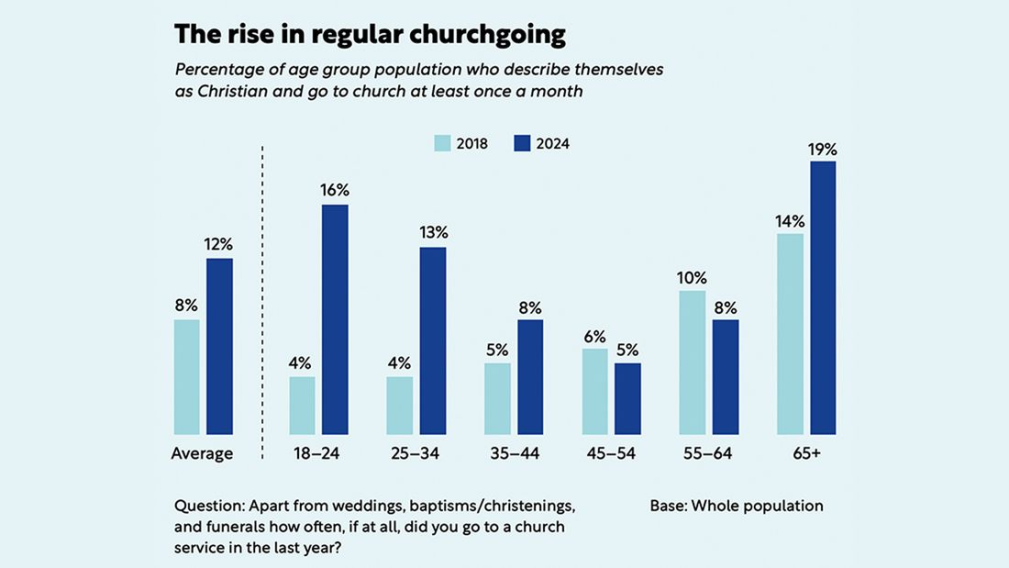
Church attendance in the United Kingdom is seeing a dramatic resurgence, particularly among young adults, according to new findings published by Bible Society UK. The report, The Quiet Revival, reveals that over two million more people are now attending church than six years ago—a 50% increase in attendance that challenges longstanding narratives of Christian decline.

The research, conducted by Bible Society and YouGov, highlights the most significant growth among 18–24-year-olds. In 2018, only 4% of this age group reported attending church at least monthly. That figure has since quadrupled to 16%. Among young men, attendance jumped from 4% to 21%, while young women saw an increase from 3% to 12%.

Source: The Bible Society

The also study found the Church is becoming more ethnically diverse, especially among younger groups. Around one-third (32%) of churchgoers under 55 are from non-White backgrounds, compared to just 6% among those over 55. This younger demographic is more ethnically diverse than the general population, where 18% identified as non-White in the 2021 census. Notably, nearly half (47%) of young Black people aged 18–34 attend church monthly, and one-third (33%) of 18–34-year-olds from mixed ethnic backgrounds are also regular churchgoers.

The rise in church attendance is not only due to increased participation from minority ethnic groups; White attendance is also on the rise. For example, 18% of 18–34-year-old White men now attend church monthly, a figure that has quadrupled from just 3% in 2018. A similar, though less pronounced, trend is observed among young White women. This demonstrates an overall increase in churchgoing among young adults, with notable growth from the White population.

“These are striking findings that completely reverse the widely held assumption that the Church in England and Wales is in terminal decline,” said Dr. Rhiannon McAleer, co-author of the report.

Young adults today are not just attending church—they are becoming the most religiously engaged generation alive. The data shows a rise in Bible reading and belief in God among 18–24-year-olds, marking a shift from passive identification to active faith.

Beyond attendance figures, the report notes broader social benefits tied to church involvement. More than 60% of churchgoing Christians say they feel a strong sense of belonging in their local community—compared to just 25% of non-churchgoers.

Church involvement is strongly correlated with improved mental and emotional well-being—particularly among young adults. At a time when this generation faces a growing mental health crisis, active faith participation appears to offer significant support and stability.

Researchers suggest the real decline is not in Christianity itself, but in nominal Christianity—where people identify as Christians culturally, but do not actively participate in church life or mission.

These findings are based on a nationally representative longitudinal study tracking religious attitudes and behaviour across England and Wales since 2018. The data, commissioned by Bible Society and conducted by YouGov, offers the most comprehensive look at the Church’s trajectory in years.

Speaking with Caldron Pool, Reverend Brett Murphy of Emmanuel Church, in Morecambe Lancashire, described the United Kingdom’s recent past as a “spiritual wasteland” marked by decades of decline in Christian attendance and a corresponding rise in radical secularism.

“Radical secular leftism has weakened the Christian foundations of our culture to the extent that aspects of British culture many Britons take for granted are dissolving before their very eyes,” Rev. Murphy said, adding that for over forty years, much of the church—particularly the Protestant denominations—has “capitulated to the prevailing leftist cultural zeitgeist.”

Rev. Murphy cited widespread biblical revisionism and theological compromise as contributing factors in the collapse of church attendance across the country. According to recent reports, over 3,000 churches have either closed or are now rarely used within the past decade.

On top of this, Rev, Murphy noted that Britain has simultaneously seen “almost uncontrolled levels of Islamic migration.” Despite the bleak outlook, he pointed to the findings as signs of hope: “In the midst of this darkness, there is a glimmer of light, a reminder that Almighty God has preserved a remnant and is building His church.”

“Young men, and to a lesser extent young women, are attending predominantly traditionalist churches, avoiding the woke denominations almost entirely,” Rev. Murphy said. “This confirms a hunch I’ve had for a few years. The younger generations are fed up with the shallow vapid lies of wokeism and are yearning for a belief system of substance.”

According to Murphy, many young people are disillusioned with the country’s trajectory and are turning back to historic Christianity as a source of cultural and spiritual strength. “We have attracted people from all walks of life,” he said of his own independent, traditionalist Anglican congregation. “A large percentage are young men searching for a community of Christians who stand firm on God’s word.

“Let’s hope and pray that the survey results from Bible Society and YouGov are good signs of a revival beginning to break out in the Green and Pleasant Land,” he said.

Source https://caldronpool.com/study-revival-in-the-uk-church-attendance-up-50-gen-z-leading-the-way/

What Is Easter About?

Easter is more than a 4 day long weekend and an opportunity for a short holiday, special as that is.

It is more than chocolate eggs and bunnies, and I enjoy chocolate as much as anybody.

Easter is about the ultimate revelation of what life is about. So of course our culture reacts to that by focusing on the chocolate.

To understand why this is important, we need to travel back in time to a couple of thousand years ago and to the city of Jerusalem. On the eve of the annual Passover festival, a religious teacher called Jesus was put to death on a cross. Three years of public teaching about God had got him into trouble with the authorities, so they did what dictators always do, they had him killed. Problem solved.

That was the Friday, but by Sunday an incredible thing had happened. Jesus’s followers were claiming that Jesus was alive. Even back then, people understood that dead people do not normally come back to life.

Looking back at the reports of the events of that weekend, there are 4 alternatives;

1. Jesus was not really dead. Some people think that in the cool of the cave Jesus somehow revived. The Roman army was the most ruthless and efficient killing organisation of its time. When they killed you, you stayed dead. They did not make mistakes.

2. The disciples stole the body and perpetrated a huge hoax on humanity. The Twelve apostles, (minus Judas who suicided) suffered horrendous torture and death. Would you die for a lie?

3. The authorities stole the body. They had no interest in promoting christianity and could have squashed the movement by simply producing the body.

4. Jesus really is alive. This fits what we know about the early church. Hundreds of followers of Jesus were galvanised by their own meetings with the risen Christ or by reports of people they knew. Their lives were changed for the better, their communities were changed, and in a couple of generations, the whole Roman Empire was changed.

Jesus promised that those who believe in Him, who give Him their loyalty and obedience, they will not die but live for ever. We don’t know exactly what that looks like, but we do know that for followers of Jesus, the next life will be even better than this life. There will be no sadness, fighting, disease or death.

Easter is a time of celebration and joy for christians around the world. Give is a go. Every church in town will be pleased to welcome you.