Jo Nova: Corals On The Nullarbor

Jo Nova reports the astounding find of corals way above current sea levels. Maybe we could restore those coal fired power stations, burn some fossil fuels and restore the reef.

Corals covered the Australian desert once – maybe they’ll grow back if we screw in the right light globes?

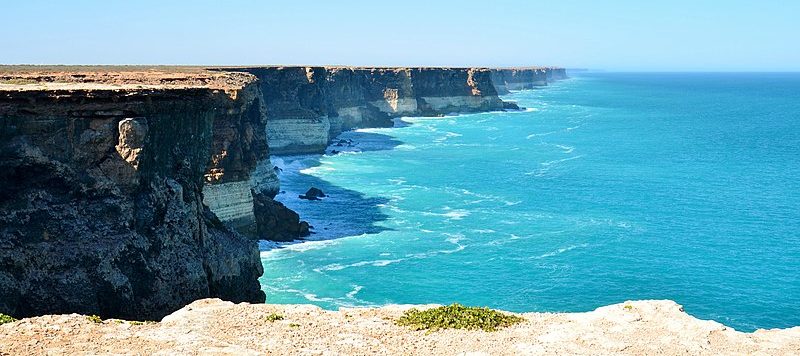
The remnants of a long gone coral reef are not in the water here, but on top of the cliff. This is what real climate change looks like:

Bunda Cliffs, Nullarbor, Great Australian Bight. Photo.

The whole coral reef is now 100 m out of the water | Bahnfrend |

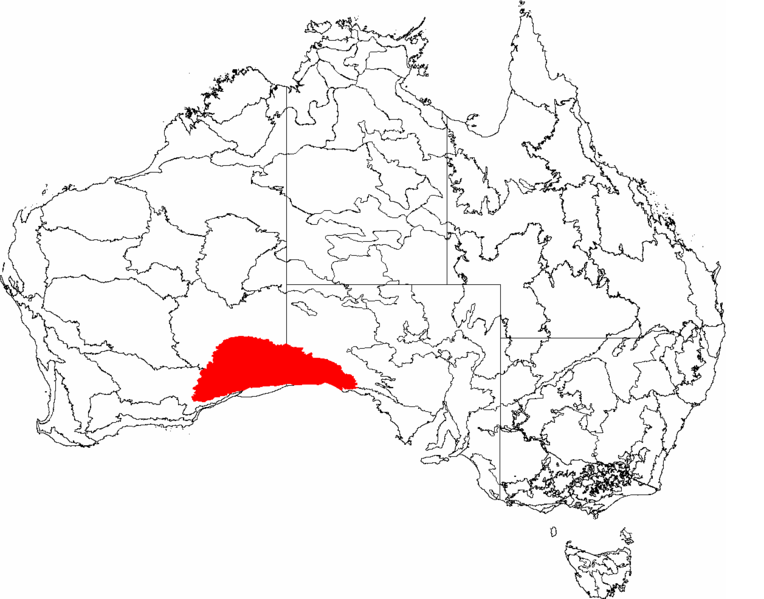
Nullabor plain map. Australia

The Nullabor Plain.

It turns out the high plateau desert called the Nullarbor was once a coral reef. It’s a thousand kilometer stretch without a tree that’s now about 100m above sea level. Obviously it’s a wilderness that’s begging to be restored to its true Miocene glory. The question is whether we can put on enough solar panels to save this reef, or if we can melt the Antarctic and raise the oceans…

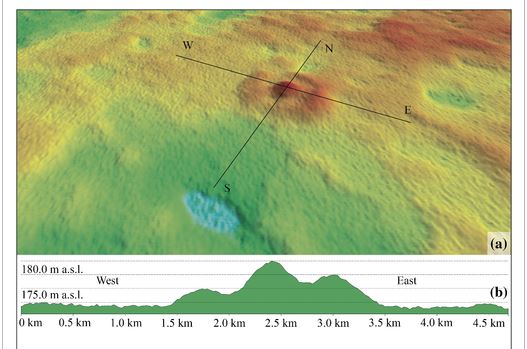
Researchers looking at satellite images spotted a suspicious looking dome and ring (below) . They figured out it was not a meteor crater but probably a former coral atoll. It’s about one kilometer across and corals built this (probably) 14 million years ago. Tectonic shifts lifted the land out of the ocean. If only the polyps had put in a carbon tax?

The Nullarbor is a bit special because the surface is well preserved. There is not a lot of rain, no rivers to speak of, humidity is low, storm surges don’t wash over it and sediments don’t settle on it. Plus the nearest glaciers are in New Zealand.

““So even though it’s exposed, it’s kind of like a land that time forgot … the erosion is so slow, [these features] get preserved for millions and millions of years, kind of capturing a snapshot of how environments were at different times.” —WA Today

Coral Dome, remnant, Nullabor Australia

Coral Dome, remnant, Nullabor Australia

Once fish frolicked in the afternoon sun among the anenome here. Now there is saltbush.

This is the kind of climate change we need to teach children at schools. Geological, not Gretalogical.

Imagine the effect if students knew almost nothing was permanent, life was adaptable, and the climate changed all the time.

Coral reef nullabor

The remnants of a 14 million year old reef

ScienceAlert:

Mysterious Reef From Millions of Years Ago Discovered in Vast Australian Desert

Most of Australia is now arid and dry, with vast inland deserts. Millions of years ago, though, during the Miocene, the continent was teeming with life; not just dense, thriving forest ecosystems, but huge inland seas.

“Through high-resolution satellite imagery and fieldwork we have identified the clear remnant of an original sea-bed structure preserved for millions of years, which is the first of this kind of landform discovered on the Nullarbor Plain,” says geologist Milo Barham of Curtin University in Australia.

The ocean that covered the Nullarbor started to dry up around 14 million years ago, exposing the shallow-water limestones deposited during the middle Cenozoic.

That means the Nullarbor is effectively a clean record of geological processes and features dating back to the Miocene.

“Evidence of the channels of long-vanished rivers, as well as sand dune systems imprinted directly into limestone, preserve an archive of ancient landscapes and even a record of the prevailing winds,” Barham says.

“And it is not only landscapes. Isolated cave shafts punctuating the Nullarbor Plain preserve mummified remains of Tasmanian tigers and complete skeletons of long-extinct wonders such as Thylacoleo, the marsupial lion.”

That’s not all. “At the surface,” adds Barham, “due to the relatively stable conditions, the Nullarbor Plain has preserved large quantities of meteorites, allowing us to peer back through time to the origins of our Solar System.”

REFERENCE

Lipar et al (2022) Enigmatic annular landform on a Miocene planar karst surface, Nullarbor Plain, Australia,  Earth Surface Processes and Landforms.  https://doi.org/10.1002/esp.5459

Bill Muehlenberg: DISMANTLING THE COVID SHIBBOLETHS

Bill Muehlenberg writes:

DISMANTLING THE COVID SHIBBOLETHS

Posted on

Busting the Rona myths:

There have been a number of mantras pushed over the past two years in regards to the Rona which the “experts” have assured us are completely true and fully based on the science. But just this week two of the biggest ones have taken further blows: that we all must be locked down, and that we all must get jabbed. Important new studies continue to appear showing these have been hugely questionable health mandates.

There has been plenty of research showing how wrong the statists have been in locking us all down and demanding that we are to be coerced into having substances injected into our bodies against our compliance. Two of the newest bits of research on these matters simply further confirm what we have known for quite some time now.

Take the issue of harsh, draconian lockdowns – something I and others have been speaking against for nearly two years now. Many have argued that the evidence points to the fact that they actually cause more harm than good. And even if not, they are doing little to stop the spread of Covid deaths.

Consider one new study, a Johns Hopkins University meta-analysis of studies. This 60-page report is found here: sites.krieger.jhu.edu/iae/files/2022/01/A-Literature-Review-and-Meta-Analysis-of-the-Effects-of-Lockdowns-on-COVID-19-Mortality.pdf

Read the rest of the article here

Irukandji Jellyfish Are Tiny And Deadly

From Australian Geographic

Scientists have successfully hatched Irukandji eggs. Here’s why that’s important

A breakthrough by Australian marine scientists means they’ll be able to at last unlock the secrets of one of the world’s most dangerous creatures.By Sheree Marris • December 23, 2021 • Reading Time: 8 Minutes • Print this pageResearch assistant and aquarist Sally Turner monitors the behaviour of captive-bred Irukandji jellyfish. Image credit: Sheree Marris

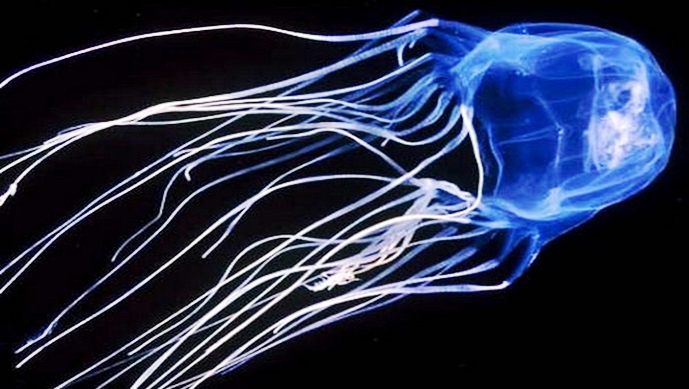
The Irukandji jellyfish could have sprung from the fertile imagination of a sci-fi horror writer. It looks deceptively insignificant and benign, but its entire body is a biological booby trap. In most jellyfish it’s only the tentacles that are studded with the minuscule harpoon-like, venom-loaded stinging cells known as nematocysts. But in Irukandji the bell is also armed with these toxic weapons – as many as 5000 per square centimetre. An encounter with an Irukandji can have an adult human soon fighting for their life. Like most jellyfish, the Irukandji is transparent, but it’s tiny – no more than 2.5cm wide – so you’re unlikely to see it coming and stay out of its way. And even if you did, those tentacles are extendable, reaching out to four times their relaxed length. 

This jellyfish was named after the Irukandji people, traditional fishers whose Country includes the sea off the coastal regions near Cairns, Queensland. Although this was the area where the jellyfish was first recognised, its distribution is much wider. And with more people venturing into the waters where they occur, reports of stings are becoming increasingly common and scientific scrutiny of the Irukandji has been mounting. 

But research on the species in the wild has had limitations. Although it’s been possible to collect these tiny, near-invisible creatures in their natural habitat at night using lights, scientists have been struggling to study them in a controlled laboratory environment and haven’t been able to breed them in captivity. 

Now in a world-first, Professor Jamie Seymour and his team of jellyfish researchers working in a lab dubbed the eduQuarium at James Cook University’s Cairns campus have managed to breed the Irukandji in captivity. It’s an achievement that’s been 20 years in the making and is a vital step forward in the mitigation of the threat posed by this intriguing jellyfish species.

It also means that we finally have a chance to learn the secrets of a creature that produces one of the most diabolically painful experiences known to humans.

Irukandji–human encounters

Jamie Seymour is a global expert on jellyfish, as well as many other dangerous sea creatures. Protected in tanks stretching around the walls of his lab is a range of deadly marine animals, from colourful crustaceans that literally punch their prey into submission, to slimy snails with weapons stuffed up their noses and sand assassins with blade-like claws that would make Freddy Krueger cower.

But it’s the Irukandji jellyfish that are the stars of this show in their futuristic round tanks, designed without corners to prevent damaging the soft bodies of these hard-core carnivores. 

Jamie understands the pain of an Irukandji sting better than most. It’s one of the risks of his research and he’s been stung 11 times so far. “Yep, I’ve experienced the pain of an Irukandji sting many times in the past. It’s not something I’m proud of and it’s 11 mistakes I wish I hadn’t made,” he admits. “So on a more positive note, at least I’m intimately familiar with the incredible pain and discomfort that victims can suffer, and I wouldn’t wish it on my worst enemy.”

As with many things about this poorly understood jellyfish, its lethal weaponry of explosive and spring-loaded venomous harpoons is unique in the animal kingdom. Certainly people have died following envenomation by Irukandji, with victims succumbing to the effects of potent toxins and incredible pain, but it’s rare. There are only two recorded deaths.

But there’s concern that these jellyfish may have been responsible for more deaths than those attributed directly to them and that for various reasons, including the impact of climate change on their distribution, Irukandji–human encounters are on the rise. And that’s what makes the discovery of how to breed them so important.

Read the rest of the article here 

The Piglet Squid

The variety of creatures that live on the land and in the sea is a testament to the creativity of God our Creator.

From Australian Geographic

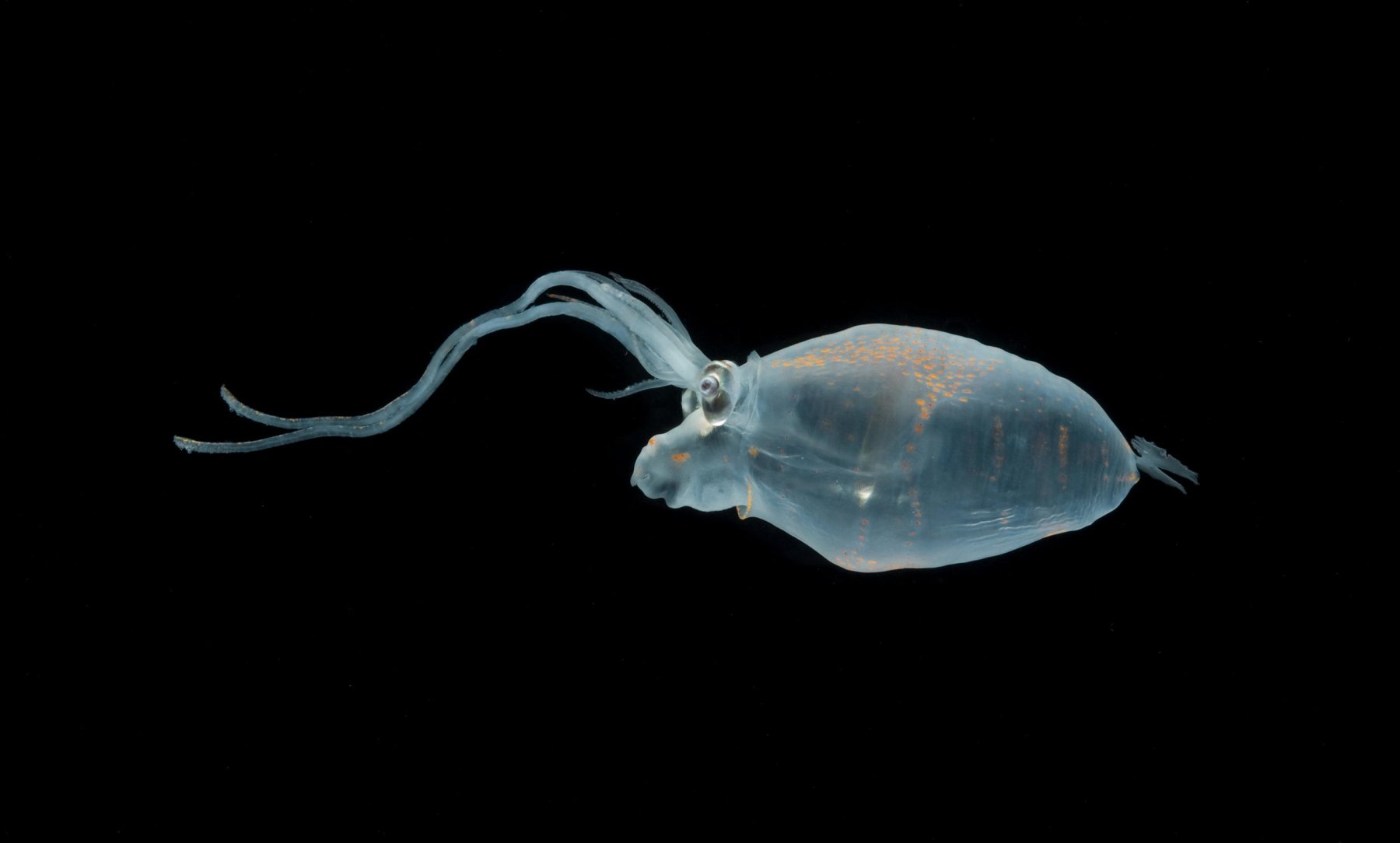
The piglet squid is a squidgy little enigma

Only the luckiest divers, researchers and ocean-enthusiasts will ever get the chance to spot a piglet squid in the wild. Or, if you’d prefer, a squiglet.

These elusive little cephalopods charm with their cartoonish appearance and intrigue with their gelatinous, transparent bodies. Those spots you can see in the image above are chromatophores, or pigment organs, which, when you look at the piglet squid from front-on, give it the appearance of a broad smile

The piglet squid (Helicocranchia pfefferi) grows to about 8 or 10 cm long. It’s found throughout the Pacific and Atlantic Oceans, ranging from tropical to polar waters. It can live at depths of just 1 metre to more than a kilometre below the surface – an unusually wide range for such a delicate creature.

It’s been spotted off the coast of Australia right down in the south-eastern corner of the mainland and occasionally in Tasmanian waters.

The piglet squid’s ‘nose’ is an exposed syphon, a hole used for filling itself with water, breathing and propulsion. Oddly enough, the piglet squid is able to keep itself buoyant by regulating the levels of ammonium (yes, the same kind of chemical you use to clean the oven) and sodium ions throughout its body.

You can see the way it bobs around in the ocean as these chemical levels ebb and flow within its balloon-like mantle (the main body of a squid) in the amazing deep-sea footage below. It was captured by a robotic underwater rover in the Palmyra Atoll, located in the Pacific Ocean roughly halfway between Australia and Mexico:Play

Piglet squids belong to the family Cranchiidae, which comprises roughly 60 species of glass squid, named for their transparent bodies.

Glass squid have been known to display an unusual habit of swimming upside-down, and no one really knows why they do it. It gives them the appearance of having a weird mop of hair, their arms and tentacles flowing freely above their eyes.

Read the full article here

Giant Reef Discovered Near Tahiti

Australian media seem to have been silent about the discovery of a giant pristine reef near Tahiti, apparently untouched by “climate change.” Makes you wonder how it has coped without UNESCO World Heritage listing or environmental worriers trying to “protect” it.

From Canada’s CBC:

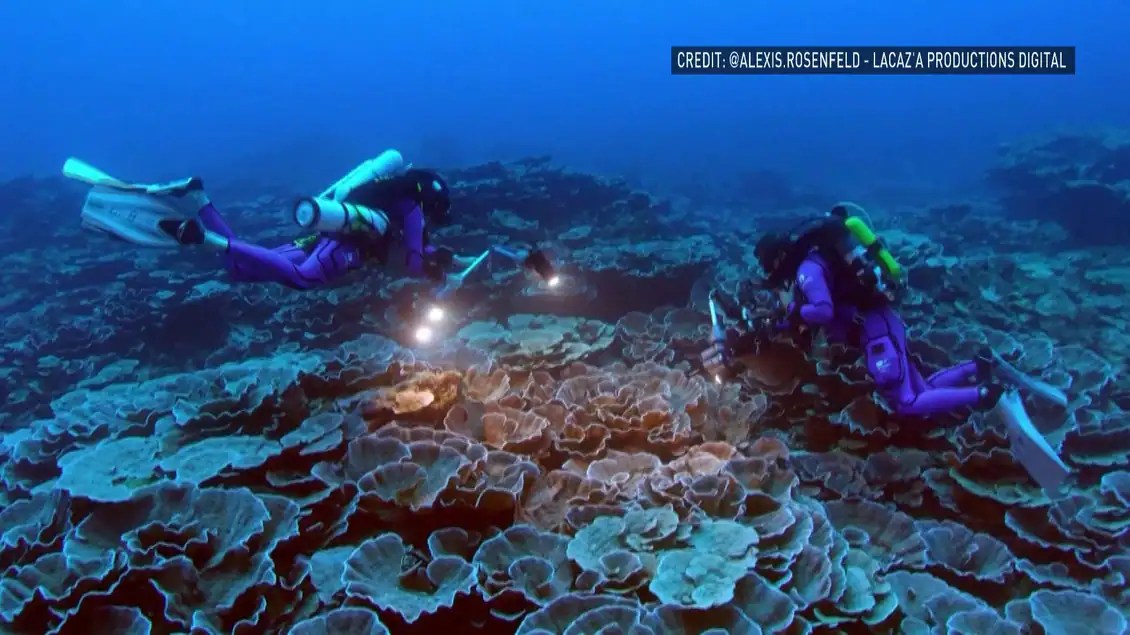
Scientists have discovered a pristine, three-kilometre-long reef of giant rose-shaped corals off the coast of Tahiti, in waters of the southern Pacific Ocean thought to be deep enough to protect it from the bleaching effects of the warming ocean.

The reef, which lies at depths of more than 30 metres, probably took around 25 years to grow. Some of the rose-shaped corals measure more than two metres in diameter.

“It was magical to witness giant, beautiful rose corals, which stretch for as far as the eye can see. It was like a work of art,” said French photographer Alexis Rosenfeld, who led the team of international divers that made the discovery.

Most of the world’s known coral reefs are in warmer waters at depths of up to 25 metres, the United Nations Educational, Scientific and Cultural Organization (UNESCO) said. The reef off Tahiti lies in the “twilight zone” 30 to 120 metres below the surface where there is still enough light for coral to grow and reproduce.

UNESCO says the newly discovered reef is one of the largest in the world.

Bleaching is a stress response by overheated corals during heat waves. They lose their colour, and many struggle to survive.

Perhaps the most famous — Australia’s Great Barrier Reef, a World Heritage-listed wonder — has suffered severe bleaching to an estimated 80 per cent of its corals since 2016.

The discovery off Tahiti’s shores suggests there may be many more unknown large reefs in our oceans, given that only about 20 per cent of the entire seabed is mapped, according to UNESCO scientists.

“It also raises questions about how coral reefs become more resilient to climate change,” UNESCO’s head of marine policy, Julian Barbiere, told Reuters.

More of the ocean floor needs to be mapped to better safeguard marine biodiversity, Barbiere said.

“We know more about the surface of the moon or the surface of Mars than the deeper part of the ocean.”

Jo Nova: Microbes Are Dealing With The Plastic “Crisis”

Jo Nova writes:

Plastics are not forever: Bugs already evolved 30,000 new plastic eating enzymes
Plastic cup at the beach. Photo

flockine

Plastics are a free dinner for life on Earth so it was just a matter of time before microbes evolved to eat it.

A PET bottle normally takes 16 – 48 years to break down, but if it were lunch for microflora it would take weeks instead. Hydrocarbons are ultimately just different forms of C-H-O waiting to be liberated as carbon dioxide and water. The only question was “how long” it would take bacteria and fungi to break those unusual bonds.

Sooner or later all plastic will be biodegradable.PET Plastic, Polyethylene-terephthalate
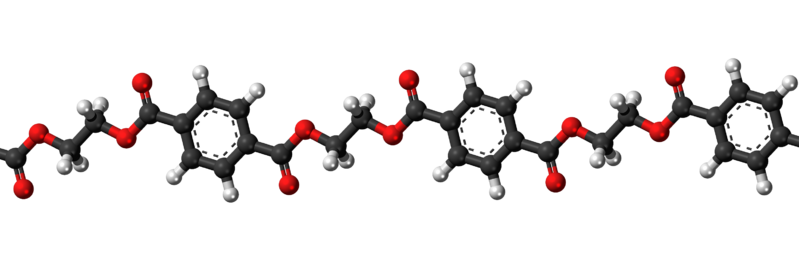
Polyethylene-terephthalate (PET)

The first bacteria known to chew through PET bottles was discovered at a Japanese rubbish dump in 2016. But we had no idea then just how advanced the microbial world of plastic processing was.

A new study shows. Instead of hunting for single bacteria Zrimec et al mined through collected metagenomes of soil and ocean and found not just 5 or 10 new enzymes but 30,000. It appears that they could metabolize at least ten different types of plastic.

And in places where there was more plastic pollution, there were more enzymes. All over the world a whole new ecosystem is rising out of the puddles and bubbles and grains of sand.

Enzymes that degrade plastics are found all over the worldMap od plastic degrading microbes
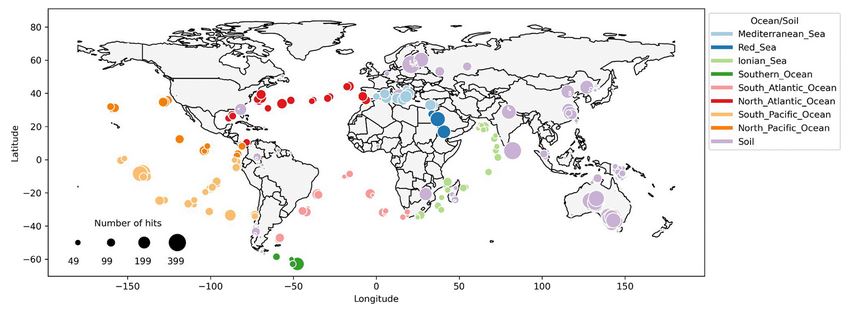
FIG 2 Plastic-degrading enzymes across the global microbiome. Depicted are 11,906 enzyme hits in the ocean and 18,119 in the soil data sets, obtained by constructing HMMs of known plastic-degrading enzymes and querying them across metagenomic sequencing data sets. The potential to degrade up to 10 and 9 different plastic types was observed in the respective ocean and soil fractions (Fig. S3A).

Mother Nature has a big toolshed of genes to play with:

With a library like this, is it any wonder life on Earth could find and amplify the right tools to process plastics?

For example, global ocean sampling revealed over 40 million mostly novel nonredundant genes from 35,000 species (35), whereas over 99% of the ∼160 million genes identified in global topsoil cannot be found in any previous microbial gene catalogue (34)

So there are 200 million genes to work with.

Bugs across globe are evolving to eat plastic, study finds

Damian Carrington, The Guardian, 15 Dec 2021

The explosion of plastic production in the past 70 years, from 2m tonnes to 380m tonnes a year, had given microbes time to evolve to deal with plastic, the researchers said. The study, published in the journal Microbial Ecology, started by compiling a dataset of 95 microbial enzymes already known to degrade plastic, often found in bacteria in rubbish dumps and similar places rife with plastic.

About 12,000 of the new enzymes were found in ocean samples, taken at 67 locations and at three different depths. The results showed consistently higher levels of degrading enzymes at deeper levels, matching the higher levels of plastic pollution known to exist at lower depths.

The soil samples were taken from 169 locations in 38 countries and 11 different habitats and contained 18,000 plastic-degrading enzymes. Soils are known to contain more plastics with phthalate additives than the oceans and the researchers found more enzymes that attack these chemicals in the land samples.

Nearly 60% of the new enzymes did not fit into any known enzyme classes, the scientists said, suggesting these molecules degrade plastics in ways that were previously unknown.

The not so apocalyptic plastic crisis
TheDigitalArtist, Turtle Ocean.

TheDigitalArtist

The new 250 page “Consensus” Study (their words) by the National Academies of Science, Engineering and Medicine, is as out of date and useless as it sounds. While it is scoring headlines, scaring us about accumulating plastics, it largely writes off the idea that microbes will evolve to degrade plastic, saying “measurable biodegradation (complete carbon utilization by microbes) in the environment has not been observed.” Which is one of those true but useless statements.

Some 40 year old theory says it won’t happen:

Plastics with hydrolysable chemical backbones (e.g., PET and polyurethanes) may be more susceptible to enzymatic degradation and eventual biodegradation than those with carbon-carbon backbones (Amaral- Zettler, Zettler, and Mincer 2020), as illustrated by the discovery of PET-degrading bacteria isolated from a bottle recycling plant (Yoshida et al. 2016). However, Oberbeckmann and Labrenz (2020) argue, based upon Alexander’s (1975) paradigm on microbial metabolism of a substrate, that the very low bioavailability and relatively low concentration of plastics in the ocean together with their chemical stability render these molecules very unlikely candidates for biodegradation by marine microbes, despite their potential as an energy and carbon source.

But if plastics are so tiny and low in concentration, it’s a big “so what” — they are unlikely to be a problem. If they were concentrated in one place or collected in an organism, they could be bad, but then, of course, they also become fodder for microbes.

The bottom line: We don’t want to drown dolphins and trap turtles, but we shouldn’t demonize plastics either.

Don’t throw rubbish in the ocean or toss hype in national news. It’s all litter.

Hat tip to Kip Hansen at Watts Up.

REFERENCES

Zrimec et al (2021) Plastic-Degrading Potential across the Global Microbiome Correlates with Recent Pollution Trends, ASM Journals mBio Vol. 12, No. 5 DOI: https://doi.org/10.1128/mBio.02155-21 

Reckoning with the U.S. Role in Global Ocean Plastic Waste, (2021) ISBN 978-0-309-45885-6 | DOI 10.17226/26132  https://www.nap.edu/download/26132

Full article

Creation.com:What’s a billion years between friends?

by 

Published: 9 December 2021 (GMT+10)
commons.wikimedia.orgstar

The extinction of the dinosaurs is typically said to have been about 65 million years ago (mya),1 but 66 mya has also been suggested.2 During my dinosaur presentations I inform the audience, but I don’t amend my slides. After all, what’s a million years (in this case around 1.5 %)?!

In other public talks, I discuss the big bang timeline, starting ~13.8 billion years ago. This is more than one billion years off from the age of the universe taught in the mid-nineteen nineties, of some 15 billion years (actually 8%).3 But what’s a billion years?!

The Bible’s timeline is unchanging (e.g. 1 Peter 1:25), like its Author; ‘Jesus Christ is the same yesterday and today and forever’ (Hebrews 13:8). The word of God reliably teaches a creation around 4,000 BC. Therefore, building your worldview on Scripture is a sure thing—your source does not keep changing. Not so with an evolutionary view, where new discoveries often seem to throw the prevailing (long age) view, for the timing of this or that aspect of history, under the proverbial bus. No need to worry though, for adherents can simply alter some previously believed interpretations in order to keep the narrative alive. Three recent examples of this are given below.

1. How can a star be older than the universe?

A spanner has been thrown in the works for those who believe the universe is 13.8 billion years old. Why? Apparently there are stars over 14 billion years old. You might wonder, “If the universe is 13.8 billion years old, how can a star be more than 14 billion years old?”4


Click here to read the rest of this article

Bit of a problem with the time line (yet again)

Ken Kam writes:

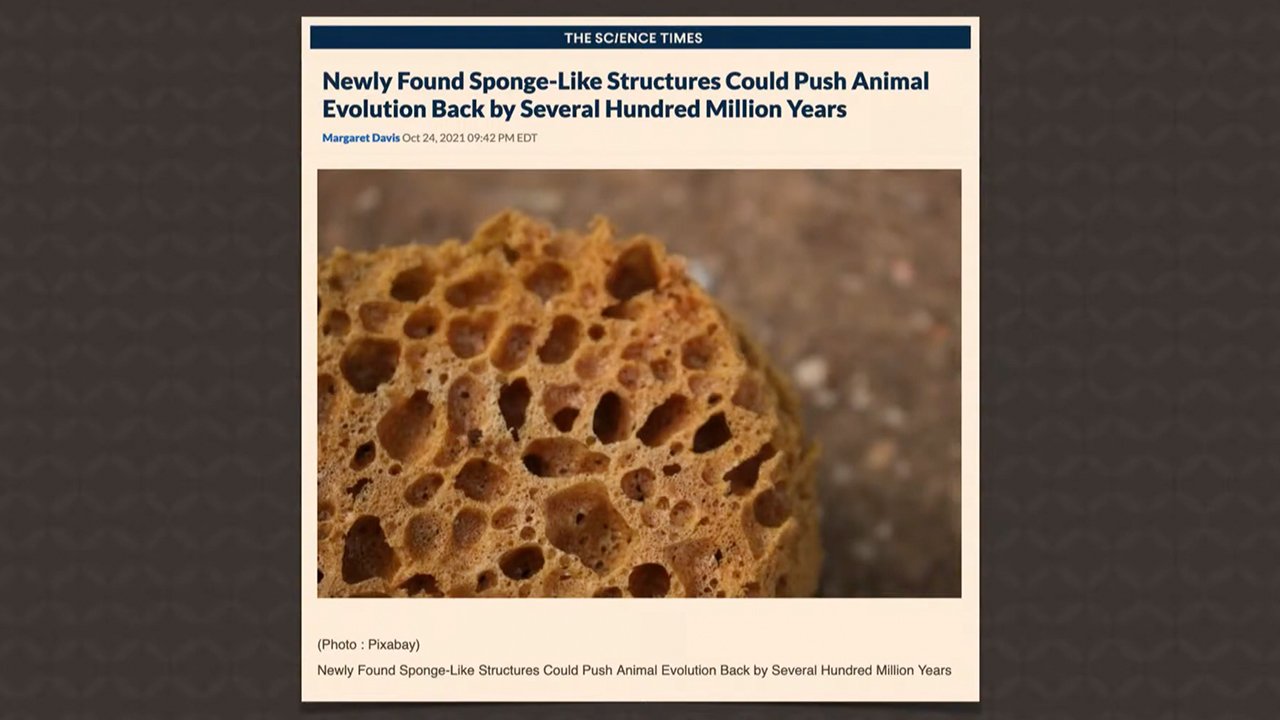
Animal Evolution Pushed Back Hundreds of Millions of Years

New sponge pushes back the “settled science” on evolution but doesn’t change the biblical narrative—since people didn’t evolve from sponges.

by Ken Ham on November 12, 2021Featured in Ken Ham

“Newly discovered sponge-like animals could change the known history of animal evolution.” Claims like this are ones we often hear—the evolutionary story and timeline are constantly changing as new finds upset everything they thought they knew, such as when animals first evolved from sponges (if they even evolved from sponges—that’s much debated in the evolutionary community!).

Now, some will claim this is just how science works. After all, our knowledge about the natural world adjusts as we make new discoveries. But it’s interesting to note how frequently this happens with the idea of evolution—timelines that were “settled science” or “undebatable” are suddenly changed by hundreds of millions of years (no small amount of imaginary time!), and now everything must change in light of the new interpretation of the evidence. It seems stories about such changes are now happening weekly! Why is the story changing so frequently?

The reason evolutionary ideas are constantly in flux, with “settled science” being overturned constantly, is that millions of years/evolution is the wrong worldview and the wrong starting point.

Well, because animals didn’t evolve from sponges (or anything else!) in the first place. The reason evolutionary ideas are constantly in flux, with “settled science” being overturned constantly, is that millions of years/evolution is the wrong worldview and the wrong starting point. It relies on the faulty interpretations of people who weren’t there, who don’t know everything, who frequently make mistakes, and who are attempting to explain the origin of the universe and all life apart from the eyewitness account God has given us in his Word! Wrong starting points mean wrong conclusions regarding the data.

When we start with God’s Word, we have an unchanging basis on which to ground our thinking. Only then can we properly understand the world around us and develop models and hypotheses that are consistent with both the evidence and the eyewitness of all history.

Read the full article here

The Sad State of Science

Science, as it is popularly understood, is in a parlous state. Politics and activists have captured important areas of research such as climate science and virology. People make stuff up and rely on dodgy computer “models” to make apocalyptic predictions, and nobody is ever held to account.

Now we have major science journals publishing mountains of computer-generated gibberish. So much for peer review.

Jo Nova writes:

Sea level height based on aerobics and other gibberish published in top science journals

Nature and Elsevier are agog and aghast that hundreds of junk papers filled with random word salad have been published in their esteemed journals.

It’s as bad as it sounds — one retracted title was: “‘Sea level height based on big data of Internet of Things and aerobics teaching in coastal areas’. “

They are shocked that  scammers who were “organised” and “sophisticated” found tricks to get published — wait for it — not just by hyping up, adjusting and exaggerating their cherry-picked papers and incompetent models, but with nothing more than fake e-mails “with ‘univ’ instead of ‘uni’ and ‘-ac.uk’ instead of ‘.ac.uk’”. That’s right, the highest and most intellectual “peer review” journals in the world have such inadequate, nonexistent standards, that not only do they fail to weed out weak papers, they couldn’t even defend themselves against randomized nonsense coming from fake professors with dodgy emails.

In other words, no one who matters even reads the papers before they are published.

Indeed, no one even read the titles…

Scammers impersonate guest editors to get sham papers published

Nature

Hundreds of articles published in peer-reviewed journals are being retracted after scammers exploited the processes for publishing special issues to get poor-quality papers — sometimes consisting of complete gibberish — into established journals. In some cases, fraudsters posed as scientists and offered to guest-edit issues that they then filled with sham papers.

Elsevier is withdrawing 165 articles currently in press and plans to retract 300 more that have been published as part of 6 special issues in one of its journals, and Springer Nature is retracting 62 articles published in a special issue of one journal. The retractions come after the publishers each issued expressions of concern earlier this year, covering hundreds of articles.

Guillaume Cabanac,  a computer scientist who uncovered nonsense papers, was shocked:

…it is shocking to see such papers in journals from ‘flagship’ publishers and that “it is not only predatory journals that publish bullshit”.

The papers are computer generated junk:

 71 articles have abstracts or titles that contain the words ‘dance’, ‘aerobics’ or ‘sports’ in relation to geoscience, including the articles ‘Sea level height based on big data of Internet of Things and aerobics teaching in coastal areas’ and ‘Rock stress and deformation characteristics based on SVM and sports high-intensity interval training’.

And it’s all happened before — in 2014 at least 120 papers were “computer generated nonsense” and were published and later retracted. It’s emblematic of the entire academic sector really. An industry using AI to produce nothing, discover nothing, get published, and then write papers about it?

So who benefits?

But the scammers’ motivations remain a mystery to Ivan Oransky, a journalist who runs Retraction Watch. Even the article titles, which would be listed as part of an individual’s publication record, often do not make sense, he says. “The papers are so obviously terrible, so why would you want them on your CV?”

Many of the papers were from authors based at Chinese institutions, and most contained nonsensical phrases that Elsevier thinks came from the use of reverse-translation software to disguise plagiarism.

Perhaps Western professors are trying to plump out their bio’s with statements about “publishing 412 Nature papers” and just paid a paper-scam generator in China. But who’d really want their name on papers like these? These papers are so bad, they look like the hoax papers done purposely to expose the rot in academia.Will a team appear next week admitting the papers were faked to test the system? Or are there just too many incentives for Chinese or other academics to “publish or perish”?

Either way, Western Civilization is paying tillions of dollars to change the weather based on “The Science” according to peer review — which appears to have no more intellectual prowess than a Nigerian 419 email scam.

Peer review is anonymous and unpaid and worth every cent.