It started when he was told the same moon rock had two vastly different ages
How old is the moon? Is it 4.6 billion years old, as consensus geologists insist, and as textbooks uncritically teach?
The Apollo astronauts were given extensive training in geology so that they would know what rocks on the moon were significant. This was true for Brigadier General Charles M. Duke (USAF), the Lunar Module Pilot on Apollo 16 who became the 10th man to walk on the moon. One of his geology trainers was Harrison Schmitt, a PhD geologist, who would fly on the final mission, Apollo 17 (see 14 Dec 2022). Apollo 16 (April 16-27, 1972) was the only mission to study the lunar highlands in the Descartes region, with its elevation 7,400 feet higher than the Sea of Tranquillity explored by Apollo 11. (Charlie Duke was also the CapCom, or capsule communicator, for Apollo 11.)
During their three extensive extra-vehicular activities (EVAs), including 16.6 miles of drives on the lunar rover, Charlie Duke and Mission Commander John Young collected 209 pounds of lunar samples.
Moonrock, by Alan Bean, depicts John Young and Charlie Duke (Apollo 16) collecting lunar samples. Used by permission from Alan Bean (Apollo 12 astronaut).
On April 6, during an interview before an audience of nearly a thousand people, Duke related a strange thing that the experts said about one of the lunar rocks he collected.
I picked up a rock on the moon, and it was about the size of my hand. And on one end it dated 3.9 billion years. On this end it dated 1.6 billion years. So there was two billion years between six inches! [audience laughter]. And, something was wrong here, somewhere!
Duke went on to say that he “began to doubt a little bit,” but not to the point of disbelieving evolution. At the time, he was a non-Christian, thoroughly preoccupied with his own career success within the NASA community. It was only later, when he became a Christ follower after seeing the dramatic change in his wife Dotty’s conversion, that his earlier doubts about that rock made sense. “I became a believer, and I went from an evolutionist to a creationist.”
At age 88, Charlie Duke is the youngest of four surviving Apollo astronauts among the 12 men who walked on the moon. Another Apollo astronaut who was a young-earth creationist and Christ follower was Apollo 15 astronaut James Irwin (1930-1991).
From Wattsupwiththat.com, Willie Eschenbach talks about the Living Planet Index
A few years back, some scientists got together and invented something they call the Living Planet Index, or LPI. It’s supposed to measure how well (or poorly) the species that make up the living world are doing. They say it is a “measure of the state of the world’s biological diversity based on population trends of vertebrate species.” So it’s an index based on the decline of some selected species, which is claimed to represent the decline of the species of the “living world”.
Here’s the big news from their latest report.
The Living Planet Index claims an average 70% decline in the populations of species worldwide since 1970.
YIKES! 70% loss since 1970! EVERYONE PANIC!
But is this true?
Over in the Twitterverse where I’m @weschenbach, I said that based solely on my experience, their claim was nonsense. I’ve spent a lot of the last half-century outdoors in the elements, both on land and on and under the sea, around the planet. I said I would have noticed a 70% reduction in species populations.
Of course, folks who spend their lives behind desks in a city thought I was being ridiculous, and they laughed uproariously. How could I be so certain? Plus of course, there were the claims of “But Willis, those are actual scientists! How can you doubt them?”
So I thought I’d take a look at some real data. Let’s get a sense of the number of the species involved.
There are estimated to be around 8.7 million species on earth. Of these, about 65,000 are vertebrates.
How many of these 8.7 million species are studied by the Living Planet Index? Well, not all of them.
First, no plants, no fungi, no chromista. Next, only vertebrates, and only some of those, specifically fish, mammals, birds, reptiles, and amphibians.
The good news is that the IUCN Red List of Threatened Species, which is the official keeper of data on which species are threatened or not, lists data for 62,493 vertebrates, so it covers pretty much all of the vertebrates.
It also allows us to search based on various criteria, including those used by the LPI listed above.
And when we eliminate the vertebrate species the LPI doesn’t include, we end up with 59,866 species fitting the LPI criteria—mammals, birds, reptiles, fish, and amphibians. Of course, they didn’t look at all of them, only 5,230. But I wanted a larger view of the issues.
The Red List also lets us see if the populations of each species are increasing, stable, or decreasing.
Of the populations of the 30,763 of the LPI-studied mammal etc. species for which the Red List has population data, 53% have stable or increasing populations. So we’re left with 14,565 species with decreasing populations. Call it half to be generous.
Here’s the problem. If around half the species for which we have data are stable or increasing, then even if the rest were all totally extinct, the average decline would only be 50% … far from the 70% they claim.
Oooops …
Next, as a sensitivity analysis, let’s assume every one of the 28,714 species for which we don’t have the population trend is decreasing. Clearly, that’s not possible—some will be increasing or stable. And because the Red List is focused on threatened species, the unknown species will likely be weighted towards stable species. But it’s a sensitivity analysis, so we’ll assume every one of the unmeasured species is decreasing.
With that impossible assumption purely for a sensitivity analysis, it would mean only 27% of the species are stable or increasing.
And the problem still remains. With 27% not decreasing, the only way to get to a 70% decrease in population is if almost every one of the 33,861 theoretically decreasing species is already extinct or on the brink of extinction. Only that impossible situation would give us a 70% average decrease.
Conclusions?
Out of 59,866 species fitting the LPI criteria for which we have population data, just over half are stable or increasing.
Of the 59,866 species, only 8,509 are both decreasing and in some trouble (vulnerable or near threatened or endangered or critically endangered). Here’s the Red List Report:
The endangered and decreasing fish, birds, reptiles, amphibians, and mammals are 0.001% of all species, and there’s no reason to assume that their condition reflects the world situation.
The 70% claim of the LPI is falsified by the Red List data.
As I said, I have investigated this because based solely on my experience, I said I didn’t believe the LPI numbers, and folks laughed at that. And now, having studied the species data, I find that my experience is correct—their claims don’t hold water.
So how did the scientists behind the LPI get it so wrong? Obviously, their selected species are not representative of the whole.
I would suggest that Upton Sinclair had the answer to that. He said:
“It is difficult to get a man to understand something, when his salary depends on his not understanding it.”
The problem is, if the LPI was going up, or just slightly downwards, the scientists behind the LPI would be out of a job. To use George Orwell’s term, that’s doubleplusungood …
And almost inevitably, this leads to an unconscious bias in their choice of species, locations, and studies to include in the LPI. For the LPI, they’ve studied 31,821 populations of 5,230 species. So no overt bias is needed—just picking study A over study B because reasons, choosing population 1 over population 2, selecting species Alpha over species Beta, lather, rinse, repeat, and soon you have a 70% decline since 1970.
Finally, please be clear that I’m not saying that we should ignore population decreases. I’ve been a commercial fisherman for a good deal of my life, and I’d like my grandson to be able to do the same. The only way for that to happen is for us to care for the other life forms with which we share this magical planet. I’m just saying that the LPI is just more unsupported alarmism.
Best to all, and yeah, I’ll continue to trust my experience despite people laughing at it … I’m funny that way.
I have been thinking this week about two stories of how we arrived in the world. The first theory is evolution, which says that we are just a product of random chemical reactions over a very long period of time. The second story is that of creation as described in the very first chapter of Genesis.
This is not the place to say whether one of these stories is factually correct, or whether we can blend the two together in some way. I do want to consider some of the ramifications of these stories and the results of believing one or the other.
As we read the familiar words of Genesis 1, we discover that God is greater than the world, the sun and moon, the stars and bigger than everything all put together. Science tells us that the universe is unimaginably huge and more complex than we can imagine, but God is bigger than all of this.
At each stage of the process, God describes the creation as good, until the last day when He makes the first people and He describes it as “very good.” It is as if everything is made for the purpose of supporting human beings.
The Bible teaches that we are created for a purpose and that we are the pinnacle of God’s creative activity.
On the other hand, evolution tells us that everything is random, from the birth of our planet (an insignificant lump of rock on the edge of an average galaxy), to the production of individual human beings (you are just a random arrangement of DNA, and it determines your life).
So we get to a place of despair because there is no reason for us to exist. There is no future because in the end the whole universe will just run out of energy.
From that depressing explanation of life, we reap a harvest of depression, purposelessness, sexual anarchy and lawlessness.
God made you for a purpose. He has a plan for your life and a destiny for you in eternity.
Some very fine experiments have measured the roundness of the electron with exquisite sensitivity.1 For comparison, “if an electron were the size of Earth, they could detect a bump on the North Pole the height of a single sugar molecule.”2
The big bang is the leading naturalistic cosmogony (Greek: ‘birth of the universe’). It basically states that energy appeared from nothing and turned into matter, as per Einstein’s most famous formula, E = mc2.
However, The Standard Model of particle physics, among the best-attested theories in all science, throws up severe problems. In particular, any conversion of energy into matter must produce an equal amount of antimatter. Antimatter comprises antiparticles of the same mass but opposite charge (if the particle is charged) and magnetic moment as the corresponding matter particle. When an antiparticle meets its corresponding particle, both are quickly annihilated with a huge release of energy, again as per E = mc2. That is, antielectron (positron) with electron, antiproton with proton, antineutron with neutron, etc.
The problem for the big bang is that the universe comprises overwhelmingly matter, with hardly any antimatter except for fleeting moments. As the article says:
For one thing, our mere existence is proof that the Standard Model is incomplete since, according to the theory, the Big Bang should have produced equal parts matter and antimatter that would have annihilated each other.2
But notice the logical fallacy known as begging the question (Latin: petition principii)! That is, any argument where the conclusion to be proved is presupposed (‘begged’) in one of the premises.3 In particular, although real operational science overwhelmingly supports the Standard Model, there must be something wrong with it because it means that the Big Bang would not work. How do we know that the big bang is true? Because we are here, and we got here from the big bang. This question-begging arises from previous question-begging: that we arose by naturalistic means—no Creator necessary.
Because of this question-begging a priori commitment to naturalism (only ‘nature’ exists), evolutionary cosmologists have been trying to find loopholes in the Standard Model. In particular, any asymmetry that could explain why much more matter than antimatter was produced in the big bang.
Jo Nova reports the astounding find of corals way above current sea levels. Maybe we could restore those coal fired power stations, burn some fossil fuels and restore the reef.
Corals covered the Australian desert once – maybe they’ll grow back if we screw in the right light globes?
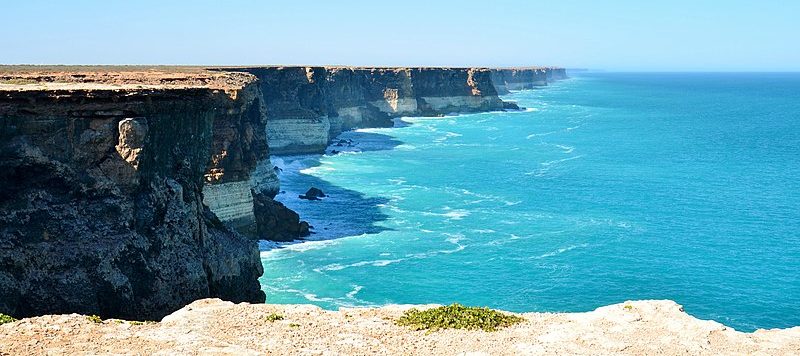
The remnants of a long gone coral reef are not in the water here, but on top of the cliff. This is what real climate change looks like:
The whole coral reef is now 100 m out of the water | Bahnfrend |
The Nullabor Plain.
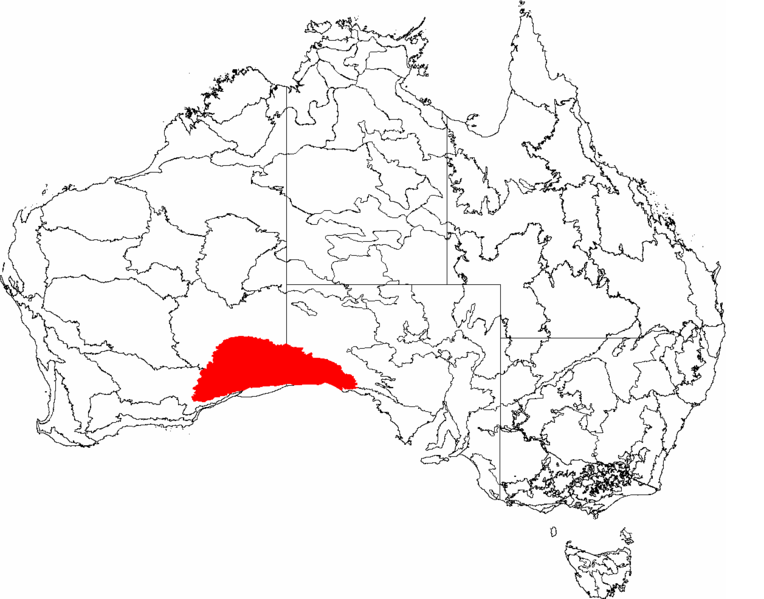
It turns out the high plateau desert called the Nullarbor was once a coral reef. It’s a thousand kilometer stretch without a tree that’s now about 100m above sea level. Obviously it’s a wilderness that’s begging to be restored to its true Miocene glory. The question is whether we can put on enough solar panels to save this reef, or if we can melt the Antarctic and raise the oceans…
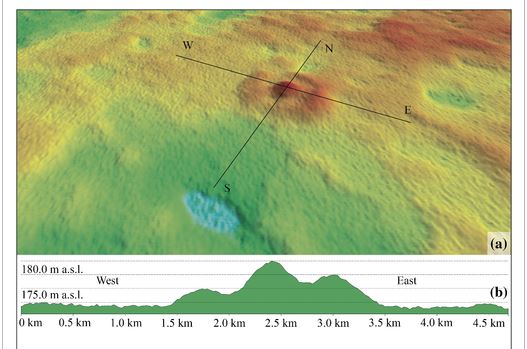
Researchers looking at satellite images spotted a suspicious looking dome and ring (below) . They figured out it was not a meteor crater but probably a former coral atoll. It’s about one kilometer across and corals built this (probably) 14 million years ago. Tectonic shifts lifted the land out of the ocean. If only the polyps had put in a carbon tax?
The Nullarbor is a bit special because the surface is well preserved. There is not a lot of rain, no rivers to speak of, humidity is low, storm surges don’t wash over it and sediments don’t settle on it. Plus the nearest glaciers are in New Zealand.
““So even though it’s exposed, it’s kind of like a land that time forgot … the erosion is so slow, [these features] get preserved for millions and millions of years, kind of capturing a snapshot of how environments were at different times.” —WA Today
Coral Dome, remnant, Nullabor Australia
Once fish frolicked in the afternoon sun among the anenome here. Now there is saltbush.
This is the kind of climate change we need to teach children at schools. Geological, not Gretalogical.
Imagine the effect if students knew almost nothing was permanent, life was adaptable, and the climate changed all the time.
Most of Australia is now arid and dry, with vast inland deserts. Millions of years ago, though, during the Miocene, the continent was teeming with life; not just dense, thriving forest ecosystems, but huge inland seas.
“Through high-resolution satellite imagery and fieldwork we have identified the clear remnant of an original sea-bed structure preserved for millions of years, which is the first of this kind of landform discovered on the Nullarbor Plain,” says geologist Milo Barham of Curtin University in Australia.
The ocean that covered the Nullarbor started to dry up around 14 million years ago, exposing the shallow-water limestones deposited during the middle Cenozoic.
That means the Nullarbor is effectively a clean record of geological processes and features dating back to the Miocene.
“Evidence of the channels of long-vanished rivers, as well as sand dune systems imprinted directly into limestone, preserve an archive of ancient landscapes and even a record of the prevailing winds,” Barham says.
“And it is not only landscapes. Isolated cave shafts punctuating the Nullarbor Plain preserve mummified remains of Tasmanian tigers and complete skeletons of long-extinct wonders such as Thylacoleo, the marsupial lion.”
That’s not all. “At the surface,” adds Barham, “due to the relatively stable conditions, the Nullarbor Plain has preserved large quantities of meteorites, allowing us to peer back through time to the origins of our Solar System.”
There have been a number of mantras pushed over the past two years in regards to the Rona which the “experts” have assured us are completely true and fully based on the science. But just this week two of the biggest ones have taken further blows: that we all must be locked down, and that we all must get jabbed. Important new studies continue to appear showing these have been hugely questionable health mandates.
There has been plenty of research showing how wrong the statists have been in locking us all down and demanding that we are to be coerced into having substances injected into our bodies against our compliance. Two of the newest bits of research on these matters simply further confirm what we have known for quite some time now.
Take the issue of harsh, draconian lockdowns – something I and others have been speaking against for nearly two years now. Many have argued that the evidence points to the fact that they actually cause more harm than good. And even if not, they are doing little to stop the spread of Covid deaths.
Scientists have successfully hatched Irukandji eggs. Here’s why that’s important
A breakthrough by Australian marine scientists means they’ll be able to at last unlock the secrets of one of the world’s most dangerous creatures.By Sheree Marris • December 23, 2021 • Reading Time: 8 Minutes • Print this pageResearch assistant and aquarist Sally Turner monitors the behaviour of captive-bred Irukandji jellyfish. Image credit: Sheree Marris
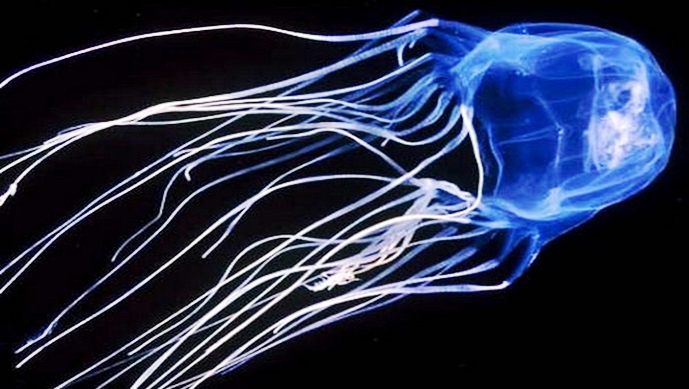
The Irukandji jellyfish could have sprung from the fertile imagination of a sci-fi horror writer. It looks deceptively insignificant and benign, but its entire body is a biological booby trap. In most jellyfish it’s only the tentacles that are studded with the minuscule harpoon-like, venom-loaded stinging cells known as nematocysts. But in Irukandji the bell is also armed with these toxic weapons – as many as 5000 per square centimetre. An encounter with an Irukandji can have an adult human soon fighting for their life. Like most jellyfish, the Irukandji is transparent, but it’s tiny – no more than 2.5cm wide – so you’re unlikely to see it coming and stay out of its way. And even if you did, those tentacles are extendable, reaching out to four times their relaxed length.
This jellyfish was named after the Irukandji people, traditional fishers whose Country includes the sea off the coastal regions near Cairns, Queensland. Although this was the area where the jellyfish was first recognised, its distribution is much wider. And with more people venturing into the waters where they occur, reports of stings are becoming increasingly common and scientific scrutiny of the Irukandji has been mounting.
But research on the species in the wild has had limitations. Although it’s been possible to collect these tiny, near-invisible creatures in their natural habitat at night using lights, scientists have been struggling to study them in a controlled laboratory environment and haven’t been able to breed them in captivity.
Now in a world-first, Professor Jamie Seymour and his team of jellyfish researchers working in a lab dubbed the eduQuarium at James Cook University’s Cairns campus have managed to breed the Irukandji in captivity. It’s an achievement that’s been 20 years in the making and is a vital step forward in the mitigation of the threat posed by this intriguing jellyfish species.
It also means that we finally have a chance to learn the secrets of a creature that produces one of the most diabolically painful experiences known to humans.
Irukandji–human encounters
Jamie Seymour is a global expert on jellyfish, as well as many other dangerous sea creatures. Protected in tanks stretching around the walls of his lab is a range of deadly marine animals, from colourful crustaceans that literally punch their prey into submission, to slimy snails with weapons stuffed up their noses and sand assassins with blade-like claws that would make Freddy Krueger cower.
But it’s the Irukandji jellyfish that are the stars of this show in their futuristic round tanks, designed without corners to prevent damaging the soft bodies of these hard-core carnivores.
Jamie understands the pain of an Irukandji sting better than most. It’s one of the risks of his research and he’s been stung 11 times so far. “Yep, I’ve experienced the pain of an Irukandji sting many times in the past. It’s not something I’m proud of and it’s 11 mistakes I wish I hadn’t made,” he admits. “So on a more positive note, at least I’m intimately familiar with the incredible pain and discomfort that victims can suffer, and I wouldn’t wish it on my worst enemy.”
As with many things about this poorly understood jellyfish, its lethal weaponry of explosive and spring-loaded venomous harpoons is unique in the animal kingdom. Certainly people have died following envenomation by Irukandji, with victims succumbing to the effects of potent toxins and incredible pain, but it’s rare. There are only two recorded deaths.
But there’s concern that these jellyfish may have been responsible for more deaths than those attributed directly to them and that for various reasons, including the impact of climate change on their distribution, Irukandji–human encounters are on the rise. And that’s what makes the discovery of how to breed them so important.
Only the luckiest divers, researchers and ocean-enthusiasts will ever get the chance to spot a piglet squid in the wild. Or, if you’d prefer, a squiglet.
These elusive little cephalopods charm with their cartoonish appearance and intrigue with their gelatinous, transparent bodies. Those spots you can see in the image above are chromatophores, or pigment organs, which, when you look at the piglet squid from front-on, give it the appearance of a broad smile
The piglet squid (Helicocranchia pfefferi) grows to about 8 or 10 cm long. It’s found throughout the Pacific and Atlantic Oceans, ranging from tropical to polar waters. It can live at depths of just 1 metre to more than a kilometre below the surface – an unusually wide range for such a delicate creature.
It’s been spotted off the coast of Australia right down in the south-eastern corner of the mainland and occasionally in Tasmanian waters.
The piglet squid’s ‘nose’ is an exposed syphon, a hole used for filling itself with water, breathing and propulsion. Oddly enough, the piglet squid is able to keep itself buoyant by regulating the levels of ammonium (yes, the same kind of chemical you use to clean the oven) and sodium ions throughout its body.
You can see the way it bobs around in the ocean as these chemical levels ebb and flow within its balloon-like mantle (the main body of a squid) in the amazing deep-sea footage below. It was captured by a robotic underwater rover in the Palmyra Atoll, located in the Pacific Ocean roughly halfway between Australia and Mexico:Play
Piglet squids belong to the family Cranchiidae, which comprises roughly 60 species of glass squid, named for their transparent bodies.
Glass squid have been known to display an unusual habit of swimming upside-down, and no one really knows why they do it. It gives them the appearance of having a weird mop of hair, their arms and tentacles flowing freely above their eyes.
Australian media seem to have been silent about the discovery of a giant pristine reef near Tahiti, apparently untouched by “climate change.” Makes you wonder how it has coped without UNESCO World Heritage listing or environmental worriers trying to “protect” it.
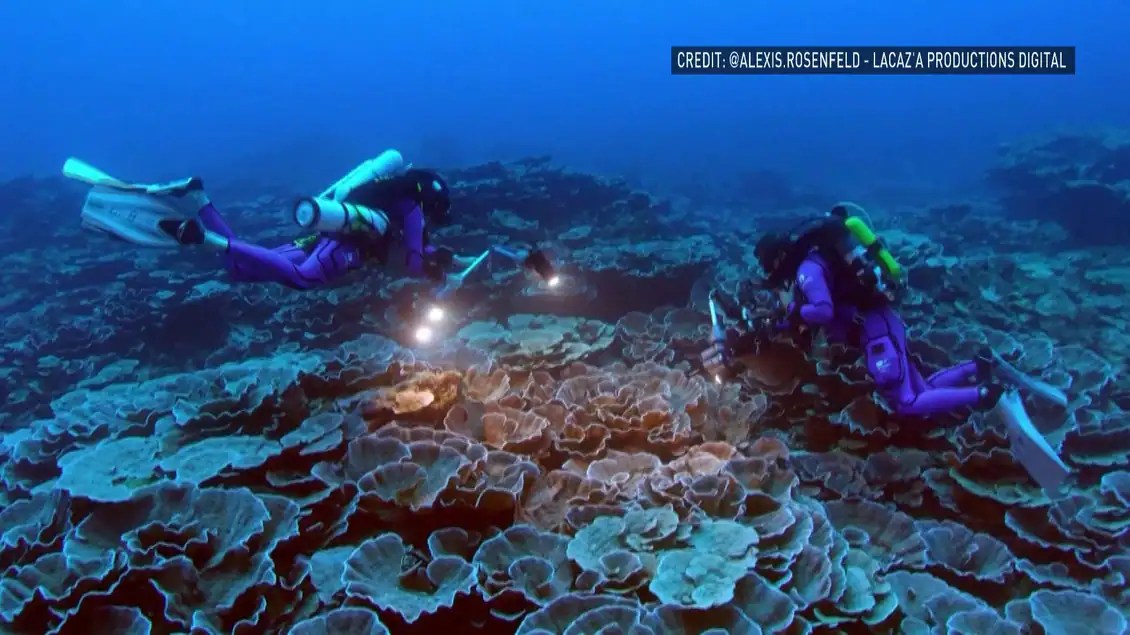
Scientists have discovered a pristine, three-kilometre-long reef of giant rose-shaped corals off the coast of Tahiti, in waters of the southern Pacific Ocean thought to be deep enough to protect it from the bleaching effects of the warming ocean.
The reef, which lies at depths of more than 30 metres, probably took around 25 years to grow. Some of the rose-shaped corals measure more than two metres in diameter.
“It was magical to witness giant, beautiful rose corals, which stretch for as far as the eye can see. It was like a work of art,” said French photographer Alexis Rosenfeld, who led the team of international divers that made the discovery.
Most of the world’s known coral reefs are in warmer waters at depths of up to 25 metres, the United Nations Educational, Scientific and Cultural Organization (UNESCO) said. The reef off Tahiti lies in the “twilight zone” 30 to 120 metres below the surface where there is still enough light for coral to grow and reproduce.
Bleaching is a stress response by overheated corals during heat waves. They lose their colour, and many struggle to survive.
Perhaps the most famous — Australia’s Great Barrier Reef, a World Heritage-listed wonder — has suffered severe bleaching to an estimated 80 per cent of its corals since 2016.
The discovery off Tahiti’s shores suggests there may be many more unknown large reefs in our oceans, given that only about 20 per cent of the entire seabed is mapped, according to UNESCO scientists.
“It also raises questions about how coral reefs become more resilient to climate change,” UNESCO’s head of marine policy, Julian Barbiere, told Reuters.
More of the ocean floor needs to be mapped to better safeguard marine biodiversity, Barbiere said.
“We know more about the surface of the moon or the surface of Mars than the deeper part of the ocean.”







 Research assistant and aquarist Sally Turner monitors the behaviour of captive-bred Irukandji jellyfish. Image credit: Sheree Marris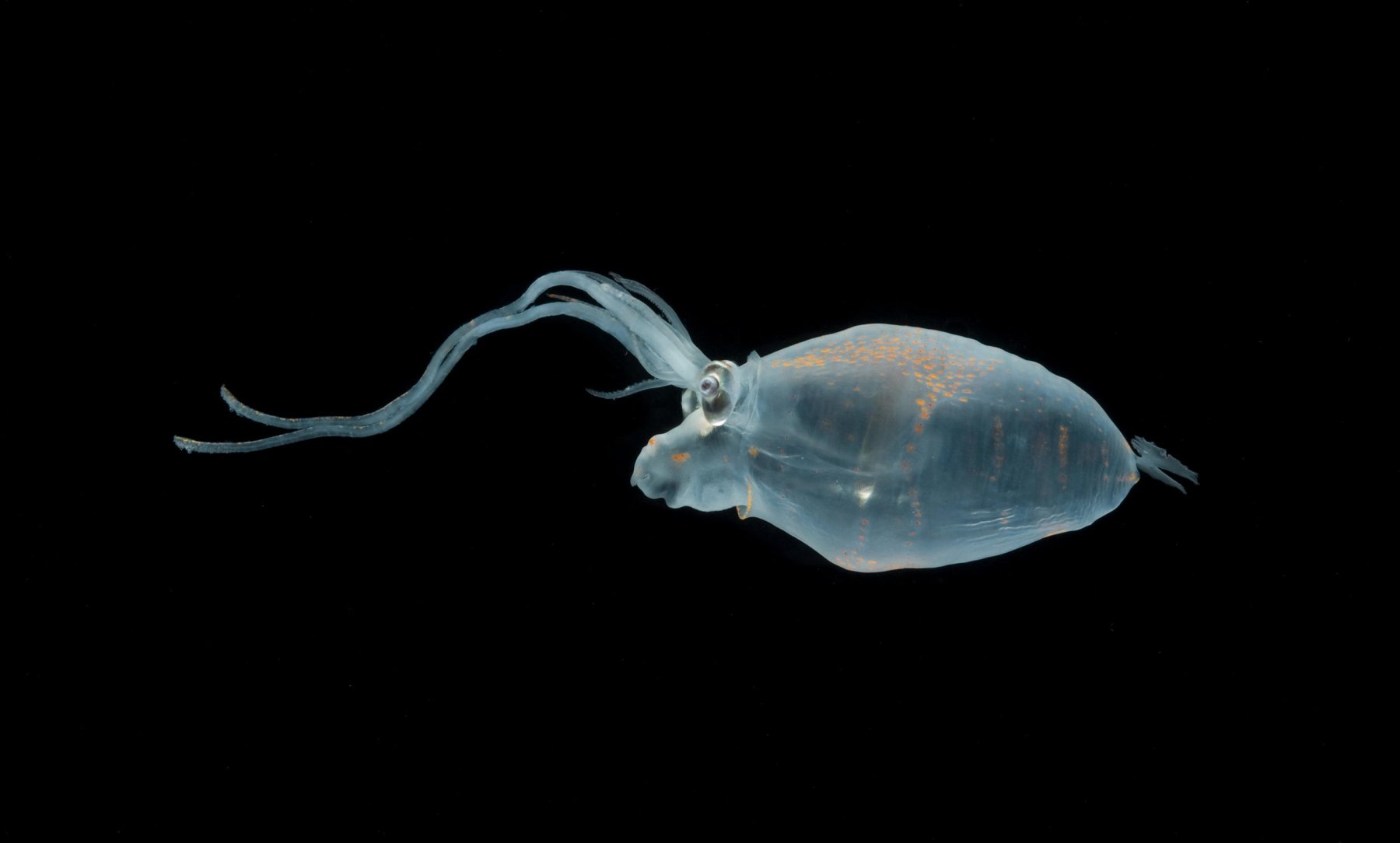


.jpg)