He has done great things…
Scripture
Shadrach, Meshach and Abednego replied. “O Nebuchadnezzar, we don’t need to defend ourselves before you. If we are thrown into the blazing furnace, the God whom we serve is able to save us. He will rescue us from your power, Your Majesty
Observation
King Nebuchadnezzar has a statue of himself, some 27 metres high, set up on the plains adjacent to the city of Babylon. He decrees that at the sound of musical instruments, everybody must worship the statue.
Shadrach, Meshach and Abednego are found to be ignoring this directive. So Nebuchadnezzar orders they be thrown into a fiery furnace. They tell him that their God is able to save them, but even if He does not save them, they will not worship the statue.
The men are thrown into the furnace, but the observers see not just the three men but another man also, one who looks like a god walking with them. So Shadrach, Meshach and Abednego are promoted to even greater positions of power.
Application
The faith of these men always astounds me. They refuse to disobey God’s commands to not worship idols. But when pressed, they express faith in God’s ability to save them in the furnace. However, even if God does not save them, there is no way that they will worship the statue. It is easy to be faithful to God in the small things of life. Choosing to obey God, rather than give in to sin is a fairly basic level of discipleship.
When we are faced with death, as the consequence of righteousness, it is a very big decision. We need to make. Will I save my flesh and potentially lose eternity?
It is in the life and death moments that our faith is greatly tested, But we cannot overcome that test until we have conquered the tests of daily temptations.
Prayer
Father, may I never have to make this kind of decision for you. Please help me to be faithful to you every day, so that when the time of testing comes I will stand firm. Amen.
When the New Testament speaks of appointing elders, it calls for elders in “every church” and over “every town” (as cited above). The terms “church” and “town” here are interchangeable, for biblically, in any given city or region, though there may be many fellowships and many leaders, there is but one Body. John Alley

Scripture
“As you watched, a rock was cut from a mountain, but not by human hands. It struck the feet of iron and clay smashing them to bits…. but the rock that knocked the statue down became a great mountain that covered the whole earth.
Observation
Daniel is given the revelation of what the King’s dream contained and also the dream’s interpretation. In the dream, Nebuchadnezzar saw a huge shining statue of a man. The head was made of gold, the chest and arms were silver, its belly and thighs were bronze, and the feet a mixture of iron and clay. A stone cut from a mountain struck the statue, obliterating it.
Daniel explains that the statue represents four great Empires. The Lord will set up a kingdom that will never be destroyed or conquered, and this Kingdom will stand forever.
Nebuchadnezzar is so pleased with Daniel’s revelation that he makes him ruler over the province of Babylon and chief over the king’s wise men.
Application
This dream is a powerful description of the four empires of ancient times – Babylonian, Persian, Greek, and Roman.
The stone cut from the mountain but not by human hands is God’s kingdom, the church. This Kingdom is eternal and covers the entire world.
All of this was foretold centuries before the birth of Jesus. The church began as an offshoot of Judaism and quite insignificant in size. Yet, in a few generations, it conquered the Roman Empire by love, and it outlasted it. Now, the church spans the entire world.
It is estimated that one-third of all the people in the world identify as Christian
God’s kingdom is the greatest Kingdom in history. It is eternal and it is available for all people to enter it. Praise be to God, our great Creator and Sustainer.
Prayer
Lord, I marvel at your grace and power. You overcome great empires and prove yourself to be above every human kingdom. Amen.
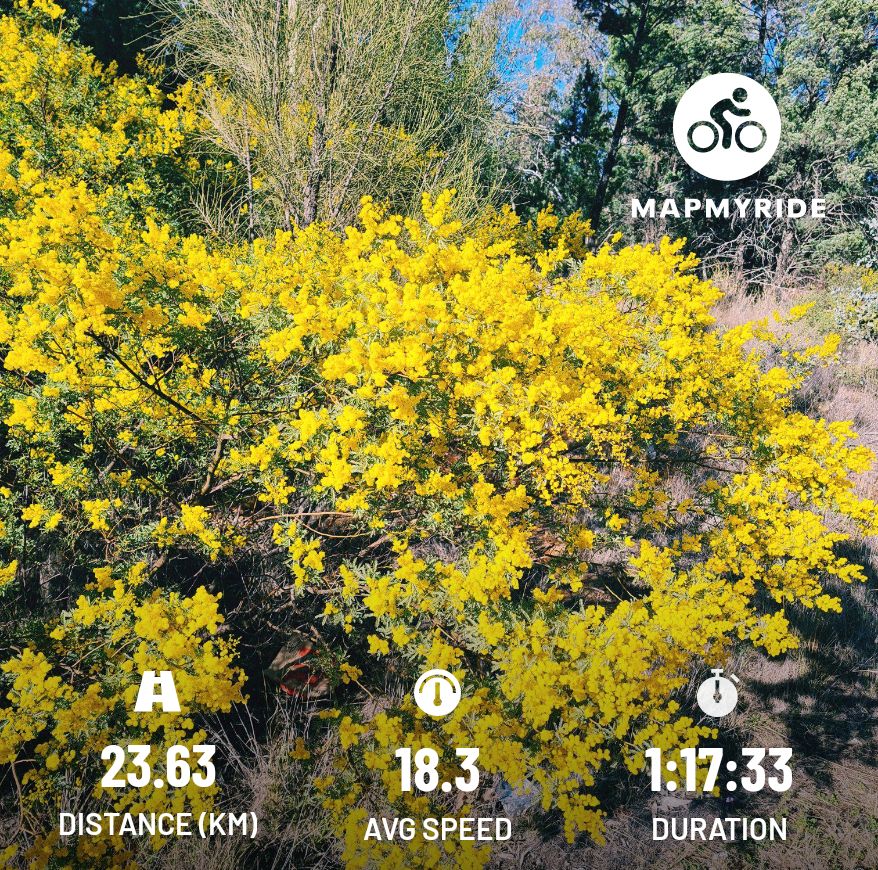
The wattles are in full bloom and spring is around the corner. I rode along Yarrie Lake Rd this morning. #cycling #narrabri #Biketooter
It is Christ who chooses His apostles, equips and tests them, and finally will commission them. This is never to be a glib matter for the laying on of hands. John Alley

 New Life Narrabri