Irukandji Jellyfish Are Tiny And Deadly

From Australian Geographic

Scientists have successfully hatched Irukandji eggs. Here’s why that’s important

A breakthrough by Australian marine scientists means they’ll be able to at last unlock the secrets of one of the world’s most dangerous creatures.By Sheree Marris • December 23, 2021 • Reading Time: 8 Minutes • Print this pageResearch assistant and aquarist Sally Turner monitors the behaviour of captive-bred Irukandji jellyfish. Image credit: Sheree Marris

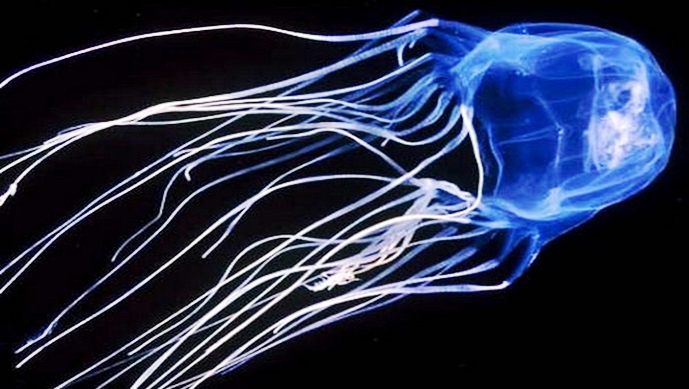
The Irukandji jellyfish could have sprung from the fertile imagination of a sci-fi horror writer. It looks deceptively insignificant and benign, but its entire body is a biological booby trap. In most jellyfish it’s only the tentacles that are studded with the minuscule harpoon-like, venom-loaded stinging cells known as nematocysts. But in Irukandji the bell is also armed with these toxic weapons – as many as 5000 per square centimetre. An encounter with an Irukandji can have an adult human soon fighting for their life. Like most jellyfish, the Irukandji is transparent, but it’s tiny – no more than 2.5cm wide – so you’re unlikely to see it coming and stay out of its way. And even if you did, those tentacles are extendable, reaching out to four times their relaxed length. 

This jellyfish was named after the Irukandji people, traditional fishers whose Country includes the sea off the coastal regions near Cairns, Queensland. Although this was the area where the jellyfish was first recognised, its distribution is much wider. And with more people venturing into the waters where they occur, reports of stings are becoming increasingly common and scientific scrutiny of the Irukandji has been mounting. 

But research on the species in the wild has had limitations. Although it’s been possible to collect these tiny, near-invisible creatures in their natural habitat at night using lights, scientists have been struggling to study them in a controlled laboratory environment and haven’t been able to breed them in captivity. 

Now in a world-first, Professor Jamie Seymour and his team of jellyfish researchers working in a lab dubbed the eduQuarium at James Cook University’s Cairns campus have managed to breed the Irukandji in captivity. It’s an achievement that’s been 20 years in the making and is a vital step forward in the mitigation of the threat posed by this intriguing jellyfish species.

It also means that we finally have a chance to learn the secrets of a creature that produces one of the most diabolically painful experiences known to humans.

Irukandji–human encounters

Jamie Seymour is a global expert on jellyfish, as well as many other dangerous sea creatures. Protected in tanks stretching around the walls of his lab is a range of deadly marine animals, from colourful crustaceans that literally punch their prey into submission, to slimy snails with weapons stuffed up their noses and sand assassins with blade-like claws that would make Freddy Krueger cower.

But it’s the Irukandji jellyfish that are the stars of this show in their futuristic round tanks, designed without corners to prevent damaging the soft bodies of these hard-core carnivores. 

Jamie understands the pain of an Irukandji sting better than most. It’s one of the risks of his research and he’s been stung 11 times so far. “Yep, I’ve experienced the pain of an Irukandji sting many times in the past. It’s not something I’m proud of and it’s 11 mistakes I wish I hadn’t made,” he admits. “So on a more positive note, at least I’m intimately familiar with the incredible pain and discomfort that victims can suffer, and I wouldn’t wish it on my worst enemy.”

As with many things about this poorly understood jellyfish, its lethal weaponry of explosive and spring-loaded venomous harpoons is unique in the animal kingdom. Certainly people have died following envenomation by Irukandji, with victims succumbing to the effects of potent toxins and incredible pain, but it’s rare. There are only two recorded deaths.

But there’s concern that these jellyfish may have been responsible for more deaths than those attributed directly to them and that for various reasons, including the impact of climate change on their distribution, Irukandji–human encounters are on the rise. And that’s what makes the discovery of how to breed them so important.

Read the rest of the article here 
The Piglet Squid

The variety of creatures that live on the land and in the sea is a testament to the creativity of God our Creator.

From Australian Geographic

The piglet squid is a squidgy little enigma

Only the luckiest divers, researchers and ocean-enthusiasts will ever get the chance to spot a piglet squid in the wild. Or, if you’d prefer, a squiglet.

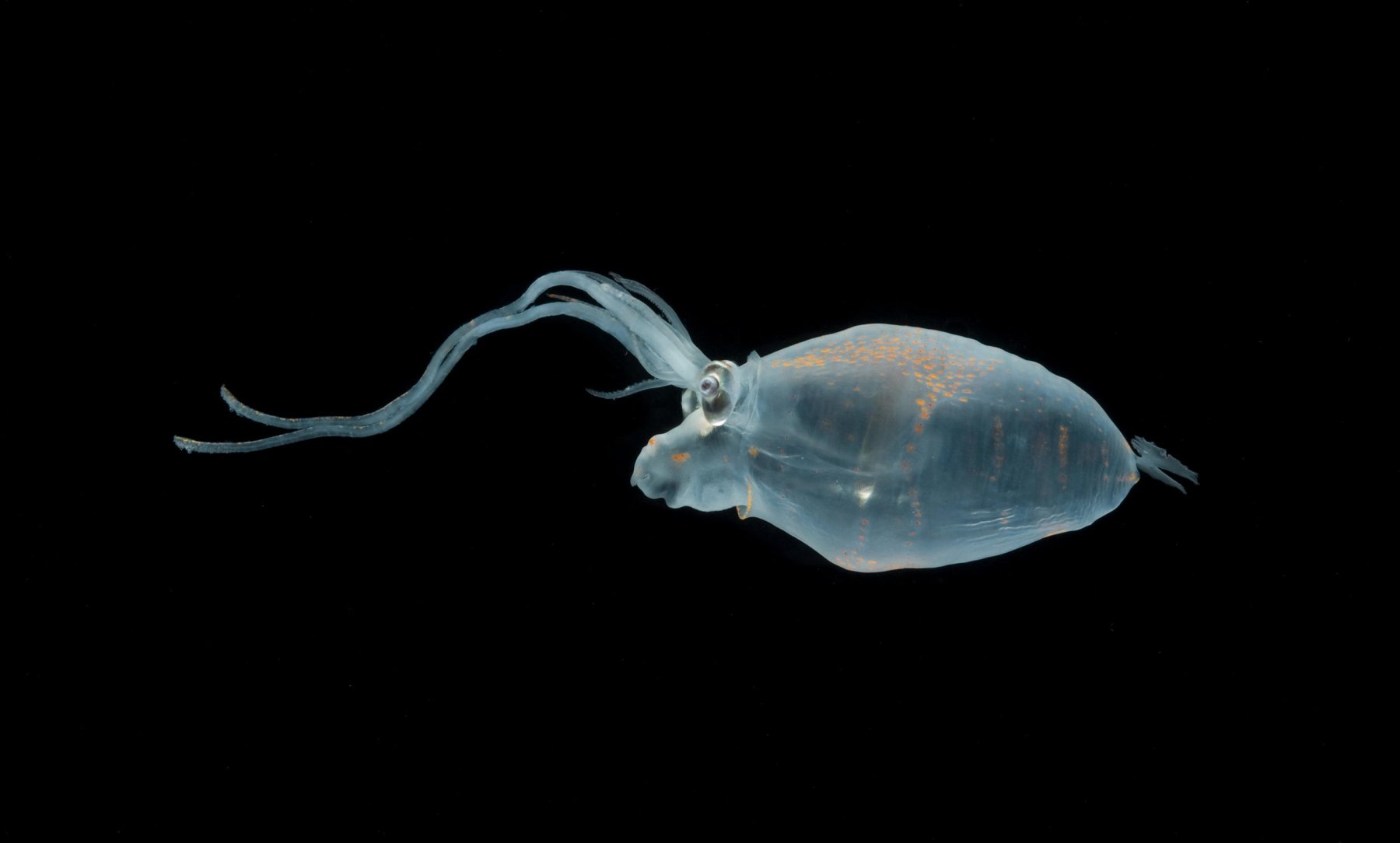
These elusive little cephalopods charm with their cartoonish appearance and intrigue with their gelatinous, transparent bodies. Those spots you can see in the image above are chromatophores, or pigment organs, which, when you look at the piglet squid from front-on, give it the appearance of a broad smile

The piglet squid (Helicocranchia pfefferi) grows to about 8 or 10 cm long. It’s found throughout the Pacific and Atlantic Oceans, ranging from tropical to polar waters. It can live at depths of just 1 metre to more than a kilometre below the surface – an unusually wide range for such a delicate creature.

It’s been spotted off the coast of Australia right down in the south-eastern corner of the mainland and occasionally in Tasmanian waters.

The piglet squid’s ‘nose’ is an exposed syphon, a hole used for filling itself with water, breathing and propulsion. Oddly enough, the piglet squid is able to keep itself buoyant by regulating the levels of ammonium (yes, the same kind of chemical you use to clean the oven) and sodium ions throughout its body.

You can see the way it bobs around in the ocean as these chemical levels ebb and flow within its balloon-like mantle (the main body of a squid) in the amazing deep-sea footage below. It was captured by a robotic underwater rover in the Palmyra Atoll, located in the Pacific Ocean roughly halfway between Australia and Mexico:Play

Piglet squids belong to the family Cranchiidae, which comprises roughly 60 species of glass squid, named for their transparent bodies.

Glass squid have been known to display an unusual habit of swimming upside-down, and no one really knows why they do it. It gives them the appearance of having a weird mop of hair, their arms and tentacles flowing freely above their eyes.

Read the full article here

Quote for the Day

Go for it! Consumed with Holy Fire, you are what the world is waiting for. You are the light of the world, the express manifestation of Love in you on the earth! Billions of souls are desperate to discover Heaven’s Blueprint and live a life in Christ Jesus full of miracles and power that never ends. Duncan Smith

Reflection on Zechariah 14:1-21

Scripture

And the Lord will be king over all the Earth. On that day there will be one Lord – his name alone will be worshipped.

Observation

The Day of the Lord is coming. Nations will gather around Jerusalem to attack it. The Lord will rescue his people and fight against these nations.

Then the Lord will come. Sources of light will not shine, but there will be continuous day. Living waters will flow from Jerusalem to the Mediterranean and the Dead Seas.

The Lord will be king over all the Earth, and He alone will be worshipped.

The Lord will send a plague on the nations that attacked Jerusalem. Those who survive the plague will go to Jerusalem each year to worship the Lord.

Application

The Lord will be king over all the earth.

Every knee will bow before Jesus, every tongue will confess that He is Lord .

The religions and philosophies of the world will fade away to nothing, utterly demolished by the reality of Christ’s Kingdom.

This will not come without a cost. Zechariah’s prophecy speaks of an attack on Jerusalem before the Lord intervenes. After that, even those people who were opposed to the people of God will come for the annual festival.

The Kingdom of God is advancing day by day. We see set backs here and there, but every day there are more Christians in the world than the day before.

Prayer

Lord Jesus, you are the King of Kings, the Lord of Lords. I give you my heart and soul. Use me as you wish. Amen.

Australia Day

January 26th is Australia Day, marking the day that the First Fleet of European Settlers arrived in Sydney Cove in 1788.

The usual suspects of radical left-wing haters have turned it into a day of division.

I love Australia and I love this day. I also love this quintessentially Aussie poem by Dorothea Mackellar, who lived not 100 miles from Narrabri.

My Country

The love of field and coppice,
Of green and shaded lanes.
Of ordered woods and gardens
Is running in your veins,
Strong love of grey-blue distance
Brown streams and soft dim skies
I know but cannot share it,
My love is otherwise.

I love a sunburnt country,
A land of sweeping plains,
Of ragged mountain ranges,
Of droughts and flooding rains.
I love her far horizons,
I love her jewel-sea,
Her beauty and her terror –
The wide brown land for me!

A stark white ring-barked forest
All tragic to the moon,
The sapphire-misted mountains,
The hot gold hush of noon.
Green tangle of the brushes,
Where lithe lianas coil,
And orchids deck the tree-tops
And ferns the warm dark soil.

Core of my heart, my country!
Her pitiless blue sky,
When sick at heart, around us,
We see the cattle die –
But then the grey clouds gather,
And we can bless again
The drumming of an army,
The steady, soaking rain.

Core of my heart, my country!
Land of the Rainbow Gold,
For flood and fire and famine,
She pays us back threefold –
Over the thirsty paddocks,
Watch, after many days,
The filmy veil of greenness
That thickens as we gaze.

An opal-hearted country,
A wilful, lavish land –
All you who have not loved her,
You will not understand –
Though earth holds many splendours,
Wherever I may die,
I know to what brown country
My homing thoughts will fly.

— Dorothea Mackellar