No room for fear!
People in our age often arrogantly assume that we are smarter than ancient people. This is probably because we live in an information age, where the the combination of technology and widespread education makes a wide range of knowledge available to just about everybody.
Additionally the flawed theory of evolution causes us to assume we must be better than people who lived a long time ago.
This story of how a man with rudimentary measuring and calculating technology is also a reminder of how God blesses people at all ages and all nations.
So about 2200 years ago there was a very bright man called Eratosthenes who came from Greece which was then the centre of learning and philosophy. He took up residence in Alexandria in Egypt, where there was a famous library which contained all of the world’s great learning.
While he was living in Alexandria, Eratosthenes heard about a well in the village of Syene in the south of Egypt where there was a well, where at midday on the summer solstice the sun shone right to the water below without casting a shadow on the walls of the well. In other words, the sun at that time was directly overhead. Today we would recognise that Syene is located on the Tropic of Cancer.
This caused Eratosthenes to wonder if this held true at Alexandria, some distance to the north. So at midday on the summer solstice, he observed a vertical post in the ground and noted that it cast a shadow. So when the sun was overhead in Syene, it was not directly overhead in Alexandria.
Measuring the length of the shadow and the post he discovered that the sun was at an angle of 7.2 degrees off the vertical. This proved that the world is not flat but is a sphere. All he needed to do was find the distance from Alexandria to Syene to find out just how big the sphere is.
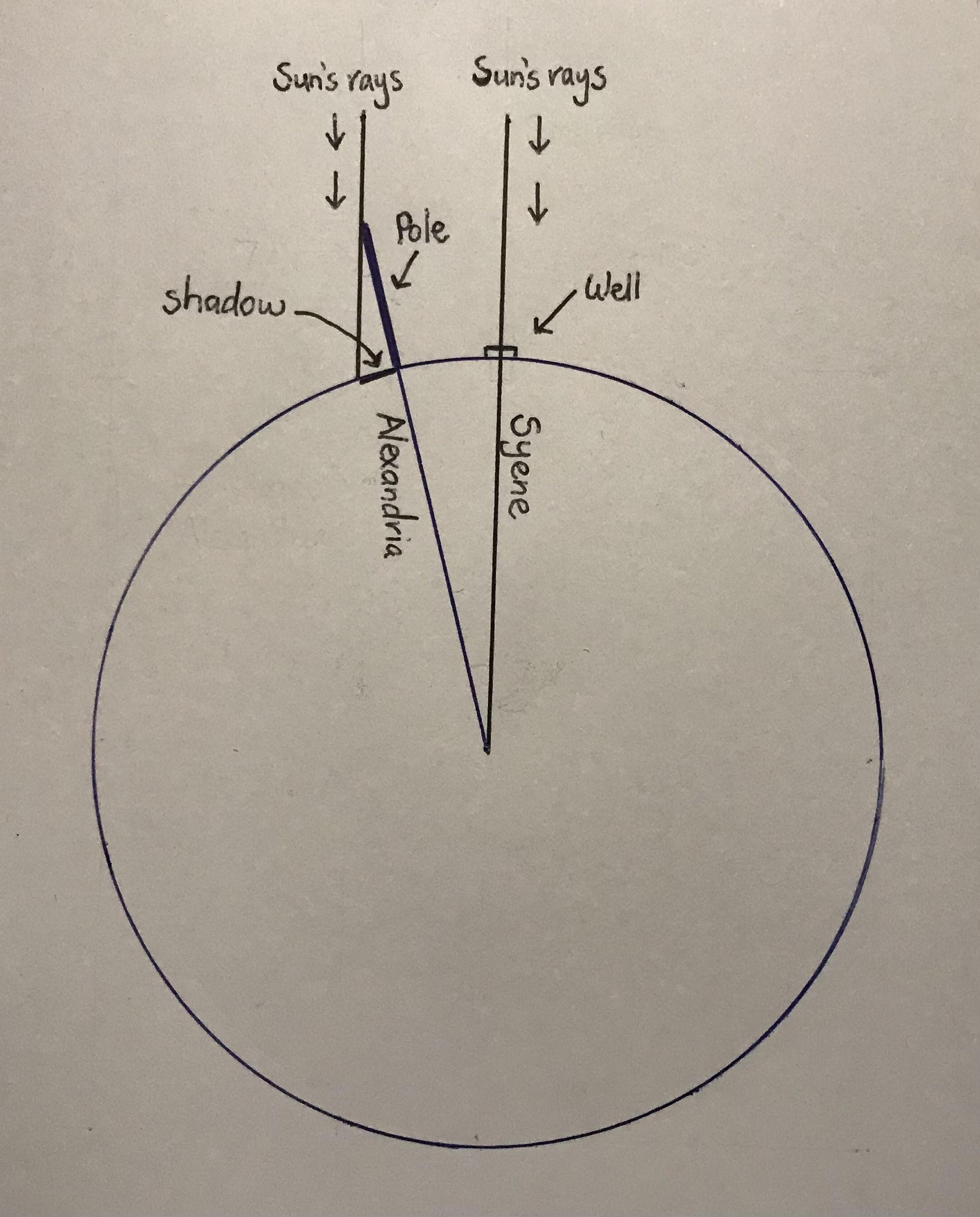
Apparently in the ancient world they had people called bematists whose job was to accurately pace out the distances between locations. He discovered that the distance between the two towns was 5000 stadia or 800 km.
Now here is the clever part. A complete circle is 360 degrees, and 7.2 degrees is one fiftieth of 360. If 800 km, the distance from Alexandria to Syene, represents one fiftieth of the circumference of the earth, then the full circumference is 50 x 800 km or 40,000 km.
Was he close? Yes! The pole to pole circumference is 40,008 km while the circumference at the equator is 40,075 km. That is brilliant calculation with such limited tools as he had.
So Eratosthenes drew a map of the known world with grids of latitude and longitude, and hundreds of towns and cities. This made it much easier to estimate distances than ever before, and laid the foundations of modern geography.
God created people with great intelligence. We have not evolved into higher levels of smartness over the millennia. Despite the arrogance of our age, people in the ancient world knew more than we give them credit for.
Here is my commentary on Ephesians 5:18 I am publishing these once or twice a week, but you can read all of the available articles at our web-site, http://www.new-life.org.au
Ephesians 5:18
“Do not get drunk with wine, for that is debauchery, but be filled with the Spirit.”
Many people coming to Christ through the ages have had to wrestle with the various addictions and practices that were a part of their old life. There is no doubt that alcohol and other drugs have an appeal for many people to alleviate the misery of lives marked by abuse, neglect, failed relationships, or purposelessness. People medicate to relieve emotional pain and to give some sense of joy.
The Bible nowhere forbids the consumption of alcohol, except for those who have taken a vow. Paul indeed encourages the temperate use of wine, especially as a treatment for some ailments. Jesus himself was accused of mixing with drunkards, and we know that he created very good wine for a wedding.
However, the Bible does warn consistently about excessive consumption of alcohol. This turns something that is a gift from God into something destructive.
The word translated here as “debauchery” means both the lack of self control which drunkenness brings, as well as the waste of time and money that it entails.
Drunkenness is first condemned for the destruction of self-control which it involves. Every part of life can give us indications of what can go wrong when a person is drunk. Everyday, road fatalities and injuries occur because of alcohol use. The rate of domestic violence spikes during summer when alcohol consumption also increases. Footballers and celebrities go on rampages when under the influence of alcohol and other drugs.
Christians are required to put to death the old nature. However, being under the influence of alcohol seems to amplify the sinful nature and reduce the moderating influence of the Holy Spirit. It seems that the driving force behind these drugs is not just chemical but demonic.
Drunkenness is also condemned because of its wastefulness. Clearly, what we spend on drugs we cannot spend on productive things. What seems to be a relatively cheap form of entertainment comes at the cost of keeping people in poverty.
Of course when the substances go to their logical destination, they waste a person’s life with unemployment, homelessness, and destroyed families just a part of the human cost.
Each christian needs to come to their own conclusion about the role of various drugs in their life, and ensure that they are a positive factor in their walk with Christ.
Instead of seeking a chemically induced high, Paul says we should be “ filled with the Spirit.”
It is interesting that Spirit fullness should be contrasted with drunkenness. This goes right back to Pentecost. Then, the disciples receiving the baptism of the Holy Spirit were speaking in tongues and praising God. While some people recognised that this was an actibvity of the Holy Spirit, others cynically said they were drunk (Acts 2:13).
The tense of the verb “ be filled” is a continuous imperative. This means that it is a command that is to be continually or repeatedly obeyed. We are to be regularly filled with the Holy Spirit.
There is a one-time experience for Christians often called the Baptism in the Holy Spirit. This is an occasion when we receive the power of the Holy Spirit in us. it is often accompanied by the gift of speaking in tongues, usually interpreted as a unique prayer language that comes by the inspiration of the Spirit and not through human learning. The Baptism in the Spirit is an entry point for the gifts of the Holy Spirit (see 1 Corinthians 12:1-11).
To be filled with the Holy Spirit is to be inundated by the Spirit, equipped for ministry, and empowered to do the works of Christ. We see this expression used often in the book of Acts (see for example Acts 4:31, 9:17).
We might think from the use of this expression in Acts that being filled with the Holy Spirit was something that people had no control over, indeed no say about. The Holy Spirit filled them uninvited.
Paul says we are to be filled with the Holy Spirit. This is a continuous imperative that indicates that we have some agency in the process. Clearly Paul thought so, and expected that the Ephesians did too
How can we be filled with the Holy Spirit?
Pastor Che Ahn suggests 4 steps add we can take daily to be filled with the Holy Spirit
These are by no means prescriptive instructions. They do put us into a place of expectancy and receptivity to the Holy Spirit.
I would add to this regular times of praise and worship, so that our hearts and minds are soaking in the presence of the Holy Spirit.

Scripture
My conscience is clear, bu that doesn’t prove I am right. It is the Lord himself who will examine me and decide.
Observation
Apollos and Paul are just servants of Christ. Paul does not worry about how he might be evaluated by any human authority. It is the Lord who will judge Paul.
We must not make judgements about anyone before the Lord returns. Then the Lord will judge everyone, giving whatever praise is due.
We should not boast about one leader at the expense of others because we do not have the right to make these judgements.
Application
The heart is deceitful above all things. We are told to follow our heart, but this is a disastrous idea.
Even an apostle like Paul was nervous about trusting his own conscience. He says his conscience was clear, but in the end it is God who makes the judgement.
In all things, we should seek to be faithful to the Lord. I keep my eyes on my patch, doing the task that Christ has called me to. He will judge my faithfulness.
There is then no room for me to judge other people. I don’t see their motives or the reasons why they do things. Therefore I cannot judge them.
If a clear conscience proves nothing in me, how can I presume to judge others?
Prayer
Lord, please convert my conscience and all my thoughts to your purposes. Help me not to judge other leaders, but instead stay focused on the mission you have assigned to me. Amen.
Faith that works is one which is undefiled with doubt. We established earlier that doubt is to do something apart from the Holy Spirit. Steve Wallace