“This is the finger of God!” the magicians exclaimed to Pharaoh. But Pharaoh’s heart remained hard. He wouldn’t listen to them, just as the Lord predicted.
Observation
Three more plagues infest the land of Egypt. Increasingly, Pharaoh and his magicians recognise that God is in control and their magic cannot compete with His power.
But still Pharaoh remains stubborn, and he refuses to let the Israelites go.
Application
Frogs were revered by Egyptians because of their ability to live in both water and the land. Likewise flies seemed to be able to turn death into life as their young emerged from decaying matter. Biting insects would have made life very unpleasant for everyone.
By the time we get to the plague of flies, the Lord is exempting the land where the Israelites live. Flies do not respect lines on a map, but the Lord ensured that this supernatural plague hurt the Egyptians more than the Israelites.
Both Pharaoh and the magicians can see that a greater power than they can imagine is at work. But Pharaoh remains stubborn.
The idea of losing a large slave population must have seemed threatening to Pharaoh. Maybe he thought that he could manage the crisis, just riding out each plague until things returned to normal.
God cannot be managed, resisted or out-waited. If we are for Him, blessings abound. If we oppose Him, serious consequences will flow like a tsunami.
Whether we are rulers of great nations or humble every day people, surrendering to the Lord Is always the best way.
Prayer
Lord, please help me to surrender to you, to let you have your way in my life. Amen.
“I will make the Pharaoh’s heart stubborn so I can multiply my miraculous signs and wonders in the land of Egypt.”
Observation
The Lord again commands Moses and Aaron to confront Pharaoh. Pharaoh demands to see a miracle, so Aaron throws down his staff which turns into a snake. Pharaoh summons his magicians who do a similar miracle, although Aaron’s staff eats their staffs.
Then the Lord tells Moses to meet Pharaoh at the river. When Pharaoh again refuses to release the Israelites, Aaron raises his staff over the river, and the Lord turns it into blood, killing the fish and making it undrinkable.
Pharaoh’s heart remains hard, and he refuses to let God’s people go.
Application
God confronts Pharaoh’s heart, multiplying miracles in Egypt to convince him that the Lord is the one true God.
The plagues that afflict Egypt seem random to us, but to God they had a definite purpose- to destroy Egypt’s religious system and demonstrate that the Lord, the God of the Hebrews is greater than the gods of Egypt, even on their home ground.
The Egyptians worshipped the Nile because it was the source of life and prosperity for them. When the Lord turned it instantly into blood, becoming dead and putrid, it shod that God’s word is greater than the river gods.
This is not just about water, important as that is. It is the religious issue of the source of life.
It is God who gives us life. In many western nations there is a push to liberalise abortion and assisted suicide laws. Soon the State will be seen as the source of life and death.
Christians must proclaim that the Lord, and the Lord alone, gives life.
Prayer
Thank you Father for the gift of life in this world and in the world to come. Amen.
But Moses argued with the Lord, saying, “I can’t do it! I am such a clumsy speaker! Why would Pharaoh listen to me?”
Observation
The clans and the ancestors of Moses and Aaron are listed.
Moses and Aaron are the ones to whom the Lord gave the commandment to go to Pharaoh to demand that he sets God’s people free.
Moses had said to the Lord, “I can’t do it!”
Application
It has been said that we can tell when it is God who calls us to a task by the fact that it is too hard for us in our own ability.
Moses felt that he was incapable of speaking to Pharaoh. This was despite the fact that he had been brought up in Pharaoh’s palace and given all the training and education necessary for being a government leader.
When God calls us, we are often most aware of our inadequacy. This is a good thing because it negates pride.
God does not call the most talented, or the smoothest speaker. Rather, He calls those who are available, and then He equips them for the task.
Just on 24 years ago, God ed Margaret and me to start a new church. We have no idea why it was us, except that we said “Yes” to the call.
We endured many years of very little in the way of salary. We enjoyed countless miracles of God’s provision. And so we persevered.
That is the story of many of God’s people, including Moses. After his initial attempt to rescue the Hebrew people, he fled to the desert and stayed there for 40 years. That was not the end of the story because, as inadequate as Moses felt, He was God’s man for the job.
Prayer
Help me Lord to trust you every day for the things and the skills I need to carry out your plan for my life. Amen.
Here is my commentary on Ephesians 3:18. I am publishing these once or twice a week, but you can read all of the available articles at our web-site, http://www.new-life.org.au
Ephesians 3:18
“… may have power together with all the saints to grasp how wide and long and high and deep is the love of Christ.”
Paul continues his prayer for the Ephesians (and us) that, having been grounded in love, they may have power to grasp how big is Christ’s love.
Paul’s desire is that “ all the saints” should grasp the magnitude of Christ’s love. This is not a journey of discovery just for the church in Ephesus, but a necessary understanding for the church everywhere and throughout history.
When Christians fail to grasp the love of Christ, we can be fearful about our future. We worry that we may have committed the unforgivable sin. We fret to make sure that all of our sins, no matter how trivial, we confess, keeping short accounts with God, as the saying goes.
For christian leaders, uncertainty about Christ’s love can lead us to legalism. It is so easy to define rules of outward behaviour, dress codes, and language usage in order to keep the flock under control. We don’t want our people to sin so we define the boundaries of acceptable behaviour to keep everybody safe. This was the sin of the Pharisees.
Sin and righteousness are not really about behaviour derived from morality codes. The real issue is abut our love for God, and His love for us. All sin is relational.
When we grasp the magnitude of Christ’s love, it changes everything. We no longer act from fear but from faith. Anxiety is replaced by joy.
To know that I am not just accepted by Christ, but loved by Him, means that I do not have to fear ever being rejected by Him. I can rest, knowing that I don’t have to prove that I am good enough.
Knowing that I am loved by Christ means I can be relaxed about my sins. That is not to say that I should be complacent about sin – Paul has something to say about that in the next verse. It does mean that when I do trip up in some way, I don’t have to expect a punishment. I don’t have to fear missing out on heaven. He does not reject His children.
To grasp the magnitude of Christ’s love is not about mental or cognitive knowledge. Love is experiential; it is revealed in its activity and understood in relationship.
I could read in the Bible that Christ loves me. it has to go far deeper than that. The knowledge has to go past the theoretical and be received in my heart. While ever the love of God is just a chapter in the Bible I have not taken hold of it.
When I think of the word grasp, it makes me think of a rock climber holding firmly to the face of the rock, or a person in the water clinging to a floating object. In both cases, the person holds on confidently and desperately. To cling means safety, but to let go means death.
Our experiential knowledge of Christ’s love is a life and death matter. In faith, we hold on to him because letting go results in death.
How big Is this love? Paul describes a four-dimensional measurement. Can we come to the end of Christ’s love in any direction? Of course not! it extends as far as we can imagine in any direction we can consider .
We cannot go around the love of God. We cannot go under it or over it. It surrounds us, as God Himself surrounds us, in every direction. If we want to escape His love we have to construct a bubble around ourselves that cuts us off from it. That bubble is called unbelief.
Key points in this verse
We are on a journey of discovery of the love of Christ
If we fail to grasp God’s love for us we will be led by fear or legalism
Understanding God’s love brings joy and freedom
This is heart knowledge not head knowledge – relational not theoretical
Understanding of Christ’s love is a life and death issue
One of my great concerns in the pandemic has been the potential for Government to seize emergency powers to “protect” us, and then never let those powers go when the emergency is over.
While the NSW Government has been pretty sensible in its approach, just as we are getting to the end of the worst of the pandemic, they are trying to soften us up for more loss of liberty.
Today, Premier Gladys Berejiklian was again talking about the use of QR codes to track who goes into which business venue at various times. Business people can use the Service NSW site to generate their unique QR code which they print and put near the entry to the business. Customers then use the app to scan the code and everything is good.
It’s a great solution for contact tracing, except for one fatal flaw. The information that you were at the Good Coffee Cafe is instantly sent to the NSW Government and held for four weeks in case they need to use it for contact tracing.
They guarantee that your information is used only for this purpose and that their database is secure.
I am somewhat sceptical about those claims. Government databases are always being attacked by people looking for data. But people who work for the Government can always find great reasons for using these great data resources for other purposes. Imagine some diamond rings are stolen from the “Glittery Things Jewelers”. How long will it be before the police think that information might be useful “to eliminate people from their enquiries”?
So I went to the NSW Premier’s contact page today to express my concerns about this. After filling out the form I found this little disclaimer at the bottom of the page:
By submitting this meeting/ event request, I/ my organisation and its representatives consent that Department of Premier and Cabinet do not take responsibility for the security of any commercially or otherwise sensitive content.
So all those claims about “You can trust us we are the Government” just don’t mean a thing.
That is why if you go to any business with a Service NSW QR code you should say, “No thanks. I will register with pen and paper.”
The choice is always between the real King and false kings:
The reasons why people hate Christ, Christians and Christianity are many, but a major factor in this hatred is the fact that Christ sets himself up as a king – the one and only real king – and challenges all other false claimants to the throne.
The chief challenger is of course self: the Christophobe hates the claims of Christ because it means they have to surrender their false pretences of being the centre of the universe, of being god. Human pride – and delusion – makes us think we are all there is, and we can call the shots.
But the all-powerful state – and those slavishly devoted to it – is another and related false kingdom that far too many worship. And the easiest way to pinpoint one very contemporary illustration of this is simply to look at how the state has treated Christianity during the COVID crisis.
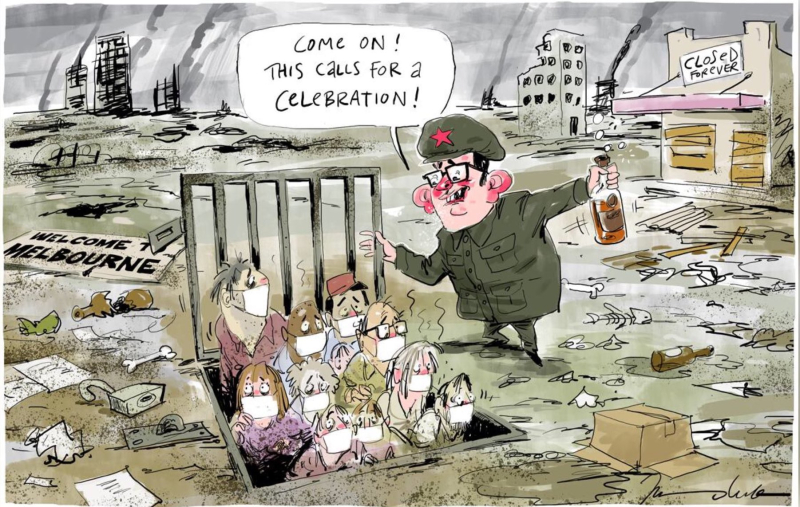
In many places churches are STILL closed down, including here in Victoria. Yes, a handful of folks can gather inside, and a few more outside. But overwhelmingly it seems most folks – and incredibly, most Christians – have no problem with this at all! There is complete silence.
Never mind that plenty of church structures are built to hold hundreds, if not thousands of worshippers. But we are allowed only 10 inside. Really? Yet the shops are packed with shoppers, and so on. In Brisbane the other day 30,000 screaming fans could cram into a sporting arena to watch a football game, yet the churches remain basically off-limits.
The fact that so little protest about this has been heard by the Christian community demonstrates that for too many, they have another king. They are far more willing to slavishly go along with whatever the state says, even if it means allowing churches to be shut down indefinitely.
And this is a perennial problem. Religious folks have long put the state ahead of devotion to Christ. We see that happening all the time in the Gospels and the book of Acts. Consider what I just read again this morning. In Acts 17:1-9 we read about what happened when Paul and Silas were in Thessalonica.
Now when they had passed through Amphipolis and Apollonia, they came to Thessalonica, where there was a synagogue of the Jews. And Paul went in, as was his custom, and on three Sabbath days he reasoned with them from the Scriptures, explaining and proving that it was necessary for the Christ to suffer and to rise from the dead, and saying, “This Jesus, whom I proclaim to you, is the Christ.” And some of them were persuaded and joined Paul and Silas, as did a great many of the devout Greeks and not a few of the leading women. But the Jews were jealous, and taking some wicked men of the rabble, they formed a mob, set the city in an uproar, and attacked the house of Jason, seeking to bring them out to the crowd. And when they could not find them, they dragged Jason and some of the brothers before the city authorities, shouting, “These men who have turned the world upside down have come here also, and Jason has received them, and they are all acting against the decrees of Caesar, saying that there is another king, Jesus.” And the people and the city authorities were disturbed when they heard these things. And when they had taken money as security from Jason and the rest, they let them go.
While I have long emphasised what we find in verse 6 about the early believers ‘turning the world upside down,’ here I want to emphasise what is found in the next verse: “they are all acting against the decrees of Caesar, saying that there is another king, Jesus.”
Yep, because they said that Jesus is Lord, that meant that all other lords and all other gods are in fact false kings, false rulers. That is not to say that there is no place for human rulers and civil government – there is. But no human authority dares to set himself up against the one true God. That is idolatry of the highest order, and never ends well.
These things are not just found in the New Testament. The attempt to challenge God and throw off his rightful place of rule goes way back to the book of Genesis of course. Our first parents, Adam and Eve sought to do it – with disastrous consequences – and folks have been seeking to do it ever since.
In Genesis 11:1-9 for example we read about the Tower of Babel episode. This was another direct challenge to God and his rule. That did not end well either. Whenever people seek to become fully autonomous, rejecting the rightful rule of God, they always end up in big trouble.
Of interest, just hours ago I found a book I had been looking for for a while (that is one problem with having a large library). The book was released the year I was born, and is penned by the German Catholic philosopher Dietrich von Hildebrand (1889-1977). The volume is called The New Tower of Babel (Sophia Institute Press, 1953, 1994). Early on he says this:
The real conflict today is between Christianity on the one hand, and a thoroughly anti-Christian conception of life on the other. This struggle has reached a decisive stage and has become a radical clash between two worlds, embracing all domains of life and human existence. The liberal age was an age of compromise. Notwithstanding its anticlericalism and its contention against Christian doctrine in the religious and philosophical fields, it retained Christian elements in the moral, sociological, juridical, and cultural spheres. Our present age, however, reveals a consistent, anti-Christian conception in every domain of life on the part of the enemies of Christianity.
The mark of the present crisis is man’s attempt to free himself from his condition as a created being, to deny his metaphysical situation, and to disengage himself from all bonds with anything greater than himself. Modern man is attempting to build a new Tower of Babel.
The Message of Acts (Bible Speaks Today)by Array
Exactly so. The situation described in Acts 17 is simply more of the same. Let me offer some commentary on this. In his commentary I. Howard Marshall says this about the charge levelled at the disciples: “This is an apt description of the positive content of the gospel with its claim that Jesus is Lord (cf. 16:31); it indicates how the focus had shifted very naturally from the proclamation of the ‘kingdom’ in the ministry of Jesus to the proclamation of the ‘king’ in the evangelism of the early church.”
John Stott comments this way about the charge:
Since the emperor was sometimes called basileus (‘king’), as well as kaisar (‘emperor’), how could the attribution of basileus to Jesus (7) not be a treasonable offence? The ambiguity of Christian teaching in this area remains. On the one hand, as Christian people, we are called to be conscientious and law-abiding citizens, not revolutionaries. On the other hand, the kingship of Jesus has unavoidable political implications since, as his loyal subjects, we must refuse to give any other ruler or ideology the supreme homage and total obedience which are due to him alone.
I’ll leave N. T. Wright have the final word here:
Another king! Well, they really have got the message. Jesus is Lord and Caesar isn’t; the fundamental ‘decree’ or ‘dogma’ of Caesar is that he and he alone in the emperor….
So was Paul being a loyal Roman citizen, or wasn’t he? It all depends on what sort of a ‘king’ you think he thought Jesus really was. It is easy to quote Jesus’ famous saying, ‘My kingdom is not of this world’, but what John actually wrote was ‘My kingdom is not from this world’ (John 1 8.36), with the clear implication that, though derived of course from elsewhere, Jesus’ kingdom was definitely for this world. And it is easy to show that the charge Luke reports against Jesus, that he was claiming to be a king (Luke 23.2), was, like the other accusations hurled around at the time, at best deeply misleading.
But when we stand back from the present incident and look at the whole sweep of Acts as it unfolds before our eyes, we begin to see a pattern emerging, a pattern which will grow and swell until it leaves us . . . wondering what on earth happened next. In Acts 1—12 Jesus is hailed as Messiah, king of the Jews, until eventually the present king of the Jews tries to do something about it but is struck down for his pagan arrogance. Now, from Acts 13 onwards, Jesus is being hailed as ‘another king,’ ‘lord of the world’; but there already is a ‘lord of the world,’ and anyone who knows anything about tyrants, particularly ancient Roman ones, knows well that they don’t take kindly to rivals on the stage.
And they still don’t today. All the more reason for Christians to get their allegiances and loyalties right. As the state takes ever more powers for itself, the Christian will need to determine who it will ultimately serve. We need to decide now, before things get even worse.
“I will claim you as my own people, and I will be your God. Then you will know that I am the Lord your God who has freed you from your oppression in Egypt.”
Observation
The Lord tells Moses that not only will Pharaoh let the people of Israel leave Egypt, he will expel them.
The Lord is Yahweh, the God of Abraham, Isaac and Jacob. He is the covenant keeping God, and He has heard the cries of His people.
Moses is to tell the people that the Lord is going to redeem them with a powerful arm and acts of judgement. He will bring them into the land He promised to Abraham, Isaac and Jacob.
The Lord tells Moses to go back to Pharaoh and tell him to let the people go. He gives Moses and Aaron directions for the Israelites and for Pharaoh.
Application
The Lord is about claiming people for his own. This is not about slavery or control. It is a voluntary association.
How wonderful it is to know that the God f all creation is the God who claims me as His own. We are His people, the chosen ones.
He frees us from captivity- not the bondage of a national tyranny, but the bondage of sin.
We were made for more than the life most people accept as normal. We were meant for Freedom- the Freedom to love, the Freedom to live abundantly, the Freedom of living without sin.
Jesus died on the cross as the perfect sacrifice that makes this Freedom possible. All we have to do is to receive His forgiveness.
Prayer
Thank you, Lord, for the knowledge that you are my God and that I belong to you, my Creator and Redeemer. Amen.
‘Buffet-Style’ Christianity: 1 In 3 Evangelicals Believe Jesus Is Not God
Kevin SimingtonOctober 26, 2020
A recent study called “The American Worldview Inventory” has revealed that about a third of Americans who claim to be evangelicals do not believe that Jesus Christ is God. The study, conducted by Arizona Christian University, confirmed what has already become obvious over the last decade. Traditional Christian beliefs and values are on the decline – not just in society as a whole, but even with the Christian church itself.
The new ‘progressive’ version of Christianity that is beginning to gain traction is one of open-minded acceptance of many beliefs and practices that contradict the Bible. Progressive Christianity does not accept the Bible as God’s inerrant, authoritative Word. In particular, it tends to regard the accounts of Jesus Christ’s incarnation, miracles and resurrection as myths. This new ‘enlightened’ version of Christianity also embraces the LGBTQI movement and regards the Bible’s prohibitions against homosexuality and pre-marital sex as out-dated.
Of course, this type of liberal Christianity has existed for many years, particularly since the Age of Enlightenment in the 18th century. But it has gained significant momentum in recent decades. Today, gay pride flags adorn church buildings that were once bastions of orthodox beliefs. Christian publishing houses that once exclusively published orthodox evangelical works now promote a wide diversity of ‘progressive’ books that openly dispute the Bible’s authority and call for a re-imagining of what it means to be a Christian.
John Stonestreet, in his article, “Why Progressive Christianity is Another Gospel”, (in The Christian Post, Oct 19) says:
“Today, there is an effort to update Christianity, to adapt and re-form it according to the spirit of the age.”
I recently heard a podcast interview with Alisa Childers, a member of the Christian pop group, “Zoe Girl”. Alisa spoke about her shock when she learned that her church Pastor was a sceptic. At one point, he apparently confronted her with arguments against the Bible’s reliability and authority, as well as admitting that he doesn’t believe that Jesus rose from the dead or that his death on the cross purchased forgiveness for sins. Even more shocking to Alisa, was her Pastor’s admission that he wasn’t even sure that God existed and, if he did exist, his assertion that God certainly isn’t at all concerned with our sexual choices and behaviour.
This is typical of the new open-minded Progressive Christianity – a form of religion which is much more concerned with social justice and personal autonomy than with what is perceived as narrowly-defined, out-dated, restrictive dogma.