Ephesians 2:14

Here is my commentary on Ephesians 2:14. I am publishing these once or twice a week, but you can read all of the available articles at our web-site, http://www.new-life.org.au

Ephesians 2:14

“For he is our peace, who is made us both one, and has broken down the dividing wall of hostility”

Christ is our peace. He is the source of all peace in the world, just as satan is the source of all enmity.

Peace is a major idea in Hebrew thinking, in fact it is a desire in many human hearts. The Hebrew people, and their language, elevated peace to a highly desirable quality- in the same way that Western democracies emphasise freedom as a basic human right.

The Romans had their Pax Romana, a peace obtained across the Empire by military might. It could be said that while Roman citizens enjoyed peace, their subjects often did not.

We may think of peace as an absence of conflict or hostility, but peace is more than that.

the Hebrew word for peace is shalom, which at its heart understands peace as about harmony or fitting together.

To fond true peace, we need to have:

1. Harmony with God. We live in a world scarred by sin and alienated from God. There can be no peace in our lives until we are reconciled to the Father .
2. Harmony with others. We need to be fitting in well with our family, neighbours, village, and nation. Unless a group of people knows peace with God, there can be no peace for individuals within the group. Lawlessness is perhaps the biggest sign of disharmony within a community.
3. Harmony with creation. We need to recognise that we are a part of the created world, and that our our activities either help to improve the creation or they help to destroy the natural harmony within creation which God declared to be good.
4. Harmony within. We are complex beings with body, mind and spirit. Our sins and hurts from the past may tend to pull us in directions that displease God or which setup warring factions within our own being. We cannot function as peaceful people while we are facing internal battles.

Christ is our peace. He restores the situation that hostility and conflict steal away from us. It does this by firstly restoring our harmony with the Father, and then, over time, showing us areas in our lives that need to be healed or repented of. He also gives us the grace to be peace makers where needed.

Others may rely on military might, diplomatic skills, force of personality, or other human qualities, but Christ is our peace.

To know peace, true peace, we must stay close to the source of peace, that is Christ. We need to listen to him, obey him and walk closely to him in order to live in his peace .

Christ has broken down the dividing wall of hostility between Jews and Gentiles , making both one people. He did this on the cross, offering God’s forgiveness to all who receive it, and extending his kingdom to all nations.

The division between Jews and Gentiles is no longer relevant. The wall that had previously separated the two groups is now irrelevant in the light of the revelation of God’s grace.

Jews and Gentiles, at least those in each group who are being saved, are all children of the living God. It is therefore wrong for a Gentile believer to disrespect a Jewish believer. This would be dishonouring the Father of both, and saying that the sacrifice of Christ is not important.

We can apply this to every group that sets itself as superior to other groups. A white christian has a responsibility to love an aboriginal believer and vice versa. The sufferings of each group in conflict is nothing to the suffering of Christ. If he has forgiven, then so must we.

We are the people who walk-in shalom because Christ is our peace. Wherever there is a failure of shalom, it is a failure of us to see Christ in the other.

Key points in this verse

• Christ is our peace
• The peace that Christ brings is not just an absence of fighting. It is all encompassing.
• This peace can overcome deep hostility if only we will let Christ rule.
• We must not allow flights with Christian brothers and sisters to stand .
• As christians we are called to be peace carriers and peace makers .
Reflection on Acts 26:1-32

Scripture

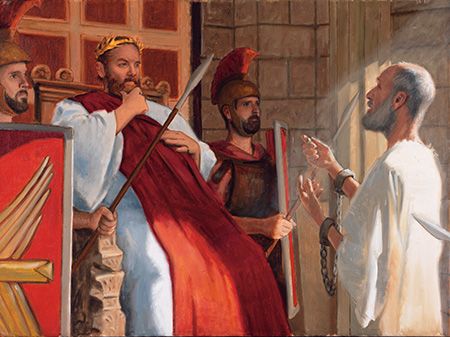
Paul replied, “Whether quickly or not, I pray to God that both you and everyone here in this audience might become the same as I am, except for the chains.”

Observation

Paul now speaks before King Agrippa. He argues that his faith in Christ is totally in accordance with Jewish beliefs. He was raised a Pharisee, zealous for the faith, and persecutor of christians.

Paul tells the story of his encounter with Jesus on the way to Damascus. Jesus commissioned him to testify to the world and to rescue the Gentiles from the power of satan.

Paul asserts that he is being opposed by the Jewish leaders because he has preached the Good News to the Gentiles.

Agrippa asks Paul if he thinks he can be persuaded to be a christian so quickly. Paul responds that he prays that everyone there will come to know Jesus whether quickly or slowly.

Agrippa and Festus agree together that Paul has done nothing illegal, and that if he had not appealed to Caesar they would have released him.

Application

It is a fact that some people turn to Jesus the first time they hear the gospel, but many people take much longer.

It has been estimated that on average it takes a person eleven times of hearing the gospel before they say “Yes” to Jesus.

Whether it is the first time or the hundredth, it doesn’t matter. But we do need to pray regularly and over a prolonged period for people to receive Jesus.

As Paul says in his speech, people everywhere are in the darkness and under the control of satan. This battle can only be won by prayer; by faithful prayer perhaps over years.

Let us join together in praying for friends and family members who do not yet know Jesus.

Prayer

Holy Spirit, enlighten the hearts of the people who do not yet know about Jesus. Open their eyes to the truth. Amen.

A Fish Tank Experiment

For many years, since I was 18 years old, I have kept a saltwater fish tank. I love the colours of reef fish. Over the last couple of decades, the hobby has moved on, and many people keep reef tanks with living corals and other invertebrates. The equipment required for keeping the pristine conditions and lighting necessary for corals is beyond my means so I have stayed with the FOWLR system- fish only with living rock.

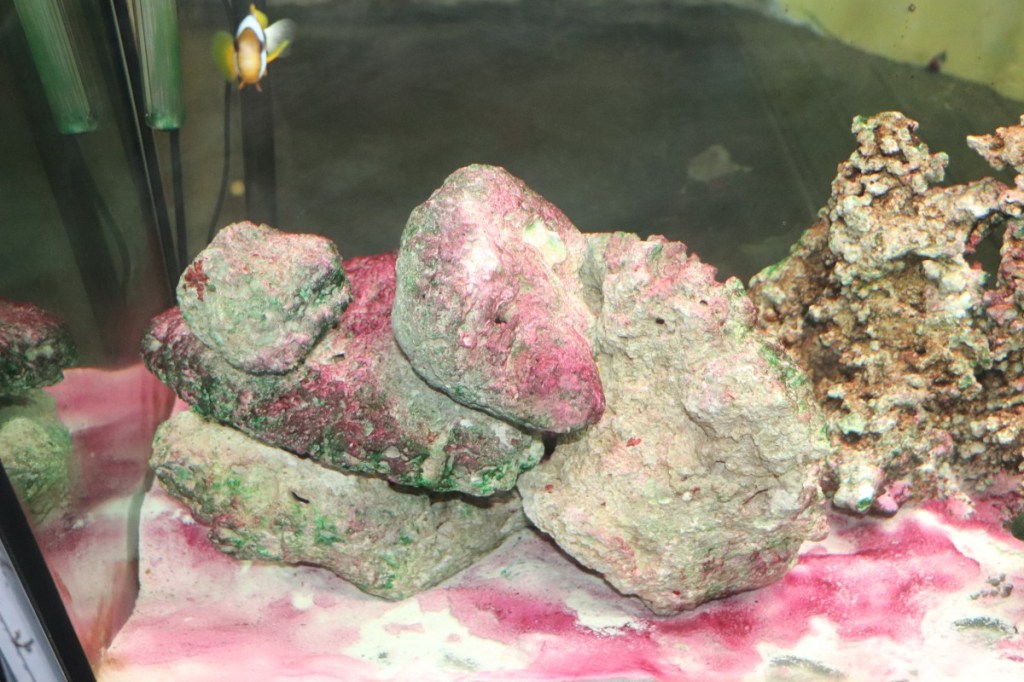
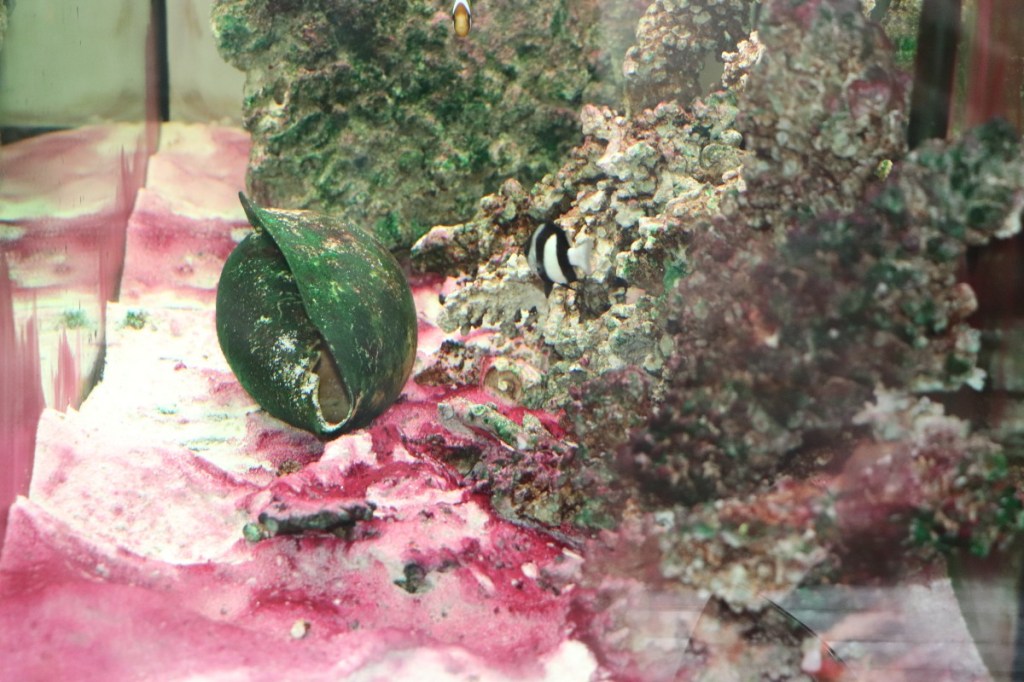
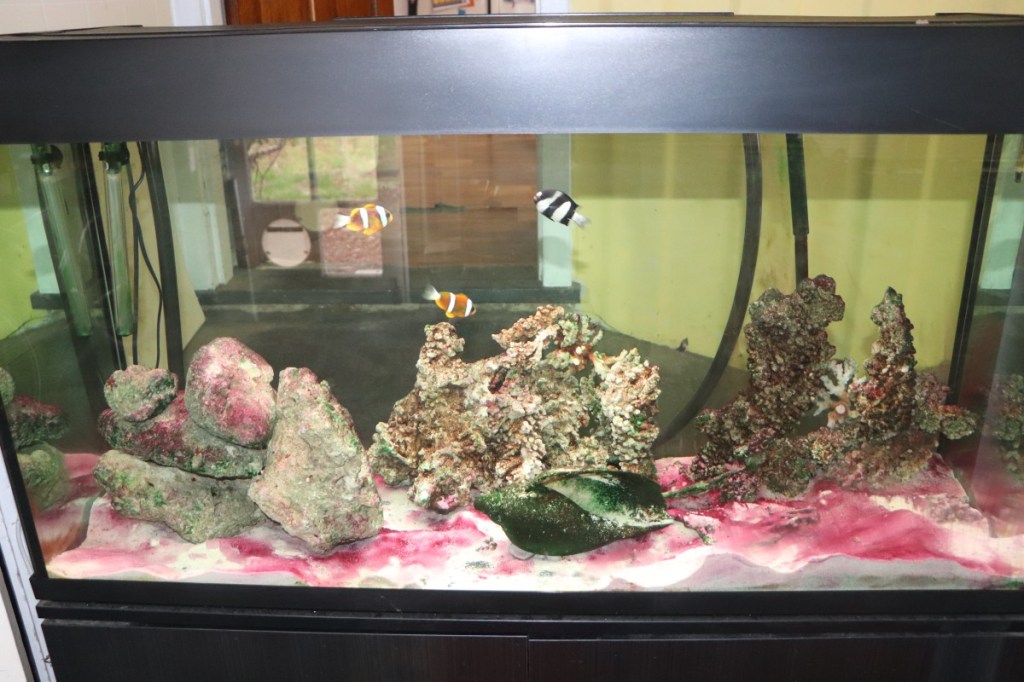
I have never really found algae control a problem, although in the current location we get a fair bit of light coming in from outside. In this picture you can see a lot of green algae on various parts of the aquarium. The reddish material is actually bacteria called cyanobacter.

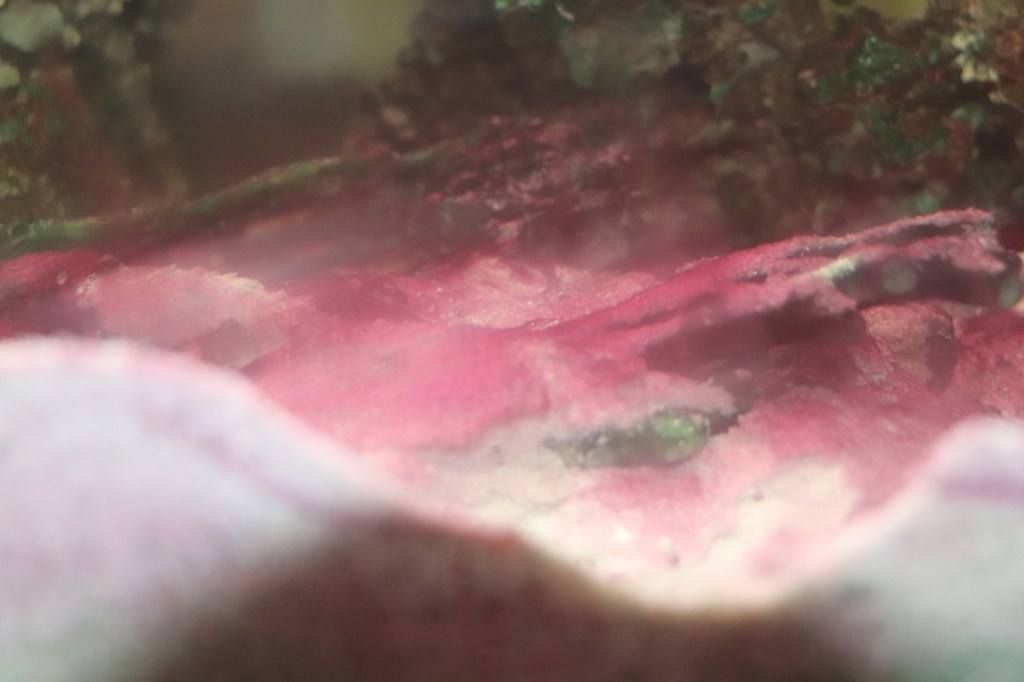
In the image on the right, there is a small black blob- out of focus- just above the low point in the sand. It is a very sticky algae which adheres to the glass and literally has to be scrubbed off.

My procedure until now is every week I do a 9 litre water change, clean the inside of the glass and remove about a third of the ornaments for cleaning with a hose connected to my rain water tank. During the water change I try to siphon off as much cyanobacter from the sand as I can.

It’s all good. In less than an hour a week I keep the water quality good and the tank fairly clean.

Last week i read about this product:

I ordered some after seeing a video test on Youtube which looked quite impressive. They took some very badly algae encrusted test tanks and dosed them with Vibrant twice a week. Over about 6 weeks the algae of several different species just about disappeared from all tanks.

I am going to dose my tank once a week and see how the tank responds. I will not be cleaning the sand or rocks, but just doing the regular water changes.

Vibrant is a culture of various bacteria that has been developed for use in marine tanks. There is a version that is for fresh water tanks.

What I like abut it is there are no poisonous chemicals involved, so it should be safe for the fish.

We will see how it goes over the next few weeks,

Doing My Head In.

Vibrant is an additive for aquariums. A bacterial culture, it helps to eliminate algae from tanks. I’ve seen Youtube videos showing the vast improvement in various aquariums over a number of weeks.

I am looking forward to using it and recording my experience in photos over the next few weeks.

The instructions are straight forward: use 1 ml per 10 gallons each week.

What?

You can’t mix unit systems like that! Every High School maths and science teacher knows (and constantly hammers it into the heads of their students) you have to use consistent units- always.

To make matters worse the bottle is labelled as containing 16 oz- which is a weight measurement. It should be fluid ounces or fl. oz.

I’m not even sure whether we are talking imperial or US gallons here. An imperial gallon (the real British unit) is 4.5 l while the poor cousin midget US gallon is just 3.9 l. Since the product is manufactured in the US it’s probably safe to assume it is US gallons.

The US and UK systems start at a good point. A fluid ounce is the volume of 1 ounce of water- an ounce is, of course, 1/16th of a pound.

So yes a US fl oz and a UK fl oz are the same. Yay for consistency!

But it crumbles rapidly from there. A pint in the UK is 20 fl oz while in the US a pint is just 16 fl oz. Congratulations to the US for a bit of internal consistency- a US pint of water then weighs 16 ounces or 1 pound. A UK pint is 20 ounces or in the words of the rhyme I learnt as a child- A pint of pure water weighs a pound and a quarter.

From there, in both systems a gallon is 8 respective pints.

What we call a 44 gallon drum in Australia is a 55 gallon drum in the US or 200 l everywhere. Of course, the standard drum can hold 218 l, so your actual volume of product may vary a little from what we call standard.

Back to the aquarium.

For many years I used to have a standard 4 foot tank (about 120 cm long), or as my wife says “120 by 14 inches.” I used to calculate a volume of 140 litres of water for the purposes of medicating the fish. You have to allow for the volume taken up by rocks, gravel etc.

My current fish tank is 118 cm long by 59 cm high by 43 cm deep. So a quick calculator gives me 299 l or 79 US gallons. That suggests it is meant to be an 80 gallon tank.

So my dosage will be 1 ml per 10 gallons or 8 ml.

That was simple.

Kenneth Gentry: Postmillennialism and The Great Tribulation

A great and thoughtful article by Kenneth Gentry places the Great Tribulation at around 70 AD. I’m glad we missed it!

This is my second in a multi-part series explaining how we can believe in postmillennialism, even though Jesus teaches about “the great tribulation” that is to come. In this series of articles we will learn a remarkable fact: The great tribulation is past. Indeed, it occurred long ago in the first century and was concerned with the destruction of the temple in AD 70.

Obviously, if this is so, then the great tribulation punctuated the beginning of Christianity (as the new covenant-phase of God’s kingdom) and has no direct bearing on the end of the Church Age (supposedly lying in our near future). Thus, it does not contradict postmillennialism’s historical optimism. Let us consider the evidence.

Most evangelicals focus on the remarkable judgments in the Matthew 24. And they do so to such an extent that they overlook important contextual clues that go against the popular conception of the great tribulation. And they do this despite the fact that these clues are quite clear and compelling.

These clues revolve around Matthew 24:34 which involves the key observation for a proper understanding of the great tribulation. This is the text we must focus upon; it will be our guiding star shedding light on our pathway through this dark and frightening passage.

Read the full article here

Jodie Hughes: It’s Time To Dream Again

“It’s Time to Dream Again”Jodie Hughes, Graham, Texas

“This is what God says…’Forget about what’s happened; don’t keep going over old history. Be alert, be present. I’m about to do something brand-new. It’s bursting out! Don’t you see it? There it is! I’m making a road through the desert, rivers in the badlands.'” (Isaiah 43:16,18-19, The Message)

Dreaming helps us formulate new strategies and allows for maximum capacity of creativity as we pursue new “frontiers.” We will pioneer and take new territory in the spirit in this new era and in the natural. It’s time to dream with abandon once more and stir hope for what is yet possible, and build what hasn’t yet existed. Dreaming doesn’t just activate hope and provoke creative juices, it stirs faith to go where we’ve never been before.

It doesn’t take a prophet to know that the world is in a season of rapid change. As things shift and change, God is compelling His people to prophesy and decree what He is saying. He wants us to partner with Him to establish on the earth the dreams and plans of Heaven, as we, the Body of Christ on Earth, are called to pioneer change and extend into new territory. We are being invited to walk in something fresh, something brand-new—and it’s time to dream again!

Read the full article here

Ephesians 2:13

Here is my commentary on Ephesians 2:13. I am publishing these once or twice a week, but you can read all of the available articles at our web-site, http://www.new-life.org.au

Ephesians 2:13

“But now in Christ Jesus, you who once were far off have been brought near in the blood of Christ.”

We were once far off, alienated and strangers to the covenant of promise. We had no hope.

We Gentiles were out of the family because of our birth. This is in contrast to every Israelite who was in the covenant because of their birth.

But now in Christ Jesus, we who were once “far off” have been brought “near.” We were distant, out of reach, but now we are near to the family of God.

This could be interpreted as all christians, the saints to whom Paul is writing, are now near to Christ and His people. In fact so near that we are as close to God as any Jewish person ever was.

Alternatively it could mean that every Gentile, every person who is not Jewish, is brought close to the covenant promise. Not that they are “in” the promise already, but that the gulf that separated them from God has been closed up. In some ways it is just a line that needs to be stepped over to receive Christ and His forgiveness.

All this is God’s work. It is the gift which He has offered to us. The Jewish people, the people of the covenant, had allowed their favoured position to become a cause of pride and self-righteousness. As Gentiles “brought near”, we must never allow our status as saints to become a source of pride. God did it all.

We have been brought near in the blood of Christ. He has paid the price for our sins with His blood.

There is no other way to enter into God’s family. We must all be cleaned by the blood of the Lamb.

For some people, this is a stumbling block. They are offended by the cross, by the thought that God should suffer on their behalf.

That is just pride. They want to think that they can save themselves, or even that they are not sinners who need saving. All have sinned and fallen short of God’s glory. Therefore, to be saved we all need to come through the blood, through the cross. There is no other way.

This is a continuous process. We don’t get ”washed in the blood” just once, but many times. We come to God “in” the blood of Christ, not through the blood of Christ.

This means that repentance becomes a way of life. We don’t just say the sinner’s prayer and get saved. We need to be constantly on guard against sinning. When we fall, we need to repent (again and again), turning away from those sins that so easily entangle us.

This repentance and regular confession of sins keeps us “ in the blood”, in the place of humility before God.

However, we need to also ensure that this is not an obsessive preoccupation with our guilt.. That is a religious bondage, not the freedom of Christ.

As the Holy Spirit brings conviction of sin, we ask Jesus to forgive us. We bring ourselves back in the blood and receive ongoing forgiveness and cleansing.

Key points in this verse


Salvation is always a gift not a reward

We were once far off but now we are near

The blood of Christ cleanses us from all sin

Reflection on Acts 24:1-27

Scripture

As he reasoned with them about righteousness and self-control and the coming day of judgement, Felix became quite frightened. “Go away now,” he replied. “When it is more convenient I will call for you again.”

Observation

Ananias arrives in Caesarea with some elders and a lawyer to prosecute the case against Paul.

The lawyer Tertullus alleges that Paul is a trouble maker who stirs up riots among the Jews, and that he tried to desecrate the Temple.

In his defence, Paul says that he was at the Temple to worship not to desecrate it. The only time he caused any trouble was when he shouted in the council that he was on trial because he believed in the resurrection of the dead.

Felix orders Paul held in the prison in order to gain favour with the Jews. Every so often he summons Paul and talk with him, hoping to gain a bribe. This goes on for two years.

Application

Felix was a politician and was motivated by ambition. He changed his actions to suit what was more politically expedient at the time.

He had very mixed motives:

  • he wanted to placate the Jews so he held Paul in prison
  • he wanted to hear Paul but was too frightened to listen
  • he was hoping for a bribe from Paul in order to release him

When people act out of self-centredness, they are not in a position to respond to the gospel. We can pray and talk all that we are able, but they have to be in a place where they are willing to either take on the truth with all its implications or to worship God regardless of the cost.

Repentance and faith are gifts from God.

Prayer

Thank you Lord for saving me. I pray that my friends and family who do not yet know you will receive your gift of salvation. Amen.