
The sermon for August 7th 2016 is now available on the New Life web site.
In this sermon, which is based on Psalm 119:1-24, I talk about the importance of reading Scripture.
Britain and Australia are following very similar trajectories. Only thoroughgoing revivals such as those which established them as christian countries in the first place can save us.
From thedokimos.org
Is Britain really ceasing to be a Christian country?
The decline in religious belief has become precipitous in recent years
A landmark in national life has just been passed. For the first time in recorded history, those declaring themselves to have no religion have exceeded the number of Christians in Britain. Some 44 per cent of us regard ourselves as Christian, 8 per cent follow another religion and 48 per cent follow none. The decline of Christianity is perhaps the biggest single change in Britain over the past century. For some time, it has been a stretch to describe Britain as a Christian country. We can more accurately be described now as a secular nation with fading Christian institutions.
There is nothing new in the decline of the church, but until recently it had been a slow decline. For many decades it was possible to argue that while Christians were eschewing organised religion, they at least still regarded themselves as having some sort of spiritual life which related to the teachings of Jesus. Children were asked for their Christian name; conversations ended with ‘God bless’. Such phrases are now slipping out of our vocabulary — to wear a cross as jewellery is seen as making a semi-political statement. Christians are finding out what it’s like to live as a minority.
Just 15 years ago, almost three quarters of Britons still regarded themselves as Christians. If this silent majority of private, non-churchgoing believers really did exist, it has undergone a precipitous decline. Five years ago, the number of people professing no religion was only 25 per cent.
Remarkably, the overall decline of religion in Britain has coincided with the arrival of three million migrants who tend to have more religious belief than British Christians. In particular, the visual impact of Islam, most obviously expressed in the proposal for a 9,000-capacity ‘super-mosque’ in east London that was rejected by planners last year, might give the impression that migration has brought a religious revival to Britain. Yet neither the growth of British Islam nor the huge influx of Christian immigrants from Africa and Eastern Europe has spurred a revival in public Christianity.
It is possible that the rise of Islamism has made casual believers less inclined to ally themselves with any kind of organised faith. Say ‘religious’ to many Britons and the next word that pops into their heads is ‘extremist’, or perhaps ‘bigot’ or ‘homophobe’. To the growing population of secularists, religion has become something to be treated with suspicion. Politicians who are religious find their faith used against them. Iain Duncan Smith’s Department of Work and Pensions was known by his critics as the Department of Worship and Prayer, the joke being that his reforms were inspired by a desire to save lives rather than money. In government, to be a Christian can be seen as a personal failing. The ambitious minister keeps his or her faith under wraps. It is unthinkable now that a Prime Minister would do as Mrs Thatcher did on arrival in Downing Street 37 years ago, and quote St Francis of Assisi. All Cameron has dared to say, quoting Boris Johnson, is that his faith comes and goes like the reception of Magic FM in the Chilterns.
The eclipsing of our national religion has deep implications for those who do retain faith, especially those who wish to pass it on to their children. They must now face the reality that they, no less than Muslims, Jews and Hindus, face being treated as oddballs.
As for the church itself, it is no use pretending there is a Christian majority whose non-attendance at church is just down to laziness. If church leaders wish to keep their buildings open, they will have to start from the beginning — with missionary work to recruit parishioners in a now-sceptical country.
Inevitably, the question of what is to be done about our national Christian institutions will arise. Is it appropriate that we are still invited to swear on the Bible in court? (Many new MPs routinely refuse to do this in the Commons.) Is it right that the Lords Spiritual should still have a role in the Upper House, or that church and state should have any formal connection at all? The British regard for tradition will see that such roles are preserved, but for nostalgic reasons. The aesthetics of Christianity — the architecture, the choral singing and so on — still pull in crowds, even if little of the liturgy is inwardly digested.
Christians, for their part, should not automatically associate a decline in religiosity with a rise in immorality. On the contrary, Britons are midway through an extraordinary period of social repair: a decline in teenage pregnancies, divorce and drug abuse, and a rise in civic-mindedness.
We cannot discount the possibility of a Christian revival; the Christian faith specialises in defying the odds. But it seems more likely that Britain will continue to muddle along as a post-Christian country with quaint customs that derive from its history as a deeply religious country. Some will find this sad, others as a sign of progress, but the greater majority will view it with indifference.
I don’t like football – the AFL type. Don’t follow it. Don’t watch it. Don’t bet on it. Don’t talk about it on Monday morning in the office (which would basically be a one way conversation).Fit men in tight shorts? If I want to see that I can go to the gym. Which I don’t want to see, I might add.
Couldn’t tell you who is second on the ladder (I know Hawthorn is top, they’re always top). And the last Saturday of September – aka Grand Final Day – is a fantastic stress-free day to go clothes shopping. Could hardly name a player other than the obvious ones such as Nick Fyfe and Nat Nickanui .
I worked briefly as a radio journalist in my youth and part of my job was covering the AFL. There’s nothing quite as intimidating as being a 60kg Gothic 22 year old standing holding a microphone in a post-match change room interviewing a muscle-bound Gary Ablett Snr and behemoth six foot eleven ruck man Simon Madden, completely in the buff (they were in the buff not I). I hardly knew where to look. I knew where not to look.

Phwoar!
So it would be weird if I didn’t follow football, didn’t care for it, but when asked in a survey what my perspective on football was, was to answer “I have football values.”
Read the full article here

Passage: https://www.biblegateway.com/passage/?search=Luke+12:32-40
Scripture
“Don’t be afraid, little flock, for it gives your Father great happiness to give you the Kingdom.”
Observation
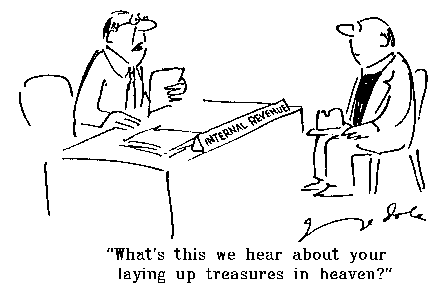
The Father delights to give us the Kingdom. We need to sell our possessions and give them to those in need in order to store up treasures in heaven.
Like servants awaiting the return of their master from a wedding, we need to be ready the moment Christ returns. He will reward those who are ready by Himself serving them.
If a home owner knew when the burglar was coming he would not let the robber in. We must also be prepared for the Son of Man.
Application
The work of the Kingdom of God must always be our first priority. If possessions are a distraction we must get rid of them in order to invest in God’s kingdom.
Jesus could turn up at any time for a surprise inspection! What will He find when He checks on my life?
This is not supposed to fill us with dread. If Jesus checks in with me today and finds I am serving His purposes then He will reward me- perhaps serving my needs.
This is a mystery of the Kingdom. We work hard to serve the Lord, but along the way we find such fellowship with Him that He is blessing us. The task we thought we had to do becomes joy.
Prayer
Lord you always turn my expectations over. Help me to seek your purposes and to serve your Kingdom. Amen.
This is a nice way to reset your brain in 3 minutes. Must get on my bike!

I don’t often blog on party political issues these days. It could be boredom or disillusionment with the political process or the gradually growing realisation that we can’t fix the nation until we fix the people.
The re-elected left-wing “Labor-lite” Liberal Government is now starting to show the disastrous path we will be walking for the next three years. Forget about Budget repair and even moderately conservative values, it’s all soft pedalled Labor/Greens socialism until at least the next three years.
This morning Greg Hunt was on AM on ABC Radio proudly announcing that they are reversing the CSIRO cuts to climate “science” research and establishing a new climate centre in Hobart. Best of all they are spending more tax payers’ dollars on this folly.
The head of the CSIRO, Dr Larry Marshall, is looking a bit lame right now, and he should be sending his resume out looking for a job where he can make a difference. Last year he announced that since the “science is settled” we don’t need those costly scientists investigating why the climate apocalypse is not happening yet. That caused much gnashing of teeth in the climate industry, but rejoicing in the scientific circles which could now look forward to extending their own projects.
So it looks like more of the rubbish of the Rudd/Gillard/Rudd years rearing its ugly head again.
I think we can expect that the plebiscite for same sex “marriage” will have to go now to pay for the increased funding for climate “science.” The “Safe Schools” anti-hetersoexuality program will become mandatory at all schools.
And forget about the Federal Budget ever coming into balance again.
Passage: https://www.biblegateway.com/passage/?search=Hebrews+11.1-16
Scripture
It is impossible to please God without faith. Anyone who wants to come to him must believe that God exists and that he rewards those who sincerely seek him.
Observation
Faith is the confidence that what we hope for will happen. By faith we believe that God created the universe with a command.
The Old Testament heroes were saved by their faith- Abel, Enoch, Noah and Abraham.
Abel presented a better sacrifice than Cain.
Enoch please God and was taken up to heaven.
Noah built an ark and was saved from the judgement.
Abraham looked to a city with eternal foundations
These people did not necessarily see what God had promised, but they believed. They were looking for a heavenly homeland.
Application
Faith is not about believing impossibly and contradictory things. Faith is about trusting God in difficult situations.
Faith means looking to an eternal home not an earthly home, to a city of God rather than one of human construction.
Faith causes us to lift our visions above the tumult of the nations to see God at work in our daily life.
Prayer
Lord Jesus I choose to walk by faith and not by what I see and to trust you in every part of my life. Amen.

But there is a great difference between Adam’s sin and God’s gracious gift. For the sin of this one man, Adam, brought death to many. But even greater is God’s wonderful grace and his gift of forgiveness to many through this other man, Jesus Christ. And the result of God’s gracious gift is very different from the result of that one man’s sin. For Adam’s sin led to condemnation, but God’s free gift leads to our being made right with God, even though we are guilty of many sins. For the sin of this one man, Adam, caused death to rule over many. But even greater is God’s wonderful grace and his gift of righteousness, for all who receive it will live in triumph over sin and death through this one man, Jesus Christ.
Yes, Adam’s one sin brings condemnation for everyone, but Christ’s one act of righteousness brings a right relationship with God and new life for everyone. Because one person disobeyed God, many became sinners. But because one other person obeyed God, many will be made righteous. God’s law was given so that all people could see how sinful they were. But as people sinned more and more, God’s wonderful grace became more abundant. So just as sin ruled over all people and brought them to death, now God’s wonderful grace rules instead, giving us right standing with God and resulting in eternal life through Jesus Christ our Lord.
• Romans 5:15-21, New Living Translation
• • •
In a recent sermon by Pastor Robert Jeffress of First Baptist in Dallas, he said the following:
Listen to me. When you die, you don’t cease to exist. Your spirit is going to live forever. Everybody’s spirit lives forever. It doesn’t matter what you believe. Jew, atheist, Muslim, Catholic, Baptist. Everybody’s going to live forever.
Some are going to live forever in heaven, with God. Others, the majority of people, will be in hell, separated from God. But we live on, after our bodies fall asleep. That’s what the Bible says.
This post is not a knock on Pastor Jeffress in particular. What he said represents mainstream Christian evangelical and fundamentalist teaching. But when I read those words, I gasped, and the thought came immediately to my mind: “If this is true, then the gospel of Jesus is not good news.”
Here’s the line over which I stumbled: “Some are going to live forever in heaven, with God. Others, the majority of people, will be in hell, separated from God.”
The majority of people.
Let that sink in for a moment.
Can it really be that most people who’ve ever lived will be condemned to hell? That is staggering.
What makes it even more astounding to me is that the preacher said it as a passing phrase on the way to making his main points. As though this is just understood, axiomatic, the clear expectation of anyone who reads the plain teaching of the Bible. A few of us happy with God in heaven, the vast majority in hell.
And what will that place be like? Jeffress describes hell in another message as “a place of eternal physical torment, of excruciating physical torment.” He puts it this way: “Ladies and gentlemen, the awful truth about hell is this: when you have spent ten billion, trillion years in that excruciating pain, you will not have lessened by one second the time you have left to spend there.” He believes the flames of the fires of hell are literal, but warns us that if the Bible is using figurative language it must actually be even more terrible, because the only comparison Jesus could make to it was of human beings being burned in fire forever and ever.
If that’s what you believe hell is, how can you make a passing remark in a sermon saying that the majority of people in this world are going to go there? Wouldn’t that stick in your throat, make you choke up, utterly devastate you and keep you from saying anything else?
How can that thought not drop you dead in your tracks? How can such an image not force you to question everything you think you know about God? How can the prospect not send you running back to the Bible to scour its pages until you’ve ripped them and torn them to shreds in a desperate effort to find some other way of understanding your “gospel”?
That is not good news, and it stupefies me to think it would be to anyone else.
I also don’t think it matches the vision of “superabounding” grace Paul sets forth in Romans 5 (see above). I can’t tell you how it all works out, but the apostle’s unambiguous point is this: whatever sin has wrought, grace accomplishes much more. Whatever terrible consequences Adam brought upon us are overwhelmed by the results of Jesus’ gracious actions.
“Even greater is God’s wonderful grace and his gift of forgiveness,” Paul exclaims. Or, as the older versions put it, “much more.” That’s what God’s grace in Jesus does — much more.
The scriptures envision that this triumph of grace will culminate in a new creation, populated by vast multitudes no person can count (Rev. 7:9). This has been the anticipation of the faithful ever since God promised Abraham descendants as numerous as the stars in the sky and the grains of sand upon the seashore.
It greatly diminishes the grace of God and the great victory of our Lord Jesus Christ to argue the opposite: that only a remnant will be with God while the majority of humans are lost to him. How can anyone call this victory? How can that offer any hope worth having? It is not good news.
Even John Calvin, infamous for his strict doctrine of predestination, sees Paul’s logic here, saying that the grace of Christ “belongs to a greater number than the condemnation contracted by the first man, for if the fall of Adam had the effect of producing the ruin of many, the grace of God is much more efficacious in benefiting many, since it is granted that Christ is much more powerful to save than Adam was to destroy.”
A later Reformed scholar, C.H. Hodge agreed: “the number of the saved shall doubtless greatly exceed the number of the lost,” he wrote. Hodge suggested we might grasp the proportion by comparing the general population with the much smaller number who are imprisoned.
I suggest, along with Hans Urs von Balthasar
Ultimately, I think the problem with the standard evangelical/fundamentalist view represented by Jeffress and others is the soterian nature of the gospel they proclaim. As we have argued often, it is a revivalistic gospel for individuals, grounded most deeply in modern notions of individual choice and autonomy rather than in the gracious Kingdom vision of the Bible, which tells of the God who brings all creation under the authority of King Jesus (Eph. 1:10).
Too often we think of hope in too individualistic a manner as merely our personal salvation. But hope essentially bears on the great actions of God concerning the whole of creation. It bears on the destiny of all mankind. It is the salvation of the world that we await. In reality hope bears on the salvation of all men—and it is only in the measure that I am immersed in them that it bears on me.
• Cardinal Jean Daniélou
quoted in Dare We Hope That All Men Be Saved

God is not hungry
That you can feed Him
He is not poor
That you can bribe Him
He is not blind
That you can trick Him
Draw near to God
Give Him your heart
Let His love
Strip sin away
Let His grace
Enfold you, rebirth you.


