Reflection on 1 John 3:1-7

Scripture

Dear friends, we are already God’s children, but he has not yet shown us what we will be like when Christ appears. But we do know that we will be like him, for we will see him as he really is.

Observation
Our Father loves us and calls us His children. We are already God’s children, but we do not yet know what we will be like when Christ returns.

Christ is pure, and so we should keep ourselves pure. To sin is to break God’s Law. Jesus came to take away our sins, and if we live in Him we will not sin.

Application
Following Jesus means that we learn to live from a place of love.

God’s love is not a sentimental thing that overlooks our sin. God’s love is pure and as we look to Him we find our lives reflecting that.

People who love Jesus do not habitually sin. We allow the Holy Spirit to speak to our conscience and we receive His grace to put our sins to death.

Prayer
Jesus you are pure. Thank you that you are transforming me to be more like you. Amen.

Reflection on Acts 3:12-19

Scripture

“Repent of your sins and turn to God so that your sins may be wiped away.”

Observation
Peter and John have healed a lame man near the temple gate. The people are in uproar as they recognise the man leaping and praising God.

Peter seizes the opportunity to address the crowd. He asks them why they are so astonished at God healing a man.

This is not done by the power of a man but by Jesus, the one the crowds had rejected, was crucified and is now alive.

Faith in the name of Jesus healed the man. Now they must put their faith in Jesus and repent in order to have their sins wiped away.

Application
Peter and John healed the man by the Name of Jesus. The Name that brings healing of the body also brings forgiveness of sins.

It is all about Jesus. My life must glorify the Name of Jesus.

Forgiveness of sins is in Jesus

Healing is in Jesus.

Grace is in Jesus.

Prayer
Lord Jesus, help me to keep my eyes on you, allowing you to be glorified in me. Amen.

The New Established Religion: You Must Bow

From Life Site News:

There’s a new established religion nowadays: Christians can’t bow to it

Just this month, we watched a family-owned pizzeria close its doors after its owners received hate mail and death threats from around the country. Their offense? Giving the wrong answer to a question about whether they’d cater a gay wedding. Keep in mind that the restaurant had never actually turned down a gay customer. They were hammered for holding the wrong beliefs about a hypothetical scenario!

Major corporations are getting into the bullying act, as well. At least two state governments have now backed down or modified religious freedom legislation in response to pressure from companies like Walmart and Salesforce. Keep that in mind next time you think about shopping at Walmart.

And this culture-wide search-and-destroy mission is only accelerating. As Princeton’s Robby George writes in First Things, activists for the new sexual orthodoxy are “giddy with success and urged on by a compliant and even gleeful media.”

The message is clear: not only should Christians remain silent about gay marriage if we know what’s good for us, but we must be made to agree with and even celebrate what Scripture calls sin. As Ana Marie Cox recently said of Christians on MSNBC, “you’re going to have to force [them] to do things they don’t want to do.”

But gay columnist Frank Bruni recently took it to the next level in the New York Times, writing that it’s time Christians get with the program and “take homosexuality off the sin list.” The lived experience of same-sex couples ought to trump what he calls the “scattered passages of ancient texts” condemning his lifestyle. Wow.

As for freedom of religion, Bruni suggests a new definition: “freeing . .  . religious people from prejudices that they . . . can indeed jettison, much as they’ve jettisoned other aspects of their faith’s history, rightly bowing to the enlightenments of modernity.”

Yes, he actually wrote “rightly bowing.”

I’m reminded of a scene from C. S. Lewis’ “The Last Battle,” in which Shift the Ape explains to the poor creatures of Narnia why they’re being shipped off to the Calormene salt mines.

“You think freedom means doing what you like,” says Shift. “Well, you’re wrong. That isn’t true freedom. True freedom means doing what I tell you.”

Writing at National Review, Yuval Levin says what we’re witnessing isn’t so much the suppression of free exercise of religion as it is the establishment of a new national religion; the religion of secular liberalism. And dissenters must be forced to worship at its altar and affirm its creed of anything-goes sexuality.

Given the likely outcome of this summer’s Supreme Court case on same-sex marriage, Rod Dreher asks what will it be like to be a Christian in our brave, new society—and what will become of orthodox Christianity now that the price of professing it could be our credibility and livelihoods.

The answer, Dreher says, will depend a great deal on us. Will we hold fast to biblical teaching and refuse, in a manner of speaking, to burn incense to Caesar?

Friends, the fight for religious liberty is far from over. And as John Stonestreet and I have been saying again and again, it’s time for the Church to wake up, to pray, and to publicly defend our religious rights and our brothers and sisters under assault for their beliefs.

Where was Adam?

Like Adam in the picture above, I sometimes scratch my head at what people come out with in church and in Bible Studies. Often what they say is actually the gospel according to some celebrity preacher who obviously must know more than I do because I’m just a country hack preacher without a TV show.

So last night we were watching a part of a DVD asking about death and sin, and there was a re-enactment of the temptation of Adam and Eve. In the dramatised version, it showed Adam nearby watching the interaction between the woman and the serpent (which actually had a human rather than a snake-like form).

At the end of the presentation discussion was dominated by an assertion that Adam wasn’t there when Eve was tempted and he came along later, and then she gave him the fruit and then he ate it. This theory is based on Paul’s assertion in 1 Timothy 2:14 that it was not Adam who was deceived but the woman. So clearly Adam wasn’t in on the temptation part and must have come later.

In three years of theological college and 30 years of pastoring, I hadn’t heard that one before. I can’t even see how you derive a doctrine on such a thin bit of text. The whole section of 1 Timothy 2:11-15 is difficult because of its use of language, including a word translated as “to have authority over” which is used only once in the whole of the New Testament and probably means more along the lines of to domineer or to intimidate rather than to merely teach or lead.

So I did some research and found that this view that Adam wasn’t there for the temptation is not uncommon. For example it gets a run at Answers in Genesis. It seems to have been formulated by Reformer John Calvin, and its popularity in some evangelical circles goes back to him, and is often used as a reason to keep women in an inferior position in the church.

If you look at the story in Genesis 3:1-6 you notice that it is closely written and that it does seem to happen quickly. We don’t know how long the conversation went on with the serpent. We know in our own experience that temptation can happen in a flash or it might take years to ferment before an action occurs. You could speculate that the serpent was on Eve’s case day after day- we just don’t know the time scale. We do know that even in a perfect environment, sin is always a possibility.

So on the day of the sin, the temptation comes again (or maybe for the first time). This time Eve looks at the forbidden fruit and her desire for it is awakened. In Hebrew, verse 6 is written with a narrative form called the “vav (or waw) consecutive.” This means each phrase is introduced by the letter “vav” which means “and”. It could be written as “she took some and ate and gave it to her husband who was with her and he ate it.”

We are meant to see this as one rapidly occurring action with each step following swiftly from the one before. There is no time delay.

The text even says “her husband who was with her”. The Hebrew word iym which means “with” suggests not just near proximity but common purpose (as in the name for Jesus Immanuel- God is with us).

There is no gap implied in the text. Adam was there right on the spot when she was looking at the fruit. He knew what she was thinking, and not only did he fail to stop her from sinning, he joined right in.

Paul says that Eve was deceived but Adam was not. But Paul says in Romans 5 that sin entered the world through Adam, not Eve. To me that says that Eve had an excuse, but for Adam it was just plain rebellion.

The most important rule of Scripture interpretation is this: The plain meaning of Scripture is usually the one that is right. You make allowances for context and literary types, but Scripture should be, and usually is, easy to understand.

The second rule is this: Allow the Scriptures as a whole to help interpret a specific text. Sometimes you will find a New Testament reference to an Old Testament passage and that will give some added insight into the meaning of both.

Finally, try to allow God’s holy word to speak for itself. Ask Holy Spirit to give you understanding and try to keep your preconceived notions to one side. That way we allow God to speak to us rather than us telling God what He should believe.

Today’s Sermon

empty_tomb11The sermon for April 12th 2015 is now available on the New Life web-site.

In this sermon, which is based on Luke 24, Margaret shares how Jesus is still encountering people, and then invites some people to give testimonies of this.

Click here to listen or here to download

Reflection on John 20:19-31

John20

Scripture

Then Jesus told him, “You believe because you have seen me. Blessed are those who believe without seeing me.”

Observation
On Resurrection Sunday the disciples are meeting behind locked doors. Suddenly Jesus is there in the room!

Jesus commissions them to go in His name and then breathes the Holy Spirit on them. He gives them authority to forgive sins.

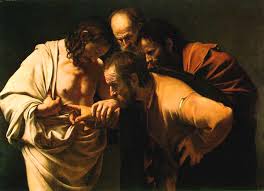
Thomas is not with them at this time, and he is sceptical about their report. He says that he won’t believe it unless he sees and touches Jesus’ wounds.

The next Sunday they are together and again Jesus appears. This time Thomas is with them. Jesus invites him to touch the wounds. Thomas believes.

Application
It is exciting when Jesus shows up! How much more for these disciples who did not yet know the full story.

Jesus is alive still, ascended into heaven where He reigns with the Father.

He has given us Holy Spirit to empower us to be His witnesses. He has given us His authority to embody the life of grace.

All power and all authority. There is nothing that can stand in the way of us serving and representing the risen Lord.

Prayer

Hallelujah! Jesus you are the risen Lord! Help me to serve you in all that I do. Amen.

Reflection on 1 John 1:1-2:2

1John

Scripture

If we claim to have no sin we are only fooling ourselves and not living in the truth.

Observation

John proclaims the Christ, the pre-existent one. He saw Him and touched Him. He is the life and the truth.

God is light and there is no darkness in Him. If someone claims to have fellowship with God but lives in the darkness, he is not walking in the truth.

If a person claims to have no sin, they are deceiving themselves. But if we confess our sins to God, He will forgive us and cleanse us from all wickedness.

Application

Jesus is the light. He leads us in the way of truth and to the Father.

We must have an honest assessment of ourselves. To say we are without sin is to deceive ourselves.

Everybody sins.

But to those who confess their sins honestly before God, there is forgiveness and grace.

No sin is too big for God, no crime too heinous that grace will not cover it.

Prayer

Thank you for your grace Lord, setting me fre from sin. Amen.

Are Old Cars Really “Rock Solid”?

If you think the good old cars were safer in a crash, take a look a tthis video from the NRMA

Do you think old cars are safe? Watch this

It’s one of the most persistent myths in motoring: old cars are as solid as rocks and can crush new cars like beer cans.

The misconception arises from the recent development of the crumple zone, where designated parts of modern cars lose their shape under even minor impacts.

But what appears to be a weakness is actually a strength – crumple zones absorb energy and effectively sacrifice themselves for the sake of the passenger compartment, the safety and rigidity of which is constantly increasing with every new model.

It’s one of the fundamental design principles promoted by organisations like ANCAP and its international car safety partners, including the Insurance Institute for Highway Safety (IIHS) in the United States.

But despite decades of innovation and improvement through rigorous testing, the myth of the tough old car persisted – so the IIHS created this truly shocking video to disprove it:

The vehicles involved are a 2009 Chevrolet Malibu (sold in Australia by Holden since 2013) and a 1959 Chevrolet Bel Air, an iconic sedan featured locally in the original Mad Max movie.

The cars are crashed into each other in a 40 per cent offset collision at 64km/h, which is what ANCAP’s frontal offset collision test seeks to replicate – most recently and notoriously when the new Kia Carnival was scored only four stars.

The Malibu, which was rated five stars by ANCAP in 2013, behaves as you’d expect with the front of the car being crushed while the passenger compartment remains intact.

By comparison, what happens to the Bel Air is nothing short of terrifying. Even the dryly technical IIHS description of the impact captures the gut-wrenching terror of what would surely be the driver’s final seconds of life:

Dummy movement wasn’t well controlled, and there was far too much upward and rearward movement of the steering wheel. The dummy’s head struck the steering wheel rim and hub and then the roof and unpadded metal instrument panel to the left of the steering wheel.

During rebound, the dummy’s head remained in contact with the roof and slid rearward and somewhat inward. The windshield was completely dislodged from the car and the driver door opened during the crash, both presenting a risk of ejection. In addition, the front bench seat was torn away from the floor on the driver side.

In other words, it’s hard to say whether the driver would’ve been killed first by brain damage, a broken neck, multiple organ failure or blood loss from leg amputation.

In terms of the car’s structure, the impact pushes the engine into the footwells while the A-frame and chassis rail simply disintegrate back beyond the line of the roof.

“The Bel Air collapsed,” said David Zuby, the senior vice president for the IIHS’s vehicle research centre.

“The area in which the driver was sitting collapsed completely around him.”

The test was to mark the 50th anniversary in 2009 of the IIHS, a group funded by the US insurance industry.

The idea was to show how much automotive safety had progressed in five decades, particularly since the IIHS – in partnership with ANCAP and other national road safety bodies – started crash testing in earnest in 1992.

And while the test is now six years old, its message is as pressing as ever: buy the newest, safest car that you can afford and drive as carefully as you can.

Were you expecting this crash test to deliver this result? Let us know what you think.

To read more NRMA Advocacy content, click here.