Evangelism- “go and catch them” or “drag ’em in”?

img_7015


Last night I saw an advertisement in our local paper inviting people to attend an Australia Day service. This follows a successful pre-Christmas service where locals were invited to come to that church.

This got me thinking about the way we “do” evangelism.

There are two basic approaches to the process of sharing the Good News with people who do not yet believe.

The first is the “attractional” model. In this approach, exemplified by the example I gave already, a church puts on some kind of event. It might be a special service with an evangelistic speaker, a bigger band than normal, perhaps drama or some kind of gimmick. The plan is to attract people to a central place where we hope that they will hear the message and be saved.

This is the way that the church has long done evangelism in the West. Think Billy Graham and other evangelists.

The problem is that this is resource- hungry and very intensive for the small group of people who take on the responsibility of producing the event.

Of course it assumes that people are waiting to be invited to church, which may be true of some. Increasingly, though, church is seen as an alien, even frightening place for many people. The expectation that some express is that the roof will fall in if they cross the threshold.

Some churches respond to this by raising the ante- offering the possibility of winning a car or a holiday, or paying people to attend.

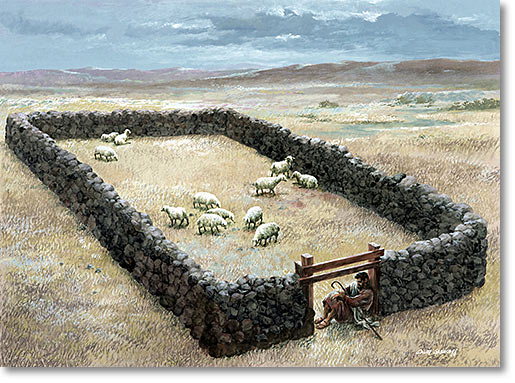
The second method is called “incarnational”. Rather than inviting people to come to where we are, we go to where the people are, living the gospel in daily life. This is a more dispersed approach that sees evangelism happening in the midst of real life, rather than taking place in a specially designated place at a particular time.

The Indian missiologist D.T. Niles described evangelism as “one beggar telling another beggar where to find bread.” In other words it is a conversation on the street of people who are spiritually poor sharing the Good News of what they have found through the grace of God.

Cell groups are a great opportunity for this kind of sharing. We invite neighbours to a meal, a picnic, or perhaps we serve them at a place of need. Out of a relationship, over time, the opportunity to share what we know about Jesus arises.

Near the end of last year, we ran a Family Festival as a Christmas outreach. It was an event, but it was incarnational. We sought out a location that was accessible to people- a park beside the river. We arranged activities, food and music. Each family received a gift bag with various goodies, including a New Testament. There was a good, happy and peaceful atmosphere, and people were free to converse in a relaxed environment. There was no altar call, but the Kingdom of God was present.

The attractional model has the advantage of being centralised and controllable. We can see how many attended and how many responded. It gives people a reason to invite people and to talk about their faith.

The incarnational approach is less tidy, but more like the way Jesus acted. He didn’t call out from heaven “Come on up and I’ll show you how to get saved.” He came down to where we live and showed us what God looks like in the flesh. Then He told us to do the same- show others what God looks like in the flesh.

The Great Commission tells us to GO and make disciples rather than STAY and tell people to come.

Let’s get out and live it.


Reflection on 1 Corinthians 1:10-18

kids-clipart

Scripture

I appeal to you, brothers, in the name of our Lord Jesus Christ, that all of you agree with one another so that there may be no divisions among you and that you may be perfectly united in mind and thought.

Observation

Paul appeals to the church at Corinth to agree with one another, being one in mind, for the sake of Jesus. Instead of being dived into factions loyal to different teachers, they must be united in their faith.

Paul’s role is not to baptise people but to preach the gospel, the message of foolishness to those who are perishing, but the power of God to those being saved.

Application

When christians major on doctrinal differences or give certain preachers celebrity status, division is certain to follow. We all want to be in the right.

We need to put Christ at the centre of our thinking, not pet doctrines or favourite speakers.

It is Christ who saves us not Joyce Meyer or Joel Osteen. It is His sacrifice on the cross that cancels my sin not the atonement theory or my belief about the rapture.

We must seek to honour one another as members of the family for whom Christ died, even if we have different ideas about aspects of what that means.

Prayer

Thank you Lord for the power of the cross through which I am saved. Help me Father to love other members of your kingdom, especially when we disagree. Amen.

Reflection on Isaiah 9:1-4

img_7039.resized


Light!

A glow in the East

A faint pink-

hope of a bright day

Watch it grow

This light


How we groaned

Evil reigned supreme

“Dog eat dog” our motto

Until the light pierced our hearts

And the darkness fled


The way of the Lord brings joy

As we walk in the light

And worship a God bigger than us

In every conception.


Daily Prompt: The Luckiest People

Image

For almost every day for the last 33 years, this has been the first person I see each day.

We love each other with the kind of fierce commitment that comes from doing life together, standing by one another when times are tough as well as in the good times. Our relationship has been tested at times but we always emerge stronger.

Margaret is an extrovert and just loves talking to people, finding out how they think and experience life. She wasn’t always this way, but when we moved to Narrabri 20 or so years ago, she came out of a box she had lived in for a long time.

There are many things I love about my wife but one of the most special things is her generosity. She just loves to buy things to give away. She is always thinking of what she can do to help other people.

Waking up to start my day with her is a real blessing.

I am the “luckiest” of people.

The End of Science

When I was younger, I loved science. I think it was because of the amazing knowledge that the disciplined examination of the world produced- quantum physics, chemistry and so on.

But something happened along the way. Sure, chemists kept doing chemistry and physicists kept on producing weirder and weirder insights in to the universe. But science was being hijacked by causes and new “disciplines” sprang up with non-scientific names and practices, usually with words such as environmental, social or sustainable tacked onto the title.

Science became politicised and, with the clmate catastrophe, turned into a religion. Now there are certain things which may not be said, even if they are true. Censored science is anti-science.

So we come to this, from Jo Nova:

Science paper doubts IPCC, so whole journal gets terminated!

…

In extraordinary news, the scientific journal Pattern Recognition in Physics has been unexpectedly terminated, a “drastic decision” taken just ten months after it started.

The publisher appears to be shocked that in a recent special issue the scientists expressed doubt about the accelerated warming predicted by the IPCC. For the crime of not bowing before the sacred tabernacle, apparently the publishers suddenly felt the need to distance themselves, and in the most over-the-top way. The reasons they gave had nothing to do with the data, the logic, and they cite no errors. There can be no mistake, this is about enforcing a permitted line of thought.

I must say, it’s a brilliant (if a tad expensive) way to draw attention to a scientific paper. It’s the Barbara-Streisland moment in science. Forget “withdrawn”, forget “retracted”, the new line in the sand is to write a paper so hot they have to terminate the whole journal! Skeptics could hardly come up with a more electric publicity campaign.

Naturally, as with all good Barbara-Streisland-moves intended to suppress information, as soon as I heard, the first thing I did was to seek out and download copies of all the papers. Right now, people everywhere would be starting to do the same, curious to know what could be so unsayable. (See the links at the bottom).

In the official announcement the excuses are amazingly transparent. There is little attempt to cover up the reasons. The publisher pays the usual lip service saying science needs disputes and discussion of controversial topics. But some things are apparently too awful to contemplate — like pointing out how the high priests of the IPCC might be incorrect.

Read the full, disturbing story here


Reflection on John 1:29-42

lamb-of-god

Scripture

The next day, John saw Jesus coming towards him and said, “Look! The Lamb of God who takes away the sin on the world!”

Observation

John the Baptist testifies that Jesus is the Lamb of God sent to take away the sin of the world. He saw the Holy Spirit coming down on Jesus and recognises that He is the Christ.

Two of John’s disciples go to follow Jesus. They go to the place where Jesus is staying to hear Him teach.

One of these two, Andrew, goes to find his brother Simon whom he tells “we have found the Messiah.” Simon comes to follow Jesus also.

Application

A testimony is a powerful thing. Telling others what we know or have seen can literally change their lives.

John testifies that Jesus is the Messiah.

Andrew testifies that he has found the Messiah.

Our testimony of a life changed by our relationship with Christ will influence the hearts and minds of those around us.

We will not always see the results, and not everyone will be convinced. That is not our problem. Our assignment is to tell others of what we have seen Jesus do.

Prayer

Please help me Lord to share a testimony of your grace today. Amen.

Road Rage

What makes your blood boil when you’re driving?

The NRMA drew up a list of 10 top rage producers.

Opinion: Top 10 road rage-causing drivers

KERMIT

It doesn’t take much for bad drivers to drive us crazy and if you drove today, chances are you’ve witnessed it, experienced it or are guilty of causing it. Here are the top 10 road rage-causing drivers – can  you relate?

Holiday season is unforgivably winding up and that means the odds for road rage will gradually increase as more drivers are commuting to and from work.  There’s nothing pretty about road rage, and traffic congestion coupled with bad drivers equals a stressful start to the day even before you step foot into work! Interestingly, in the NRMA BusinessWise Congestion Survey, we found more than half of small businesses in NSW and ACT say traffic congestion is contributing to employee stress, with almost one in 10 saying it’s responsible for staff sick days.

Researchers from Sweden even found couples where one partner commutes for 45 minutes or more were more likely to end in divorce.

So, to help you stay safe on the road here are the 10 types of drivers who I believe cause road rage.

Read more here

“Hypergrace” or “Antigrace”?

hypergrace

There is a terrible heresy going around at the moment which some call hyper-grace but which is really anti-grace.

The teaching has it that once we are saved, our eternal destiny is assured and therefore we can live as we want to. God will cover all the sin.

While it is wonderfully true that God will forgive all of our sins, even the ones we commit after we are saved, this is not to be seen as a licence to commit all the sins we want to.

To follow Jesus means that we live in obedience and allow Him to shape our lives. That’s what being a disciple means.

What these teachers overlook is the relational aspect of christianity, replacing it with a purely transactional approach. In the hyper-grace theory the sole purpose of salvation is to guarantee that our sins are forgiven. Once you’ve bought that guarantee by reciting an appropriate prayer, then you’re set to do what you like for the rest of your life.

But the real purpose of salvation is to bring us back into a love relationship with God. God isn’t merely about populating a future heaven with as many souls as possible. His desire is to pour His love onto all who will receive it. When we really receive the assurance of forgiveness, then our hearts are open to the wonder of God’s love and we are able to start loving Him.

The interesting thing is that if you really love someone, you don’t want to hurt them. There might be times when there is conflict, friction or misunderstanding, but love means having a heart that is sensitive to the other. If I am more concerned with what I can get away with than I am about how my actions affect someone, then I cannot love them.

None of this is new of course. Some in the early days of the church argued that since our sin gives God an opportunity to show His grace, we should sin more. Paul gave this notion short shrift:

“What shall we say then? Shall we go on sinning so that grace may increase? By no means! We died to sin; how can we live in it any longer?” (Romans 6:1,2)


In the end this so-called hyper-grace is actually antigrace. It’s just another religion whereby people try to force God to accept them without any desire to do what He wants. “Say this prayer and God will ignore your sins” is no different to offering sacrifices or going through the thousands of other rituals that people have invented to twist their deity’s arms.

The true gospel is so different. Yes, God forgives our sins, with no limit, no preconditions. But He does this as a Father forgives a child- in the context of a loving relationship. Let’s run into His arms and enjoy His love instead of lurking in the shadows in the furthest corner of the room.