From First Things
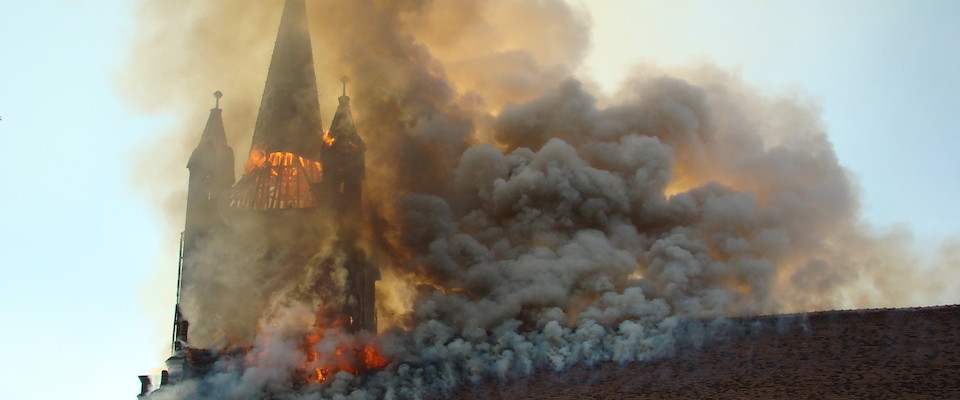
Since the news broke that the Supreme Court may be poised to overturn Roe v. Wade, some pro-abortion activists have responded by vandalizing Catholic churches and disturbing Masses. While the threats to disrupt worship en masse and even burn the sacramental elements seem to be overblown so far, the backlash against religion is surely a sign of the times. Most obviously, the sartorial choices of some of the activists (dresses inspired by a sermonizing Margaret Atwood novel) speak to the infantilism of our age. Clearly, there is no issue so profound—not even the mystery of the creation of new life—that cannot be reduced to sophomoric silliness. But if the idiom has been that of puerile performance, the focus on churches indicates that desecration is becoming a default strategy for the political class in the modern West. And that bodes ill for some of our most basic freedoms.
In striking at the Catholic Church at worship, the protesters have identified an obvious player in the history of anti-abortion activism. The Catholic Church, and many Catholics, from high-profile figures such as Robert George to countless unknown laypeople who help at crisis pregnancy centers or engage in fundraising work, have been the beating heart of the pro-life movement for decades. And the Catholic judges on the Supreme Court are the key ingredient in the impending decision. But there is surely more to the targeting of churches than the mere fact of Catholic involvement in current events. The protesters target churches because they want to profane the sacred.
Abortion is desecration. That is why it raises such passionate emotions on both sides of the debate. Sex and conception create new life and that means they possess—or should possess—a mysterious aura of the sacred. Attitudes about them therefore go to the heart of what, if anything, society thinks it means to be human. But the case for abortion teaches that new life is simply a biological process that adds a new part to a woman’s body, and that this can be removed when convenient. Terminating a pregnancy is therefore of no more significance than clipping a damaged fingernail or cauterizing an unsightly wart.
Our society intuitively knows that this is nonsense. That is why the law considers an assault leading to the loss of a fingernail or a wart to be far less heinous than one that ends in rape or miscarriage. In such extreme circumstances, the law acknowledges by escalated penalties that sex and procreation cannot be reduced to merely one more biological function or recreation. These things involve the mystery of life itself and place us on the threshold of the sacred. But a culture of abortion desecrates this mystery, at least as far as such desecration serves the purposes of perceived human autonomy and control.
That is one reason why pro-abortion activists have targeted church services. The church service is not simply a convenient place to intimidate pro-life campaigners. To attack a worship service is not simply to annoy the participants. It is to profane the sacred. It is to enact that which abortion itself represents. It is to spit on the very identity of those worshipping and thus upon the God whom they worship. It is to strike at the very heart of what Christians believe it means to be human, a dependent creature in the presence of a holy God. It is to strip away the aura that shrouds the mystery of life. It is to attempt to make ridiculous that which reminds us we are creatures defined first and foremost by obligations to others—to God and to those dependent upon us, such as the unborn child in the womb. It is an act of intentional amnesia. More than that, it is an act of descration.
Read the rest of the article here






 New Life Narrabri